Posts Tagged ‘Propagation’
 The Perception of Power
 October 3rd, 2015 |
  Author:
 Power... or lack thereof
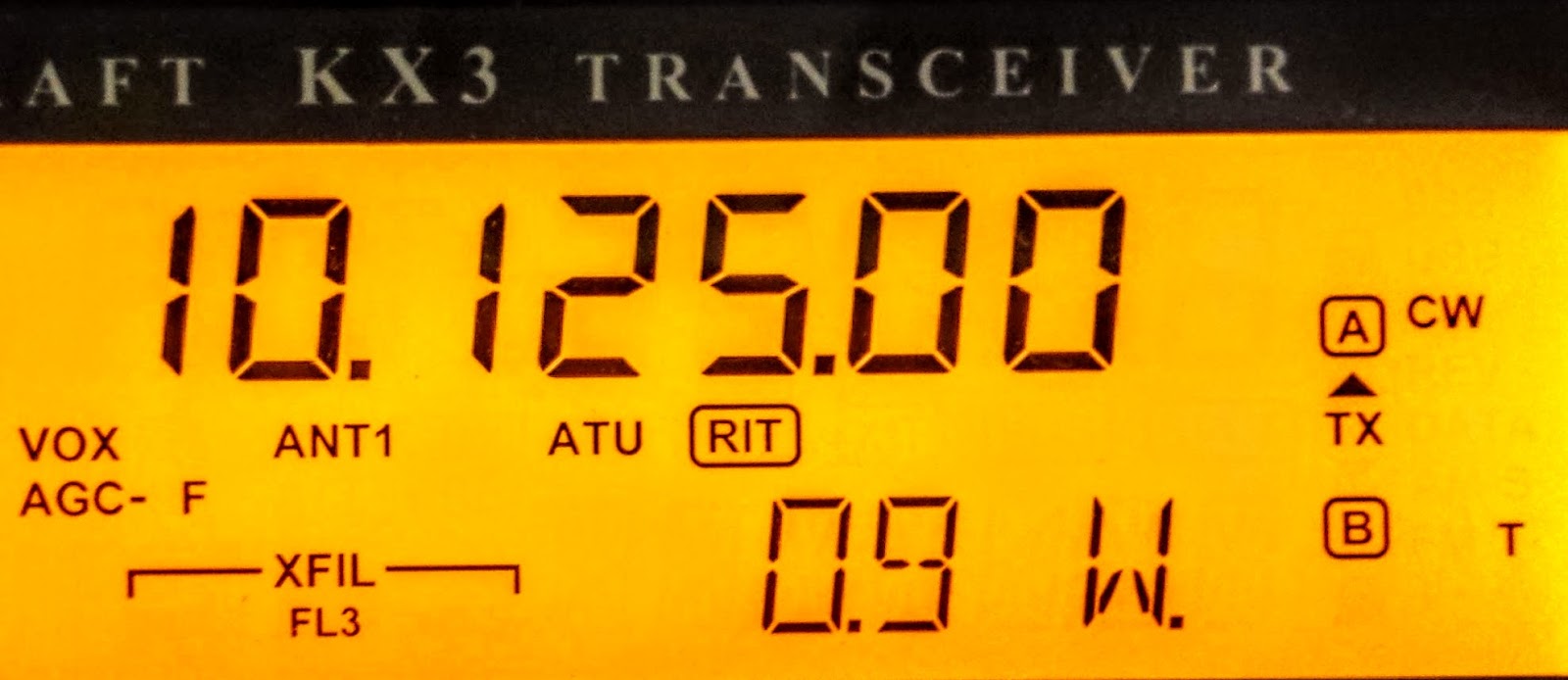
I had a good afternoon playing radio on 40m, 30m, 20m and 17m
I like 30m because that band seems to be more laid back and I seem to have some of the longest ragchews there. One of the QSOs began with a fellow in CT using a K2 at 80w while I was running 5w.
As the QSO progressed he was surprised by how well he could hear a QRP station. This seems to be repeated often enough to me that I asked him to lower his power and see how it goes.
He lowered his power from 80w to 50w and I gave him a signal report that didn't differ from his original. Then he came down to 20w and I dropped him a point. Eventually he lowered his power down to 5w while I went to about 1w. We continued to have our QSO although QSB started to make copy difficult but the main thing was that he was very surprised that he could come down to 5w and have me hear him and that he could still copy me at 1w. We were both using wire antennas and he was about 500 miles north of me. Solar Flux was only 107 today so it wasn't particularly stellar (pun intended) and it wasn't grey line by any means.
I think QRP operators should encourage QRO operators to try lowering their power just as an experiment. After all we are supposed to use just enough power for communication, rather than all that we can generate. I generally start at 5w and if a station is having difficulty or gives me a 339 I'll turn it up to my scorching 12w.
Save power, save the planet. Maybe we can design a CW key that generates enough power to run our milliwatt rigs.
So lower your power and raise your expectations
73 es 72
Richard
N4PBQ
Alaskan NDBs Awaken

Good geomagnetically-quiet conditions continued into Tuesday morning, with the 'K' index hitting '0' just before dawn here on the west coast. A two-minute Perseus recording of the NDB band revealed good propagation towards Alaska, the first of the season.
The first good opening of the new DX season always provides an opportunity to see which NDB's have survived the summer and have not been closed down by the FAA bean counters. Every year, a few more of the Alaskan NDBs go quiet, with no new ones being added to the list.
The situation is certainly not confined to Alaska. The growing reliance on GPS and RNAV procedures is gradually making the reliance on NDBs a thing of the past. Frankly I'm astounded, yet grateful, that there are many hundreds of NDBs still in use and I'll really miss chasing the low-powered DX targets when they are all eventually decommissioned.
The following Alaskans were heard on Tuesday morning at 1300Z, about one hour before my local sunrise:
9/30/15 1300 529 SQM Level Island AK CO36
9/30/15 1300 396 CMJ Ketchikan AK CO45
9/30/15 1300 391 EEF Sisters Island AK CO28
9/30/15 1300 372 FPN Fredericks Point AK CO36
9/30/15 1300 266 ICK Annette Island AK CO45
9/30/15 1300 414 IME Mt. Edgecumbe AK CO27
9/30/15 1300 394 RWO Kodiak AK BO37
9/30/15 1300 209 CYT Yakataga AK BP80
9/30/15 1300 390 HBT Sand Point AK AO95
9/30/15 1300 358 SIT Sitka AK CO26
9/30/15 1300 350 VTR McGrath AK BP22
9/30/15 1300 338 CMQ Campbell Lake AK BP41
9/30/15 1300 429 BTS Dillingham AK BO08
9/30/15 1300 233 ALJ Johnstone Point AK BP60
9/30/15 1300 212 CGL Coghlan Island AK CO28
9/30/15 1300 223 AFE Kake AK CO36
9/30/15 1300 229 AKW Klawock AK CO35
9/30/15 1300 283 DUT Dutch Harbor AK AO63
9/30/15 1300 245 HNS Haines AK CO29
9/30/15 1300 347 DJN Delta Junction AK BP74
9/30/15 1300 411 ILI Iliama AK BO29
9/30/15 1300 277 ACE Homer AK BO49
9/30/15 1300 355 AUB King Salmon AK BO18
9/30/15 1300 524 MNL Valdez AK BP61
9/30/15 1300 382 JNR Unalakleet AK AP93
9/30/15 1300 281 CRN Cairn Mountain AK BP21
9/30/15 1300 385 EHM Cape Newenham AK AO88
9/30/15 1300 385 OCC Yakutat AK CO09
9/30/15 1300 263 OAY Norton Bay AK AP84
9/30/15 1300 390 AES Northway AK BP29
9/30/15 1300 404 GCR Cordova AK BP70
9/30/15 1300 525 ICW Nenana AK BP54
9/30/15 1300 251 OSE Bethel AK AP90
9/30/15 1300 341 ELF Cold Bay AK AO85
9/30/15 1300 248 GLA Gulkana AK BP72
9/30/15 1300 376 PVQ Deadhorse AK BQ50
9/30/15 1300 379 IWW Kenai AK BP40
9/30/15 1300 399 SRI St. George AK AO56
9/30/15 1300 359 ANI Aniak AK BP01
9/30/15 1300 272 UTO Utopia Creek AK BP35
9/30/15 1300 275 CZF Cape Romanzof AK AP61
9/30/15 1300 529 FDV Nome AK AP74
9/30/15 1300 391 EAV Bettles AK BP46
9/30/15 1300 346 OLT Soldotna AK BP40
9/30/15 1300 347 TNC Tin City AK AP65
There were several missing from the list ... but I classify them as 'third-tier' beacons since propagation needs to be even better than it was on Tuesday to hear them. These are beacons that are either suffering from terrible locations, small inefficient antenna / ground systems or in need of maintenance. I also have a list of Alaskans that have never been heard at all outside of Alaska but are known to be on the air according to recent FAA online information. It is these last two groups that keep me watching and waiting ... for those magic mornings that happen only once or twice per year.
From what I can surmise by scouring the FAA information, there are presently 77 active NDBs in Alaska, including the ones not heard down here. If you live in Alaska, and can take a listen on the NDB band, I'll send you the ones I'm not sure about. If anyone else wants a list of all of the beacons up there, with detailed frequency information, drop me an e-mail and I will send you a three-page pdf.
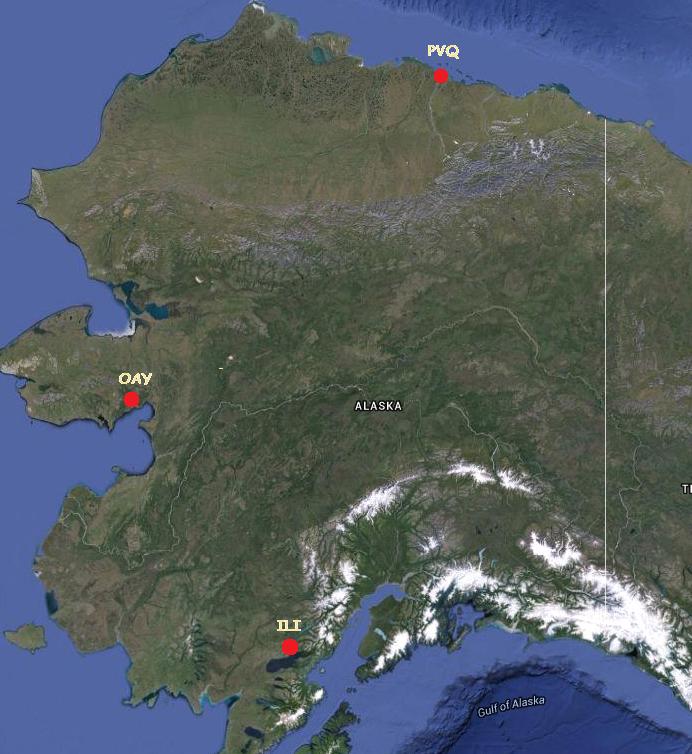
Here are some signal samples, recorded on Tuesday morning, of some of the 'second-tier' (not heard every morning) signals from Alaska.
 |
| courtesy: https://www.google.ca/maps |

PVQ - 376 kHz Put River (Deadhorse), Alaska

OAY - 263 kHz Norton Bay (Moses Point), Alaska
ILI - 411 kHz Iliamna, Alaska
With the sun getting quieter and quieter, conditions on the NDB band should continue to get better and better over the next several years ... let's just hope that the NDBs are still around long enough to enjoy the solar-quiet benefits.
Quiet Sun Not Enough
 |
| courtesy: http://sdo.gsfc.nasa.gov/ |
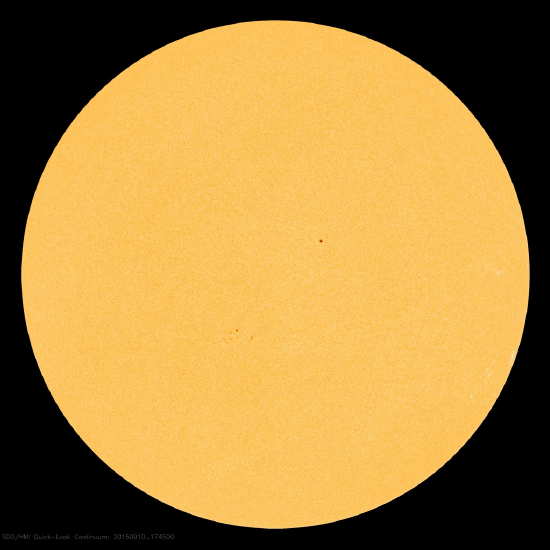
... the sun has been deathly quiet, as can be seen in yesterday's solar disk image.
It seems that just the 'normal' solar wind can disrupt things all on its own, without any solar flares or coronal mass ejections. In the late 70's, 'cracks' in the earth's magnetosphere were first observed... cracks that allowed even a quiet solar wind to actively interact with the earth's (normally protected) upper atmosphere. Apparently this is the present condition that has been disrupting normal propagation for the past many days.
The spaceweather.com web site has a nice explanation of how these cracks allow the Sun's Interplanetary Magnetic Field (IMF) to interact with the earth's field:
"Earth has a magnetic field, too. It forms a bubble around our planet called the magnetosphere, which deflects solar wind gusts. (Mars, which does not have a protective magnetosphere, has lost much of its atmosphere as a result of solar wind erosion.) Earth's magnetic field and the IMF come into contact at the magnetopause: a place where the magnetosphere meets the solar wind. Earth's magnetic field points north at the magnetopause. If the IMF points south -- a condition scientists call "southward Bz" -- then the IMF can partially cancel Earth's magnetic field at the point of contact.
When Bz is south, that is, opposite Earth's magnetic field, the two fields link up," explains Christopher Russell, a Professor of Geophysics and Space Physics at UCLA. "You can then follow a field line from Earth directly into the solar wind" -- or from the solar wind to Earth. South-pointing Bz's open a door through which energy from the solar wind can reach Earth's atmosphere!"
Earth's Bz has been pointing south during this entire period of poor propagation. Heavy ionization of the daylight D-layer, normally an 'absorber' of LF signals, has allowed reception of several NDB signals normally only heard at night. In fact, one of my favorite NDB propagation indicators, 25-watt YLJ in Meadow Lake, Saskatchewan, has been heard all day long on 406KHz for the past week as its signal skirts along the underside of the dense D-layer. These auroral conditions however, often enhance the path to the south Pacific and several western BCB DXers have reported excellent propagation to Australia and New Zealand in the pre-dawn hours.
Another indicator of LF propagation disturbance is the DST or Disturbance Storm Time index. This number gives an indication of the severity of the weakness in the magnetosphere, with numbers going further and further negative as the charged particles trapped in the magnetosphere increase in numbers.
 |
| courtesy:http://wdc.kugi.kyoto-u.ac.jp/dst_realtime/presentmonth/index.html |
The DST has been having a rough ride since the beginning of the month and as these numbers grow more positive and remain there, propagation will return to normal. With late September and October often being among the best months of the year for LF propagation, and with the sun now doing its part by remaining quiet, let's hope that the earth's magnetosphere will also co-operate and seal-up those propagation-killing cracks.
156th Anniversary
It was this time of year, from August 28th to September 2nd, 1859 that the Earth experienced what was to be known as The Carrington Event. On September 1st, a solar flare was observed by two British amateur astronomers, Richard Carrington and Richard Hodgson.

This was a coronal mass ejection that occurred during Cycle 10. It was a solar storm of such great intensity that reportedly, people as far south in Florida and Cuba were able to see aurora. In the Rockies, gold miners woke up in the middle of the night and started preparing breakfast because they thought it was daybreak. The aurora was so bright here in the northeast, that people outside were able to read newspapers by the aurora's glow.
Telegraph stations (our forerunners) were hit particularly hard. It was reported that some telegraph poles threw sparks into the air. Telegraph operators reported that not only did they receive shocks when they tried to operate, but that they were also able to continue to operate their telegraph apparatus after disconnecting it from the power supply.
I can only imagine the damage that would occur today if we suffered a direct blast from the sun as we did in 1859. I'm pretty sure that not only would the power grid be very badly affected, but that telephone and radio communications of all types would probably be non-existent, and much, much more.
Here are some interesting links:
http://news.nationalgeographic.com/news/2011/03/110302-solar-flares-sun-storms-earth-danger-carrington-event-science/
http://science.nasa.gov/science-news/science-at-nasa/2008/06may_carringtonflare/
http://www.history.com/news/a-perfect-solar-superstorm-the-1859-carrington-event
72 de Larry W2LJ
QRP - When you care to send the very least!

This was a coronal mass ejection that occurred during Cycle 10. It was a solar storm of such great intensity that reportedly, people as far south in Florida and Cuba were able to see aurora. In the Rockies, gold miners woke up in the middle of the night and started preparing breakfast because they thought it was daybreak. The aurora was so bright here in the northeast, that people outside were able to read newspapers by the aurora's glow.
Telegraph stations (our forerunners) were hit particularly hard. It was reported that some telegraph poles threw sparks into the air. Telegraph operators reported that not only did they receive shocks when they tried to operate, but that they were also able to continue to operate their telegraph apparatus after disconnecting it from the power supply.
I can only imagine the damage that would occur today if we suffered a direct blast from the sun as we did in 1859. I'm pretty sure that not only would the power grid be very badly affected, but that telephone and radio communications of all types would probably be non-existent, and much, much more.
Here are some interesting links:
http://news.nationalgeographic.com/news/2011/03/110302-solar-flares-sun-storms-earth-danger-carrington-event-science/
http://science.nasa.gov/science-news/science-at-nasa/2008/06may_carringtonflare/
http://www.history.com/news/a-perfect-solar-superstorm-the-1859-carrington-event
72 de Larry W2LJ
QRP - When you care to send the very least!
Tuna Tin Fun
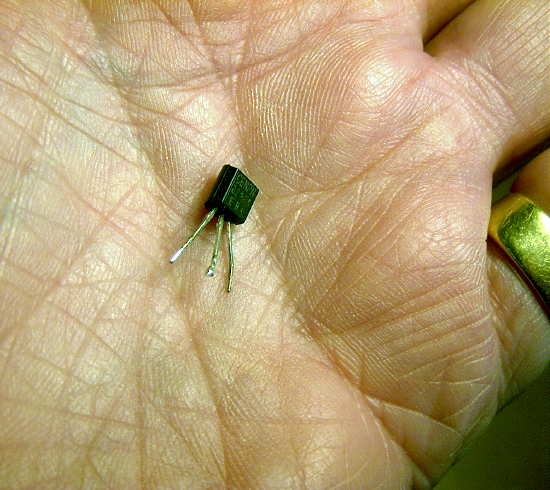
I was doing a little housekeeping in the shack this past week and ran across small piece of anti-static foam with a transistor sticking out of it. It was the transistor from my Tuna Tin II final amplifier's stage ... the actual transistor that I had used to 'Work All States' on 7040KHz using my Tuna Tin back in 2000. Looking at it in my hand brought back a lot of wonderful memories from the fall of that year when I spent so much of my time looking for new states.
Like many others at the time, I was swept up in the second 'Tuna Tin revolution' when the NorCal QRP Club released a very inexpensive kit for the Tuna Tin II. It turned out to be the best $13 I had ever spent on ham radio bits as it brought me so much operating fun while making many new acquaintances in the process.
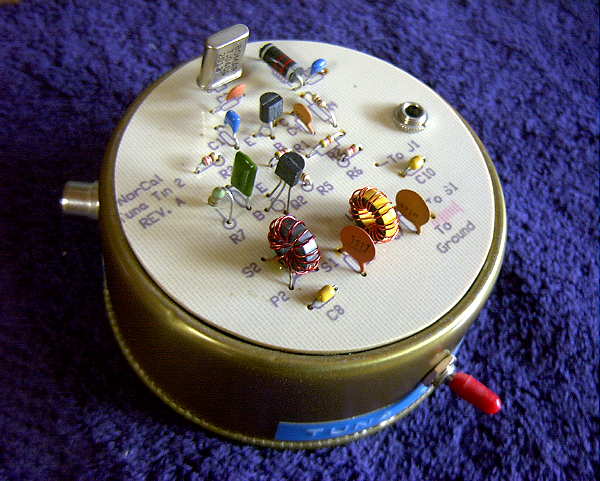
I recall the afternoon that I completed the kit ... attaching my antenna and calling 'CQ' on 7040 with a hand key plugged into the Tin. My afternoon call brought an immediate response from a station in Oregon who gave me a 579 report! Needless to say I was elated that it's ~360mw had done so well.
Over the next few days I worked a few more stations in the western states even stretching out to northern California and had pretty much decided that most of my QSO's with it would be fairly short range ... until the pre-dawn hours of August 6th when my hand-keyed 'CQ' was answered by NØTU (Steve), in Colorado! We had a nice solid ragchew until we ran out of darkness but the contact had given me re-newed optimism. If I could get a decent signal into Colorado, then perhaps I could actually work further afield ... maybe it was even possible to work all 50 states!
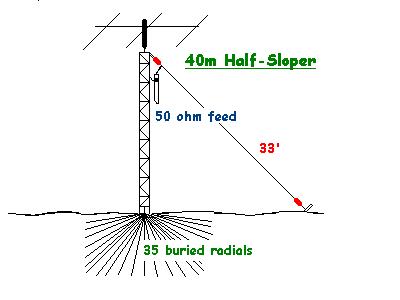
With that, I set myself a goal of trying to work them all. Although my 40m half-sloper was well matched and had proven to be a good performer in the 40m pileups, it only had four buried radials. The first thing I did was to bury another 30 radials around the base of the 48' tower, hoping to lower my ground losses as much as possible. With just one-third of a watt, there was no power to waste.
Back in those days, I was still working and could only get to the Mayne Island QTH on weekends. With the Friday night ferry arriving at around 8PM, by the time the woodstove had been fired-up and dinner taken care of, I very often didn't get to the Tuna Tin until around 11PM. As it turned out, the late hour operation worked out well and it didn't take long for my state total to climb. The toughest states were the New England '1's and as I neared the end, I still needed several. In late November, 40m revealed its magic-side and an early-evening 'CQ' brought replies from three W1's, all at once, each one a new state. Finally, in early December, I worked Wyoming for state number fifty!
The fifty QSL's were duly gathered and sent to the ARRL for an official "WAS" award. Although there was no special endorsement for the Tuna Tin, other than for 'QRP', there was a nice note about it in the 'ARRL Letter' as well as in QST:
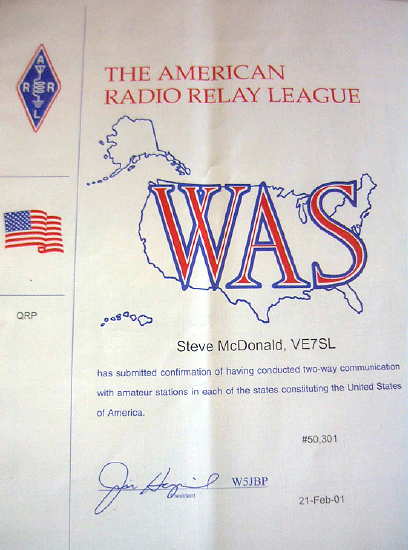
First Tuna Tin 2 WAS claimed: When the Tuna Tin 2 low-power transmitter article appeared in QST in 1976, its author Doug DeMaw, W1CER (later W1FB), envisioned it as a weekend project that could be used for short-range contacts.
Now, a quarter of a century later, a Canadian amateur has claimed the first Tuna Tin 2 Worked All States Award! Steve McDonald, VE7SL, got caught up in "Tuna Tin 2 Mania" and bought one of the popular TT2 kits. After working about 30 states with the little rig, WAS suddenly seemed plausible. McDonald realized his dream several months later when he turned in his cards for WAS. All contacts for the award had been completed while he was running about 400 mW from a Tuna Tin 2. As far as the ARRL awards folks know, this marked the first time WAS was achieved with a Tuna Tin 2--although there is no special endorsement for having done so. "Doug DeMaw knew in his heart that the rig would be useful and popular, but I don't think he ever envisioned that this little transmitter would still be working its QRP magic over 25 years after it first appeared in the pages of QST," said ARRL Lab Supervisor Ed Hare, W1RFI--himself a QRP and TT2 aficionado who has promoted the Tuna Tin 2 Revival and was McDonald's Connecticut contact for WAS. Congratulations to VE7SL on a tremendous operating accomplishment.--Ed Hare, W1RFI
Holding the battle-scarred 2N2222 in the palm of my hand reminded me of just how much excitement can be had with just a few simple parts and the magic of radio.
Summer Es
 |
| courtesy: http://www.dxmaps.com/ |
There is no doubt about it.
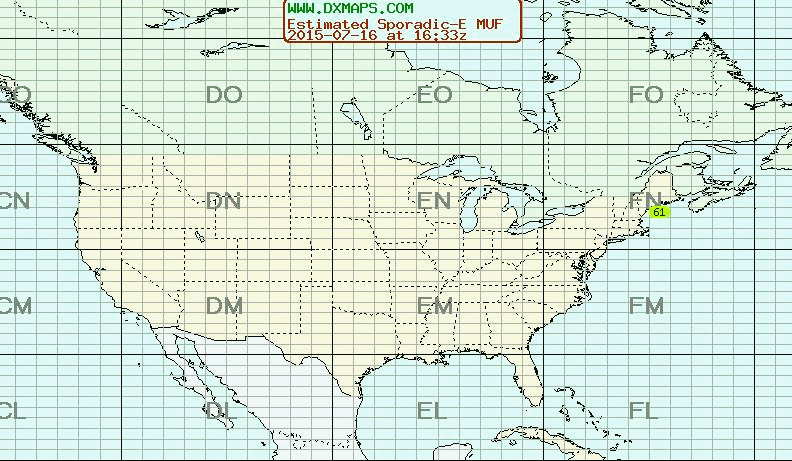
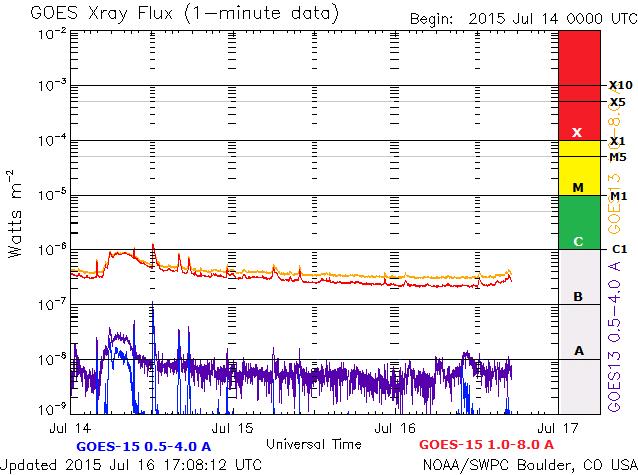
This summer's Sporadic-E season has been the worst in memory, for myself and for most North American six-meter fans. My last log entry, and the last time that I heard a signal on 6m, was on July 7th. During a 'normal' season, rarely a day goes by without an opening in some direction. Often, the band will be open for several days in a row. It was only a few summers ago that the PNW region had propagation to Europe (extremely rare) for three days in succession!
There has been much speculation as to why this season is particularly poor. Is it the early higher-than-normal temperatures being experienced this summer? Is it the constant bombardment from the sun, with several solar flares during the prime weeks as well as an almost continuous coronal hole streaming? Is it all just a normal part of the cyclical behavior of most natural phenomena? Whatever the reason, time is running out for this year.
After operating on 6m for over 40 years, the peak conditions always seem to happen during or close to the first week of July ... but, living up to its 'sporadic' classification, I have seen some spectacular openings right up until early August. In fact, my longest 2m Es contact (Oklahoma) was made on July 24, so there is still some time left for the band to exonerate itself.
 |
| courtesy: http://www.swpc.noaa.gov/ |
One great opening over the pole will make the poor conditions just a distant memory!
A More Optimistic Cycle 25
 |
| courtesy: http://www.solen.info/solar/ |
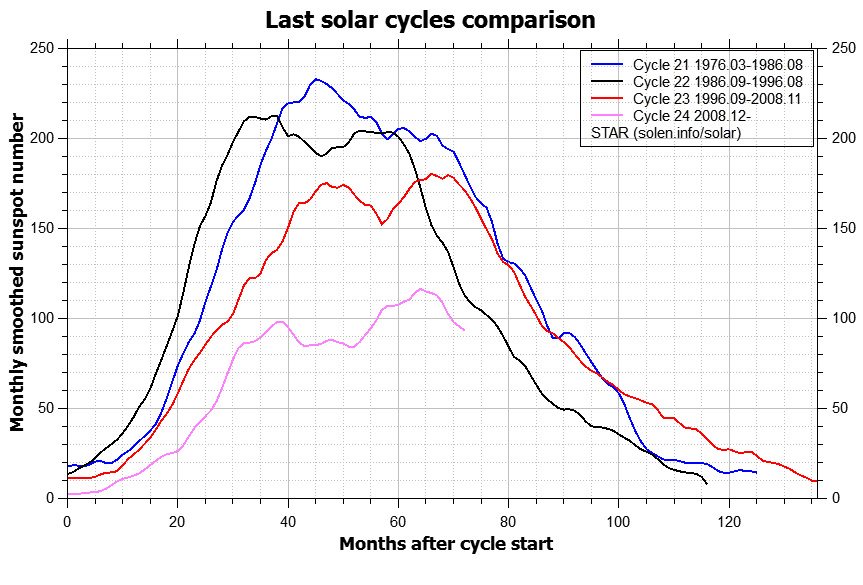
With all of the doom and gloom forecasts for the upcoming solar cycles, I was reminded of the various prognostications that were made for our present Cycle 24. I recall one in particular, made in the winter of 2006 ...
Solar cycle 24, due to peak in 2010 or 2011 "looks like its going to be one of the most intense cycles since record-keeping began almost 400 years ago," says solar physicist David Hathaway of the Marshall Space Flight Center. He and colleague Robert Wilson presented this conclusion last week at the American Geophysical Union meeting in San Francisco.
So much for that prediction!
It seems that at least one group, led by Leif Svalgaard, got it right, as W4ZV recently reminded us on the Topband reflector ...
I had to do a memory refresh but finally recalled that Leif Svalgaard, et.al.
accurately predicted Cycle 24 in October 2004. He did not use conveyor
belt theory but polar field measurements:
"Using direct polar field measurements, now available for four solar
cycles, we predict that the approaching solar cycle 24 ( 2011 maximum) will
have a peak smoothed monthly sunspot number of 75 ± 8, making it
potentially the smallest cycle in the last 100 years."
http://www.leif.org/research/Cycle%2024%20Smallest%20100%20years.pdf
The actual smoothed sunspot peak for Cycle 24 was around 82 in early 2014
(blue line on the graph below). He missed the peak date because it
occurred during the cycle's second peak.
http://www.swpc.noaa.gov/products/solar-cycle-progression
73, Bill W4ZV
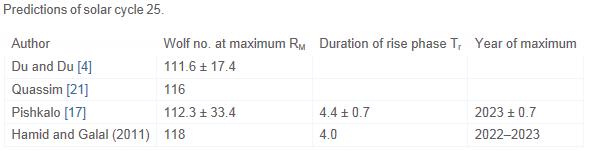
But Svalgaard wasn't the only one with an accurate forecast. Searching for a less-gloomy outlook for upcoming Cycle 25, I happened upon a paper by Hamid Helal and A.A. Galal of the National Research Institute of Astronomy and Geophysics, in Cairo. In "An early prediction of the maximum amplitude of the solar cycle 25", the authors cite a methodology that was bang-on for the last three cycles and gives a very optimistic outlook for Cycle 25.
Table 2 gives our prediction for cycle 25 in comparison with the published predictions of other authors in chronologic alphabetic order. It is obvious that our results agree with some contributions and disagree with others. In fact the differences of the predicted strengths by different authors may be attributed to the variety of the used techniques and methodology. Although some authors think that cycle 25 could be one of the weakest in centuries, in contrast, we think that the next cycle will be relatively stronger than cycle 24 and it will have nearly the same strength of cycle 23, i.e. the sunspot maximum may rebound in the near future.
 |
| courtesy: http://www.sciencedirect.com |
If Cycle 25 is comparable to Cycle 23 it will be happy days again ... it was a very robust cycle and provided several winters of high F2 MUFs, leading to day after day of amazing 50MHz propagation!
I'm somewhat vexed about which scenario I'd prefer, being both an LF'er (quiet, weak cycle) and a diehard 6m guy (chaotic, strong cycle). In any event, Cycle 25 will likely be the last one of any interest to me. I was born at the peak of Cycle 18 ... you do the math!
Obviously it will be a few years yet before we see who is right, but I'm kind of pulling for Helal and Galal's big numbers for one last 6m hoorah!













