Posts Tagged ‘Propagation’
 Another Blast Coming
 March 25th, 2017 |
  Author:
 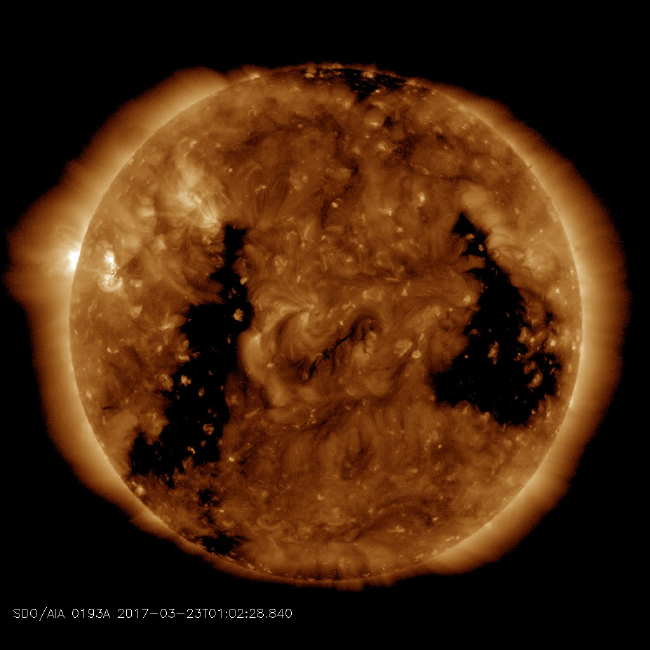 |
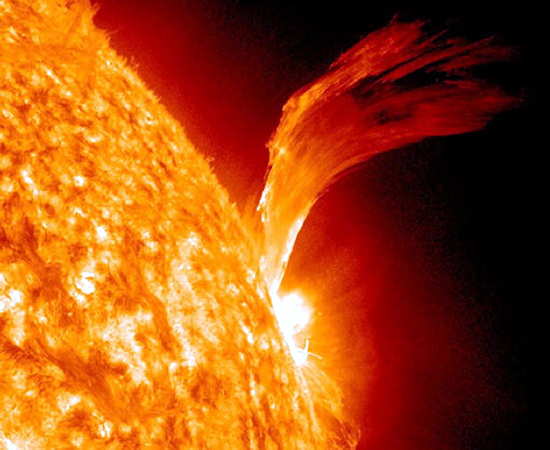
| courtesy: https://sdo.gsfc.nasa.gov/ |
Speaking of 'everlasting', wimpy Solar Cycle 24 has been showing more energy in its death throws than it ever seemed to show during its peak.
It continues to blast earth with a never-ending series of coronal hole streams leading to periods of high signal absorption (particularly on the lower frequencies) and widespread auroras.
The present rip in the Sun's surface is the same one that caused major disruptions during the last solar rotation. Geomagnetic storming and propagation disruptions are forecast to begin around the 28th, with a proviso ... these ones could be even worse than last time as the wind's polarity at present is favorable to greater coupling with the Earth's magnetosphere, sending the Earth's Bz southward (negative) into auroral producing, prop-killing conditions.
Sometimes, though not normally, these events can produce periods of enhanced low frequency propagation, especially during the hours just before the event's commencement ... the best thing to do is just continue to operate normally and not assume the worst. I've been guilty of this in the past and being caught off guard, have missed some better than usual LF propagation.
I'll keep my fingers crossed over the next few days and think positive ... Bz-wise!
Another Blast Coming
|
| courtesy: https://sdo.gsfc.nasa.gov/ |
Speaking of 'everlasting', wimpy Solar Cycle 24 has been showing more energy in its death throws than it ever seemed to show during its peak.
It continues to blast earth with a never-ending series of coronal hole streams leading to periods of high signal absorption (particularly on the lower frequencies) and widespread auroras.
The present rip in the Sun's surface is the same one that caused major disruptions during the last solar rotation. Geomagnetic storming and propagation disruptions are forecast to begin around the 28th, with a proviso ... these ones could be even worse than last time as the wind's polarity at present is favorable to greater coupling with the Earth's magnetosphere, sending the Earth's Bz southward (negative) into auroral producing, prop-killing conditions.
Sometimes, though not normally, these events can produce periods of enhanced low frequency propagation, especially during the hours just before the event's commencement ... the best thing to do is just continue to operate normally and not assume the worst. I've been guilty of this in the past and being caught off guard, have missed some better than usual LF propagation.
I'll keep my fingers crossed over the next few days and think positive ... Bz-wise!
Novice Rig Round-Up Report
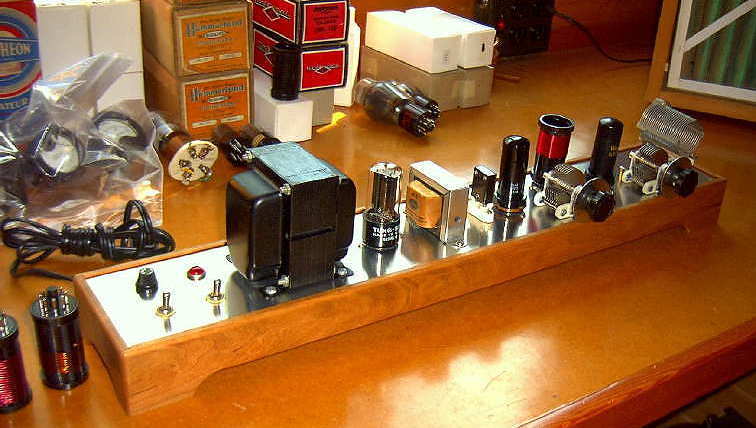
Last week's Novice Rig Round-Up delivered far more enjoyment than I ever imagined!
Operating from the left coast and choosing to limit my output power to 5 watts, I really didn't expect to work more than a half dozen stations or so. The week-long event included two weekends, providing plenty of opportunity for participants to spark-up their novice-class rigs or their favorite pre-80's 'boatanchors' ... and they did!
I had 68 contacts with other 'NRR' stations, working numerous Heathkits, Drakes, Johnsons and homebrewed favorites ... even a Collins KWS-1! Staying true to the 'novice' class spirit, most were using hand keys and a surprising number were even using crystal control.
I decided to enter the fray with my homebrew "Longfeller", shown above, run at 5W to take advantage of the low power multiplier as well as using crystal control.
After struggling to work two stations, I soon decided that if I was going to work much at all, I would need to switch to 'search and pounce' mode and use the VFO. The once ubiquitous Heathkit VF-1, with all of its charming quirks, was pressed into service. Although I've always loved its green hypnotic dial, a week with the VF-1 reminded me of all the things I also hated about it as a teenaged ham back in the mid 60s'. But as it did back then, it served me well and allowed me to park the Longfeller wherever I wanted.
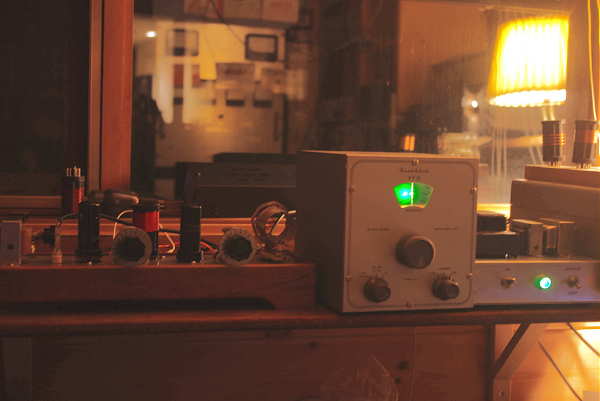 |
| My NRR Setup |
For the low bands (80/40m), the Longfeller was fed into full-sized vertical wire groundplanes made from homebrew ladder line and both fed with the same coaxial feedline.
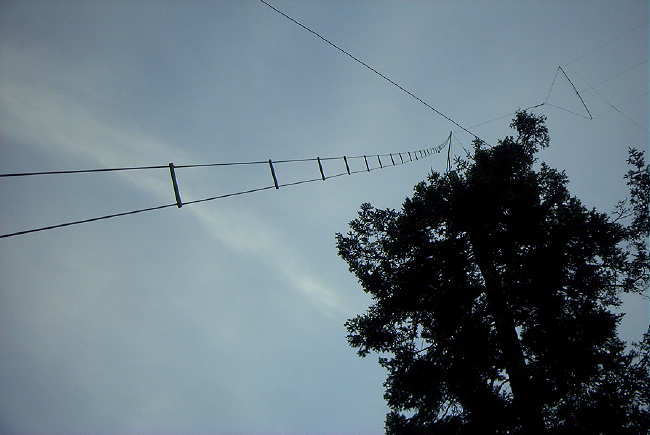
A counterpoise of eight wire radials were laid on the lawn temporarily with the feedpoint sitting about 20' from the ocean. Being right at the ocean allows me to take advantage of an approximate 6db of "sea gain", effectively turning my 5 watts into 20 watts of radiated power. At times, my signal needed all the help it could get.

It was also exciting to catch the sometimes fleeting transcontinental openings on 15m, as the MUF often struggled to reach 21 MHz each morning. This very much reminded me of past solar cycle peak winters and the morning excitement of watching the MUF slowly climb towards 50MHz, or in some cases, shoot up like a rocket. As Cycle 24 reaches the bottom, the effects of low solar flux values on our higher bands becomes increasingly more evident. I suspect that there will be no 15m transcontinental work in next winter's NRR and who knows how long that might be the case. High MUFs were fun while they lasted ... another thing often taken for granted.
Without question, one of the most interesting parts of the nine day event was following the propagation variances from night to night on 40 and 80m. With a couple of exceptions, low-band propagation was generally pretty good, with one mid-week night being just great. Signals from the east coast to the southern states were strong and with almost no QSB. The Longfeller pushed its 80m signal to Florida, Maryland, New York, Alabama, Louisiana, Ohio and Kentucky. I remember many nights like this when operating 80m back in the early to mid 60's, during the lull between monster Cycle 19 and wimpy Cycle 20. Hopefully we will see more of these really nice transcontinental nights on 80 over the next several years.
For me however, the highlight of the event occurred last Saturday afternoon, while on 40m, fully ninety minutes before our local sunset. I had called WW6D after his 589 CQ only to hear him respond to another NRR local, Mark, CF7MM. He gave Mark's 50 watt DX-60 a '589' and when he finished I called him again ... with not even a whisper of response or even a QRZ. After I called him a third time, he returned to his CQ, leaving no doubt that he wasn't hearing a trace of my signal. Now full-sized 1/4 wave groundplanes mounted beside the ocean are not noted for producing high-angled radiation, which this path would certainly have benefited from, but I would have expected something!
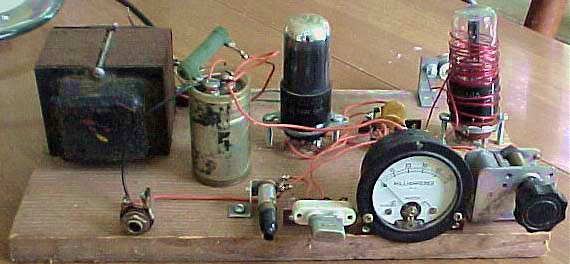
I immediately moved down the band a few kilohertz and sent a short hand-keyed CQ and received an immediate response from WS1K in Plymouth, MA! Jon's signal was a solid and unwavering 559 and he was running only 5 watts as well ... and, he was crystal-controlled! The groundplane had swiftly redeemed itself as this exciting contact went into the log on 40m ... and all in broad daylight! Pictured below is Jon's transcon ether-busting machine ... proof that form does indeed follow function!
 |
| WS1K's 40m Transcon 6V6 Ether-Buster |
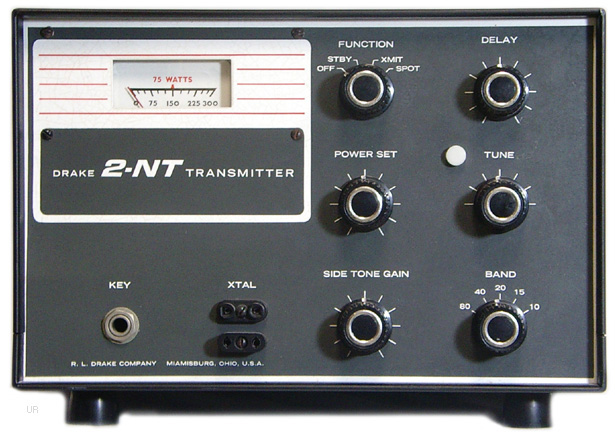
I'm really looking forward to next year's NRR but will definitely be running more power. I was impressed with the several Drake 2NT's that I heard and luckily enough, have one such rig in my boatanchor basement. It will be a good project to recap and put back on the air, along with the VF-1, which will also be given the once over to encourage it to behave properly when driving the classy Drake.
Please give the NRR some serious thought for next year ... it's not too early to start planning, refurbishing or to seek out and cherish that aging old beauty, presently hiding in someones attic gathering dust. See you in the NRR!
Novice Rig Round-Up Report
Last week's Novice Rig Round-Up delivered far more enjoyment than I ever imagined!
Operating from the left coast and choosing to limit my output power to 5 watts, I really didn't expect to work more than a half dozen stations or so. The week-long event included two weekends, providing plenty of opportunity for participants to spark-up their novice-class rigs or their favorite pre-80's 'boatanchors' ... and they did!
I had 68 contacts with other 'NRR' stations, working numerous Heathkits, Drakes, Johnsons and homebrewed favorites ... even a Collins KWS-1! Staying true to the 'novice' class spirit, most were using hand keys and a surprising number were even using crystal control.
I decided to enter the fray with my homebrew "Longfeller", shown above, run at 5W to take advantage of the low power multiplier as well as using crystal control.
After struggling to work two stations, I soon decided that if I was going to work much at all, I would need to switch to 'search and pounce' mode and use the VFO. The once ubiquitous Heathkit VF-1, with all of its charming quirks, was pressed into service. Although I've always loved its green hypnotic dial, a week with the VF-1 reminded me of all the things I also hated about it as a teenaged ham back in the mid 60s'. But as it did back then, it served me well and allowed me to park the Longfeller wherever I wanted.
|
| My NRR Setup |
For the low bands (80/40m), the Longfeller was fed into full-sized vertical wire groundplanes made from homebrew ladder line and both fed with the same coaxial feedline.
A counterpoise of eight wire radials were laid on the lawn temporarily with the feedpoint sitting about 20' from the ocean. Being right at the ocean allows me to take advantage of an approximate 6db of "sea gain", effectively turning my 5 watts into 20 watts of radiated power. At times, my signal needed all the help it could get.
It was also exciting to catch the sometimes fleeting transcontinental openings on 15m, as the MUF often struggled to reach 21 MHz each morning. This very much reminded me of past solar cycle peak winters and the morning excitement of watching the MUF slowly climb towards 50MHz, or in some cases, shoot up like a rocket. As Cycle 24 reaches the bottom, the effects of low solar flux values on our higher bands becomes increasingly more evident. I suspect that there will be no 15m transcontinental work in next winter's NRR and who knows how long that might be the case. High MUFs were fun while they lasted ... another thing often taken for granted.
Without question, one of the most interesting parts of the nine day event was following the propagation variances from night to night on 40 and 80m. With a couple of exceptions, low-band propagation was generally pretty good, with one mid-week night being just great. Signals from the east coast to the southern states were strong and with almost no QSB. The Longfeller pushed its 80m signal to Florida, Maryland, New York, Alabama, Louisiana, Ohio and Kentucky. I remember many nights like this when operating 80m back in the early to mid 60's, during the lull between monster Cycle 19 and wimpy Cycle 20. Hopefully we will see more of these really nice transcontinental nights on 80 over the next several years.
For me however, the highlight of the event occurred last Saturday afternoon, while on 40m, fully ninety minutes before our local sunset. I had called WW6D after his 589 CQ only to hear him respond to another NRR local, Mark, CF7MM. He gave Mark's 50 watt DX-60 a '589' and when he finished I called him again ... with not even a whisper of response or even a QRZ. After I called him a third time, he returned to his CQ, leaving no doubt that he wasn't hearing a trace of my signal. Now full-sized 1/4 wave groundplanes mounted beside the ocean are not noted for producing high-angled radiation, which this path would certainly have benefited from, but I would have expected something!
I immediately moved down the band a few kilohertz and sent a short hand-keyed CQ and received an immediate response from WS1K in Plymouth, MA! Jon's signal was a solid and unwavering 559 and he was running only 5 watts as well ... and, he was crystal-controlled! The groundplane had swiftly redeemed itself as this exciting contact went into the log on 40m ... and all in broad daylight! Pictured below is Jon's transcon ether-busting machine ... proof that form does indeed follow function!
|
| WS1K's 40m Transcon 6V6 Ether-Buster |
I'm really looking forward to next year's NRR but will definitely be running more power. I was impressed with the several Drake 2NT's that I heard and luckily enough, have one such rig in my boatanchor basement. It will be a good project to recap and put back on the air, along with the VF-1, which will also be given the once over to encourage it to behave properly when driving the classy Drake.
Please give the NRR some serious thought for next year ... it's not too early to start planning, refurbishing or to seek out and cherish that aging old beauty, presently hiding in someones attic gathering dust. See you in the NRR!
Upcoming Solar Years … Can They Be Too Quiet?

Most of us LF/MF and topband diehards have been looking forward to the next several years of low solar activity ... maybe even 'ultra-low' as some of the solar gurus are predicting.
An interesting posting on the Topband reflector a few weeks ago by noted propagation expert, Carl, K9LA, made me re-think my expectations!
I flagged the post for a later blog topic but have since seen the information pop-up on a couple of other reflectors as well as on the ARRL News page. Apparently I wasn't the only one to give the posting a double-take. If you missed it, here is Carl's post:
About a week ago Wolf DF2PY posted a message here commenting on the recent adverse levels of geomagnetic field activity and how it will now change for the good - giving us good 160m propagation.
We'll certainly see less geomagnetic field activity as we move into winter,
but there's another issue we should be aware of. The Sun's magnetic field
is weakening - probably to the lowest levels in our lifetime. With a weak
solar magnetic field, more galactic cosmic rays will be able to get into
the Earth's atmosphere. We are now seeing unprecedented high neutron counts (neutrons are one of the by-products of cosmic rays)
Since galactic cosmic rays are mostly *very energetic* protons, they can
get down to low atmospheric altitudes, causing collisional ionization in
the D region (and lower E region). A cursory estimate using cosmic ray
ionization rates confirms more ionization in the lower atmosphere. 160m is
not very tolerant of more absorption, so we may see an adverse effect of
the weakened solar magnetic field.
Many of us think that "solar min is solar min is solar min". But maybe a
solar minimum can be too deep for 160m. A good question to ask in the early 2020s will be "how was 160m?" So stay active on 160m and let's see what happens.
Carl K9LA
My initial response was to think that perhaps there wouldn't be as much to look forward to as I had been hoping for, when it came to improved LF, MF and 160m propagation. Carl's postulation was also backed-up by another mention on the Spaceweather site, although the influence of cosmic ray bombardment on radio propagation was not discussed.
As I thought more about this unfortunate possibility actually coming to pass, I thought back to my own on-air and listening experiences during previous solar-low years ... particularly the unprecedented low between our most recent cycle and its predecessor, Cycle 23.
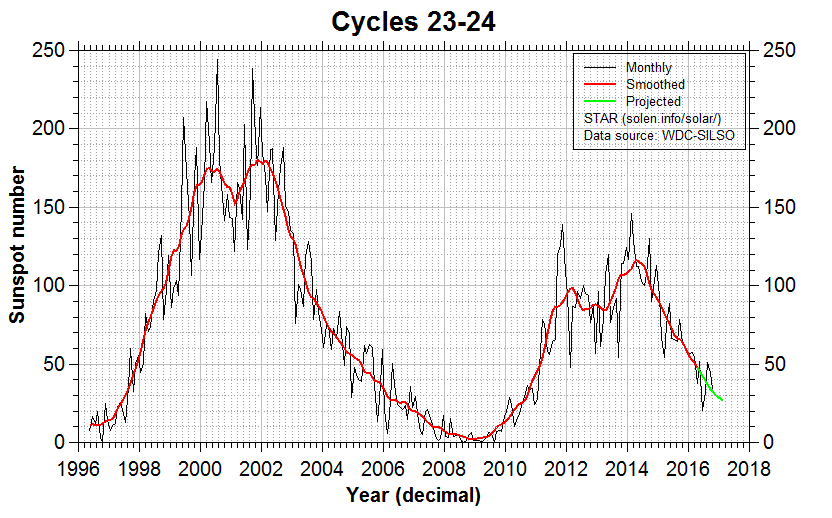
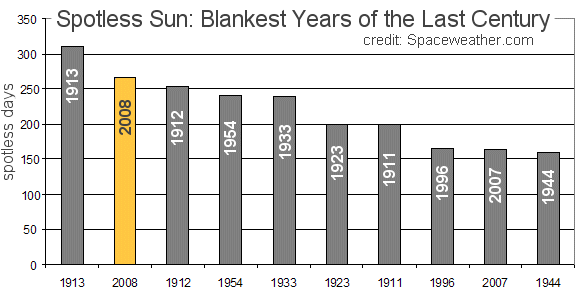
The low period between these two cycles, as most will likely recall, saw the quietest solar conditions observed in the past 100 years. The solar-low winters saw week after week of a blank Sun, with solar activity virtually flatlining for the entire period. In 2008 there were 265 'zero sunspot' days and the following year saw another 262 days of blank suns!
These effects were well noted here for two winters that are usually prime 'DX times' ... if ever there were a period when cosmic ray bombardment should negatively impact low frequency propagation, surely it would have been then.
So just what did I observe?
What I saw was not only what I had been expecting but was much much better than I had ever believed possible. For west coast topband operators, the 'holy grail' of propagation is working Europe. Working Europe from here means that signals must travel through the polar regions, usually the kiss-of- death for weak signals, as the severe attenuation through the auroral zone means that it just doesn't happen very often ... except for this prolonged period of ultra lows. In a word, conditions to Europe were 'spectacular' ... night-after-night, for several weeks over a period of two winters, working Europe on 160 became normal.
On most nights, European signals could be heard before local sunset, and on several occasions, CW contacts with Europeans, were completed up to one and a half hours before my local sunset. As darkness set in, more signals would appear and the band would rapidly become populated with Europeans ... and only Europeans.
Most of the time there were no signals from North America evident, just Europeans ... a condition that had me shaking my head in disbelief night after night. It was something I had never observed before, as I watched 160m behaving more like 20m CW on a good day to Europe! During this period, my DXCC totals skyrocketed from 99 to 143 worked, as new Europeans and Africans were added to my logbook.
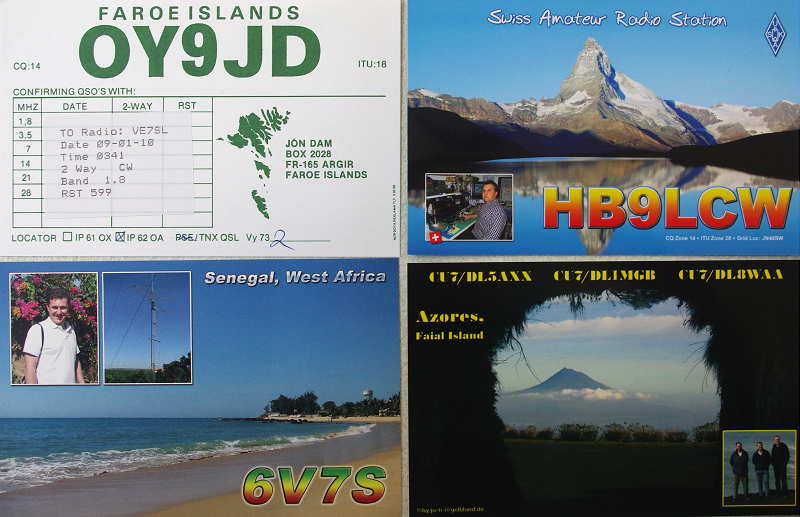
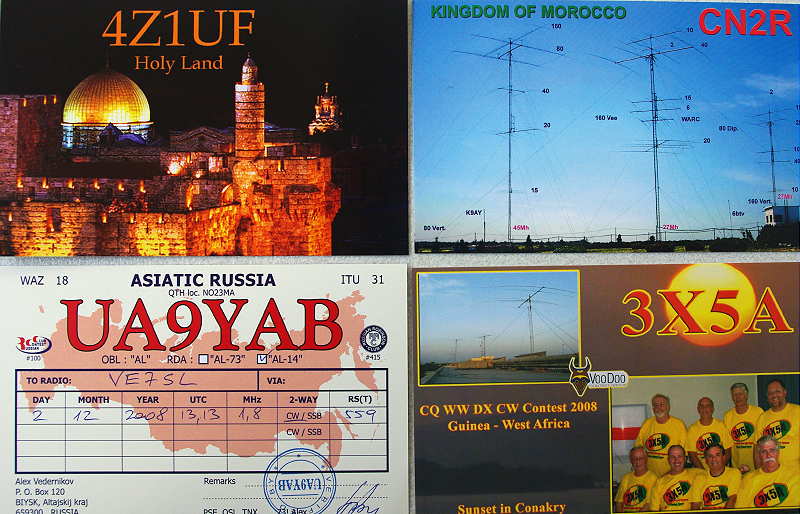
Signal levels were also outstanding, often pushing the FT-1000 S-meter well past the S9 level. On one particular night, I recall hearing an SM4 calling CQ, with just such a signal. I set my output power level at 10 watts and gave him a call, to which he quickly responded. If cosmic ray bombardment was at a high level, it was not reeking any havoc as far as the west coast path to Europe was concerned! For the record, my topband system is nothing special, consisting of a simple 'half-sloper' over a poor ground and a very old amplifier running about 500W output.
My other favorite winter pastime is chasing NDBs in the MF range between 200-500 kHz. Exceptional east west conditions were evident throughout the two winters of ultra-lows.
On one such night, I noted a new strong signal where none had been previously heard. Because of its strength, I surmised that it was probably a new NDB in nearby Washington state. Noting its ident ('NYA' on 414 kHz), I was not able to find any reference to such a beacon being previously reported and turned to the Yahoo ndblist group for help, posting my catch as 'unidentified'. Almost immediately I received a response, telling me that the signal I was hearing was located in Europe ... Svalbard to be exact, located midway between Norway and the North Pole!
Now, European NDBs have never been heard from the west coast, other than occasional signals from some of Greenland's powerhouses, so this represents a very rare event. Although I have often listened for this signal, it has yet to be heard here again and my logging of remains its only reported foray into any part of North America. Unfortunately, in 2015, it was listed as 'decomissioned'. I have no doubts that this rare propagation was a result of the solar flatlining conditions of the time.
As chilling as Carl's warning sounds, he himself admits uncertainty with a 'let's wait and see' attitude and after reviewing my own experiences under what surely must be similar conditions, I'm still very optimistic over what might be in store. Hopefully we shouldn't have to wait too much longer to find out!
Upcoming Solar Years … Can They Be Too Quiet?
Most of us LF/MF and topband diehards have been looking forward to the next several years of low solar activity ... maybe even 'ultra-low' as some of the solar gurus are predicting.
An interesting posting on the Topband reflector a few weeks ago by noted propagation expert, Carl, K9LA, made me re-think my expectations!
I flagged the post for a later blog topic but have since seen the information pop-up on a couple of other reflectors as well as on the ARRL News page. Apparently I wasn't the only one to give the posting a double-take. If you missed it, here is Carl's post:
About a week ago Wolf DF2PY posted a message here commenting on the recent adverse levels of geomagnetic field activity and how it will now change for the good - giving us good 160m propagation.
We'll certainly see less geomagnetic field activity as we move into winter,
but there's another issue we should be aware of. The Sun's magnetic field
is weakening - probably to the lowest levels in our lifetime. With a weak
solar magnetic field, more galactic cosmic rays will be able to get into
the Earth's atmosphere. We are now seeing unprecedented high neutron counts (neutrons are one of the by-products of cosmic rays)
Since galactic cosmic rays are mostly *very energetic* protons, they can
get down to low atmospheric altitudes, causing collisional ionization in
the D region (and lower E region). A cursory estimate using cosmic ray
ionization rates confirms more ionization in the lower atmosphere. 160m is
not very tolerant of more absorption, so we may see an adverse effect of
the weakened solar magnetic field.
Many of us think that "solar min is solar min is solar min". But maybe a
solar minimum can be too deep for 160m. A good question to ask in the early 2020s will be "how was 160m?" So stay active on 160m and let's see what happens.
Carl K9LA
My initial response was to think that perhaps there wouldn't be as much to look forward to as I had been hoping for, when it came to improved LF, MF and 160m propagation. Carl's postulation was also backed-up by another mention on the Spaceweather site, although the influence of cosmic ray bombardment on radio propagation was not discussed.
As I thought more about this unfortunate possibility actually coming to pass, I thought back to my own on-air and listening experiences during previous solar-low years ... particularly the unprecedented low between our most recent cycle and its predecessor, Cycle 23.
The low period between these two cycles, as most will likely recall, saw the quietest solar conditions observed in the past 100 years. The solar-low winters saw week after week of a blank Sun, with solar activity virtually flatlining for the entire period. In 2008 there were 265 'zero sunspot' days and the following year saw another 262 days of blank suns!
These effects were well noted here for two winters that are usually prime 'DX times' ... if ever there were a period when cosmic ray bombardment should negatively impact low frequency propagation, surely it would have been then.
So just what did I observe?
What I saw was not only what I had been expecting but was much much better than I had ever believed possible. For west coast topband operators, the 'holy grail' of propagation is working Europe. Working Europe from here means that signals must travel through the polar regions, usually the kiss-of- death for weak signals, as the severe attenuation through the auroral zone means that it just doesn't happen very often ... except for this prolonged period of ultra lows. In a word, conditions to Europe were 'spectacular' ... night-after-night, for several weeks over a period of two winters, working Europe on 160 became normal.
On most nights, European signals could be heard before local sunset, and on several occasions, CW contacts with Europeans, were completed up to one and a half hours before my local sunset. As darkness set in, more signals would appear and the band would rapidly become populated with Europeans ... and only Europeans.
Most of the time there were no signals from North America evident, just Europeans ... a condition that had me shaking my head in disbelief night after night. It was something I had never observed before, as I watched 160m behaving more like 20m CW on a good day to Europe! During this period, my DXCC totals skyrocketed from 99 to 143 worked, as new Europeans and Africans were added to my logbook.
Signal levels were also outstanding, often pushing the FT-1000 S-meter well past the S9 level. On one particular night, I recall hearing an SM4 calling CQ, with just such a signal. I set my output power level at 10 watts and gave him a call, to which he quickly responded. If cosmic ray bombardment was at a high level, it was not reeking any havoc as far as the west coast path to Europe was concerned! For the record, my topband system is nothing special, consisting of a simple 'half-sloper' over a poor ground and a very old amplifier running about 500W output.
My other favorite winter pastime is chasing NDBs in the MF range between 200-500 kHz. Exceptional east west conditions were evident throughout the two winters of ultra-lows.
On one such night, I noted a new strong signal where none had been previously heard. Because of its strength, I surmised that it was probably a new NDB in nearby Washington state. Noting its ident ('NYA' on 414 kHz), I was not able to find any reference to such a beacon being previously reported and turned to the Yahoo ndblist group for help, posting my catch as 'unidentified'. Almost immediately I received a response, telling me that the signal I was hearing was located in Europe ... Svalbard to be exact, located midway between Norway and the North Pole!
Now, European NDBs have never been heard from the west coast, other than occasional signals from some of Greenland's powerhouses, so this represents a very rare event. Although I have often listened for this signal, it has yet to be heard here again and my logging of remains its only reported foray into any part of North America. Unfortunately, in 2015, it was listed as 'decomissioned'. I have no doubts that this rare propagation was a result of the solar flatlining conditions of the time.
As chilling as Carl's warning sounds, he himself admits uncertainty with a 'let's wait and see' attitude and after reviewing my own experiences under what surely must be similar conditions, I'm still very optimistic over what might be in store. Hopefully we shouldn't have to wait too much longer to find out!
Wishing Upon A Star
My love for radio began at an early age when I first started to tune the shortwave bands at age eleven. Little did I know then, that I was listening near the peak of the strongest solar cycle in recorded history, monster Cycle 19.
I thought that what I was hearing was normal for shortwave and that it would always be this way ... and it was, for a number of years.
As the solar cycle slowly declined, I began to take a deeper interest in propagation and its relationship with the Sun. After obtaining my licence and getting on the air, the reality set in with the arrival of a rather dismal Cycle 20. Following the vagaries of propagation became almost a hobby in itself, trying to correlate what I was observing with what the Sun was doing and even getting comfortable with predicting what might happen next.
It was particularly exciting during the stronger Cycles (21-23), to watch the dramatic effect of solar radiation on the F layer during the peak winter years of these cycles. With a major interest in 50MHz, watching the solar flux became a daily ritual, along with the fascinating daily rise of the F2 MUF as the Sun peaked over the horizon.
On normal mornings, around sunrise, the MUF would typically start close to 28MHz and slowly begin to rise over the next few hours. Often it would slow and settle-in between 38 and 42MHz, stay there for most of the day and then slowly recede as darkness approached.
I found myself looking forward to and wishing for more solar flares, along with the solar flux boost that inevitably followed.
On these mornings, the MUF would often be at 35MHz or higher, right at sunrise ... and begin climbing. Some days it would shoot-up like a rocket and in a matter of minutes would be at 50MHz or above, bringing thundering signals from the east coast not long after dawn. On other mornings it would climb much more slowly, receding and then advancing again, surging higher and then lower, as it teased its way towards the magicband. It was as if the ionosphere was a living breathing entity, as the solar radiation danced a slow tango with the critical frequency of the moment. Often it would stop at around 48 or 49MHz, stay there for several hours and then collapse ... no 6m excitement that day.
A nice bonus of watching this live interaction between the Sun and our ionosphere, was listening to the communications in the range between 28MHz and 50MHz as I followed the rising MUF. This was, and still is to a lesser extent, utilized on FM by paramedics, fire and police services throughout the U.S. It was not uncommon to hear mobile units enroute to an emergency, with sirens blazing in the background. Southern drawls usually meant that any 6m openings would begin in the southern states or the Caribbean, while Boston or New York accents, would herald an opening to New England or the possibility of trans-Atlantic openings to Africa or Europe. I became even more familiar with the daily interaction of the solar wind and how it affected radio ... and found it fascinating.
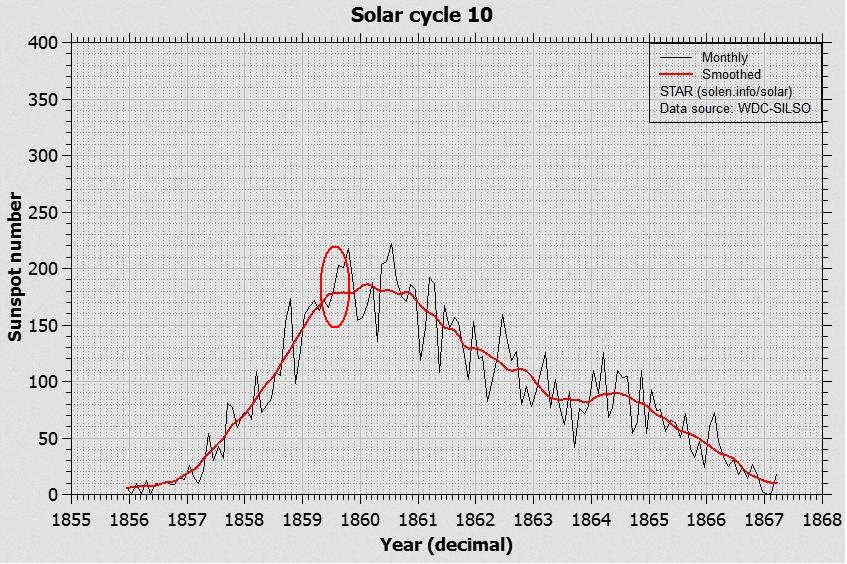
But just as the Sun affects propagation so positively, I was recently soberly reminded of how 'unfriendly' it can be ... as it has been in the past and will be again in the future. An article in this month's 'Astronomy', by Bob Berman, discussed threats to global welfare and in particular, a modern day repeat of the Carrington Event of 1859.
This was a double mega-flare and CME, taking only 19 hours to reach earth, compared to the normal 3-day trip. It was the strongest impact on earth ever recorded and one that will be repeated ... and is almost, statistically 'overdue', unless we dodged it in 2012 when a storm of similar magnitude missed the earth.
In Berman's words:
"What would a Carrington-level event do today, with our ubiquitous power lines, transformers, and more than a thousand operational satellites? In 2008, the U.S. government convened a panel of experts, who concluded that such a storm would completely destroy our electric grid. It would require two to 10 years to repair and cost about $2 trillion. We'd be knocked back to the stone age.
That panel panel called Carrington a "low frequency/high consequence" event - the kind humans typically ignore until it happens."
We quickly release how dependent on the hydro system we have become, when our power goes out for a few hours or even a day or two, following a severe weather event. Such an event is certainly 'inconvenient' but soon forgotten when the power returns. Going without power, and its trickle-down effects on our depended-upon infrastructures for several months or longer, would not be just 'inconvenient'. It would be a life-altering.
 |
| courtesy: http://www.solen.info/solar/ |
Maybe I'd better stop wishing for flares.













