Posts Tagged ‘Portable’
 Central FL QRP Group
 November 22nd, 2010 |
  Author:
 Calling all Central Florida QRP Ops… there’s a small group of us in Orlando that like to gather together on the 2nd Saturday of the month for some breakfast, show n tell, and portable ops in a nearby park.

Antenna Tweakers

Operating site

K3RLL in action with KX-1
We just had a nice time of antenna tweaking and operating down by Lake Sylvan. There’s still room for more of you, so mark your calendars and plan to join us on the 10th of December 2010. Leave me a comment if you’d like me to send an email reminder to join us, or if you’d like to get on our list for future outings. Snowbirds are welcome too!
72,
Kelly K4UPG PB #173
ATS-4 and SDR Cube
Two exciting new possibilities for portable HF have become available.

Steve Weber KD1JV's ATS-4
A few hours ago Steve Weber KD1JV announced that the ATS-4 kit was available again. These apparently sell out very quickly – so if you’re interested, act now!
Many people hanging around the AT_Sprint Yahoo group have been waiting patiently for many weeks for this morning’s announcement.
The ATS-4 is a “miniature 5 band CW rig with digital mode capabilities” designed for 80, 40, 30, 20 and 17 or 15 meter operation in the field. The AT stands for Appalachian Trail. It’s tiny – according to the KD1JV site, about 1/3 larger than an Altoids tin – the universal QRP standard of enclosure measurement – at 4.9″ wide, 2.7″ deep and 1″ tall.
ATS-4 features include a built-in Iambic A or B mode keyer with three message memories. The rig can convert Morse input via paddle to transmit as PSK31. And PSK31 and RTTY are possible using Pocketdigi software on a PC, laptop, netbook or PDA.
The other exciting portable possibility – which was designed to be independent of this kind of hardware – is the SDR Cube. George Heron, N2APB and Juha Niinikoski, OH2NLT developed this self-contained and portable SDR Transceiver using a Softrock front end and embedded Digital Signal Processing. One of the features of this design is that no PC is required. This follows naturally from George N2APB’s work developing the NUE-PSK modem which liberates portable PSK31 & RTTY ops from lugging along a laptop.

The SDR Cube
The SDR Cube is still available for ‘early-bird’ special prices, so again, not one to put off considering for too long. It’s also available in a range of different forms, from bare PC boards through to kits and assembled and tested. The design is deliberately open and flexible to accommodate experimentation. As the comprehensive SDR Cube site explains
The SDR Cube is a totally self-contained, embedded SDR transceiver for CW & SSB using a Softrock for the RF front end and a pc board implementation of an HF modem. A PC is not needed for using the SDR Cube, as all DSP processing is accomplished by an embedded DSP processor on the three internal pc boards. The Cube is designed to fit into an optional 4” x 4” x 4” pre-cut black powder-coated aluminum enclosure containing all controls, a blue graphic display showing the transceiver settings and an exciting 8 kHz-wide band scope of spectrum signals, and the popular Softrock RXTX v6.3 board.
Full ordering details for the SDR Cube can be found here.
Good Customer Service is NOT Dead!
Recently I began a project for a wire vertical antenna and it called for a 20 ft fiberglass or non-conducting pole/mast of some sort. Not to worry as I have a trusty 20 ft Jackite pole in a nice green color. I put the antenna together but the vertical wire was too long and so there was considerable slack wire swinging in the breeze. After some head scratching, I measured my 20 ft Jackite and found it was only 18 ft long!!! YIKES! Did it shrink?

Did it shrink? Nope, it is all good to go!
Thanks to the internet, I was able to send an email to Jackite products and ask if that was normal. In a short time, I received a very nice response from the Jackite vp and an offer that was over the top and way more than I was expecting. It was more than I could accept as I’ve been quite happy with the product otherwise. Turns out that it was a small quality control issue that I can tweak and correct personally.
I get no monetary or other gain out of this, but did want to give credit where credit is due. This level of customer support is often lacking in today’s busy world. I am glad to give a shout out to this company and its products! They do the job and the company stands behind them with good service. Outstanding job Jackite!
72,
Kelly K4UPG PB #173
I am CAD afflicted
Yep, it is confirmed now for sure. Compulsive Antenna Disorder has haunted me since I was first licensed and ran a coax fed 80 meter dipole on multiple bands without a tuner. The first time the symptoms were noticed by my family and friends was when I got a couple OO tickets for out of band harmonics. Hmmmm… what’s up with that? So a bit of reading and the antenna tweaking began and that’s when it all started.
Soon thereafter I tried to load up a nifty pin from my Junior Prom Boutonnière that reminded me of a triple stacked halo for 1296 Mc (MHz for the newer ones amongst us). Then it was the handheld yagis for 432 Mc that we used with some military surplus gear that used dynamos so we could chase tornadoes. (We thought if it bounced off the moon, it should bounce off of a tornado!) The saucer sled that became a parabolic for listening to satellite telemetry and on it goes… Compulsive Antenna Disorder has had a firm grip on me for some time now.

Am I dreaming? Thanks wiki images!
As a QRP operator, I am always looking for more antenna power. I know that somewhere out there simply MUST be a silver bullet, that magic QRM and pileup busting antenna that makes my 2 watts output sound like a full gallon.
I can say one thing for sure, I know a lot of non-silver bullet antennas, as I have a box full of them.
But they still make a few QSO’s at times and I’m having fun along with a bit of frustration and disappointment as I deal with my CAD affliction.
I’m told that much like telegraph key collectivitis there is no known cure or relief. I share in your grief brothers and sisters…
72,
Kelly K4UPG PB #173
Giving Out Points Again!
Nice weather and an open schedule allowed for some radio time this weekend. The QRP ARCI Fall QSO Party made some buzz so I loaded up the gear and headed out by the lake. I put up an 88ft doublet in an inverted vee. I shoot a line over a tree limb at about 40ft and use that for the center and have two 17ft Crappie Poles that I use for end supports. That allows me to reorient the antenna to suit the conditions.

Ground Mount Closeup
One of the things I threw together is a simple mount for the crappie poles. I use a 2ft piece of PVC with a couple bolts inserted at right angles to one another at the base to keep the pole from going all the way through to the ground. The PVC is attached to a 3ft piece of aluminum angle iron that with 3 stainless steel hose clamps.

Crappie Pole End Supports
The poles are pretty limber and take a bit of a bend but do a good job of handling the 24 gauge teflon wire I use. As you can see in the pictures, the mounts do the job and don’t cost as much as commercial counterparts.
So it was a good day and I made a few contacts, enjoyed the outdoors and had a nice picnic lunch with my XYL down by the lake between QSO’s. The bands were pretty decent and I gave points to 20 of the more serious contestants out there.
72,
Kelly K4UPG PB #173
p.s. The Polar Bears will be out and on the air next weekend. Give a listen, hear?
Computer Does Not Save Time
Remember when we used to think computers would save us time?

Why did we think the computer would save us time?
I spent the last 6 hours running updates, fixing the problems the updates created and figuring out how to install the updates that would not install automagically. Grrrrrrr!
Think I need some time to play radio, but I won’t be taking a SDR radio with me for a bit. Grrrrr…. need to recover from the 26 reboots and all the time wasted surfing and reading the small print.
Good thing there is a QRP ARCI event this weekend and the following weekend is our Polar Bear Moonlight Madness Event. Grrrr! I’m ready for some CW. CU on the bands!
72,
Kelly K4UPG PB #173
On the cliffs in West Cumbria
Cumbria is famous as the county of the English Lake District but it has more to offer than mountain walks. I don’t agree with Alfred Wainwright who said he could not see the point of walking round a mountain when you could climb to the top of it. There are many beautiful walks in the valleys and round the lakes which my wife (and my knees) much prefer over climbing and descending even if they don’t offer much scope for making radio contacts. Less well known, but just as spectacular, are parts of the coastline. One of our favourite outings is to park in the village of Sandwith and go for a walk along the cliffs. This is where we went last Sunday.
 |
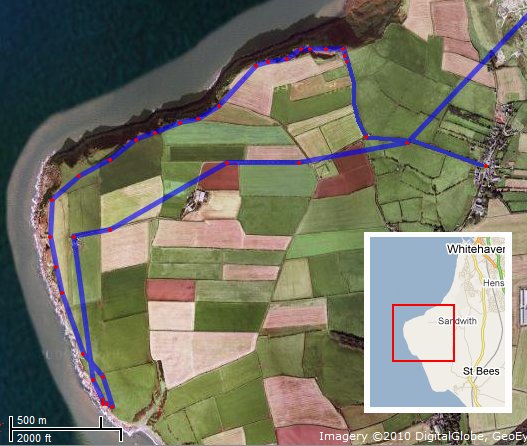
| Map of the walk (from aprs.fi Google Maps) |
The map of the walk shows the path that was tracked on Google Maps APRS, with some additions by me where my position was not tracked.
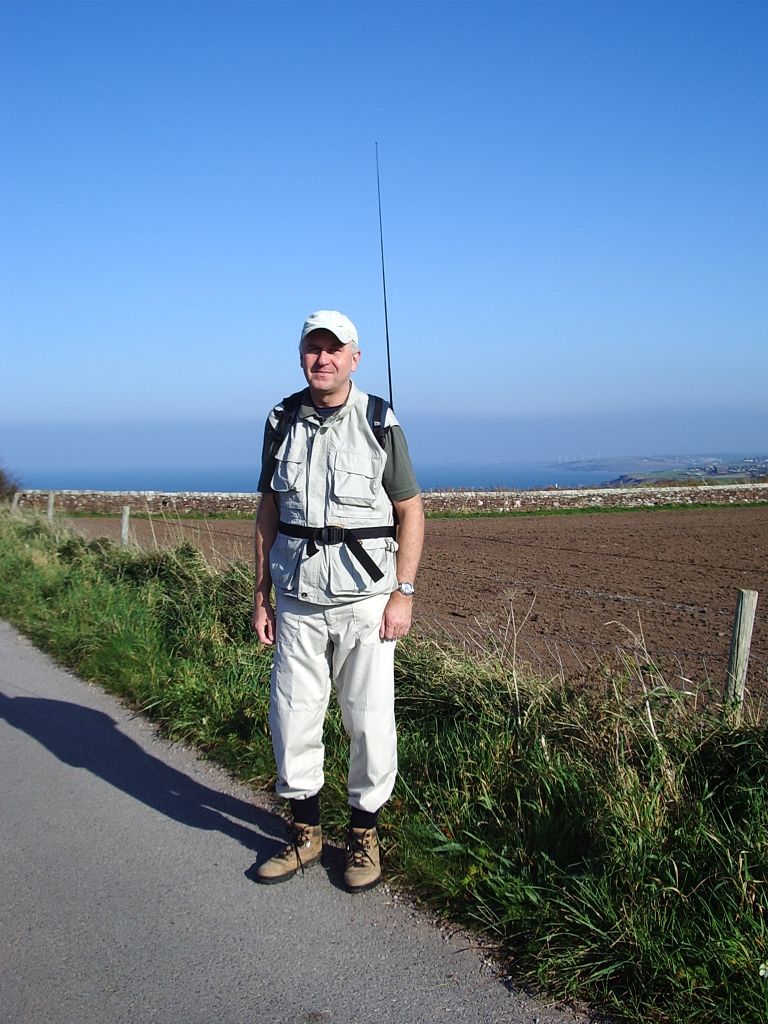
I was using my VX-8GR with the 5/8 telescopic whip in my rucksack, as shown in the picture on the right. I operate pedestrian portable like this when I don’t expect to encounter too many people who will give me strange looks or think I am a dork. The radio sits in a little mesh pocket on the side of the rucksack which was probably meant to carry a water bottle. The antenna is supported by pushing it through a string loop attached to one of the zips of the main pocket of the rucksack. It is quite stable and does not flex the spring or the mounting at all.
I don’t know what the SWR is like. Possibly it isn’t that good as the radio does not have me holding it to provide a ground plane. Perhaps I should try clipping a 19 inch “tail” to the outer ring of the BNC connector as a counterpoise? But even without it, it worked well. Most of my position beacons were received by MM1BHO across the water in Scotland so I was able to see the track after the walk. I also received some interesting APRS DX, of which more later.
But back to the walk. The weather was glorious, as you can see from the pictures. The temperature was around 20 degrees Celsius with only a slight breeze. The view from the cliffs was spectacular and always reminds me a bit of Cornwall. To think that people pay money to come on holiday to places like this!
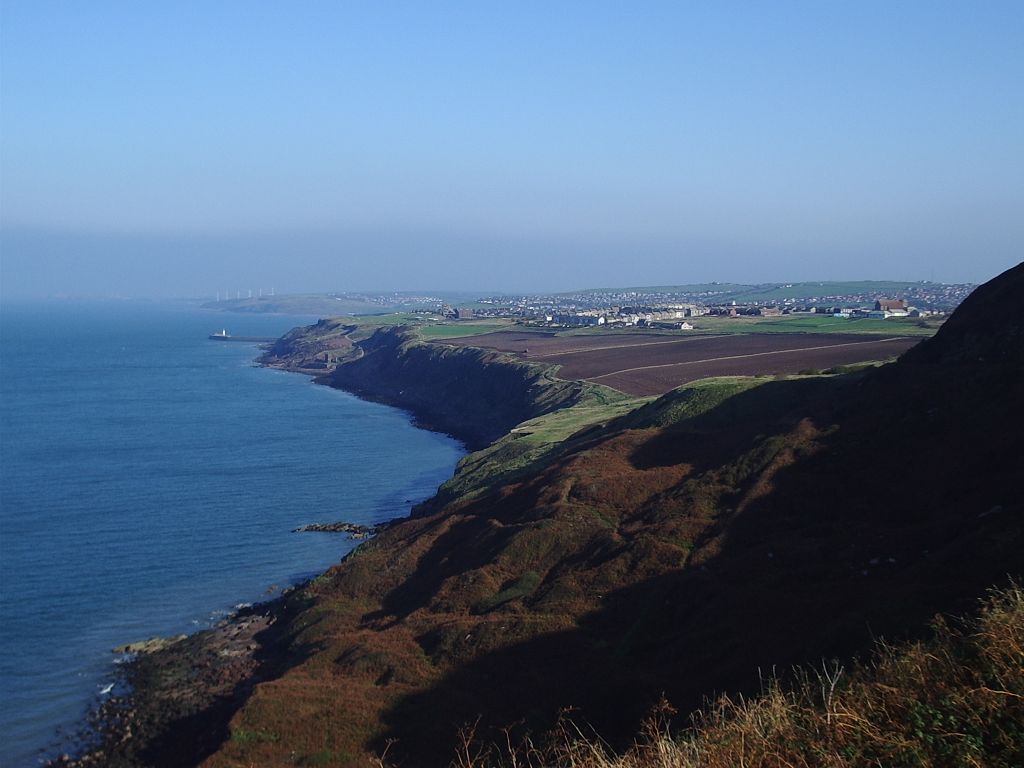
We walked for about an hour along the cliffs, stopping now and again to watch some birds through binoculars or just take in the view. This is an important area for wildlife and the Royal Society for the Protection of Birds (RSPB) has set up several places where you can watch them with safety on the edge of the cliffs.
You can walk right along these cliffs as far as St. Bees, where there are people and cafes and ice cream kiosks. But we usually stop at Fleswick Bay, a beach backed by the high cliffs that is always quiet and secluded even in the height of the season because it isn’t possible to reach it by car, it can only be accessed by footpaths. We call it our private beach because we often have it to ourselves.

This Sunday we didn’t go down to the beach because we saw from the clifftops that the tide was in and the sea was right up to the foot of the cliffs. So we had our picnic lunch in one of the RSPB birdwatching areas instead. I made a couple of FM contacts using the VX-8GR, including one with another portable station on a 2,500ft mountain top in Wales. Then we started the walk back.
On the way back I heard the VX-8GR braaping away constantly such as I hadn’t heard since we were in Prague. On my return home I scrolled through the station list and observed that for a couple of minutes between 12:28 and 12:30 UTC I had received beacons from several DX stations including F4EQD-1 and OZ2DXE-2. These beacons had actually been digipeated by a station in south west England but that was still an amazing distance to receive signals on a VHF handheld, even if I didn’t hear them direct.
The glorious weather had also produced fantastic tropospheric propagation which was enjoyed by people in most parts of Europe. I wished I had climbed to the top of a mountain as I would certainly have heard more there than I did down on the west coast and perhaps have worked some real handheld VHF DX. But you can’t predict propagation and it was still a wonderful day’s walk.