Posts Tagged ‘Operating’
 My #POTA Pickle, or How I Learned to Stop Worrying and Love the ARRL #DX Contest
 March 5th, 2018 |
 Author:
Sunday March 4th was a beautiful and slightly cool (mid-seventies) day in Jupiter, Florida and was the day I selected for my first #POTA activation (parksontheair.com). I picked the 11,000 acre Jonathan Dickinson State Park, KFF-1887, just six m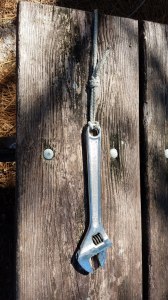 iles from my Florida QTH. I scouted out locations a few days earlier and chose the picnic area near the river, with cooperating pine trees with handy limbs. Using my unique antenna launch tool (see pic) on only the second try I hit my target limb and hoisted the “high” end of an EndFedz antenna cut for 20 meters. My battery was charged, I had my sandwich, I even had a cushion for the hard picnic table bench seat. Right on time I was ready to spot myself, all settled and happy. Do you hear a “but” coming?
This was 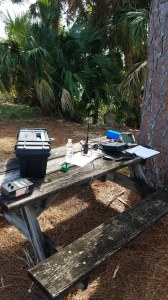 also the weekend ARRL chose, without checking with me, for their hugely popular annual DX Contest. There were a few thousand hams on 20m, most, it seemed, with a kilowatt and a pretty good beam competing with me barefoot with a dipole up all of fifteen feet. I spotted myself on DXSummit.fi but apparently nobody cared. I raised my friend Rick on the local repeater and got him to listen for me at 14.244 a few miles away and we could barely hear one another on ground wave. We were in a wall of sound (and I was learning the value of a filter for sideband.)
So there’s my POTA Pickle; I’m in the right place and all set to operate POTA but cannot compete with a thousand big gun stations. Well golly, let’s join in on the fun then.
First I took down the End Fedz that just doesn’t work that well for me and put up my link dipole made from lamp cord and began to hunt and pounce. Worked a dozen international stations in an hour and called it, after all, a good non-POTA day.
This is Wayne, K4WK, http://www.hamdom.com. Thanks for listening; you’re in the log.
On the Air – SOTA, POTA, BOTA, IOTA and now, COTA
The newest OTA I’ve discovered is the World Castles Award, or COTA – Castles on the Air. Not sure if COTA is official or not, but let’s call it that for now, since it rhymes so well with SOTA, POTA and BOTA. (IOTA is only a half-rhyme).
You might think “We Americans don’t have any castles here; we were settled after the period of castle-building, so how is this relevant to me?” Well, you can think that if you want to, but you might be wrongish. True, we have no castles in North America (or do we? – see below), but we do have other structures that the wise men and women of WCA have recognized as eligible structures of note. Happy Dance! Here’s a new game we can play once we’re all worn out activating all the mountains in SOTA, parks in POTA, and beaches in BOTA.
Here in the Southeast that I inhabit, there are scores of eligible structures. In my own tiny hometown of Decatur, GA, pop. 18,000, I find that we, too, have a castle called Oakhurst Castle. I need to find out what that is, and of course, activate it. Look for me on Dxsummit some day.
Forts, even if not fortified, can qualify, such as Fort Jackson, SC, where I spent three happy months one summer and most if not all other military bases with “Fort” in their title. Also, historic forts like Castillo de San Marcos in St. Augustine, Florida qualifies but the towns of Fort Lauderdale, Fort Myers and Fort Pierce where we can imagine forts once stood, are sadly excluded. However, don’t despair – you can still go to the beach in those towns and activate your suntan via BOTA!
Mansions, or “Stately Homes,” also seem to qualify, such as the indisputably stately Biltmore House in Asheville (raise your hand if you’ve been there). The WCA styles it as “Biltmore Castle.”
Scanning the list I see others in my haunts I can consider activating and some that raise questions such as one on Marco Island known only as “Unknown Castle.”
But there is one I expected to see that has been overlooked – probably the only purpose-build Castle in the United States, and it’s certainly not unknown; of course I’m talking about Cinderella’s Castle at the Magic Kingdom (raise your hand again if you’ve been there). If you are as hurt as I am at this (rather slight) slight, please join me in a letter-writing campaign to the WCA to help right this wrong. We’re Americans – we fought for our freedom, now we must fight for Cinderella’s honor!
Signing off for now, de k4wk, www.hamdom.com. Thanks for listening; you’re in the log.
Update: Propagation Forecasts for CQ WW (SSB and CW) DX Contest Weekends
Are you participating in this year’s CQ World-Wide DX Contest, either the SSB weekend (this coming weekend, October 28-29, 2017), or the CW weekend (November 25-26, 2017)? The CQ WW is the largest Amateur Radio competition in the world. Over 35,000 participants take to the airwaves on the last weekend of October (SSB) and November (CW) with the goal of making as many contacts with as many different DXCC entities and CQ Zones as possible.

Space Weather and Radio Propagation
I have updated my forecast on the expected propagation conditions during both the SSB and CW weekends of the 2017 CQ World-Wide DX Contest. I will publish a new update for the CW weekend, when we get closer to that November weekend.
The link to the latest update is: http://cqnewsroom.blogspot.com/2017/10/cqww-dx-contest-propagation-update.html
Good luck!
73 de NW7US dit dit
Do You Travel? Don’t Forget Your Ham Gear! – ETH087

In this episode of the Everything Ham Radio Podcast, we talk with Vance Martin, N3VEM, about how he takes his Ham Radio Equipment with him when he goes on business trips. If you travel at all, you know the boringness of sitting in a hotel room after working all day, right? Maybe it is a new city, or maybe you have to be up early and don’t want to “go out” and be out late so you are able to function the next day.
So why not take your ham radio equipment with you while you travel and use that down time to make some contacts? This can also give you a chance to get out of your shack and get some fresh air and make some contacts to boot.
Vance and I talk about everything from what he does before he leaves, to what to do at the airport to how he operates while he has down time while traveling. Check out the show notes and listen to the episode by following the link below:
Magnitude X8 X-ray Flare of Sept 9 2017 (2nd Biggest in Cycle 24)
The sun erupted with an X8 solar flare, one of the largest of the current solar cycle (Sept. 10, 2017). Its source was the same sunspot region that produced an X9 flare last week. We show this in two wavelengths of extreme ultraviolet light at the same time, and each reveals different features. Both are colorized to identify in which wavelength they were observed. The coils of loops after the flare are the magnetic field lines reorganizing themselves after the eruption. The video clip covers about six hours.
FCC Opens 630/2200 Meters Amateur Band; Pre-Registration Required!

Yes, the headlines read, “FCC OPENS 630/2200 METERS TO AMATEUR USE AS OF OCTOBER 16, 2017; PRE-REGISTRATION REQUIRED.”
The FCC has authorized amateur radio use of the 630 and 2200-meter bands, effective October 16, 2017, providing registration procedures have been followed and no objections are received within 30 days.
The PLC (Power Line Communications) database is live and hams may begin registering immediately. They may begin operating on 472 kHz (630 meters) and 137 kHz (2200 meters) as early as October 16 if they register today and receive no objection in the next 30 days. Hams may not operate on the bands without going through this process.
Please fill out the UPC Form, today, to register your station, even if you don’t have any plans on transmitting on these new bands.
It is imperative that all amateurs register, even if they don’t plan to use these bands in the near future, as the FCC rules prohibit UTC (the Utilities Technology Council) from deploying PLC in these bands closer than one (1) kilometer from registered stations. Registration now will protect your ability to use our new MF/LF bands in the future.
US exams at Wyong
About midway through January, I heard via a Sunday morning WIA broadcast that a group of ARRL Volunteer Examiners was offering to hold exam sessions at the Wyong Field Day at the end of February.
I passed my original amateur license exam here in Australia almost 40 years ago. My AOCP (Amateur Operator’s Certificate of Proficiency) says I passed a test on 21st November 1978. (That was probably the date of my second or third attempt to pass the morse at 10 wpm test.)
For the exam, I also had to answer questions about radio regulations and to demonstrate “a knowledge of wireless telegraphy and wireless telephony and electrical principles”, I had to write a number of essays about things like neutralizing a valve (tube) power amplifier or how a superheterodyne receiver works. A lot has changed since then. New technology like software defined radio and the internet.
After I heard that local hams were conducting US license exams here, my first resolution of the year was to pass the US exams for all three levels.
I was surprised that I was able to do this. All the FCC required was an online registration of an FRN (an FCC Registration Number) using a US address which was easy enough to obtain without having to pay a monthly fee. Also for the US, there is no license fee and licenses have a term of ten years.
With just on six weeks to prepare I planned to work sequentially through the three levels, spending more time on the hardest level, Extra. With no time to spare I ordered Kindle versions of the license manuals for all three levels. I also downloaded copies of the freely available complete question pools for each level. The exams are objective tests based on random selections from every part of all of the ten main exam topics – 35 questions for Technician and General, and 50 for Extra.
 The license manuals essentially re-arrange the hundreds of disparate questions into a more or less flowing narrative about how to be a modern ham radio operator.
As I worked my way through the manuals I would mark up the questions and answers in my copies of the question pools and make notes if necessary to explain the answer.
The information in the manuals was very well presented and manageable and digestible. I loved the way liberal amounts of ham radio wisdom about operating practice was added to the mix. It was really like having your own personal Elmer guiding you through the intricacies of aspects of the hobby that previously were unclear or were new to me.
Best of all for me the study process demystified a lot of the mathematics of electronics and set me on a path to better understand what after all is the basis of the ‘magic’ of radio. I love the fact that the Scottish mathematician Maxwell concluded radio waves must exist, just from the maths, many years before they were actually discovered or produced by Hertz and others.
The ARRL web pages supporting the license manuals has links to a range of other resources including a page of references that pointed me to a really brilliant site which sets out to systematically (and enjoyably) explain the advanced maths to those whose school maths didn’t quite reach those dizzy heights, like me. It’s highly recommended if you want to delve deeper.
I’m happy to say I passed all three exams. I received an email from the FC about two weeks after the tests. There was no real need to do it, but it was a personal challenge – a little like voluntarily doing a driving test again, times three. It also turned out to be a convenient way to calibrate and update my ham radio knowledge.
The session was well organised and afterward, one of the VEs demonstrated how he uses his US call by connecting via remoteham.com on his iPad to a contest-grade station high in the hills in New York state. Amazing and fast! At rates around a US$ a minute, this must be a good way to turn a remote location into a source of revenue to be earned from the hordes of hams living in cities with a high level of local electrical noise.