Posts Tagged ‘Operating’
 Taking part
 November 1st, 2010 |
  Author:
 On Saturday I blew the dust (literally!) off my K3’s microphone. After I had finished sneezing, I started making some contacts in the CQ WorldWide SSB DX Contest.
This was not intended to be a serious competitive effort. My intention was to spend all of the time I could spare that weekend making contest contacts and see how many stations I could work. I spent about an hour on Saturday morning before going with Olga to the garden centre, and a couple of hours in the afternoon. On Sunday I was up earlier than normal because the clocks went back overnight, so I operated for about three hours in the morning before lunch. I had intended to do some operating in the afternoon as well but the three hours in the morning had left me feeling a bit tired and stiff so I went for a walk after lunch and then fell asleep on my return home. Getting old is my excuse!
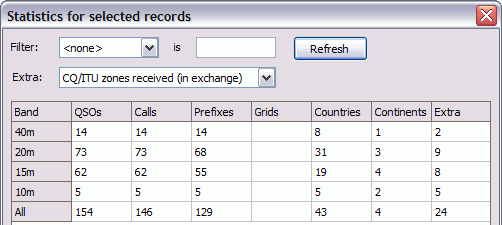
I made a total of 154 contacts in 43 different countries and 4 continents during my six hours or so of operating. The detailed breakdown, for those interested, is shown in the screen grab of the contest statistics dialog from KComm (the Extra field shows the number of CQ zones.) This would give me a claimed score of 17,487 points if my calculations are correct, which by comparison with last year’s results would place me well down the second half of the All Band Single Operator Low Power Unassisted results table.
This was the first time I had made such an effort for an SSB contest. Until now I hated turning on the radio during big SSB contests because the bands sounded like bedlam. But I had never tried with the K3 before. Instead of a mush of intermod, splatter and AGC pumping I could hear everything clearly. Sometimes I could hear two or three stations on the same frequency simultaneously, one in the foreground and a couple in the background. And the superb DSP filtering made it easy to shut out close-by stations so I could copy a weaker one. I often had the passband down to 1.8kHz and copy was still crystal clear.
Initially I started off just working the loud ones because I didn’t want to waste the serious contesters’ time by making them struggle to hear my call. But I found there was no hard and fast rule relating how strong a station was with whether they heard me. One Finnish station, 10dB over 9 with me, just kept on calling as if I wasn’t there. But many weaker ones came right back to my first call.
Frustratingly, a significant number of stations came back to me as “Golf 4 Lima India Oscar” – exactly the same error that was made when I ordered my QRSS beacon kit a couple of weeks ago. What is it about my call? This doesn’t happen on CW (though I used to get replied to as G3ILO very often as the holder of that call is a well known QRP CW operator.)
Conditions didn’t appear to be very good this weekend. I’d hoped to hear some interesting DX on 10m but I heard hardly anyone at all on the band. As always, 20m was the liveliest band, but I made almost as many contacts on 15m, probably because the QRM was less making it easier to make contacts.
I didn’t work any DX and I only worked one all time new DXCC entity – Svalbard, JW5E. I did hear a VK on 15m on Sunday morning but he had a big pileup going and after trying for about five minutes I decided not to waste any more time and move on.
Despite my unspectacular results I thoroughly enjoyed my few hours in the CQ WW DX SSB contest. No doubt QRZ.com and other online forums will be full of grumbles about contests taking over the band for the entire weekend, the only time working people can get on the air etc etc. But if you can’t beat them, why not join them?
My feeling is that contesting is one of the many different activities you can pursue and to get the most from the hobby you should try as many of those different activities as you can. As this post has hopefully shown, having indoor antennas is no obstacle to working a decent number of stations and earning a respectable score for the time spent. It’s not the winning, it’s the taking part that counts. I certainly felt like a real participant in this radiosport event and I look forward to seeing my call in the results table next year.

Fraternity?
Over the last few days a North American ham has been operating a beacon at the top end of the 30m band on the frequency that has been used for many years for HF APRS. At times this has made HF APRS operation impossible. After some difficulty, due to the fact that the beacon operator’s contact information was incorrect, someone managed to get in touch with him to point out the problems he was causing and ask politely if he would move the beacon. This is part of the reply that was received, copied verbatim from an APRS mailing list:
“Last week I moved the beacon when some other hams we’re bitching at me about ‘their’ all important!!! ham activity…… PSK, RTTY what ever!!! .
I move AGAIN then another cry baby bunch CRIES about ‘THEIR’ ALL IMPORTANT activities like weak signal CW QRRS CW whatever!
We have to SHARE the frequencies I will think about the QSY ….. if I get Bitching from so other ham ‘group’ like the DX cluster folks who are ‘DXing’ fish in a BARREL for some ALL IMPORTANT ‘certificate’ What am I to do??? I am an experimenter /builder when do I get to use a frequency????????
WHY is ‘APRS’ more important than MY activity? I look in the regs and I see NOTHING about one ham activity has priority over another!”
I have left out the individual’s details as I don’t want to start a personal attack that could be counterproductive by leading him to entrench his position. But whatever happened to good manners, politeness and consideration for one’s fellow amateur? When, as a young teenager, I first began listening on the amateur bands, I used to be impressed by the politeness and courtesy of the conversations I heard. No longer is amateur radio a gentleman’s hobby.
This OM is quite correct that we have to share the frequencies. It is a common courtesy that if a frequency is in use then you don’t use it, even if you have a net that has been meeting on that frequency every day since Marconi invented the spark transmitter.
But in the digital parts of the bands which can be used for more than conversations between two or more people, checking whether a frequency is in use may involve more than just sending “QRL?” or listening for a couple of minutes. Activities like APRS, packet radio, Winlink and so on are effectively nets that operate 24/7. If you don’t hear anything for a while that may just be because propagation isn’t sending anything your way at the moment.
This is how Chris, G4HYG prepared to select the frequency to use for APRS over PSK. He recently wrote: “Before I released the HF version of APRS Messenger I spent some time checking various frequencies on the 30m band. I found that the section from the 300 bd APRS frequency to the band edge appeared to be clear. I then started a period of monitoring the band from 10.1494 to 10.150 on a receiver with a digital mode program running with a very slow waterfall to catch anything I heard. This ran for a month from mid January to mid February.” It’s a pity the developer of the ROS digital mode that has caused so much disruption to other established activities could not have been as thorough and considerate in selecting operational frequencies.
To those who will trot out the response that activities like APRS have no more right to use a particular frequency than anything else I would say first of all that some types of activity need a specific frequency where other users can find it. It isn’t a matter of one activity being more important than another. If you had to hunt to find what frequency everyone is using today, some types of worldwide net operation would not be possible. In any case, a frequency that was clear in, say, North America might well be occupied in Europe. Allowing legitimate activities sole use of an established frequency by gentleman’s agreement is the only option. There is still plenty of room for other activities including ad-hoc beacons.
In activities like APRS, many dozens of stations all use the same frequency, making this a very efficient use of bandwidth. If users are driven off these frequencies or prevented from using these modes the result would be even less space left for other activities.
What people who object to this argument really mean is “I don’t have any interest in that mode and I don’t give a fig about those who do.” Is ham radio a fraternity? Yes, we are like a family of brothers who are forever breaking each other’s toys and beating the shit out of one another.

Logging assistant
When you are out in the field, especially on a windy hilltop, logging the contacts you make can be a bit difficult. One hand holding the radio or microphone leaves only one hand free to hold down the log book and write in it. If you’re using a hand-held and standing up to get the maximum height gain, it’s even more awkward.

A few weeks ago I hit on the idea of using a personal digital voice recorder. Initial researches suggested that they were a bit expensive – many models sell for around £70 or more. But diligent searching on eBay revealed that it was possible to buy them for much less than this.
The one I got is an Olympus VN-100 Digital Voice Recorder and cost £15.99 including free postage. It was described as “refurbished to new condition by Olympus.” This might be an indicator of a product that tends to fail and has a high number of warranty returns. However, this particular one was indistinguishable from new, works fine and is simple to use. It isn’t the colour I’d have picked if I had a choice, but price and functionality were the principal considerations.
I don’t know what the differences are between the VN-100 and the more expensive models apart from colour, probably storage capacity. However this model has capacity for more than 13 hours of recording – more than adequate for my purposes.
I find the VN-100 easy to operate with the hand that isn’t holding the radio. You just press one button to start recording and another to stop. A bar meter shows the level of the audio input. You can either say the callsign, time and whatever else you are interested in logging, or just point the device at the radio and make an off-air recording. At home it could be a handy shack tool for recording unusual DX contacts.
The only problem I found is that the voice recorder is just as sensitive to wind noise as the microphone in the radio. More than once I have returned home to find a recording was unintelligible. However, mishaps like this can probably be avoided with practise.
I’m finding my digital voice recorder to be an indispensable companion on portable outings. It’s also handy for jotting down ideas for blog posts that occur whilst you’re out and about!

Internet killed the radio chat
The unwillingness of many hams to chat or ragchew on the air is becoming a frequently raised topic on blogs and forums. One QRP blogger recently complained after one of his CQs received a “599 TU OM” type of reply.
It’s sad but, I think the disappearance of the ragchewer is inevitable. Thirty five years ago when I was first licensed, if I wanted advice on something I was doing I would call CQ and hope someone knowledgeable would reply. Much of what I learned about radio after getting my ticket I learned from on the air conversations. Today I would go on the internet where I can find out much more, much faster.
In the late 1980s I added my first modem to my home computer and discovered bulletin boards – the forerunner of today’s internet. There I could chat with fellow computer enthusiasts without any of the aggravations of QRM, QRN and QSB that afflicted ham radio communications. My ham radio usage fell right off to the extent that I eventually sold my gear and let my license lapse for several years.
Whilst playing with radio is fun, especially if you like building electronic things or are interested in propagation, the internet is a much better system for finding like-minded people to chat with and provides more reliable ways to communicate with them. We’re all guilty! Every mailing list or forum thread and every blog post with its follow-on comments is a conversation that once upon a time might have been conducted on the air. The internet has changed ham radio and there is nothing anyone can do about it.
That isn’t to say there is no point to ham radio any more. But the point is increasingly about how far (or where) your radio signals reach, not what you actually say. Contesting and award chasing with their “599 TU” exchanges are popular like never before. And there is lots of interest in modes like WSPR and QRSS beaconing that allow you to see how far your transmissions go without the bother of having to contact somebody and receive a report from them.
The art of on the air conversation is dying out. The reluctance of digital mode users to venture beyond sending their pre-prepared macros is one example of this. Making a ham radio contact no longer requires an exchange of personal information, you simply need to receive enough of someone’s signal for it to be identifiable as theirs. And digital modes have been developed that facilitate the exchange of just this minimum information.
The popularity of the JT65A mode on HF can be explained by the fact that it allows people to make “contacts” without having to speak or type anything, because the exchanges are all coded into the software. VHF enthusiasts now work each other using weak signal digital modes whilst they are in constant contact, not using radio, but via ON4KST Chat, an internet chat channel. When you need to keep in contact, it seems, radio is too unreliable. The same appears to be true for DX Cluster spots. How many people still receive them using packet radio?
The ham bands are becoming no more than a playground for those in which the unpredictable vagaries of propagation provide the key element that makes their activities a challenging and absorbing pastime. But as a serious communications medium, unless you’re half way up a mountain or in the middle of Africa where the internet and cellular networks aren’t available, radio is becoming somewhat redundant.
If you want to talk to somebody about your favourite ham radio topic why worry whether the propagation gods are feeling kind to you when you could just start a thread on Yahoo Groups or QRZ.com or go on Echolink?

Rumors of my death have been greatly exaggerated…
I’ve been QRT (both radio- and blog-wise) for quite some time as the XYL and I have been planning and, over the past week, executing a move from Robinson to the charming little town of West, TX — that’s West (comma) Texas, population 2,690, which despite the name is nowhere near “West Texas” but just a dozen miles or so north of Waco in the central part of the Republic. According to the FCC database there are 18 licensed amateurs in West, including your faithful correspondent.
The new QTH is an old but freshly renovated 3 bedroom house with a detached garage and (praise Jesus!) trees, giving me antenna possibilities that did not exist at our suburban-hell duplex in Robinson. There’s a tripod already on the roof; it’s not exactly heavy-duty but it should be adequate for a vertical. Whether I’ll put the Cushcraft R7000 back into service or simply mount the Tarheel on the roof remains to be decided. One of my priorities is to at least get a dipole strung up for 6/10/12 meters. Not yet sure if there’s room for an 80m wire.
The shack/office is about the same size and layout as at the last QTH. There’s a large walk-in closet that I will use as a library to store some of the 8.6 million books that I seem to have acquired over the years and which I hope to have moved for the last time. I no longer have a loud central air conditioning unit outside the window of the office; however, I now live across the street from the main Union Pacific train line that runs through the middle of the state. Being a lifelong fan of model railroading but never having the room, tools or skills to build the N-scale layout of my dreams, I can now enjoy a 1:1 scale road with regular trains that shake the entire house about a dozen times a day like a coin-operated bed in a cheap motel. Must remember turn the VOX off when I’m not at the radio.
Since we’re still living out of boxes it may be some time yet before I can get the shack reassembled, antennas installed, and return to the bands — needless to say, the IARU HF contest is going to have to get along without WW2PT’s big signal, and the IOTA test in a couple of weeks will be a long shot, but I fully intend to be up and running in time for NAQP in August.
Rumors of my death have been greatly exaggerated…
I’ve been QRT (both radio- and blog-wise) for quite some time as the XYL and I have been planning and, over the past week, executing a move from Robinson to the charming little town of West, TX — that’s West (comma) Texas, population 2,690, which despite the name is nowhere near “West Texas” but just a dozen miles or so north of Waco in the central part of the Republic. According to the FCC database there are 18 licensed amateurs in West, including your faithful correspondent.
The new QTH is an old but freshly renovated 3 bedroom house with a detached garage and (praise Jesus!) trees, giving me antenna possibilities that did not exist at our suburban-hell duplex in Robinson. There’s a tripod already on the roof; it’s not exactly heavy-duty but it should be adequate for a vertical. Whether I’ll put the Cushcraft R7000 back into service or simply mount the Tarheel on the roof remains to be decided. One of my priorities is to at least get a dipole strung up for 6/10/12 meters. Not yet sure if there’s room for an 80m wire.
The shack/office is about the same size and layout as at the last QTH. There’s a large walk-in closet that I will use as a library to store some of the 8.6 million books that I seem to have acquired over the years and which I hope to have moved for the last time. I no longer have a loud central air conditioning unit outside the window of the office; however, I now live across the street from the main Union Pacific train line that runs through the middle of the state. Being a lifelong fan of model railroading but never having the room, tools or skills to build the N-scale layout of my dreams, I can now enjoy a 1:1 scale road with regular trains that shake the entire house about a dozen times a day like a coin-operated bed in a cheap motel. Must remember turn the VOX off when I’m not at the radio.
Since we’re still living out of boxes it may be some time yet before I can get the shack reassembled, antennas installed, and return to the bands — needless to say, the IARU HF contest is going to have to get along without WW2PT’s big signal, and the IOTA test in a couple of weeks will be a long shot, but I fully intend to be up and running in time for NAQP in August.
March 2010 Wrap-Up
All | 80m | 40m | 30m | 20m | 17m | 15m | Ph | CW | Dig | |
DXCC | 83 | 2 | 43 | 10 | 67 | 13 | 38 | 59 | 5 | 63 |
WAS | 50 | 28 | 49 | 7 | 48 | 19 | 21 | 43 | 1 | 50 |
WAZ | 26 | 3 | 21 | 8 | 23 | 9 | 18 | 22 | 5 | 22 |













