Posts Tagged ‘ndb’
 Hunting For NDBs In CLE 213
 November 24th, 2016 |
  Author:
 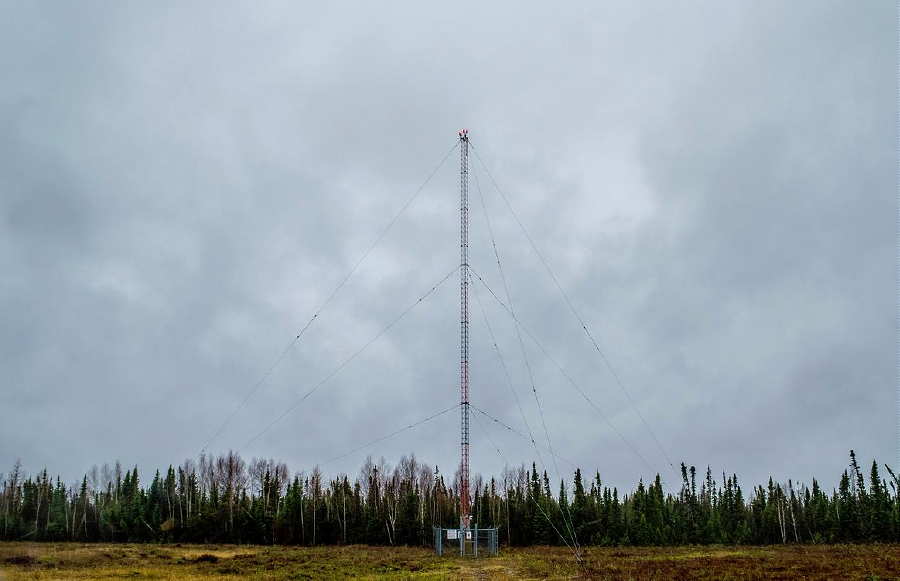 |
| 'YLH' - 247 courtesy: http://www.ve3gop.com/ |
This coming weekend will see another CLE challenge, this time in two ranges: 240.0 - 259.9 kHz plus 420.0 - 439.9 kHz.
A 'CLE' is a 'Co-ordinated Listening Event', as NDB DXers around the world focus their listening time on one small slice of the NDB spectrum.
A nice challenge in this one is to hear the Lansdowne House, Ontario, NDB, 'YLH' on 247 kHz. This one runs 250 watts and gets out well, having been logged from coast to coast. Listen for it on 247.417 kHz with your receiver in the CW mode.
From CLE organizer Brian Keyte, G3SIA, comes the usual 'heads-up':
Hi all,
Here are the final details for our 213th co-ordinated listening event this
weekend. First timer logs too? Yes, please!
Days: Friday 25 Nov. to Monday 28 Nov.
Times: Start and end at midday, your LOCAL TIME
Range: 240.0 - 259.9 kHz plus 420.0 - 439.9 kHz
(BOTH ranges are for ALL listeners)
Please log NDBs that you can positively identify in the ranges, plus any
UNIDs that you come across there.
The lower frequency range will be really hard for most Europe listeners,
the higher range not at all easy for most others.
Send your CLE log to the List, if possible as a plain text email and
not in an attachment, with CLE213 at the start of its title.
Show on EVERY LINE of your log:
# The Date (or day 'dd') and UTC (the day changes at 00:00 UTC).
# kHz - the beacon's nominal published frequency (if you know it).
# The Call Ident.
Please show those main items first on each line, BEFORE any optional
details (Location, Offsets, Cycle time, Distance, etc.)
If you send interim logs, do make sure that you also send a 'Final' log
containing all your loggings. As always, please make your log useful and
interesting to everyone by including your own location and brief details
of your receiver, aerial(s) and any recording equipment that you used.
I will send the usual 'Any More Logs?' email at about 18:00 UTC on
Tuesday so that you can check that your Final log has been found OK.
Do make sure that your log has arrived on the List at the very latest
by 09:00 UTC on Wednesday 30th November.
I hope to complete the combined results later on that day.
To help you with your search you can find lists of your target NDBs at
http://www.ndblist.info/cle.htm Select the SEEKLIST link there.
(To also see a MAP of the seeklist NDBs, just change 'List' to 'Map',
select 'All Results' and uncheck 'Clustering')
Good listening
Brian
----------------------------------------------------------
From: Brian Keyte G3SIA ndbcle'at'gmail.com
Location: Surrey, SE England (CLE co-ordinator)
----------------------------------------------------------
(Reminder: You could use any one remote receiver for your loggings,
stating its location and owner - with their permission if required.
A remote listener may NOT also use another receiver, whether local or
remote, to obtain further loggings for the same CLE).
These listening events serve several purposes. They:
- determine, worldwide, which beacons are actually in service and on-the-air so the online database can be kept up-to-date
- determine, worldwide, which beacons are out-of-service or have gone silent since the last CLE covering this range
- will indicate the state of propagation conditions at the various participant locations
- will give you an indication of how well your LF/MF receiving system is working
- give participants a fun yet challenging activity to keep their listening skills honed
Final details can be found at the NDB List website, and worldwide results, for every participant, will be posted there a few days after the event. If you are a member of the ndblist Group, results will also be e-mailed and posted there.
The very active Yahoo ndblist Group is a great place to learn more about the 'Art of NDB DXing' or to meet other listeners in your region. There is a lot of good information available there and new members are always very welcome. As well, you can follow the results of other CLE participants from night to night as propagation is always an active topic of discussion.
If you are contemplating getting started on 630m, listening for NDBs is an excellent way to test out your receive capabilities as there are several NDBs located near this part of the spectrum.
You need not be an ndblist member to participate in the CLEs and all reports, no matter how small, are of much value to the organizers.
'First-time' logs are always VERY welcome!
Reports may be sent to the ndblist or e-mailed to either myself or CLE co-ordinator, Brian Keyte (G3SIA), whose address appears above.
Please ... give the CLE a try ... then let us know what NDB's can be heard from your location! Your report can then be added to the worldwide database to help keep it up-to-date.
Good hunting!
Upcoming Solar Years … Can They Be Too Quiet?

Most of us LF/MF and topband diehards have been looking forward to the next several years of low solar activity ... maybe even 'ultra-low' as some of the solar gurus are predicting.
An interesting posting on the Topband reflector a few weeks ago by noted propagation expert, Carl, K9LA, made me re-think my expectations!
I flagged the post for a later blog topic but have since seen the information pop-up on a couple of other reflectors as well as on the ARRL News page. Apparently I wasn't the only one to give the posting a double-take. If you missed it, here is Carl's post:
About a week ago Wolf DF2PY posted a message here commenting on the recent adverse levels of geomagnetic field activity and how it will now change for the good - giving us good 160m propagation.
We'll certainly see less geomagnetic field activity as we move into winter,
but there's another issue we should be aware of. The Sun's magnetic field
is weakening - probably to the lowest levels in our lifetime. With a weak
solar magnetic field, more galactic cosmic rays will be able to get into
the Earth's atmosphere. We are now seeing unprecedented high neutron counts (neutrons are one of the by-products of cosmic rays)
Since galactic cosmic rays are mostly *very energetic* protons, they can
get down to low atmospheric altitudes, causing collisional ionization in
the D region (and lower E region). A cursory estimate using cosmic ray
ionization rates confirms more ionization in the lower atmosphere. 160m is
not very tolerant of more absorption, so we may see an adverse effect of
the weakened solar magnetic field.
Many of us think that "solar min is solar min is solar min". But maybe a
solar minimum can be too deep for 160m. A good question to ask in the early 2020s will be "how was 160m?" So stay active on 160m and let's see what happens.
Carl K9LA
My initial response was to think that perhaps there wouldn't be as much to look forward to as I had been hoping for, when it came to improved LF, MF and 160m propagation. Carl's postulation was also backed-up by another mention on the Spaceweather site, although the influence of cosmic ray bombardment on radio propagation was not discussed.
As I thought more about this unfortunate possibility actually coming to pass, I thought back to my own on-air and listening experiences during previous solar-low years ... particularly the unprecedented low between our most recent cycle and its predecessor, Cycle 23.
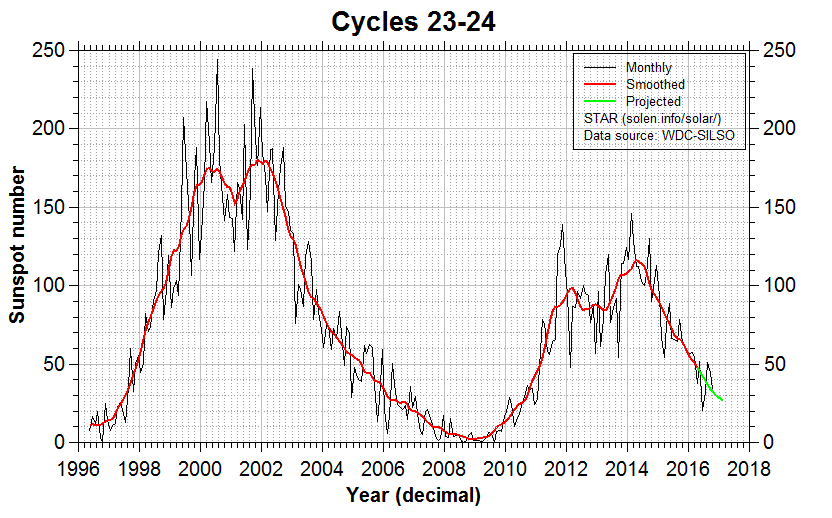
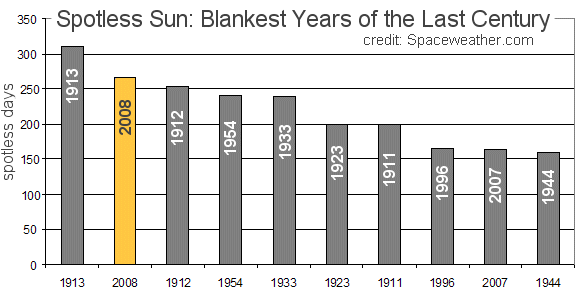
The low period between these two cycles, as most will likely recall, saw the quietest solar conditions observed in the past 100 years. The solar-low winters saw week after week of a blank Sun, with solar activity virtually flatlining for the entire period. In 2008 there were 265 'zero sunspot' days and the following year saw another 262 days of blank suns!
These effects were well noted here for two winters that are usually prime 'DX times' ... if ever there were a period when cosmic ray bombardment should negatively impact low frequency propagation, surely it would have been then.
So just what did I observe?
What I saw was not only what I had been expecting but was much much better than I had ever believed possible. For west coast topband operators, the 'holy grail' of propagation is working Europe. Working Europe from here means that signals must travel through the polar regions, usually the kiss-of- death for weak signals, as the severe attenuation through the auroral zone means that it just doesn't happen very often ... except for this prolonged period of ultra lows. In a word, conditions to Europe were 'spectacular' ... night-after-night, for several weeks over a period of two winters, working Europe on 160 became normal.
On most nights, European signals could be heard before local sunset, and on several occasions, CW contacts with Europeans, were completed up to one and a half hours before my local sunset. As darkness set in, more signals would appear and the band would rapidly become populated with Europeans ... and only Europeans.
Most of the time there were no signals from North America evident, just Europeans ... a condition that had me shaking my head in disbelief night after night. It was something I had never observed before, as I watched 160m behaving more like 20m CW on a good day to Europe! During this period, my DXCC totals skyrocketed from 99 to 143 worked, as new Europeans and Africans were added to my logbook.
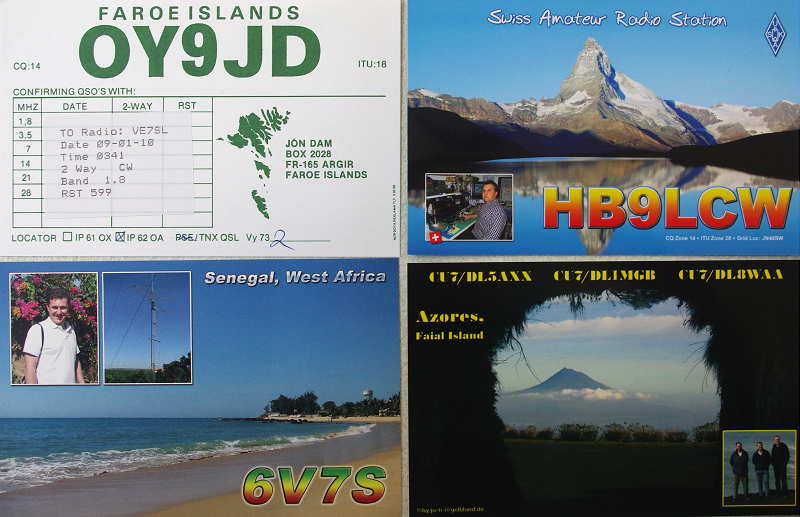
Signal levels were also outstanding, often pushing the FT-1000 S-meter well past the S9 level. On one particular night, I recall hearing an SM4 calling CQ, with just such a signal. I set my output power level at 10 watts and gave him a call, to which he quickly responded. If cosmic ray bombardment was at a high level, it was not reeking any havoc as far as the west coast path to Europe was concerned! For the record, my topband system is nothing special, consisting of a simple 'half-sloper' over a poor ground and a very old amplifier running about 500W output.
My other favorite winter pastime is chasing NDBs in the MF range between 200-500 kHz. Exceptional east west conditions were evident throughout the two winters of ultra-lows.
On one such night, I noted a new strong signal where none had been previously heard. Because of its strength, I surmised that it was probably a new NDB in nearby Washington state. Noting its ident ('NYA' on 414 kHz), I was not able to find any reference to such a beacon being previously reported and turned to the Yahoo ndblist group for help, posting my catch as 'unidentified'. Almost immediately I received a response, telling me that the signal I was hearing was located in Europe ... Svalbard to be exact, located midway between Norway and the North Pole!
Now, European NDBs have never been heard from the west coast, other than occasional signals from some of Greenland's powerhouses, so this represents a very rare event. Although I have often listened for this signal, it has yet to be heard here again and my logging of remains its only reported foray into any part of North America. Unfortunately, in 2015, it was listed as 'decomissioned'. I have no doubts that this rare propagation was a result of the solar flatlining conditions of the time.
As chilling as Carl's warning sounds, he himself admits uncertainty with a 'let's wait and see' attitude and after reviewing my own experiences under what surely must be similar conditions, I'm still very optimistic over what might be in store. Hopefully we shouldn't have to wait too much longer to find out!
Upcoming Solar Years … Can They Be Too Quiet?
Most of us LF/MF and topband diehards have been looking forward to the next several years of low solar activity ... maybe even 'ultra-low' as some of the solar gurus are predicting.
An interesting posting on the Topband reflector a few weeks ago by noted propagation expert, Carl, K9LA, made me re-think my expectations!
I flagged the post for a later blog topic but have since seen the information pop-up on a couple of other reflectors as well as on the ARRL News page. Apparently I wasn't the only one to give the posting a double-take. If you missed it, here is Carl's post:
About a week ago Wolf DF2PY posted a message here commenting on the recent adverse levels of geomagnetic field activity and how it will now change for the good - giving us good 160m propagation.
We'll certainly see less geomagnetic field activity as we move into winter,
but there's another issue we should be aware of. The Sun's magnetic field
is weakening - probably to the lowest levels in our lifetime. With a weak
solar magnetic field, more galactic cosmic rays will be able to get into
the Earth's atmosphere. We are now seeing unprecedented high neutron counts (neutrons are one of the by-products of cosmic rays)
Since galactic cosmic rays are mostly *very energetic* protons, they can
get down to low atmospheric altitudes, causing collisional ionization in
the D region (and lower E region). A cursory estimate using cosmic ray
ionization rates confirms more ionization in the lower atmosphere. 160m is
not very tolerant of more absorption, so we may see an adverse effect of
the weakened solar magnetic field.
Many of us think that "solar min is solar min is solar min". But maybe a
solar minimum can be too deep for 160m. A good question to ask in the early 2020s will be "how was 160m?" So stay active on 160m and let's see what happens.
Carl K9LA
My initial response was to think that perhaps there wouldn't be as much to look forward to as I had been hoping for, when it came to improved LF, MF and 160m propagation. Carl's postulation was also backed-up by another mention on the Spaceweather site, although the influence of cosmic ray bombardment on radio propagation was not discussed.
As I thought more about this unfortunate possibility actually coming to pass, I thought back to my own on-air and listening experiences during previous solar-low years ... particularly the unprecedented low between our most recent cycle and its predecessor, Cycle 23.
The low period between these two cycles, as most will likely recall, saw the quietest solar conditions observed in the past 100 years. The solar-low winters saw week after week of a blank Sun, with solar activity virtually flatlining for the entire period. In 2008 there were 265 'zero sunspot' days and the following year saw another 262 days of blank suns!
These effects were well noted here for two winters that are usually prime 'DX times' ... if ever there were a period when cosmic ray bombardment should negatively impact low frequency propagation, surely it would have been then.
So just what did I observe?
What I saw was not only what I had been expecting but was much much better than I had ever believed possible. For west coast topband operators, the 'holy grail' of propagation is working Europe. Working Europe from here means that signals must travel through the polar regions, usually the kiss-of- death for weak signals, as the severe attenuation through the auroral zone means that it just doesn't happen very often ... except for this prolonged period of ultra lows. In a word, conditions to Europe were 'spectacular' ... night-after-night, for several weeks over a period of two winters, working Europe on 160 became normal.
On most nights, European signals could be heard before local sunset, and on several occasions, CW contacts with Europeans, were completed up to one and a half hours before my local sunset. As darkness set in, more signals would appear and the band would rapidly become populated with Europeans ... and only Europeans.
Most of the time there were no signals from North America evident, just Europeans ... a condition that had me shaking my head in disbelief night after night. It was something I had never observed before, as I watched 160m behaving more like 20m CW on a good day to Europe! During this period, my DXCC totals skyrocketed from 99 to 143 worked, as new Europeans and Africans were added to my logbook.
Signal levels were also outstanding, often pushing the FT-1000 S-meter well past the S9 level. On one particular night, I recall hearing an SM4 calling CQ, with just such a signal. I set my output power level at 10 watts and gave him a call, to which he quickly responded. If cosmic ray bombardment was at a high level, it was not reeking any havoc as far as the west coast path to Europe was concerned! For the record, my topband system is nothing special, consisting of a simple 'half-sloper' over a poor ground and a very old amplifier running about 500W output.
My other favorite winter pastime is chasing NDBs in the MF range between 200-500 kHz. Exceptional east west conditions were evident throughout the two winters of ultra-lows.
On one such night, I noted a new strong signal where none had been previously heard. Because of its strength, I surmised that it was probably a new NDB in nearby Washington state. Noting its ident ('NYA' on 414 kHz), I was not able to find any reference to such a beacon being previously reported and turned to the Yahoo ndblist group for help, posting my catch as 'unidentified'. Almost immediately I received a response, telling me that the signal I was hearing was located in Europe ... Svalbard to be exact, located midway between Norway and the North Pole!
Now, European NDBs have never been heard from the west coast, other than occasional signals from some of Greenland's powerhouses, so this represents a very rare event. Although I have often listened for this signal, it has yet to be heard here again and my logging of remains its only reported foray into any part of North America. Unfortunately, in 2015, it was listed as 'decomissioned'. I have no doubts that this rare propagation was a result of the solar flatlining conditions of the time.
As chilling as Carl's warning sounds, he himself admits uncertainty with a 'let's wait and see' attitude and after reviewing my own experiences under what surely must be similar conditions, I'm still very optimistic over what might be in store. Hopefully we shouldn't have to wait too much longer to find out!
CLE 212 Results
 |
| Friday's auroral condx courtesy of :OVATION |
Well another CLE has come to pass with most listeners in North America reporting poor conditions ... other than those in the southern states.
As typically happens when hit with a serious geomagnetic event (why do they always coincide with our CLE's?), northernmost stations are affected worse than those further south. This disturbance was a strong and persistent solar wind, making the band very noisy. Signals in the Perseus SDR waterfall that looked as if they should be easy copy, were mushy and run together, making many idents uncopyable in the solar wind noise.
 |
| Welcome to CLE 212 couretsy of: OVATION |
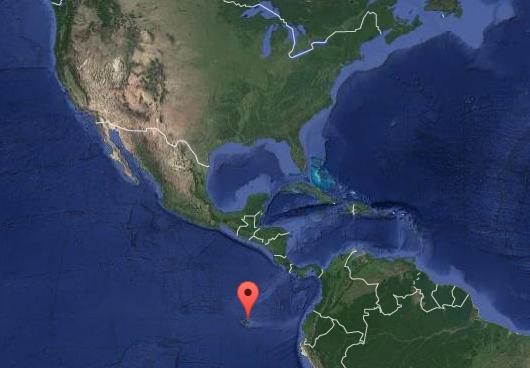
The east-west path, being reliant on quiet geomagnetic conditions, was totally absent, with no NDB's from Ontario making it into my log. Somewhat surprising was the rarely heard Galapagos Island NDB on 272 kHz ... heard widely throughout North American.
 |
| GLS - 272 Galapagos courtesy: Google Maps |
As usual, my receiver for the CLE was the Perseus SDR along with my normal LF / MF inverted-L antenna, tuned to ~ 300kHz.
29 08:00 272.0 YLB Lac La Biche, AB, CAN
29 11:00 272.0 XS Prince George, BC, CAN
30 06:30 272.0 GLS Galapagos, GAL
29 05:00 274.0 FR Fort Resolution, NT, CAN
29 08:00 275.0 SF Williston, ND, USA
29 07:00 275.0 HIN Chadron,NE, USA
29 05:00 275.0 GEY Greybull, WY, USA
29 06:00 275.0 AV Winnipeg, MB, CAN
31 12:00 277.0 OT Worthington, MN, USA
31 05:00 280.0 GYZ Guernsey, WY, USA
31 13:00 281.0 CRN Sparrevohn, ALS
30 13:30 283.0 DUT Dutch Harbor, ALS
29 08:30 284.0 QD The Pas, MB, CAN
29 13:00 284.0 FHR Friday Harbor, WA, USA
29 08:00 287.0 ZWG Winnipeg, MB, CAN
29 08:30 287.0 PE Peace River, AB, CAN
29 08:30 290.0 YYF Penticton, BC, CAN
30 08:00 290.0 QR Regina, SK, CAN
30 08:00 292.0 ZET Edmonton, AB, CAN
30 08:00 293.0 TOR Torrington, WY, USA
29 08:00 293.0 MB Sidney, BC, CAN
30 08:00 295.0 8C Fairview, AB, CAN
29 08:30 296.0 LGD La Grande, OR, USA
29 08:30 299.0 TV Turner Valley, AB, CAN
30 10:00 302.0 QW North Battleford, SK, CAN
29 08:30 304.0 FH Mc Leod, AB, CAN
29 08:30 305.0 Z1 Three Hills, AB, CAN
29 08:30 305.0 ONO Ontario, OR, USA
30 06:30 307.0 M5 Manning, AB, CAN
29 08:30 308.0 ZZD Edmonton, AB, CAN
29 08:30 311.0 9Y Pincher Creek, AB, CAN
29 08:30 312.0 UNT Naramata, BC, CAN
29 08:30 317.0 VC La Ronge, SK, CAN
The results from all participants can be found in a few days at the NDB List website, or if you are a member of the ndblist Group, results will also be posted there.
The very active Yahoo ndblist Group is a great place to learn more about the 'art' of NDB DXing or to meet other listeners in your region. There is a lot of helpful information available there and new members are always very welcome. As well, you can follow and chat with other NDB chasers regarding antennas, techniques, unidentified signals and nightly propagation ... and, if you are building a 630m station, listening for NDB's is a great way to determine your receive capability and if it needs improvement.
Hunting For NDBs In CLE 212
 |
| YPM-274 courtesy: ve3gop.com |
Another NDB CLE challenge is in store this coming weekend with CLE 212. This time the frequency range is 270 - 319.9 kHz bringing it into the DGPS band, although these signals should not be reported.
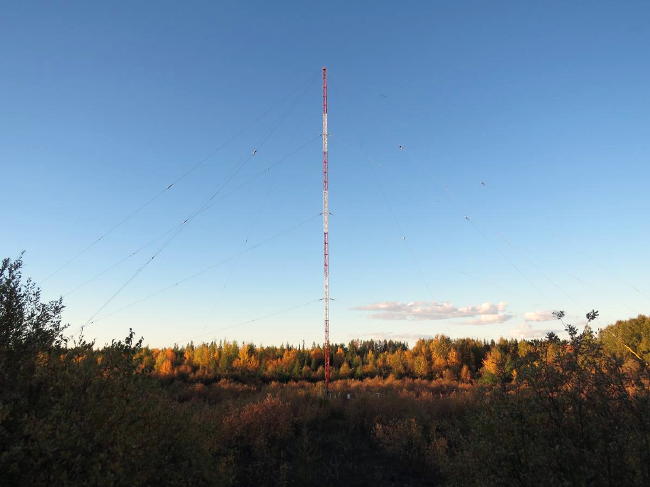
A good target for this range is 25W YPM in Pikangikum, Ontario, transmitting on 274 kHz. It is widely reported throughout North America, thanks to its large antenna system, pictured here. Look for it on 274.361 kHz with your receiver in 'CW' mode. Remember that most Canadian NDBs use a ~ 400Hz tone for modulation while the U.S. ones are usually ~1020Hz on both sidebands.
'CLE's' are 'Co-ordinated Listening Events', and NDB DXers around the world focus their listening time on one small slice of the NDB spectrum ... but this time around, the range has been expanded.
From CLE coordinator Brian Keyte (G3SIA), via the Yahoo ndblist Group, comes the following reminder:
Hello all
The NDB List has really come back to life recently - you can see the effect
of the good recent propagation on the number of emails we have posted
to NDB List each month since last June:
Jun Jul Aug Sep Oct (so far)
197 279 404 663 768
Our 212th co-ordinated listening event is this weekend, covering a 50 kHz
frequency range - about three times wider than usual.
Days: Friday 28 October - Monday 31 October
Times: Start and end at midday, your LOCAL time
Range: 270.0 - 319.9 kHz (NOT DGPS beacons)
We can expect very good propagation, but in part of the frequency range
it will be a bit of a challenge to tease out the NDB signals from among
the DGPS ones.
Any first-time CLE logs will be very welcome, as always.
Please log the normal NDBs you can identify that are listed in the range
(it includes 270 kHz but not 320 kHz).
Please send your CLE log to NDB List, if possible as a plain text email
and not in an attachment, with 'CLE212' at the start of its title.
Show on EVERY line of your log:
# The Date (e.g. '2016-10-28' or just '28', etc.)
# UTC (the day changes at 00:00 UTC).
# kHz - the beacon's nominal published frequency if you know it.
# The Call Ident.
Those main items can be in any order within themselves, but BEFORE any
other optional details (Location, Distance, etc.) later in the same line.
Many of us in Europe will be changing our house clocks this weekend.
UTC time continues unchanged of course, but as we finish the CLE on
Monday at LOCAL midday we may win an extra hour's listening!
As always, give details in your log of your own location and the receiver,
aerial(s), etc. that you were using.
If you send any interim logs, please also send a Final (complete) one.
You can find anything else to help you, including seeklists for your part
of the World, from the CLE page, http://www.ndblist.info/cle.htm
I will send the usual 'Any More Logs?' email at about 18:00 UTC on Tuesday so that you can check that your CLE log has been found OK. Do make sure
that your log has arrived at the very latest by 09:00 UTC next Wednesday,
2nd November. I am hoping to make all the combined results on that day.
Enjoy your listening
Brian
----------------------------------------------------------
From: Brian Keyte G3SIA ndbcle'at'gmail.com
Location: Surrey, SE England (CLE co-ordinator)
----------------------------------------------------------
(Reminder: You could use any one remote receiver for your loggings,
stating its location and owner - with their permission if required.
A remote listener may NOT also use another receiver, whether local or
remote, to obtain further loggings for the same CLE).
These listening events serve several purposes. They:
- determine, worldwide, which beacons are actually in service and on-the-air so the online database can be kept up-to-date
- determine, worldwide, which beacons are out-of-service or have gone silent since the last CLE covering this range
- will indicate the state of propagation conditions at the various participant locations
- will give you an indication of how well your LF/MF receiving system is working
- give participants a fun yet challenging activity to keep their listening skills honed
Final details can be found at the NDB List website, and worldwide results, for every participant, will be posted there a few days after the event. If you are a member of the ndblist Group, results will also be e-mailed and posted there.
The very active Yahoo ndblist Group is a great place to learn more about the 'Art of NDB DXing' or to meet other listeners in your region. There is a lot of good information available there and new members are always very welcome. As well, you can follow the results of other CLE participants from night to night as propagation is always an active topic of discussion.
If you are contemplating getting started on 630m, listening for NDBs is an excellent way to test out your receive capabilities as there are several NDBs located near this part of the spectrum.
You need not be an ndblist member to participate in the CLEs and all reports, no matter how small, are of much value to the organizers. 'First-time' logs are always VERY welcome!
Reports may be sent to the ndblist or e-mailed to either myself or CLE co- ordinator, Brian Keyte (G3SIA), whose address appears above.
Please ... give the CLE a try ... then let us know what NDB's can be heard from your location! Your report can then be added to the worldwide database to help keep it up-to-date.
CLE 211 Results
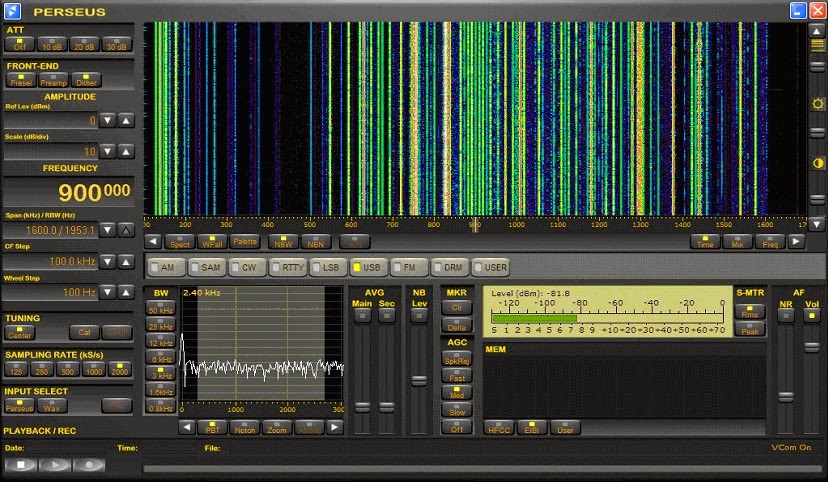
This past weekend's CLE saw noticeably improved conditions compared with the previous event.
With the fall DX season fast-approaching, the combination of diminishing thunderstorm activity and improved propagation provided some interesting catches. Friday night was the best with Saturday having a brief period of favorable prop, while no new stations were heard on Sunday night, the poorest.
It was particularly nice to hear strong signals from the eastern provinces on Friday, highlighted with an excellent signal from 'JT' (390 kHz) in Stephenville, Newfoundland. This long haul east-west propagation can only be found with quite geomagnetic conditions as was the case on Friday.

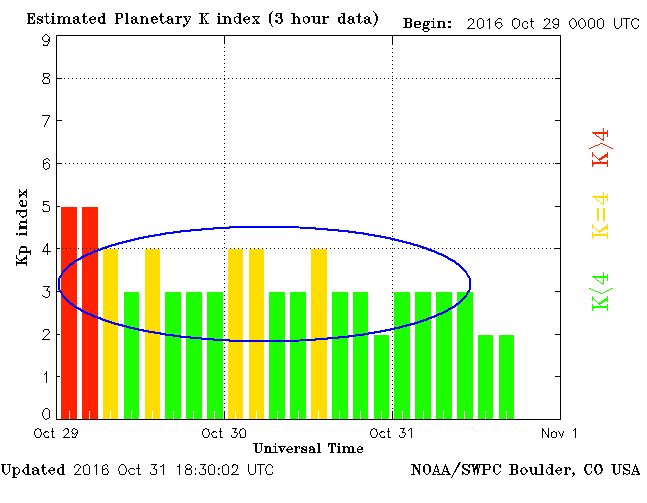
After examining the geomagnetic 'K' data for Saturday (25th), it's interesting to note that the four catches for that night all coincided exactly with the brief green bar (K= 0-3) centered on the hours around 0900 UTC (circled).
The following NDBs were heard using my Perseus SDR and 'inverted-L' resonated to ~ 300kHz:
24 06:30 385.0 WL Williams Lake, BC, CAN
24 13:00 385.0 OCC Yakutat, ALS
24 10:00 385.0 MR Pacific Grove, CA, USA
24 13:00 385.0 EHM Cape Newenham, ALS
24 08:30 386.0 SYF St. Francis, KS, USA
24 06:30 386.0 HAU Helena, MT, USA
24 06:00 386.0 4N Oxford House, MB, CAN
24 06:30 388.0 MM Fort Mc Murray, AB, CAN
24 09:30 388.0 JW Pigeon, AB, CAN
24 06:30 388.0 GLY Clinton, MO, USA
24 06:30 389.0 YWB Kelowna, BC, CAN
24 08:00 389.0 TW Twin Falls, ID, USA
25 08:30 389.0 EN Kenosha, WI, USA
24 06:00 389.0 CSB Cambridge, NE,USA
24 06:30 390.0 JT Stephenville, NL, CAN
24 06:00 390.0 HBT Sand Point, ALS
24 06:00 390.0 AES Northway, ALS
24 06:30 391.0 TK Telkwa, BC, CAN
24 13:00 391.0 EEF Sisters Island, ALS
24 06:00 391.0 DDP Dorado, PTR
24 06:30 391.0 4W Kelsey, MB, CAN
24 08:30 392.0 ZFN Tulita, NT, CAN
24 06:00 392.0 PNA Wenz, WY, USA
24 06:30 392.0 ML Charlevoix, QC, CAN
25 08:30 392.0 FMZ Fairmont, NE, USA
25 08:30 392.0 BAJ Sterling, CO, USA
24 06:00 392.0 AGZ Wagner, SD, USA
25 09:30 393.0 TOG Togiak, ALS
24 08:30 393.0 2M Opapimiskan Lake,ON, CAN
24 13:00 394.0 RWO Kodiak, ALS
24 08:30 394.0 DQ Dawson Creek, BC, CAN
24 08:30 395.0 YL Lynn Lake, MB, CAN
24 06:00 395.0 ULS Ulysses, KS, USA
24 08:30 395.0 L7 Estevan, SK, CAN
24 08:30 396.0 YPH Inukjuak, QC, CAN
24 13:00 396.0 CMJ Ketchikan, ALS
24 08:30 397.0 ZSS Saskatoon, SK, CAN
24 08:00 397.0 SB San Bernardino, CA, USA
24 08:00 397.0 CIR Cairo, IL, USA
24 08:30 398.0 YOD Cold Lake, AB, CAN
24 08:30 398.0 3D Cumberland House, SK, CAN
24 08:30 399.0 ZHD Dryden, ON, CAN
24 13:00 399.0 SRI St George, ALS
The results from all participants can be found at the NDB List website, or if you are a member of the ndblist Group, results have also been e-mailed and posted there.
The very active Yahoo ndblist Group is a great place to learn more about the 'art' of NDB DXing or to meet other listeners in your region. There is a lot of helpful information available there and new members are always very welcome. As well, you can follow and chat with other NDB chasers regarding antennas, techniques, unidentified signals and nightly propagation.
The Amazing BOG
 |
| courtesy: http://www.wd0m.com/antennas1.html |
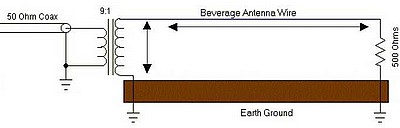
A recent inquiry about 'BOG' antennas on the topband reflector reminded me of my own experiences with this simple yet very effective antenna. A 'BOG' or 'Beverage On Ground' seems to come in many varieties and is usually, out of necessity, shorter than a 'real' beverage.
In many instances, BOGs are as simple as running a wire out on the ground as long and as straight as practical. Not always, but usually, the BOG is fed by a small homemade balun to isolate and match the impedance to a 50 ohm feedline. Most real Beverages are terminated at the far end with a resistor to ground, while for BOG builders, some use it and some don't.
My own experience with a BOG, or as close as I could come to one, was an extension of my 160m half-sloper. The topband half-sloper was quite normal, being about 132' long and fed at the top of its supporting metal tower with 50 ohm coax ... the hot-side of the coax going to the wire and the shield going to the metal tower.
One afternoon I wondered how the antenna would work lower in frequency, in the NDB band below the broadcast band, if I were to extend the sloping 132' element further. I added another length of wire to the lower end and proceeded to run the wire along the ground on the bankside above the beach. I was able to run out another 500' approximately, in a straight line to the east, before running out of beach. I left the far end unterminated and waited for darkness to to have a listen.
The first thing I noticed when tuning the NDB band was how quiet it sounded. There seemed to be almost no noise, man-made or nature-made. Disconnecting the antenna showed a small drop in what little noise there was, indicating that sensitivity levels were still being determined by skynoise ... a good thing.
What amazed me however, was that signals just popped-up everywhere and although not as strong as on my normal NDB antenna (a loop at the time), they were much better copy since there was virtually no noise. The BOG produced a significant improvement in my SNR on all signals. It had been several months since I had logged any new beacons on the NDB band but over the next three weeks I was able to put 65 new catches in the log ... all previously unheard! Switching between the loop and the BOG almost always produced no copy at all on the new signals, compared to an easily copied one on the BOG.
My experience was very similar to that shown in these videos by VO1HP ... with solid signals well out of the low noise background and no sign of atmospheric noise to mask them.
It is clearly evident that the BOG delivers a much better SNR than the comparison loop and is the reason so many topbanders use a separate antenna for receiving. The next video compares the BOG with a 160m 'Inverted-L', a very popular antenna on topband.
BOGs need not be really long and good results can be had with just 200' of wire. Many BOG users employ a simple preamp to boost the low level of signal but often the switchable 'preamp' built into a receiver or transceiver will be enough to overcome the low gain of shorter wires.
I've often thought that if I had a lot of acreage, the ideal receiving system for MF and LF work would be a centrally located radio shack with long Beverage wires fed-out in various directions ... like the spokes of a wheel. Having the ability to directionally switch antennas would produce 'beam-like' capabilities on LF.
There is a ton of web information available on the BOG and the Beverage should you want to give this simple antenna a try and have a narrow strip of space where one might be laid out without causing a problem.
A very comprehensive source of BOG and Beverage information can be found on WØBTU's Beverage Receiving Antennas page here.
A nice compilation of Beverage / BOG exchanges from the Topband Reflector may be found on N1EU's Beverage Antenna Tips page here.
In addition, N1EU has a useful page of discussion about transformers used in these antennas.
PA5MW offers a colorful description of his own BOG experience here.
Bruce, K1FZ has a nice BOG 'hint's' page here and also passed this advise to the original BOG inquiry:
A BOG can do a good job unterminated. If too long they self terminate. Depends upon the soil as to length.
The biggest mistake is making the BOG antenna too long. Try not to go
over 200 feet for 160 meters. Longer will work in some locations
soil like desert, sand, other non/ partial conducting types.
Its been a few years since my last experience with a BOG but I may run one out again for the DX season, now that most of my neighbours have left the island for the winter.













