Posts Tagged ‘Morse Code’
 Too bad they consider this an April Fool’s joke!
 April 1st, 2012 |
  Author:
 But even in a joke there’s truth to be found.
“It’s a dot and a dash. To have a conversation with the entire world. It’s great.”
Yes, yes it is.
72 de Larry W2LJ
QRP – When you care to send the very least!

Whetting my appetite
The weather has been phenomenal this winter, as you all know. Due to Arctic air staying way up north, we’ve had one of the warmer Winters that we’ve had in a while. Who would’ve thought last Halloween, when we had that early snow, that Winter was going to turn out the way it did?
The early warmth and early blooming and budding is playing havoc with my head, though. My nose is all stopped up and my eyes are itchy and watery. Allergies are no fun; but this too shall pass.
So when my friend Rem K6BBQ posted about another video from last year, it’s gotten me all torqued up for portable operating for this coming Spring and Summer outdoor operating season. Shorts and T-shirt weather may not be immediately imminent; but I dare say it’s closer than father away!
72 de Larry W2LJ
QRP – When you care to send the very least!

Morsemail and LCWO.net
The time has come when I can’t put off learning Morse code any longer, With an interest in vintage amateur radio and the impending restoration of a Heathkit AT-1 I’m going to need to use CW sooner or later.
So I have been checking out resources for learning Morse code and stumbled across two that really intrigue me.
The first is LCWO.net, a web browser based Morse code learning tool that is usable on any internet connected computer. It is available free of charge and there is no software to install. LCWO.net keeps track of where you are in your lessons and where you need to concentrate your effort. The Koch method is the primary tool available but they also offer code group practice, callsign and plain text training modes along with a service to convert text to Morse MP3s for download and use offline.
Once you are on the way to CW proficiency and want to communicate with others you can always fire up a rig and get on the air … What if you don’t have a rig or need a confidence boost before ‘going live’?
Well, you could always send Morsemail using the Morsemail client from http://brasspounder.com:8873/.
Morsemail is, “A simple text format that encodes mark and space times to make it possible to send Morse coded messages via email” but a recently added feature allows for QSOs using a internet repeater hosted on brasspounder.com. You can use a mouse or actual key wired to the mouse or joystick buttons to send CW which can be emailed or sent through the repeater live.
Now I just have to carve out the time to sit down and use these resources!
The opposite of the other night
It’s like going from the ridiculous to the sublime.
Tonight a real treat was in store. My CQ on 40 Meters (yes, 40 Meters was quiet tonight, yay!) was answered by K4BXN, Crit who hails from Hendersonville, NC . Crit and I have QSO’ed a few times before; and as always, listening to his fist is pure pleasure. Crit was using an old bug with his K3, and if he hadn’t mentioned it, you would have thought for sure that he was using an electronic keyer and paddles.
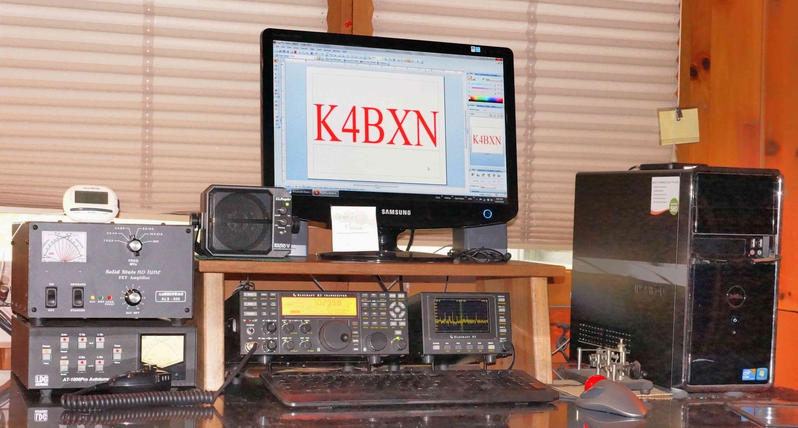
Perfect spacing and perfect sending – period. Music to my ears. And sending Morse like that with a bug is no mean feat. From my own experience, I know it’s so easy to develop a swing. Not that a swing is necessarily a bad thing – but it can be if you’re not careful. It takes a lot of practice and a lot of skill to be as good as K4BXN. But boy, is it a treat to listen to!
72 de Larry W2LJ
QRP – When you care to send the very least!

Oh my!
Listening on 20 Meters, right now, there’s a DX station calling CQ, and all I can say is “Wow!”. He’s way loud and should be at the bottom of a pile up. Why not? Because he’s sending way too fast with no spacing whatsoever. I was finally able to make out the call; but he was getting very few takers. Once he switched over to the memory keyer (which had some spacing in there, which made it legible), I can see that he’s not only getting more takers, but that he has also been spotted on the DX cluster.
You know, if you want to be a speed demon, that’s one thing. But spacing is so important. There’s no point in sending so fast that you send gibberish. Even if there are no actual errors, no one is going to want to work you if they can’t understand you.
So any time advantage that you feel you’re gaining is probably lost by either A) repeats or B) lost opportunities due to no one wanting to work a fist like that.
You know, I’m not not an expert, by any means. But I do know bad Morse when I hear it; and that was bad. A shame really, because it could mean the difference between a lot of contacts and just a few.
72 de Larry W2LJ
QRP – When you care to send the very least!

I need to follow my own advice
I went downstairs and flipped the K2 on and tuned around 40 Meters – WOW !!!!!!
After a long and full day of work, my brain is simply not ready to wrap around 40 WPM code. I worked HG3R who was cruising at about 35 WPM and called it a night. Tomorrow, after a good night’s sleep and after the opening hours pandemonium is over, I will be ready to jump into the fray. Also, during the daylight hours, stations will be spread out more as other bands open. Seems like right now, everyone is crammed into 40 and 80 Meters.
I’ve been at this Morse game for over 30 years now; and I really admire these guys who can while away at 40 – 50 WPM. I would love to be able to attain that kind of speed; but right now, it sounds more like a buzz saw than Morse Code. God bless them, you have to admire and respect that kind of ability.
72 de Larry W2LJ
QRP – When you care to send the very least!

My Morse Journey
As I’ve mentioned many, many times. My attempts at learning Morse code or CW as a teenager were unsuccessful. While I’ve mentioned my excuse was too many distractions (cars, sports, girls). I also believe my failure was a learning block which I couldn’t overcome. Perhaps another way to word this was a learning block I didn’t know how to overcome.
Since getting my license in 2007, CW has been a mode I’ve wanted to operate. I will admit that I’ve fiddled around in Ham Radio Deluxe DM780 and have also downloaded and installed other software applications to decode via the computers soundcard to text translation. I’ve decoded many times, but have never actually attempted to send via these mechanisms.
Please understand that what I’m going to say next is my opinion and only my opinion. But if I have to use computer software to send and receive CW signals, I might as well stay away from that mode. Again…this is my opinion for my own operational style and my own way of thinking.
So having said that, I am in the process of researching methods of learning Morse code. I’ve spent some time talking to some friends and researching information on the internet. I plan to wrap up this discovery phase and get started in the next few days.
While I know many learned CW from simply studying the dots and dashes which make up each letter or from listening to code tapes. I’m looking for alternative methods as I’ve tried the code tapes and studying an A is .- with not much success. Of course, I also understand I’m a much different person now than I was 30 years or so ago. Most of this will be similar to overcoming my obstacles with earning extra last summer. Meaning, I just need to focus and get it done but at the same time not setting unnecessary pressures on myself.
Morse code is very much alive on the bands and it is a mode I dearly want to enjoy. I’ll be certain to most frequent updates to share both my successes and frustrations along my Morse journey.
Until next time…
73 de KD0BIK













