Posts Tagged ‘Morse Code’
 Thank you Pietro and Bruna!
 February 27th, 2014 |
  Author: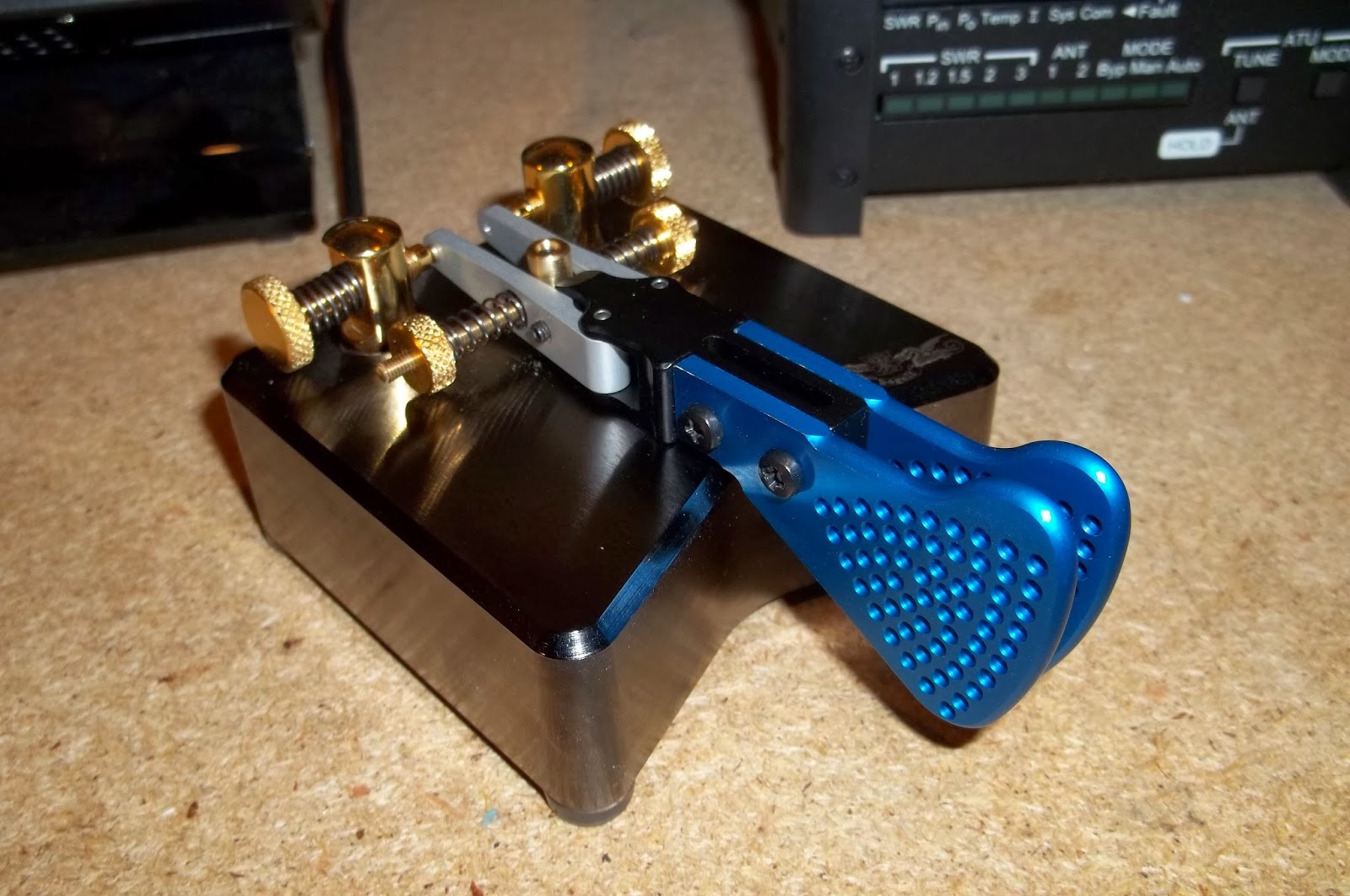
Thanks for the sexy, royal blue aluminum finger pieces! I removed the black plastic ones and put these on. Oh, and by the way, they also sent me a spare pair of black aluminum ones, too!
72 de Larry W2LJ
QRP – When you care to send the very least!
Location, location, location
I might not be in the best location for the QRP Fox hunts, but I do have to admit that I am blessed when it came to achieving QRP DXCC. Those of us in the Northeast definitely do not have the edge in Fox hunting that our fellow Hounds from the Midwest have. When you look at the Hound’s scores, the guys “who get ’em all” are usually, if not exclusively, from the middle of the US. But those of us in the Northeast, and on the East coast in general have the edge when working Europe and the Caribbean. I believe that Jim W4QO in Georgia posted that he worked over 100 different DXCC entities just this past weekend. That’s nothing to sneeze at and is a great accomplishment!
But if your a new QRPer you may be saying to yourself, “That’s all well and good, but I’m just starting out and I don’t have a tower and a beam or a fancy antenna farm.” I’m not saying that those wouldn’t be helpful, but you can achieve a lot with simple antennas. I posted yesterday that I worked about half a DXCC award this past weekend. I did it with a Butternut HF9V antenna and a home brewed 88′ Extended Double Zepp antenna. These antennas are surely within the reach of beginner QRPers (HOAs notwithstanding). With 5 Watts, I worked (in no particular order):
Estonia
Norway
France
Czech Republic
Belgium
Columbia
Italy
Slovenia
Bulgaria
Poland
Spain
Bahamas
Puerto Rico
The Ukraine
European Russia
The Azores
Mexico
Brazil
Chile
Morocco
The Turks & Caicos
The Cayman Islands
Alaska
Madeira Island
Portugal
US Virgin Islands
Sweden
Nicaragua
French Guiana
Lithiuania
Aruba
Curacao
Anguilla
Finland
Atigua & Barbuda
England
Scotland
The Balearic Islands
Germany
Jamaica
Belize
The Canary Islands
Bonaire
Belarus
Denmark
That’s 45 DXCC entities in just around four hours of operating. So I don’t want to hear about how QRP DXCC is hard or impossible. I’ve done it and believe me, if a ham and egger like me can work 100 different countries using 5 Watts, then you can do better! And when you come down to it, my performance this past weekend was really nothing to crow about. If you want to read a great story, then make sure to read Phil AK2MA’s recount of his ARRL DX Contest effort – 150 QSOs and 57 countries worked with an INDOOR Buddipole on just one band (15 Meters)! THAT my friends is an achievement!
There is a price to pay, however, and that is you’re going to have to work on your Morse Code. Life is not a dish of assorted fancy cashews. QRP DXing and CW go together like hand and glove. Some of these contest stations were sending so fast that it took me 7 or 8 listens to get their calls right. Normally I am comfortable copying up to 25-28 WPM; and on a good day, I can stretch that to 35 WPM if the code being sent well and the exchange is short (like a contest exchange). Some of these guys were sending around the 40 WPM stratosphere and I had to just pass them by. But with dedication and practice you can get to the “mere human neighborhood” of 25 WPM without going crazy.
And that’s part of what this is all about, too. Constantly improving your station, your antennas, and yourself!
72 de Larry W2LJ
QRP – When you care to send the very least!
2 Foxes in the bag
OK, so I couldn’t get into FT5ZM’s log … but I did snare both Foxes in the 40 Meter Fox hunt tonight. So I guess not all is lost. The fact is that both Paul K4FB and Kevin W9CF have fantastic ears, and I owe my call in their logs to that fact.
I used my new Begali Simplex Mono as my CW sending weapon of choice. It took a lot of trial and error over the last few days to get it set up the way I wanted. But now that I have it set up to my liking, I have to say that, “Yes, Begali keys ARE what they are cracked up to be.”
The key is silky smooth with a minimum of movement. It feels as close to using a touch paddle as you can get without actually using one. I can send at about 25 to 28 WPM effortlessly, even though I prefer my cruising altitude of about 23 WPM. The paddle’s sexy good looks don’t hurt, either. I would not hesitate recommending a Begali to anyone.
And to think, I bought the econo model. I can only imagine how the luxury version drives!
72 de Larry W2LJ
QRP – When you care to send the very least!
Vintage J-38 telegraph key.
Its finally arrived. My Lionel J-38 Morse key from the world war 2 era.
I found the key on Ebay at a fairly reasonable price but because the auction ended in the middle of the night I decided to set a stupidly high bidding amount so I cold hopefully win the auction.
In the end I really didn’t need to bother the price never increased at the end of the auction so I won the key for $61 and $42 for shipping. So not cheap, but the condition of the key really did warrant the price.
It had been stuck in customs for 3 weeks in the UK until I got the bill from UK Customs asking for yet more money due to a calculation error on the VAT oh and this letter will cost you £8. So another £20.41 was spent unlocking the key from the customs.
Anyway. Its here now. After a very long and quite awful day of work I decided to break out the Brasso and have a go at cleaning the key. I did learn 1 thing about stripping these things down, and that is to keep the left / right parts of the key separate. That proved really useful advice and everything went back exactly in the same place with no fuss.
These keys are lovely to use. Thus far I haven’t plugged it into a radio (that happens this weekend) but just getting the gap spacing, feel and tension right really makes this key a true pleasure to get your hands on.
The first portable outing with this key will be with my newly constructed FOXX3 transceiver. I’m really looking forward to sitting outside and using the key to talk to the world. Albeit slowly and quite quietly. But that’s some of the joy or going out portable.
I did make a small video of the before and after the cleaning processes, I think you will agree the key looks a lot better.
Pondering
I am pondering the possibility of acquiring a single lever paddle, possibly the Bengali Simplex Mono, with the palladium base.
I have always been more comfortable with single lever paddles, and have always used any iambic paddles that I have owned that way. I am not a squeeze keyer.
The Sculpture Mono would be great, but the price tag is too hefty for my wallet. Any of you readers have a recommendation for a good single lever paddle other than Begali? Maybe there’s a good one out there that I am not aware of?
72 de Larry W2LJ
QRP – When you care to send the very least!
Twitter & Morse
I love twitter. Some years ago I thought it was a load of rubbish, and had no purpose. But actually there is a fantastic community on the social media network, and more importantly a group of like minded Radio Hams are also on their sharing ideas, knowledge and experiences.
Take Dec 23rd for example. A simple thread was started about how we are progressing learning Morse and how we are attempting to up our speed. The conversation naturally came around to what’s best – paddle or straight key, and which particular keys do you own. For some crazy reason I mentioned I would complete a YouTube video of my keys, and share with the other participants of the conversation. Well I’m delighted to see that others have gotten on the band wagon and are sharing their keys and their experiences with them. Have a look at the following. I’ve ordered them in chronological order :
Foxx 3 TRX build
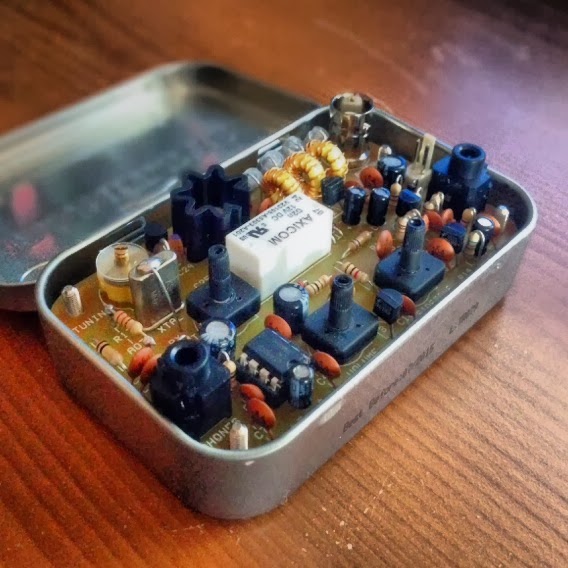 So it was my birthday recently and to celebrate the turning of another year and that I had indeed taken a day off – I decided to build a FOXX 3 QRP CW transceiver. These little kits are available from Kanga-products.co.uk and are designed to fit in a Altoids tin.
The kit comes pre bagged up in separate bags, and its just a case of soldering the correct component to the correct area on the circuit board. The kit itself is a 1 Watt QRP transceiver that can be bought on various bands. Mine was for the 20m band.
The board has a clear and easy to read Silkscreen and the pads are suitably wide enough to allow anyone with different levels of skill to create the kit. Each step allows you to test each part of the board, so you learn how each part of the kit relates to the transceiver as a whole.
I had a great time building it, it’s a simple, easy and great fun little kit. I hope to take it out and about – so hopefully you can hear my tiny signal on 20m soon.