Posts Tagged ‘kits’
 First contacts with the Warbler
 August 15th, 2010 |
  Author:
Olivia QSO with VE3FMC using a Warbler
Despite Summer not being the best time of year for 80m QSOs I have made a couple of contacts over the last two nights with the recently completed Warbler.
The first was a PSK31 contact with AE1Q who was about 285 miles away in Belgrade Lakes, Maine. The next was an Olivia 8/500 contact with VE3FMC in St Thomas, Ontario, about 325 miles away. Both QSOs proved to be tougher copy for the other stations as the Warbler puts out only about 2 Watts. However, they were successful QSOs and as can be seen by the picture above the Warbler receives well.
AE1Q gave me an IMD report which was -24 dB which is reasonable given the simplicity of the rig, but I would like it to be below -30dB.
I was fortunate and pleased that the second contact was using Olivia. This is a nice mode for QRP. For those wanting to try Olivia I recommend you read the information on the Olivia website by Gary, WB8ROL, including his QST article. Gary writes great articles (including one in the recent amateur radio edition of Linux Journal) and I have enjoyed a few Olivia QSOs with him.
Finally, if you do want to try Olivia or any multifrequency keying mode with the Warbler, you must remember that you are operating on LSB with the Warbler. Most digimode operators will be using USB so the frequencies will be reversed. The digimode software, Fldigi, offers a simple solution to this, you must select the “Rv” or ‘reverse’ button (see the lower right of the Fldigi window above, which is selected and green). You do not need to worry about this button if you just use PSK31 as it is symmetrical about a centre frequency.


Warbler now finished and working
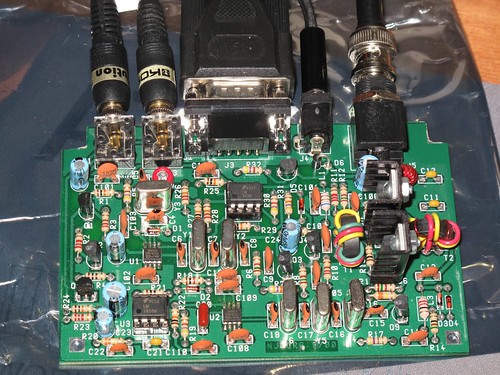
Warbler smoke test
I finally finished my Small Wonder Labs Warbler kit last night. This was started probably two years ago and then was shelved for no particular reason other than I was working on other projects. Last week I decided it was time to get it finished and so have been working on it in the evenings. It is a nice kit with a clever design based around colour burst crystals and the receiver is direct conversion. It was straight forward to build but note there are two SOIC components, the SA612 mixers (look for U1 and U2 in the photo above).
When it came to the smoke test it worked first time. I adjusted the one tuning capacitor (the only adjustment), for frequency alignment and checked power out. Alignment was done as recommended with W1AW which was coming in well (see the screenshot below). On transmit, I get 2W out on my Radio Shack power meter. It is expected that you can get 3 to 4W out of the Warbler. Given the accuracy of the meter I happy with what I measured.

Warbler working and decoding W1AW. Software is Fldigi running on Xubuntu
I have an aluminium enclosure, which is a tight fit for the board, so there is some careful drilling and filing to come. You can see in the photograph I have already cut out the corners to accommodate for the enclosure screw mounts.
Given the simplicity of the transceiver I am very pleased at how well it works. No contacts yet, so will have to see what the IMD is later. Anyone within 100 miles or so of Ottawa want to try a QSO?


Foxhunt gear – offset attenuators
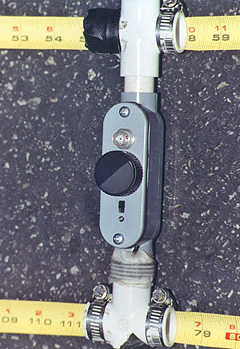
I attended a great fox hunting presentation at Dayton this year, hence a few posts on the topic.
I had some posts in the past about tape measure beam antennas. Really neat antennas and they have multiple purpose use (they are GREAT for hitting distant repeaters when you orient them vertically!). Much like the picture on the right (courtesy of Joe Moell K0OV) they are more useful for fox hunting when you add the active attenuator to your setup. FYI, Joe is the co-author of the great book “TRANSMITTER HUNTING, Radio Direction Finding Simplified” available where most ham books are sold. His website has more information on the book at http://www.homingin.com/THRDFSinfo.html and he contributes to CQ and CQ VHF.
So….. just what is an offset attenuator? Joe explains it on his “Homing in” site as:
An RF attenuator is a device that goes between antenna and receiver to reduce the signal strength down to within the range that the receiver S-meter can handle. Without one, you may think you’re close to the fox when you’re still far away. You won’t be able to get close enough to a camouflaged hidden T to identify it. The amount of attenuation should be adjustable so that you can add just a little when your S-meter first pins, up to a lot as you get within a few feet. Special ARDF receivers used by champion foxhunters have electronic attenuation built in, but ordinary handi-talkies don’t. Adding it would require major micro-surgery in the HT.
His attenuator page is:
http://www.homingin.com/joek0ov/offatten.html
I recommend his site in general, many great projects:
On his attenuator page, he has full schematics to make an offset attenuator.
But wait…… there’s more!
Further on his page, you see one made in a sweet Pomona box.  I like this box and thought it was a bit pricey at first, until I did the math and figured out the cost/time to do it myself. These boxes are shielded with the connector of your choosing (BNC/SMA/259, etc).
They generally cost around $25 or so and are shielded! Great to have. When you add the cost of connectors and such, it isn’t really so expensive after all.
I really advise using such a case or a metal case in general, makes things work out much smoother in the end. More information on this box at: http://www.pomonaelectronics.com/index.php?i=prodsub&parent=BOX&cat=BONCONN&getDetails=
But wait….. there’s even more!
 Marvin Johnston KE6HTS is now offering a “semi-kit” for this attenuator on his website. I’ve seen this kit when I was at Dayton this year and encouraged a friend to pick it up and build. I may end up running a buildathon here in CT on these attenuators.
The price is really not bad at $22.00. You can purchase them built for a few dollars more.
Information on the kits and pre-built models are at:
http://www.west.net/~marvin/k0ov.htm
And yep……. there’s even more (again!).
If you would like to “roll your own” from parts you may have on your bench, but don’t want to make a circuit board, you can get one from……. you guessed it…… Far circuits. I picked one up and am going this route myself.
There are a few boards/projects on the Far circuits website at:
There are a ton of great resources out there on the web, these will really get you going right from the start. Fox hunting is a really fun and useful part of our hobby and one that doesn’t cost a ton of money to get started in. If there are no active fox hunts in your area – start ‘em! There are plenty of options as far as transmitters and such and really doesn’t cost a club much money to get started.













