Posts Tagged ‘K3’
 Cross Country Wireless SDR update
 October 22nd, 2010 |
  Author:
 Cross Country Wireless has just announced an updated version 2 of its low cost SDR Receiver. The new version has an RF preamplifier using a power MOSFET after the RF bandpass filter which is claimed to improve sensitivity – which was a criticism of the earlier version – and reduce local oscillator output at the antenna port.
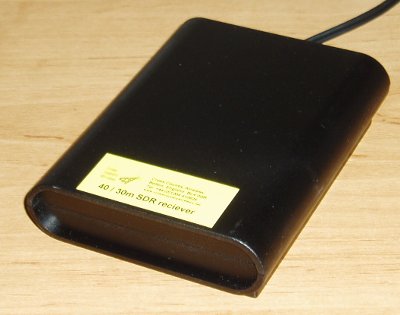 The designer Chris, G4HYG, claims that the receiver will now display a CW carrier at a level of -135 dBm on the waterfall of SDR-Radio using a 48 kHz sound card. The level of the local oscillator at the antenna port is now specified as -65 dBm, though a more typical measurement is -70 dBm. This should make it an ideal choice as a panadapter for radios such as the Elecraft K3. In fact, Chris recently stated that most orders for the receiver have been for use as panadapters, in conjunction with a sound card and suitable software such as PowerSDR-IF.
The cost of the standard SDR is £49.95. For panadapter use you will need a custom crystal for your radio’s IF which increases the price to £59.95. The SDR has two (switched) local oscillators so the other one could be specified to cover 40m or 30m for use as a conventional receiver. It’s also available as a built and tested board for assembly into your own case (at a significant saving.) If you built a USB sound device into the same box then it would be rather neat.

K3 Killer imminent?
Kenwood Corporation recently announced the October launch of the long-awaited TS-590 HF/6m transceiver. Described in some quarters as a “K3 killer”, the new transceiver uses the novel (for modern Japanese radios) approach of a single conversion receiver with a low (11.374MHz) IF on the amateur bands to give what is claimed to be exceptional dynamic range.
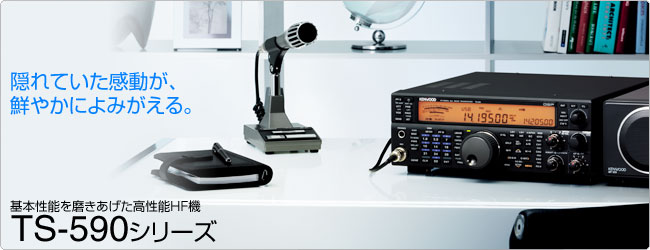
The news release bears careful reading, as what it doesn’t say is as interesting as what it does. The receiver will have a 6KHz roofing filter directly after the mixer, followed by a 500Hz or 2.7KHz filter (both included as standard) after the post-amplifier. But a footnote states that “For 1.8/3.5/7/14/21MHz amateur bands, when receiving in CW/FSK/SSB modes down conversion is selected automatically if the final passband is 2.7kHz or less” which suggests that a conventional (for the Japanese) up conversion will be used for the short wave bands, AM or FM modes, the WARC bands, 10 and 6m.
I think the current obsession with receiver performance figures is absurd. I am far from being a member of the Elecraft fan club, but even assuming the TS-590 does turn out to outperform the K3 on the main amateur bands, I think anyone considering swapping their K3 for the Kenwood on that basis would be foolish.
As far as I know, the Kenwood will not have an option for a second receiver, nor one for a panadapter. It will not have the transverter and external preamp interfacing (which I use to insert the MFJ noise canceller) nor an independent receive antenna input. I doubt that it will have fully isolated audio inputs for data nor a soft ALC in digital modes that allows you to vary the power output in PSK31 without fiddling with computer mixer settings to avoid IMD problems. I’m sure it won’t have an internal 144MHz option either.
Whenever I look at the features of the K3 that I am currently using, I realize that there is nothing else on the market at a price I am willing to pay, nor which would fit on my operating desk, that could do what my K3 is doing.
The price of the TS-590 will be 228,900 Yen, or about £2,000 by the time you have added on VAT (never mind the usual exorbitant UK dealer mark-up.) If it goes on sale here at £2,499 I will not be surprised. Compared to currently available HF radios and Kenwood’s previous HF models including the TS-570 to which this new rig bears a considerable similarity, the TS-590 looks overpriced for what in the end is nothing more than a compact HF/6m radio.
A K3 killer? I don’t think so!

It’s all down to your ears
There was a lot of excitement on the Elecraft email reflector over the fact that the majority of participants in the World Radio Team Championship 2010 (WRTC 2010) were using Elecraft K3s. There was even more glee when it was discovered that Scott Robbins W4PA, former Ten-Tec product manager, and Tim Duffy K3LR of Team Icom had taken K3s. This was like the President of Coca Cola serving Pepsi at his anniversary party!
 There have not been many comments now the results are out, which show that the top two teams, from Russia and Estonia respectively, were using FT-1000MPs. The USA team of N6MJ and KL9A in third place used K3s, as did K5ZD and W2SC who came fifth, but the fourth placed S50A and S57AW again used FT-1000MPs as did the Lithuanian entry in seventh place.
So let’s get this straight: the winning stations and several others in the top ten used a now obsolete radio that was introduced in 1996 which has frequently been criticized as inferior to the K3? I suspect the fact that many international competitors took K3s may have more to do with the fact that the Elecraft radio is small enough and light enough to be taken on an aircraft as hand baggage. And I suspect that the reason for the success of the stations using FT-1000MPs is that there is more to winning a contest than having a receiver with the best performance numbers.
Anyone want to swap an Elecraft K3 for an FT-1000MP? (Only joking.)

Back to front
 Last night for the first time in a very long time I operated RTTY. I made ten contacts in the BARTG RTTY 75 contest. The reason was that Elecraft had released a beta version of firmware for the K3 that enhances the built-in DSP modems to support the 75baud RTTY mode that was being used in the contest. Now that the K3 also supports a way to get decoded text into a computer program I thought it would be fun to give it a try.
For those unfamiliar with the K3, the transceiver boasts a built-in Morse decoder plus DSP based modems (encoders and decoders) for PSK31, standard 45.5baud RTTY and now 75baud RTTY. As the K3 doesn’t allow direct input from a keyboard, the usual way to use this facility is to send text using a Morse paddle and read received text on a scrolling 7-character window of the K3 display. However, using a program like KComm it is possible to send and receive text using software commands over the CAT interface as well. Since, like most things that require good motor skills, I’m hopeless with a paddle (or key) at anything much above 12wpm, that’s what I did.
I installed the new firmware and it decoded 75baud RTTY signals perfectly, so I waited for the contest to begin. After it did, I soon found that although people were hearing me they weren’t decoding me. I got lots of QRZ?, ??????? and SRI NO PRINT. I started to get frustrated and began thinking that RTTY is an obsolete mode that has no place in the 21st century because I know I could have made contact with these stations easily using PSK31 and a fraction of the power.
I decided to switch to soundcard mode and use Fldigi to try to make some contest contacts, and then found that people were replying to me on the first call! So clearly there was something wrong with the RTTY being generated by my K3.
This morning I tried receiving some of my transmitted RTTY using the FT-817 and Fldigi on my NC-10 netbook. When the RTTY was generated by Fldigi it was received perfectly. However when it was generated by the K3 I received gibberish unless I switched the K3 to REV DATA mode (i.e. reverse sideband.) Since I was receiving the RTTY perfectly OK using the normal sideband I presume that the K3’s transmitted RTTY was reversed. I have reported it to Wayne and await comments.
Unfortunately I did have some problems with KComm as well. After a while, it started aborting the transmission of any macro after the first few diddles. Like many programs, it has grown to the point where it is hard to understand what is going on any more and my interest in programming has fallen off a cliff in the last few months. I don’t know if I will ever get around to fixing the problems and releasing the final version. I do like using it, and KComm is the only program that really supports the K2 and K3 properly because it doesn’t treat them like a Kenwood TS2000 (whose command set it nominally shares) but was written to take account of the way these radios actually work.

KREF3 let-down
I often use WSPR, the very narrow band, low power, automatically reported beacon mode, which operates in a 200Hz wide band and reports the frequencies of received stations to 1Hz accuracy. I also sometimes use other digital modes where I want to be able to set my transceiver to a specific frequency with confidence. So one Elecraft K3 add-on that I had been eagerly awaiting was the KREF3 board that was supposed to allow you to lock the K3 reference oscillator to an external frequency standard. In fact, readers of this blog may recall that only a couple of weeks ago I posted an item about rubidium frequency standards being sold on eBay.
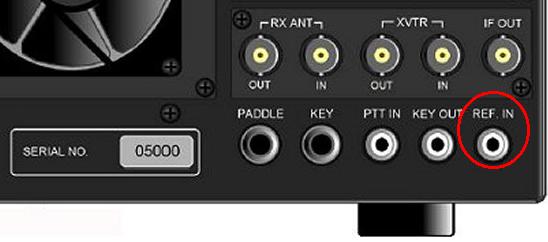 A few days ago Trevor G0KTN, who is actually the person responsible for turning me on to WSPR in the first place, posted a question to the Elecraft reflector asking for a comment from Elecraft as to when the KREF3 might be available. When no answer was received he asked again, and eventually received this reply from Eric WA6HHQ: The KREF3 is not in current planned development. I thought we had removed the references to it in all of our docs. Is it still showing up somewhere?
It is still showing up in the copies of the manuals I have. There is still a labelled, blanked-off hole for it on the back of my radio. More importantly, it showed up in the specification and brochure that Elecraft produced at the time I ordered the radio.
In the past I have been flamed quite harshly by members of the Elecraft fan club for suggesting that Elecraft had broken promises or even acted dishonestly by failing to provide advertised features. But is it being honest, when deciding not to provide a feature that was initially advertised and promised, to quietly delete all references to it and hope no-one notices? Perhaps Elecraft figured that since most hams are in their 60s or later we all have Alzheimer’s and will have forgotten the KREF3 was ever offered.

Another K3 panadapter option?
Cross Country Wireless recently introduced a new product, a built, boxed and ready to use SDR receiver that is optimized to work with the bog standard sound card provided with every computer. It covers two 48kHz segments which may be on one or two bands using a switched local oscillator. At £49.95 it looks like something of a bargain.
I was looking at the product’s web page this evening and the thought occurred to me that this might make a rather good inexpensive option for a panadapter for the Elecraft K3. It would need a different crystal to cover the K3 IF output frequency which is 8.215MHz, but that shouldn’t be a problem. CCW might even offer this as a stock option if there was a demand for it.
As the receiver covers 40m and 30m everything else should work OK unmodified. The key point would be whether there is adequate isolation to prevent the local oscillator leaking into the K3 IF and desensitizing the receiver – the reason why most people use a buffer amplifier when using SoftRock boards for this purpose.
I don’t have a great urge to have a panadapter display and I already have three sound cards (well, one and two USB sound modules) in use with my shack computer so this isn’t something I’m planning on trying. But I thought it might be worth mentioning the possibility for other K3 users. Even if the idea is a non-runner, the Cross Country Wireless receiver still looks like a very nice product.

What frequency standard?
I think the frequency readout of my IC-910H is out by about 400Hz and unfortunately I can’t receive any accurately calibrated beacons like GB3VHF to set it with. I also like to check my K3’s calibration from time to time and would like to take advantage of the option to lock it to a 10MHz frequency standard should Elecraft ever provide it as originally promised. So I decided to have a look on eBay for frequency standards.
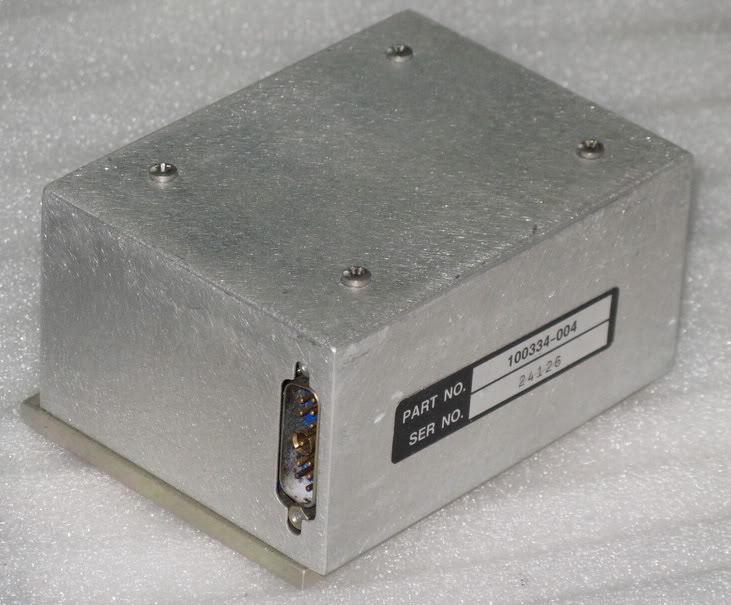 There seem to be a number of ex-equipment 10MHz rubidium frequency standards at prices starting from around £50 – which is about the right level for me – available from China. For a bit more you can have a GPS locked time and frequency standard, though where time is concerned the NTP software is good enough for me. There is also a smart looking Quartzlock off-air frequency standard, though that is a bit outside my price bracket for this and would take up a bit too much space for the G4ILO shack.
I don’t know anything about this equipment and aren’t sure if any of these things would be any use to me. The rubidium frequency standard pictured has a frequency adjustment setting which surely defeats the object. If you need to calibrate it against something else then that’s no use to me. I want something of known accuracy to calibrate my radios against. Perhaps the GPS type would be more useful?
Does anyone know about these things?














