Posts Tagged ‘field day’
 Field Day on Holiday
 July 5th, 2012 |
  Author: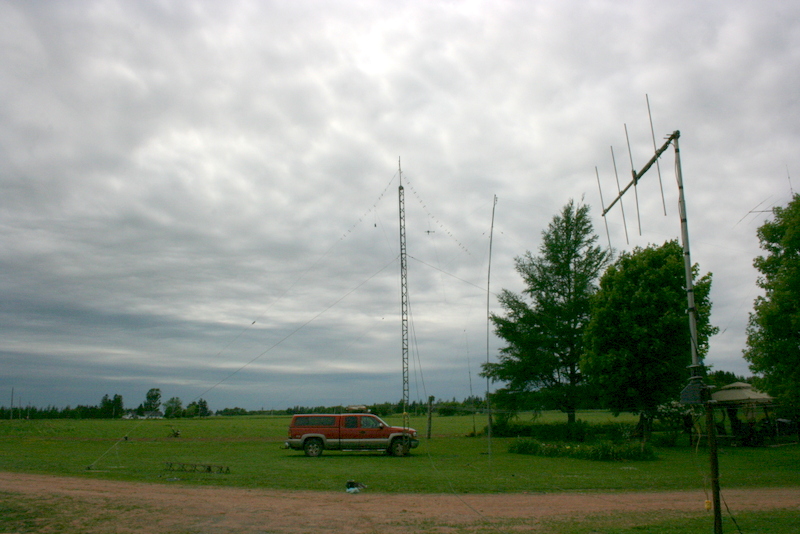
Field Day 2012 with VY2CRS
As I mentioned in a previous post, I’ve been on vacation in Prince Edward Island Canada.
This year, our vacation coincided with my favorite annual event, Field Day.
Sadly, I missed an opportunity to experience Field Day QRP-style with the NC-based QRP club, the Knightlites, on the Blue Ridge Parkway, along with my buddy, Vlado (N3CZ).
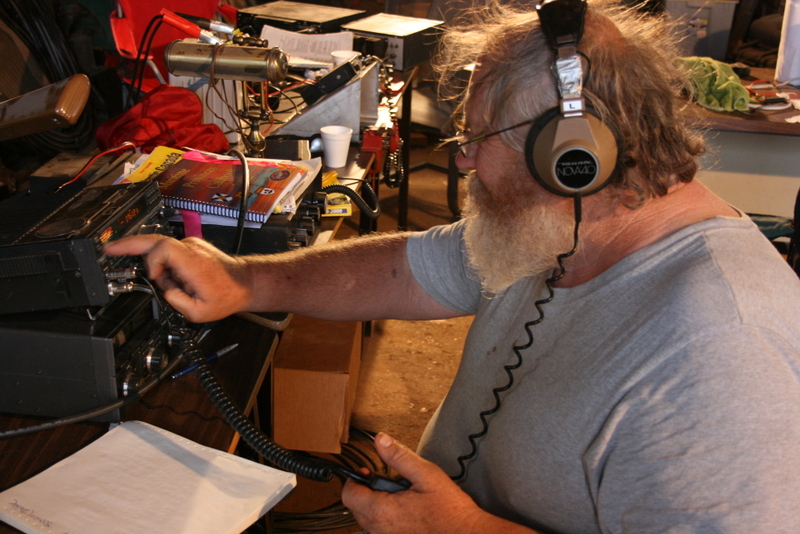
Ron Morris, VY2RM, working 20 meters
Before I left my trip up north, I contacted the Charlottetown, PEI, Amateur Radio Club (VY2CRS) and was glad to learn that they had planned a Field Day event on the farm of their club President, Andy Speelman (VA2AS). Better yet, the location was just forty minutes from the cabin where we were staying on PEI.
Perhaps one of the benefits we enjoy as amateur radio operators is that we’re all part of one enormous event, an all-inclusive fraternity of like-minded individuals. When I arrived on site at the Charlottetown Field Day location, I was greeted as if I was expected. The large sign at the end of Andy’s driveway was a great advertisement for the FD location.
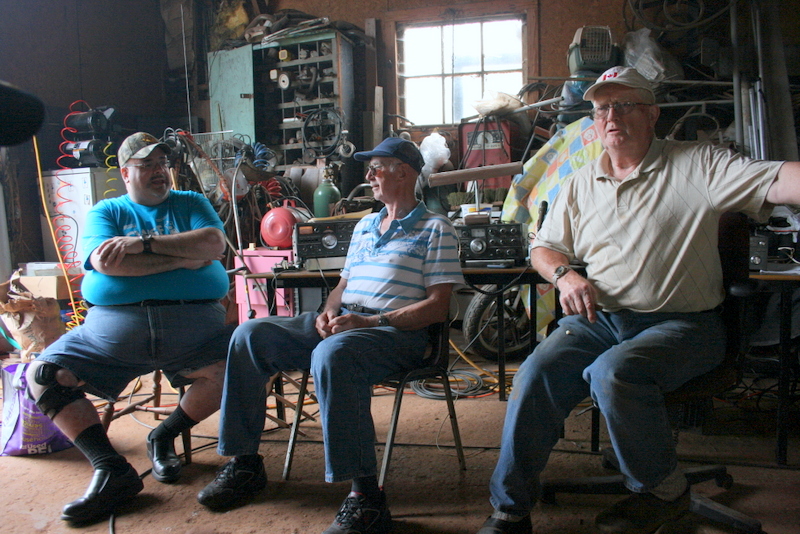
(Left to Right) Chris Vessey VY2CRV, Richard Burke VY2RB and Andy Speelman VY2AS
They instantly put me to work…eating a hamburger. After all, you can’t work a radio rig without a little something in your fuel tank, right?
“Islander” hospitality is legendary, and frankly, reminds me of the way it was when I was growing up in rural North Carolina where “no one’s a stranger,” and you’re free to accept invitations (and meals) without hesitation. This local club went a step further, and from the moment I arrived, included me in their jokes, making sure to laugh not just at but with me. I felt utterly at home.
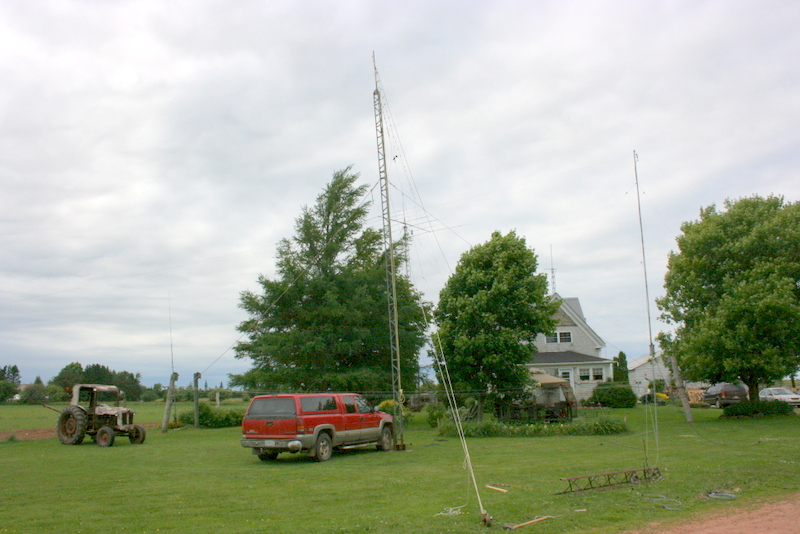 The club had a wide array of antennas up by the time I arrived. All of them had been constructed just prior to the beginning of the contest, and all were field-deployable. Andy’s farm is a wide-open space and with no limitations to big antlers, thus they even fit a 160M “V” doublet out in front of the barn where we operated.
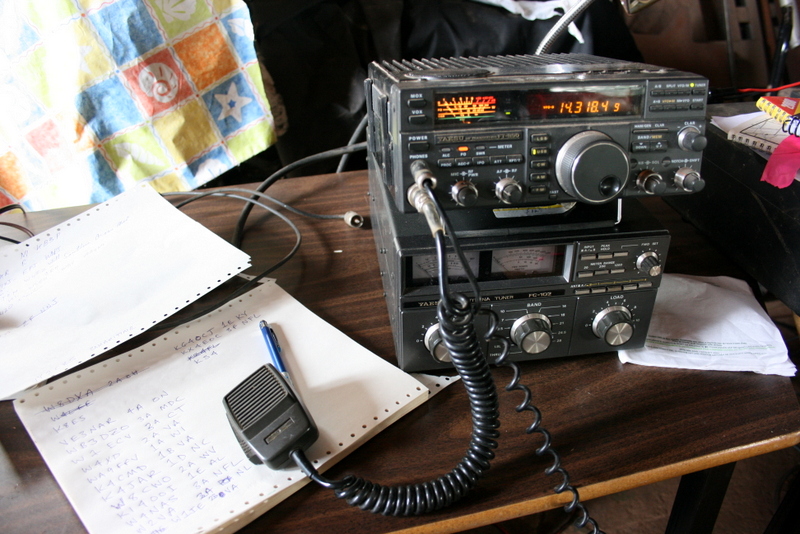
My view as I worked station after station on 20 meters
Though I had only a few hours to play radio before heading back to my family at the cabin, they put me on the 20M almost immediately. In perhaps an hour, I chalked up 100+ contacts on that band. The guys got a kick out of hearing me call “CQ Field Day, CQ Field Day, this is VY2CSR” and then offering up our “3 Alpha Maritime” in my North Carolina accent.

Though not great for identifying dupes, paper logs will work even if the power goes out
It was also fun to get a quick word in with those NC stations I worked from the island, many of whom were set up only a few miles from my home QTH.
I made sure I saved plenty of time for chatting with the club members, too. After all, this Field Day event– like many others I’ve attended–was more about comraderie and fun rather than about raking in the scores and multipliers (not that taking it to a contest level is objectionable, of course).
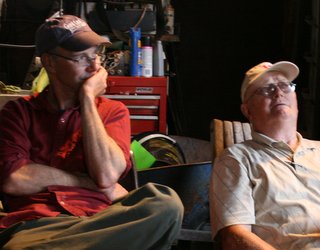
Darin Gay VY2GAY (left) and Andy Speelman VY2AS (right)
Fellows in Charlottetown: if you’re reading this post, I surely thank you for including me in FD 2012, Charlottetown-style.
Readers, if you happen to be on vacation during Field Day, search for a local event. There’s sure to be one and you’ll most likely make some new friends and create some notable radio memories.
Why We Like Field Day
This past weekend I spent Field Day with two long time friends. It wasn’t the biggest, best, most-attended, highest-scoring Field Day I’ve participated in, but it was good to do this annual ritual. I’ve always loved Field Day, and it’s perhaps my favorite event. I think my initial attraction to it was combining camping and the outdoors with my love of radio. Today I see it more as something that brings everyone in our diverse hobby together. Field Day captures nearly all of the components or

facets of our hobby into one event: casual operating, contesting, learning, construction, emergency operations, construction, socializing, and of course, eating good food. No matter what each of us does in amateur radio or what modes we like, there is a place for everyone at Field Day.
Setting up for Field Day is stressful, no doubt about it. For those of us involved in organizing these events at one time or another, you question whether it’s worth it. Then there’s the weather, often rainy, sweltering, or a combination of both. There’s never enough time to setup and you never seem to have enough hands to help out. But when everything gets underway, it’s all worth it.
 Field Day recharges me for another year of operating. Now that I’m back in the home QTH and off today, I’m thinking about the next Field Day… what can we do better and easier, and make more fun.

Field Day and sleep?
Field Day 2012 for W2LJ was not to be, so far.
I went down and helped my sister clean out my Mom’s apartment as scheduled. That was planned and was no big deal – in fact, I enjoyed spending some “alone time” with my big sister. As we both have our own families now, that just doesn’t happen often enough.
The plan to go down to the Sarnoff Radio Club Field Day site got “kiboshed”, however. Actually, my sister drove me past the site at around 11:00 AM as we were driving to Princeton to donate some paperback books. I didn’t see anyone setting up at that point and had planned to stop by later, on my way home.
Of course, shortly thereafter, while packing items in the apartment, my cell phone went off – work. They were looking for a Cisco 9513 switch and line cards for an emergency switch replacement and “could I stick around close, on standby” just in case they needed me to come in and help them locate components?
So after our cleaning session ended, I hurried home just to be available, if needed. Luckily, I wasn’t needed; but it did put a damper on my plans.
But in the evening, during my weekly Echolink session with my good friend Bob W3BBO, he mentioned his visits to some Field Day sites today and that he might visit a few more tomorrow. Then it hit me! Tomorrow! Maybe tomorrow, when I am back down there, I can hit the Sarnoff site for a half hour or so. And that is assuming they’re still set up. I know Field Day runs until 2:00 PM; but I know some clubs like to call it quits early.
So for a bit, I lived Field Day vicariously through Matt W1MST’s AmateurRadio.com, where he’s running some UStream of a couple of Field Day sites. I was watching KC2RA for a couple of minutes when one of the guys mentioned setting up his tent so that he could sleep tonight.
Sleep on Field Day? What is that, he asked, smiling knowingly?
When I was an officer with the Piscataway club (and was still single, BTW), I did my best to be there for set up, the whole event, and a good part of tear down. I remember quite a few years where sleep on Field Day was nothing more than a few minutes of cat napping in Rich W2PQ’s pop up camber or Bill W2WK’s trailer. C’mon, man! We’re there to operate, not sleep! Who can hit the sack when there’s CW contacts to be made on 80 and 40!
Of course, the end result was being rather bleary eyed and dysfunctional for work come Monday morning. The other side effect was hearing Morse Code in your head for about 3 – 5 days later until that faded away. But those were fun days and I wouldn’t trade those experiences for all the tea in China! (Ooops! Am I still allowed to say that; or is that something the PC police are going to shut me down for?)
Hope you all are having a wonderful Field Day!
72 de Larry W2LJ
QRP – When you care to send the very least!

Cool Field Day Visit
 A few days ago I received this announcement from the ARRL Eastern PA Section Manager, Bob Famiglio, K3RF:
“As EPA Section Manager, I have received a number of invitations to visit the field day sites of ARRL affiliated clubs. As an ARES District Emergency Coordinator for many years, I enjoyed visiting field day sites in my five county district from time to time. The challenge now, however, is how do I visit sites throughout the EPA section during the actual operations? I would have to sprout wings. But wait, maybe I can.
As some of you know I hold an FAA private pilot certificate. I am
fortunate to be acquainted with another ham pilot, Jim Goldman, W3JG.
Jim is not only an experienced pilot, but also owns his own late-model
Cessna 182 aircraft. What’s more, Jim’s aircraft was professionally
fitted with an extra antenna for 2 m and 70 cm. Having had the pleasure
of flying with Jim in the past, I suggested that we plan a field day
trip as a salute to as many ARRL club sites as we could comfortably
visit from the air. Jim likes the idea so we are on. Naturally,
weather, flight restrictions and safety considerations may limit what
we can do in certain instances. However, our tentative plan is to fly
over as many field day sites as practical, perhaps dip a wing in salute
and provide a contact as aeronautical mobile as well.”
Jim goes on to talk about frequencies, logistics, and how to request a fly-by visit. I think this is a wonderful idea. It’s great to see such creative thinking in amateur radio and ARRL leadership.

Personal Growth
Each year I post an article with tips for Field Day organizers, but admittedly most folks who volunteer to lead such events already know how to organize a good Field Day event. Something I see year after year but is rarely talked about is personal growth from these events. What does personal growth have to do with Field Day, you ask? By personal growth, I mean learning new things, becoming more technically proficient, and become an overall more skilled operator. You see some folks who come one year who are nervous about getting on the mic, they observe others operate, and during a slow period they may get coaxed into operating awhile. They get the hang of it after an hour or two and do fairly well. Next year when they come back to Field Day, they readily volunteer to operate and can belt out 60 or 70 QSOs an hour, with someone logging alongside. The next year they can operate and log all by themselves. Perhaps later they will branch out and do digital modes or CW. There’s a learning process going on, and it extends outside of Field Day where skills and techniques learned are applied to everyday operating or perhaps casual contest operating. Ultimately these people become a key part of the Field Day organizing process, readily becoming a resource and providing expertise to others.
Unfortunately there tends to be an element at annual Field Days who don’t grasp this concept. They don’t listen during the demonstrations of the logging program during the preparation meetings or at the final pep talk before Field Day operating kicks off. They don’t want to know how the rigs work, they will depend each year on someone setting up the band, mode, and tuner before they operate. Some may drive into the site several hours into the event, hop in an operating position in prime time hours, eat some food, and leave. Now I’m not saying it’s wrong to be a casual operator, but if you’ve been at your local club’s Field Day for the past decade, you owe it to yourself and those who are putting a lot of effort into the event to help out, learn, grow, and contribute.
Get to know the logging program. Most clubs these days tend to use free logging programs. You can download them from the Internet, install them, and get to know how they work. Undoubtedly you’ll be able to use the Field Day logging program in your own shack.
Learn about antennas. There’s a reason why Miracle Whip or Buddipole antennas, while very portable, easy to setup, and convenient, are horribly lousy antennas for Field Day. Yes, everyone does believe you worked Europe with one, which by the way, was on 10 meters when it opened up one day ten years ago.
Watch others making QSOs. Some guys can’t make a QSO to save their life, and others can stack up QSOs like cordwood. Band conditions certainly help, but you’ll notice some ops just take the mic and do short CQs, they skillfully adjust their verbaige in order to make the best use of frequency time, they manage pileups well, and they use proper phonetics and at the right times. They amass QSOs effortlessly. Other operators just can’t seem to get it together. They do long 40 second CQs in which they say CQ numerous times, but say the callsign only once or twice. They’ll wait a long time in between CQs. When someone does answer they’ll waste time giving their own callsign, perhaps multiple times. If they don’t copy the station on their first call, they’ll spend 30 seconds telling the station how weak they are, wasting precious time that could be used for the station to try again. While no one is asking people to have the communications efficiency of an air traffic controller, you can have a lot more fun with less effort by adopting a few simple techniques.
Learn about the equipment. Field Day is a great opportunity to see new rigs in operation you’re not familiar with. Ask the owner of the equipment to show you how the menus work and find out what they like and don’t like about the rigs.
Bring a pair of headphones, a “Y” adapter, a notepad and pen, and ride shotgun on the CW station. CW contesting is probably one of the most intimidating things in amateur radio, if you’ve never experienced it. Sit alongside someone running CW on Field Day and just listen and try to copy callsigns. After you attempt to copy a callsign, look up at the logging program screen and see what call the lead operator copied. You will be amazed at what you can pick out and how you eventually get the “rhythm”. Before you know it, you’ll want to hop on the keyboard and give it a try. It’s addictive.
Network and help out. While most clubs welcome people to come for a short period of time and operate, if you’re a regular annual attendee, you owe it to your club to stick around longer and talk with folks, get to know new members, and help with the clean up. If you’re a seasoned amateur, you owe it to the hobby to help others become seasoned operators.


An unscheduled interruption

OVMRC and CUARC Field Day Site 2011, the Canada Science and Technology Museum
My last post was way back in June, when I was on business in St John’s Newfoundland. I had not planned for there to be an interruption in the postings but it just seemed to turn out that way. No single reason for the lack of output, things were busy with family, jobs around the home, work (I have taken on a new role) and radio with the Carleton University Amateur Radio Club (CUARC). Once I had stopped posting for a while it was too easy to not post. There may have been some writer’s block too. One reader advised me to write again when I was feeling the mood return, but emphasized not to change the format. So now it is time to pick up the blogging again.
I may post more on these items, but here is a brief run down of recent amateur radio and electronics related activities over the hiatus.
- End of June there was Field Day and again CUARC participated with the Ottawa Valley Mobile Radio Club after being kindly invited to join them (see photo above). We operated mostly as a GOTA station (I was a GOTA captain and rules were followed) but when one transmitter turned in for the night we became the 80m station. We used a homebrew full wave 80m horizontal loop and a homebrew ¼ wave vertical with three elevated radials for 15m. Both antennas performed well.
- Somewhere in the recent past this blog went over 100,000 views. Top post in recent months has been details on the Z-Match tuner. Thanks to all of you for reading the blog!
- CUARC is constructing a 30m QRSS receiver and the oscillator, mixer, diplexer stages have been built and constructed individually. A low noise audio stage is to be built next.
- At work I have been building small SMD microcontroller boards with on board RF capabilities. The boards which we modified from some open hardware have been reduced down to about 4.5cm by 2 cm. My SMD soldering has been getting better, especially using a professional rework station.
- I have been programming the new ID-880H dualbander that I bought in Spring.
- The Saturday morning Ottawa Amateur Radio Digital Group D-STAR net continues every Saturday at 8:30am local time here in Ottawa (8:30EST or EDT) and we link through to reflector REF016B. Either Andrew, M0GRU, or myself run the net. Join us if you can.
Next post will be the pictures form a foggy Signal Hill that I promised in the previous post.


Dual band rectangular loop antenna for 15m and 10m

The loop and the off-centre fed dipole at Field Day
This is the second article describing the two antennas that were used by the Carleton University Amateur Radio Club (CUARC) at Field Day 2010. The first post described an off-centre fed dipole with a 200 ohm feedpoint impedance. This post describes the second antenna a loop antenna that worked on two bands, 15m and 10m.
I like loop antennas. I have built large loops for amateur bands, as well as small loops for receiving (which are quite different to their bigger cousins) and have found both types perform well. They are less sensitive to local noise, so often giving good signal to noise ratios. As CUARC was to operate on 10m and 15m at the Field Day site I was considering a loop for one of these bands, however, which one? 10m could be fun if there was an opening, plus the antenna would be smaller than 15m. However, 15m would be more likely to be open. In searching the internet I came across a potential solution as KT4QW’s website who describes a 17m and 10m hanging loop antenna. The idea was simple and elegant, two vertical and rectangular loops fed from the same point, similar as to how multi-band dipoles can be fed from the same feedpoint (sometimes called a fan dipole).
I went about calculating the basic design. A full-wave loop’s total perimeter length is calculated by:
Length (in feet) = 1005 / f,
where f is the intended frequency of operation in MHz.
So for 21.3 MHz that would be a total loop length of 47.2ft and for 28.5MHz it would be 35.3ft.
To attain a 50Ω feedpoint the loop needs to be rectangular, with the longer length vertical. Studying J. Carr’s Loop Antenna Handbook and KT4QW’s dimensions the sides were close to being 1/3 of the total loop length for a vertical side and 1/6 for the horizontal side. So this then gave a design as shown below.

Dual band loop antenna for 15m and 10m.
To support the wire I bought two 10ft lengths of PVC piping. The inner support for the upper part of the 10m antenna was some thin wood. Both the wood and PVC were drilled with holes prior to Field Day. The wire was cut from a single 100ft roll and the whole antenna was built by CUARC members at the Field Day site on the day. At the feed point a 1:1 balun was used, an Elecraft BL2. The intention was to suspend the antenna from a single central point so the loop(s) could be rotated, using a line tied to one lower corner. However, we could not get enough height and clearance from tree branches, so we mounted it between two trees and it keep it static with the signal projecting in South-West and North-East directions.

The loops being connected to the balun by Gerry, VA3GLT (left) and Maria, VA3MMI, (right). (Photograph and copyright of Chris Weisner, VA3SM)
After construction the SWR was measured and found to be nicely below 2:1 for both bands (at least the lower part of 10m which is quite a wide band). As mentioned in the earlier post Maria, VA3MMI, brought a portable analyzer to the site on Sunday morning and the trace of the SWR profile is shown below. You can see the antenna has two nice dips in the SWR within the two bands. In an effort to see the usable bandwidth (below 2:1 SWR) the max SWR on the Y axis has be limited to 2.0:1.

10m and 15m dual band loop antenna SWR plot
To further examine the bandwidth of the two dips in SWR Maria, VA3MMI, set markers at the 2:1 points of the SWR curves. These are shown in the next two traces (one for each band). Both show good usable portions of the bands for phone, see the tables on the right of the trace. (Thanks to VA3MMI for the measurements and traces).

Bandwidth for 15m is 467kHz, starting at 21.1MHz

Bandwidth for 10m is 767kHz, starting at 28MHz
So, with the off-centre fed dipole and this dual loop antenna, CUARC constructed two antennas for Field Day that worked on 15m and 10m without the need of an antenna tuner unit. Performance was good on both antennas and I heard at least one comment that that we had a strong signal (we used 100W). During Field Day we made over 100 contacts on 15m and 16 contacts on 10m. Not bad, as for many of the CUARC members this was their first chance at operating on HF. It was enjoyable for the newly licensed CUARC members to build and then use the two antennas and to find both worked successfully. For me that was perhaps the highlight of 2010 Field Day.















