Posts Tagged ‘engineering’
 More “Cheap Yagi” construction notes: push nuts
 March 6th, 2011 |
  Author:
 As I have mentioned in previous posts, I am a fan of the WA5VJB “Cheap Yagis” as described by W0FMS. One of the construction techniques W0FMS describes is the use of a “push nut” to secure elements to the boom. I bought some push nuts from McMaster last week. Since Mom and Dad were in town over the weekend, I took the opportunity brainstorm with Dad about methods and mechanisms for installing the push nuts. McMaster would have happily sold me a tool for $60, but as usual, I was feeling thrifty.
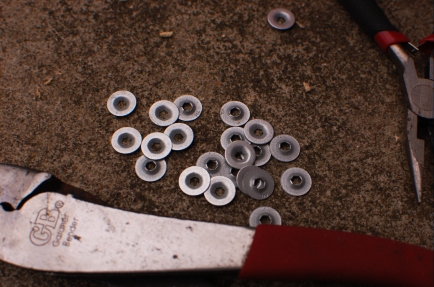
And, this is what a push nut is. They come in various sizes. These are for 1/8-inch shafts (McMaster part number 94807A024).
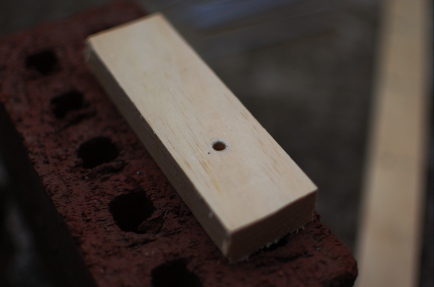
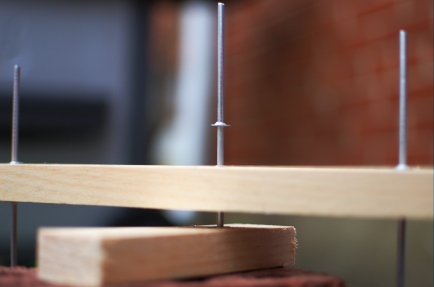
Here is a jig with an oversized (3/16-inch hole) for installing push nuts:
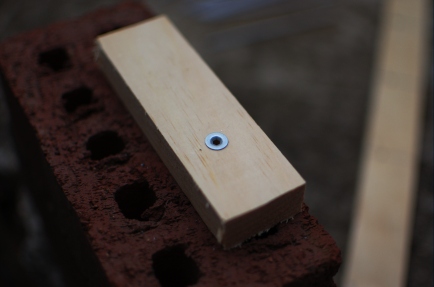
With a push nut fitted:
Dad demonstrates operation of the jig (why yes, those are tower sections in the background):
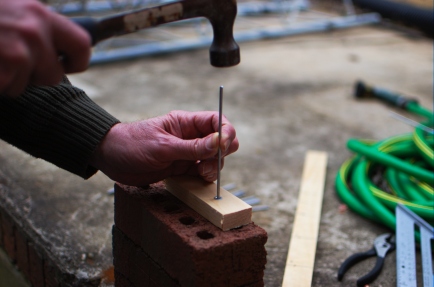
Demonstrating how to do the other side, notice that the installed (top) push nut works as a positive stop:
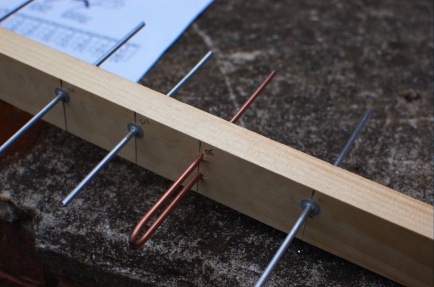
And, a (nearly) finished 10-element Yagi for 903 MHz:


NA Sprints, ARRL DX, and other notes
February, like November, is a busy month for contesting: the CW edition of the NA Sprint leads off the month (along with the Minnesota QSO Party), followed by the phone edition of the NA Sprint the second weekend, and of course, the ARRL DX CW contest on the third weekend.
In short…
NA Sprint CW SO-LP: claimed 162 x 38 = 6156, preliminary 158 x 38 = 6004. Four busted QSOs is actually better than I felt at the end. So, that is good. Still not happy with the numbers, though.
NA Sprint Phone SO-LP: claimed 28 x 16 = 448 in 1 hour operating time. As KE3X told me, his NS score was higher that week! The phone Sprint is more fun from a bigger station, but really suffers from lack of participation.
ARRL DX SOAB-LP: claimed 544 x 243 = 396,576 in 14 hours. This should have been a bit better, but I got sucked into trying to make myself heard in EU on 160 before their sunrise. Killed almost 60 minutes on 15 QSOs there. Also only operated about 1-2 hours during prime EU time on each of Sat/Sun morning. Efforts at getting a run started were a complete failure. Need. More. Firepower. I was very pleased to work ZM1A on 10 meters, though.
Other notes…
After 17ish years of amateur radio, I finally installed my first 30-meter antenna—a dipole at 35ish feet. First QSO was ST2AR, so I guess it’s working alright.
A box full of goodies arrived from Down East Microwave this week and I started working on buttoning up the 1296-MHz W1GHZ transverter. Massive thanks to Ben, N3UM, who lives nearby for sharing his construction notes with me. Not too far along other than punching and tapping a few holes in a diecast box. The DEMI box also included a couple of LNA boards that I hope to tune up for 432.
High winds (90 km/h gusts, according the forecast) from Friday night through Saturday night did not manage to topple my FO12 and A50-3S from their perch on the chimney. I haven’t checked the rotator to see if they still turn, though. This antenna situation needs to change eventually.
Finally, I also managed to score about 250 feet of RG-213 and 10 feet of LMR-600 from a dumpster-diving excursion. The LMR will make nice jumpers from the 903 and 1296 transverters to their respective antennas and I can use the RG-213 to replace the RG-8X on some of my HF antennas.
W7IUV preamplifier
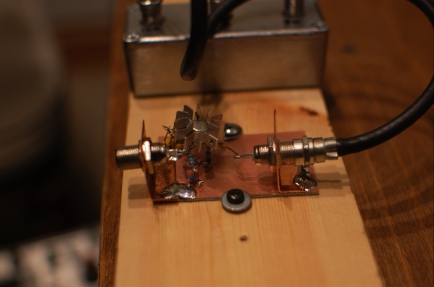
An evening project: W7IUV low-band receive preamplifier. Total cost: < $10. Total time: 1 hour.
It worked pretty well on 80 and 160 with the crossed K9AYs. The 48-volt relays in the box at the antennas are sticking (thanks to using a 40-volt PSU). I need to rebuild this with lower-voltage relays or a higher-voltage power supply.
W7IUV claims that he just leaves his connected to his RX port all the time. But, he probably has more spacing between his TX and RX antennas than I do. It will be interesting to see if I get enough RF coupled from my TX antennas to destroy the transistor.
Recent tinkerings (9 Jan 2011 edition)
Several people have commented over the years that I should “write more” on the blog. I usually respond that I could spend my free time tinkering/hamming or blogging, but not both. Here are a month’s worth of blog posts as freestyle poetry:
- A section on my workshop has been added to k8gu.com under Engineering.
- Discovered that although the SoftRock VHF Ensemble II won’t fit (barely) into the Bud CU-473 diecast box I bought for it, it will fit into an extruded enclosure that housed an ancient X-band radar detector I picked up at Dayton in 2002 in hopes of stripping the Gunn diode assembly and getting on 10 GHz. Bonus points for thriftiness. Photos will follow once I finish the project.
- Did not observe Quadrantid meteor pings with the SoftRock VHF Ensemble II, but did notice something interesting about the W3APL beacon. Need to investigate.
- Have more CE/K8GU QSL cards again, finally. Tonight, I might finish the bureau (and, ashamedly one direct) cards languishing. Some K8GU (and AA8UP, no kidding) bureau cards are sitting here staring at me, too. Not a big project, though.
- Operated the NAQP CW on Saturday (8 January 2011) for four hours and twenty minutes and made 318 QSOs x 128 multipliers for 40,740 points before log-checking discounts. This total is pleasing to me especially considering that it was almost all leap-frogging SO2R search-and-pounce, which can be very fatiguing. It’s fun to see the rate meter stay over 100 when you’re S&Ping. Good Sprint practice.
- Still the best 30 minutes on the radio every week: I operated the NS Ladder on Thursday (6 January) night and made my customary 30 QSOs x 24 multipliers for 720 points. Hopefully, adding 160 will give me some momentum to increase this score back over 1000.
- We had a spell of 50F (10C) weather on New Years’ Eve. So, I put the 2-meter beam back up on the chimney. It was formerly mounted on a steel mast that was ratchet-strapped to the chimney. A strong wind (>50 mph gusts) before Christmas bent the mast (actually a fence top-rail) and I had removed it. I cut the bent lower portion of the mast off and attached the remaining top portion with rotator to a “girder” constructed from two pieces of treated 2″ x 4″ x 10′ lumber joined with a half-dozen lag screws. Again, I ratchet-strapped the entire assembly to the chimney. The present configuration is much stronger and less prone to damage. The 3-element 50-MHz Yagi is still on the ground until I actually get the transverter finished, which should be soon (as it has been for 12 months now).
- Repaired a SoftRock v6.2 downconverter for WF1L and learned that you can solder leads back onto SOIC packages if you’re careful.
- Have had delightful exchanges with KN6X and ZL1CDP about repairing the TS-930S. Some of these discussions (and their fruits) may make it onto the site at some point.
- Back in December, I started integrating the W1GHZ transverters using UT-141 semirigid jumpers with pre-installed SMA connectors obtained on attractive terms from Max-Gain Systems. Mitsubishi RA18H1213G (1296 MHz) and RA30H0608M (50 MHz) modules arrived from RF Parts. May have a lead on something less expensive with more gain for 903 MHz via HA1AG. The big remaining tasks in all three transverter projects are the sequencer and IF interfacing.
- Also in December, I had dinner with NS Ladder father Bill, N6ZFO, in San Francisco at the Hyde Street Seafood House & Raw Bar, which is a favorite of NA Sprint father, Rusty, W6OAT. Yes, I did feel that I was in the presence of greatness. (I had their excellent pork chops since I’m not into seafood, especially raw seafood.) Like most contesters, Bill’s a super, fascinating guy apart from his radio contesting interests.
A short vertical for 160 meters
160 meters, Topband, …the names conjure all sorts of visions of grandeur, enigmatic propagation modes, and big antennas in the minds of hams everywhere. Since I have lived on suburban lots for the past five and a half years and in an apartment for two years before that, it has been the better part of a decade since I’ve had my own permanent 160-meter antenna system at my “home” station. (Despite this, I did manage to get 160-meter WAS from NO9Z’s station and if my Rhode Island and Delaware contacts ever upload to LoTW, I’ll request the certificate from ARRL.)
So, the story at hand. Just before the November Sweepstakes contest, I put up a secondary 80-meter antenna—the open-wire fed dipole I used at K8GU/9. Its performance was underwhelming and the vertical seemed to play just fine. But, I got busy and just left it up in the trees. Somewhere in the annals of the Blog, I may or may not have described this antenna, which was designed to also operate on 160 by shorting the feeder and feeding the whole mess against ground. I never used this functionality because I had to lay radials on top of the patio and that was a pain to take them up and put them down.
The North American QSO Party was this weekend and I’ve been participating in the NCCC Sprint Ladder, both of which include 160 meters. Around about last Thursday, after the NS Ladder, I decided it might be fun to have 160 for the NSL and NAQP. So, I ducked out of the office early on Friday afternoon and set about stripping the old tuning network from the K8GU/9 incarnation of the antenna.
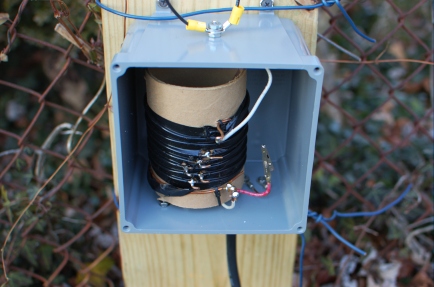
We have a lot of AM broadcast stations in the DC area. And, because of that, antenna analyzers are not always too useful on the low bands. So, knowing already that the antenna was near self-resonance after my K8GU/9 efforts, the first thing I did was just hook the antenna up to a TS-930 and give it a 5-10 watts fed against my nearby 80-meter vertical’s radial field. Sure enough, the VSWR was about 3 at 1.999 MHz and off-scale at 1.801 MHz. So, I inserted the loading coil from the old matching box. The coil is just #14 THHN solid wire in approximately the optimum-Q configuration of diameter to length and wound on a cardboard shipping tube. (As is clear from the photograph, it’s not really pretty nor the lowest-loss possible. But, it was great for what I had on-hand.)
The coil has four taps on it. I clipped the fourth tap, shorting the bottom half of the inductor and did the VSWR sweep, finding a dip at 1.950 MHz or so. Each successive tap brought the minimum lower and lower. With no taps clipped, it was tuned to the bottom of the band. I got lucky (erm, did a lot of tweaking at the previous QTH).
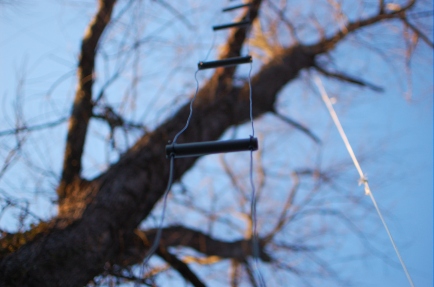
The best news of all of this is that there is enough RF actually being radiated (not just as heat, either!) to make some contacts! Further good news is that even though the antenna is between three and five feet from my 80-meter vertical, with the W3NQN filters, I can operate SO2R on both bands simultaneously. Of course, the RX noise level may just be hiding the trash. I haven’t tried the K9AY because I had that portion of the station torn-up during the conversion of all my DC accessories to PowerPoles and the preamp popped a fuse in my RigRunner when I plugged it back in.
The bottom line is that it’s not a full-sized 4-square, but it gets me on 160 from my lot in a way that’s compatible with my operating style.
“Electricity is NOT a toy”

The ARRL 10-meter (28-MHz) contest was a couple of weeks ago. Given that I had bothered to install a 10-meter antenna at this QTH and that conditions seem to be improving, I thought it would be fun to play.
I fired up CQing on Saturday and after a few minutes, Sarah appeared at the shack doorway. This usually means that something is broken or I’m causing RFI to something she wants to be using. Since I’m not KT0R, who used to tell his neighbors that he was “busy and please come back on Monday,” I obliged her. It was the CO detector again. I unplugged it (it’s battery-backed, so it just means that contesting burns through 9-volt batteries) and returned to the game. Peace reigned again in the Miller household.
Sneaking in a little bit of contesting before church on Sunday morning is a long-standing habit of mine, although it seems that the Sunday openings are usually better than the Saturday openings. Today was no exception. I was working hard to extract a few QSOs out of what appeared to be a mostly dead band and Sarah again showed up at the shack doorway—this time with wet hair and quite agitated.
“The outlet is popping when I plug the hair-dryer into it!”
I assured her that I would take care of it, adding that it was “probably just the radio getting into the GFI. Let me send a few dits and see if it starts clicking.”
“No, you stay there, I’ll send the dits. How do you do it?”
“Just press the left paddle.”
And so, Sarah made her first ham radio transmission on 10-meter CW this morning (after which I did identify, for the record). I confirmed that the outlet made a little click. She was not completely convinced, but I told her I would shut down while she dried her hair so I could monitor the situation.
The hairdryer (a prior unit), Sarah, and I have had run-ins before. Several years ago, when we were poor graduate students, a loose screw was causing a nasty vibration in the old hairdryer. So, I tightened it up and gave it back to her, not knowing that there was another screw floating around inside the case. One morning, that screw found its way into the motor and sparked. When Sarah called me on the phone, I thought she’d burnt the house down. As much as it pains me, I no longer attempt to fix any appliances that cost less than $50 as a result of this episode.
Still worked up, Sarah took the opportunity to grill me about the compatibility of contesting with family life…”When have children, how will you hear them if they’re in trouble and you have your headphones on? (In jest, I later proposed wiring a baby monitor into the SOnR audio chain.) Can’t you listen with the speaker? How will we keep them from eating your little parts, bits of wire, and globs of solder? Electricity is not a toy!”
We laughed at the last one. And she added, “I hope they’re all girls who want everything hot pink—so much hot pink that we want to barf.”
I suppose if someone makes a hot-pink Hello Kitty AK-47 (the photo actually looks like a painting of an AR-15) and the Sarah-cuda bow, we can find hot-pink solder irons, paddle finger pieces, headphones, and even radios (I seem to recall that there was a BabyPhat mod’ed hot-pink Motorola HT floating around the web a few years ago).
Anyhow, this post is for Sarah because she puts up with a lot of tinkering, RFI, and headphone time and gets very little blog recognition in return for it.
(The photo above is of Ft Rock, Oregon, taken by me when I was on assignment there.)













