Posts Tagged ‘CW’
 Upgrade to K1EL Winkeyer USB
 April 22nd, 2017 |
  Author:
 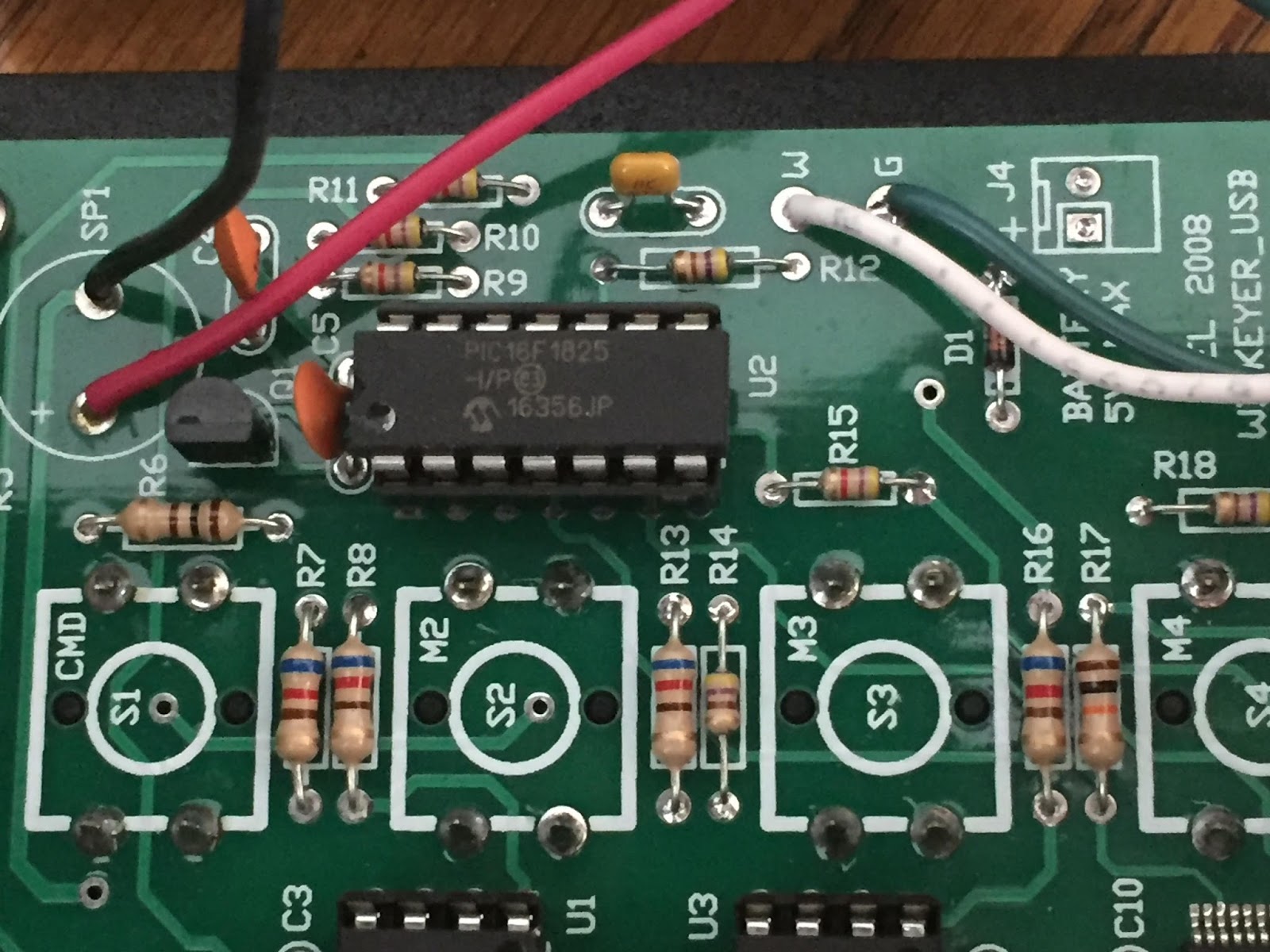 |
| New IC chip installed |
I recently upgraded the IC chip in my K1ELWinkeyer USB to version 3, it was only a 10.00 upgrade that gave me some nice advantages over the old IC chip. It was a very straight forward change out as the IC chip was not soldered in place. One of the main advantages is this IC chip has the ability (via supplied software) to be upgrade over the internet. As new functions become available in the future the upgrade is just a click away. Some of the other new features are:
1. With WK3tools downloadableprogram software you can store messages and retrieve messages. For example in contests you can store the contest exchanges, give the file the name of the contest. In the future when setting up for the contest just download the file to the keyer and your 4 push buttons (that can be preprogramed for 8 messages) can be used for that contest. When the contest is done simply reprogram the keyer with the file for calling CQ.
2. You can custom configure the keyer for 2 separate users or like me if you’re the only one using the keyer…..then have one configuration for contesting and one for QSO’s.
3. You can now adjust the side tone frequency which is not a big deal for me but for some it may be.
4. You can put your rig into tune with just the pressing of 2 of the Winkeyers top buttons the command and PB4 buttons.
5. During the transmission of a message a simple tap of the keyer will stop the message.
6. When and if you operate the unit from an internal battery the battery life has been extended by less drain.
7. Finally on the K1EL’s website under the software tab you will find some great finds. WK3tools, Winkeyer3 test app, WKscan that finds out what comport your Winkeyer is using, WK remote app and a software tools that is in the development stage and according to the website soon to be released a Winkeyer QSO simulator app,
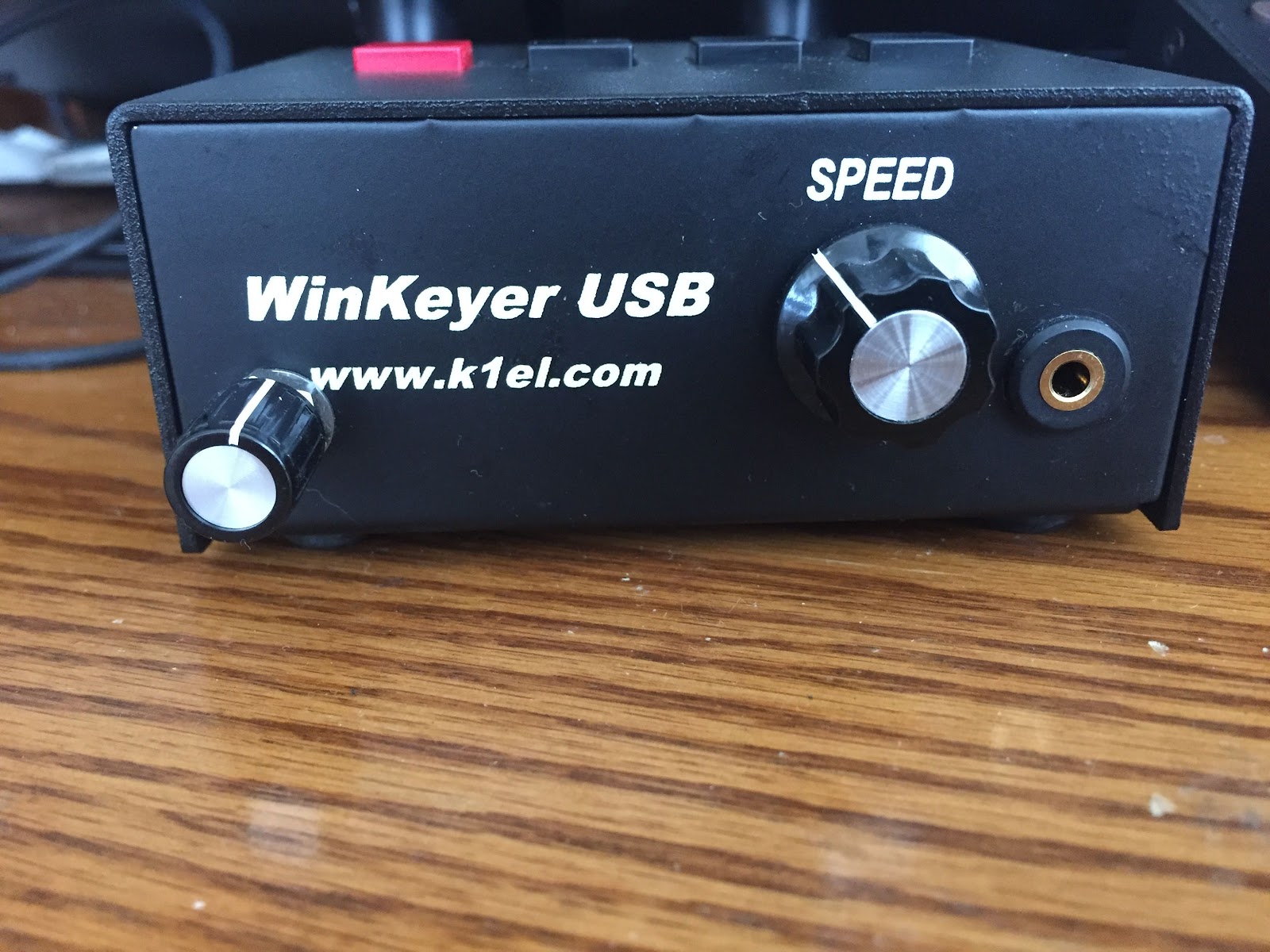 |
| With added volume and headphone jack |
These are just a few of the changes in the new IC chip to get a full rundown go to K1EL’s site where you can read thingsin more detail.
You may notice from the picture, if you are familiar with the insides of the Winkeyer USB that is I have done some upgrades to the unit of my own. I removed the internal speaker and added a headphone jack, I also added a volume control for the headphones.
Upgrade to K1EL Winkeyer USB
|
| New IC chip installed |
I recently upgraded the IC chip in my K1ELWinkeyer USB to version 3, it was only a 10.00 upgrade that gave me some nice advantages over the old IC chip. It was a very straight forward change out as the IC chip was not soldered in place. One of the main advantages is this IC chip has the ability (via supplied software) to be upgrade over the internet. As new functions become available in the future the upgrade is just a click away. Some of the other new features are:
1. With WK3tools downloadableprogram software you can store messages and retrieve messages. For example in contests you can store the contest exchanges, give the file the name of the contest. In the future when setting up for the contest just download the file to the keyer and your 4 push buttons (that can be preprogramed for 8 messages) can be used for that contest. When the contest is done simply reprogram the keyer with the file for calling CQ.
2. You can custom configure the keyer for 2 separate users or like me if you’re the only one using the keyer…..then have one configuration for contesting and one for QSO’s.
3. You can now adjust the side tone frequency which is not a big deal for me but for some it may be.
4. You can put your rig into tune with just the pressing of 2 of the Winkeyers top buttons the command and PB4 buttons.
5. During the transmission of a message a simple tap of the keyer will stop the message.
6. When and if you operate the unit from an internal battery the battery life has been extended by less drain.
7. Finally on the K1EL’s website under the software tab you will find some great finds. WK3tools, Winkeyer3 test app, WKscan that finds out what comport your Winkeyer is using, WK remote app and a software tools that is in the development stage and according to the website soon to be released a Winkeyer QSO simulator app,
|
| With added volume and headphone jack |
These are just a few of the changes in the new IC chip to get a full rundown go to K1EL’s site where you can read thingsin more detail.
You may notice from the picture, if you are familiar with the insides of the Winkeyer USB that is I have done some upgrades to the unit of my own. I removed the internal speaker and added a headphone jack, I also added a volume control for the headphones.
Hunting For NDBs In CLE218
 |
| 'XX-344' - Abbotsford, BC |
This coming weekend will see another CLE challenge. This time the hunting grounds will be: 335.0 - 349.9 kHz.
For those unfamiliar with this monthly activity, a 'CLE' is a 'Co-ordinated Listening Event', as NDB DXers around the world focus their listening time on one small slice of the NDB spectrum.
A nice challenge in this one is to hear the Abbotsford NDB, 'XX', on 344 kHz. 'XX' is located about 40 miles east of Vancouver International (YVR) and a few miles SW of the Abbotsford Airport, YVR's alternate for those foggy winter nights. 'XX' is a 500-watter and is well heard, having been logged from the east coast to Hawaii and is a good propagation indicator for listeners in eastern North America. Look for 'XX' on 344.404 kHz with your receiver in the CW mode.
When tuning for NDBs, put your receiver in the CW mode and listen for the NDB's CW identifier, repeated every few seconds. With your receiver in the CW mode, listen for U.S. NDB identifiers approximately 1 kHz higher or lower than the published transmitted frequency since these beacons are tone-modulated with a 1020 Hz tone approximately.
For example, 'AA' in Fargo, MN, transmits on 365 kHz and its upper sideband CW identifier is tuned at 366.025 kHz while its lower sideband CW ident can be tuned at 363.946 kHz. Its USB tone is actually 1025 Hz while its LSB tone is 1054 Hz.
Often, one sideband will be much stronger than the other so if you don't hear the first one, try listening on the other sideband.
Canadian NDBs normally have an USB tone only, usually very close to 400 Hz. They also have a long dash (keydown) following the CW identifier.
All NDBs heard in North America will be listed in the RNA database (updated daily) while those heard in Europe may be found in the REU database. Beacons heard outside of these regions will be found in the RWW database.
From CLE organizer Brian Keyte, G3SIA, comes the usual 'heads-up':
Hello all
Our 218th Co-ordinated Listening Event is less than a week away.
Just a normal CLE using a busy range of frequencies which usually attracts a lot of interest.
First-timers' CLE logs will also be very welcome, as always.
Days: Friday 21 April - Monday 24 April
Times: Start and end at midday, your LOCAL time
Range: 335.0 - 349.9 kHz
Please join us wherever you are - just log the NDBs you can identify
having their nominal frequencies in the range (it includes 335 kHz
but not 350 kHz) and any UNIDs that you come across there too.
We last concentrated on these frequencies for CLE200 in Nov. 2015
when 55 of us joined in.
73
Brian
----------------------------------------------------------
From: Brian Keyte G3SIA ndbcle'at'gmail.com
Location: Surrey, SE England (CLE coordinator)
----------------------------------------------------------
(Reminder: You could use any one remote receiver for your loggings,
stating its location and owner - with their permission if required.
A remote listener may NOT also use another receiver, whether local or
remote, to obtain further loggings for the same CLE).
These listening events serve several purposes. They:
- determine, worldwide, which beacons are actually in service and on-the-air so the online database can be kept up-to-date
- determine, worldwide, which beacons are out-of-service or have gone silent since the last CLE covering this range
- will indicate the state of propagation conditions at the various participant locations
- will give you an indication of how well your LF/MF receiving system is working
- give participants a fun yet challenging activity to keep their listening skills honed
Final details can be found at the NDB List website, and worldwide results, for every participant, will be posted there a few days after the event. If you are a member of the ndblist Group, results will also be e-mailed and posted there.
The very active Yahoo ndblist Group is a great place to learn more about the 'Art of NDB DXing' or to meet other listeners in your region. There is a lot of good information available there and new members are always very welcome. As well, you can follow the results of other CLE participants from night to night as propagation is always an active topic of discussion.
If you are contemplating getting started on 630m, listening for NDBs is an excellent way to test out your receive capabilities as there are several NDBs located near this part of the spectrum.
You need not be an ndblist member to participate in the CLEs and all reports, no matter how small, are of much value to the organizers.
'First-time' logs are always VERY welcome!
Reports may be sent to the ndblist or e-mailed to either myself or CLE co-ordinator, Brian Keyte (G3SIA), whose address appears above.
Please ... give the CLE a try ... then let us know what NDB's can be heard from your location! Your report can then be added to the worldwide database to help keep it up-to-date.
Good hunting!
Hunting For NDBs In CLE218
|
| 'XX-344' - Abbotsford, BC |
This coming weekend will see another CLE challenge. This time the hunting grounds will be: 335.0 - 349.9 kHz.
For those unfamiliar with this monthly activity, a 'CLE' is a 'Co-ordinated Listening Event', as NDB DXers around the world focus their listening time on one small slice of the NDB spectrum.
A nice challenge in this one is to hear the Abbotsford NDB, 'XX', on 344 kHz. 'XX' is located about 40 miles east of Vancouver International (YVR) and a few miles SW of the Abbotsford Airport, YVR's alternate for those foggy winter nights. 'XX' is a 500-watter and is well heard, having been logged from the east coast to Hawaii and is a good propagation indicator for listeners in eastern North America. Look for 'XX' on 344.404 kHz with your receiver in the CW mode.
When tuning for NDBs, put your receiver in the CW mode and listen for the NDB's CW identifier, repeated every few seconds. With your receiver in the CW mode, listen for U.S. NDB identifiers approximately 1 kHz higher or lower than the published transmitted frequency since these beacons are tone-modulated with a 1020 Hz tone approximately.
For example, 'AA' in Fargo, MN, transmits on 365 kHz and its upper sideband CW identifier is tuned at 366.025 kHz while its lower sideband CW ident can be tuned at 363.946 kHz. Its USB tone is actually 1025 Hz while its LSB tone is 1054 Hz.
Often, one sideband will be much stronger than the other so if you don't hear the first one, try listening on the other sideband.
Canadian NDBs normally have an USB tone only, usually very close to 400 Hz. They also have a long dash (keydown) following the CW identifier.
All NDBs heard in North America will be listed in the RNA database (updated daily) while those heard in Europe may be found in the REU database. Beacons heard outside of these regions will be found in the RWW database.
From CLE organizer Brian Keyte, G3SIA, comes the usual 'heads-up':
Hello all
Our 218th Co-ordinated Listening Event is less than a week away.
Just a normal CLE using a busy range of frequencies which usually attracts a lot of interest.
First-timers' CLE logs will also be very welcome, as always.
Days: Friday 21 April - Monday 24 April
Times: Start and end at midday, your LOCAL time
Range: 335.0 - 349.9 kHz
Please join us wherever you are - just log the NDBs you can identify
having their nominal frequencies in the range (it includes 335 kHz
but not 350 kHz) and any UNIDs that you come across there too.
We last concentrated on these frequencies for CLE200 in Nov. 2015
when 55 of us joined in.
73
Brian
----------------------------------------------------------
From: Brian Keyte G3SIA ndbcle'at'gmail.com
Location: Surrey, SE England (CLE coordinator)
----------------------------------------------------------
(Reminder: You could use any one remote receiver for your loggings,
stating its location and owner - with their permission if required.
A remote listener may NOT also use another receiver, whether local or
remote, to obtain further loggings for the same CLE).
These listening events serve several purposes. They:
- determine, worldwide, which beacons are actually in service and on-the-air so the online database can be kept up-to-date
- determine, worldwide, which beacons are out-of-service or have gone silent since the last CLE covering this range
- will indicate the state of propagation conditions at the various participant locations
- will give you an indication of how well your LF/MF receiving system is working
- give participants a fun yet challenging activity to keep their listening skills honed
Final details can be found at the NDB List website, and worldwide results, for every participant, will be posted there a few days after the event. If you are a member of the ndblist Group, results will also be e-mailed and posted there.
The very active Yahoo ndblist Group is a great place to learn more about the 'Art of NDB DXing' or to meet other listeners in your region. There is a lot of good information available there and new members are always very welcome. As well, you can follow the results of other CLE participants from night to night as propagation is always an active topic of discussion.
If you are contemplating getting started on 630m, listening for NDBs is an excellent way to test out your receive capabilities as there are several NDBs located near this part of the spectrum.
You need not be an ndblist member to participate in the CLEs and all reports, no matter how small, are of much value to the organizers.
'First-time' logs are always VERY welcome!
Reports may be sent to the ndblist or e-mailed to either myself or CLE co-ordinator, Brian Keyte (G3SIA), whose address appears above.
Please ... give the CLE a try ... then let us know what NDB's can be heard from your location! Your report can then be added to the worldwide database to help keep it up-to-date.
Good hunting!
CW Academy Intermediate
A little while ago I decided it was time to get a little help with my CW. Whilst I can have a reasonable QSO whilst I’m sat in the shack I tend to make a complete hash of it when /p. The bottom line is that my head copying skills just aren’t there. To try and fix this I enrolled on the CW Academy course for the slightly less than novices (Intermediate). I had expected that I was slated for October but it seems that we’re starting on April 1st! Hope there’s no significance in that.
The Everlasting Ameco AC-1
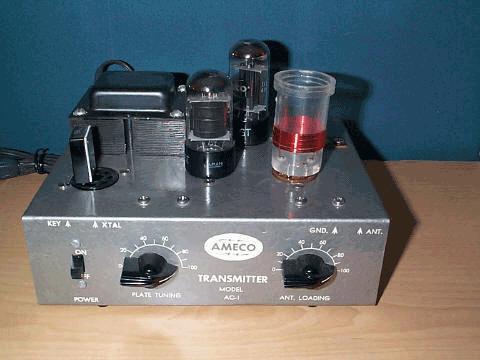 |
| courtesy: WB1GFH's AC-1 site |
I continue to be amazed at the high prices being paid on E-Bay for original Ameco AC-1 transmitters but perhaps I shouldn't ... they've been doing this for several years now.
Few radios that I can think of have elevated themselves to the cult status enjoyed by the AC-1, but the 3-tube Knight Ocean Hopper regen also comes to mind. Both radios typically reach $100- $200 on auction, with some going for much more. There were plenty of AC-1's sold and built over the years so it's not as if they're rare.
They seem to pop up frequently on E-Bay and the auctions are usually very spirited. I see a nice looking one at present, with 23 bids so far and now at $150! I guess the timing is just about right, with a large supply of now-retired ex-50's Novices who once owned an AC-1, looking to turn back the clock and recreate their early radio experience.
As transmitters go, they don't come much simpler, but the well-designed and smartly marketed radio made it extremely popular among the vast numbers of newly-licenced teenaged Novices who likely didn't have much spare change ... the first ones hit the market in the late 50's, right in time for the strongest solar cycle on record, selling for $14.95 in kit form. AC-1's continued to be sold into the early 70's with the price rising to around $25 ... a nice long run for most ham gear. I may be wrong but I don't think they were ever available in anything other than kit form.
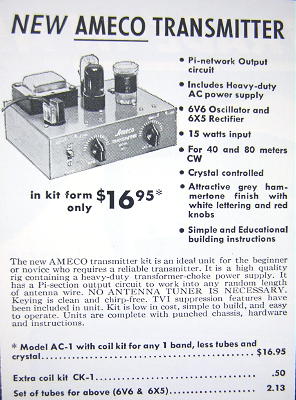
Here is what the kit looked like upon arrival ... this one still NIB in 2012!
 |
| courtesy: http://www.wa0itp.com/ac-1.html |
There is also a large builder's interest in making AC-1 'clones' along with a dedicated Yahoo Group for additional support. Several years go I decided to scratch-build my own clone and found that I had everything needed except for the gray hammertone spray paint. Although most AC-1's used black chicken head knobs, some early models used maroon knobs so I decided to go with a red slide switch and red chicken head knobs on my reproduction. The important decal was available at the time from the Yahoo group but I see them now being sold by Radio Daze, for those that may want to try their hand at building a clone themselves.

The AC-1 uses the inexpensive 6V6 elevated from AF to RF duty, in a crystal-friendly Colpitts crystal oscillator. The only departure from the norm is the output circuit. Most inexpensive one-tubers end up with a link-coupled output but the AC-1 uses the more versatile pi-network ... something that no doubt added to its production costs but produced a transmitter able to load a wider range of antenna impedances while providing superior harmonic attenuation, both important in a beginner's rig.
My clone puts out 8 watts on 80m and 7 watts on 40m. Although never intended, doubling to 20m sees a large drop in efficiency, with output power dropping to 2 watts. Swapping to a 6L6 yields an extra couple of watts. Not enough to be noticed at the other end except when doubling or tripling.
I haven't had my clone on the air for a few years and think it's time to spark it up once again for some summertime fun on 40m CW. It would be great to work another clone or even a real AC-1 if you have one, but any contacts will be exciting if you would like to try.
I'll be hanging around 7118 kHz or down near 7040 and ... I won't be loud!
The Don Miller Enigma
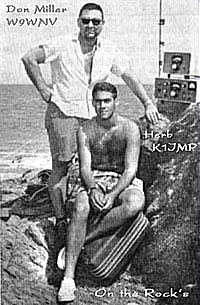
A mention in the KE9V weekly 'CALLING CQ' e-mail letter brought back more memories of my teen DX years. The article pointed to a YouTube interview of legendary DXer Dr. Don Miller, W9WNV, conducted by another DX legend, Martti Laine, OH2BH. The fascinating interview was conducted in December 2016 and is broken into five parts.
For those old enough to remember, Don spent a few years in the late 60's providing DXers with one rare country after another ... dozens of them. He was a superb operator and the originator of the now ubiquitous "5NN" shortened signal report, after trying unsuccessfully with "FNN". He was also one of the very first to operate 'split', requiring stations to call up or down instead of the then prevalent one frequency pileup! Don was really instrumental in shaping much of what we see today as 'standard ops' when it comes to DX'pedition operations. To hear Don handle a pileup was something else. Often when the pile became very large, he would listen to the calling crowd for a couple of minutes and then respond with a list of calls and signal reports ... nothing like the individual exchanges we see today.
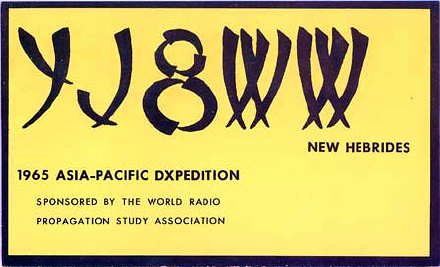
My little DX-20 and VF-1 were only able to work Don at one of his stops ... YJ8WW on 40m CW. He was all about giving the little guy, those running modest stations, an opportunity to work some rare countries.
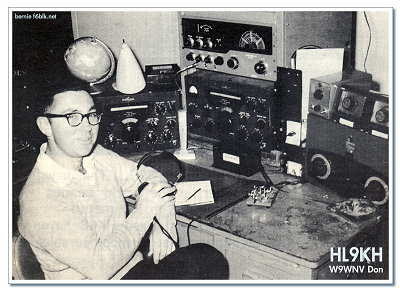 |
| courtesy: F6BLK |
As bad as things had become for Don, it got much worse, when in 1980, rightly or wrongly, he was convicted of conspiring to have his estranged wife killed and was sentenced to 25 years to life.
Don Miller is one of those 'larger than life' personalities whose presentations at DX clubs and conventions would bring the large crowds to their feet with his DX stories and expedition accomplishments.
The YouTube interviews show a somewhat contrite, remorseful man, compared to the one we met in the 60's but there's still a hint of that young mischief-maker and a twinkle in his 80 year old eyes as he teases of putting another rare one on-the-air, one last time.
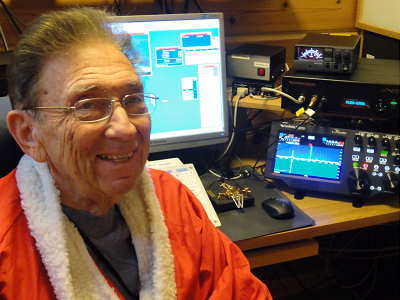 |
| courtesy: OH2BH |
[See also: "The Don Miller Story As Told By Hugh Cassidy, WA6AUD]