Posts Tagged ‘couragecenter’
 Handiham World for 03 November 2010
 November 3rd, 2010 |
  Author:
 Welcome to Handiham World!
In this edition:
Still waiting for frequencies!
Plain text frequency chart updated
Split Rock on the air event
Dip in the pool
Operating skills: How to use beacons
November events released
Live ham radio broadcast from w5kub.com starts this morning!
Remote base progress report
Video feed of Mars Rover being outfitted
Phone number for this podcast – call & listen if you don’t have access to a computer.
This week at HQ
No feedback as to frequency for new 75 meter net

Hello, anyone out there? I’m still waiting for your feedback on frequencies you have listened on during the continuing search for a place to park our new 75 meter net. If you could get back to me with your suggestions for a clear frequency anywhere in the Extra, Advanced, or General portions of the band, I would really appreciate it. Our first choice would be a clear General frequency if possible, but if one is not available in the evening, which is when we will have the net, then we will go with an Advanced or Extra frequency. The 75 meter band DX window will not be used. It is 3.790-3.800 MHz. The AM calling frequency of 3.885 MHz is also reserved as is the SSTV frequency 3.845 MHz.
Please e-mail me this week with your frequency and time suggestions, frequency reports, and other suggestions about the net.
73,
Patrick Tice, WA0TDA
Handiham Manager
[email protected]

Handiham World for 27 October 2010
Welcome to Handiham World!
In this edition:
New net will be on 75 m
Band plan isn’t the same as frequency chart
Dip in the pool
NASA internships available for students with disabilities
Launch date set for Discovery mission
Putting in a speech module proves to be quite a chore
K1RFD puts in a guest appearance on TIPSnet
This week at HQ
It’s time for a new HF net – Part 3
Two weeks ago we said : We need at least consider moving our HF net to 160, 75, or 40 meters, and those bands are likely to be most useful in the evening. Because 160 requires a very long antenna, it is impractical for many users. 40 can get crowded, but requires the shortest antenna of the three. Of course we can consider reviving our 17 meter “non-net roundtable”, which was originally started by Alan, K2WS, but the sun will have to spit out a few more spots for that band to get where it needs to be. So what do you think? 160? 75? 40? Or something else? And what about the time and day?
Decision time is here! we really need to get moving on this new net, and the consensus seems to be building around 75 m as the best band. Therefore, we will proceed to the next step, which is choosing a net frequency. Most of the responses I have gotten indicate that users would prefer a frequency in the Extra or Advanced class portions of the phone band. We were reminded by one respondent about the “DX window” in the ARRL band plan, which is 3.790 to 3.800 MHz. The Extra portion of the band runs from 3.600 to 3.700 MHz. The Advanced portion runs from 3.700 to 3.800 MHz. The General portion runs from 3.800 MHz to the top of the band at 4.000 MHz. All General frequencies are available to Advanced and Extra licensees, of course.
So the next step is to start listening in the evening for clear frequencies. Please report the frequency and the time you listened along with the day of the week so that we can pick a mostly clear spot for a regular weekly net. By the way, the net does not have to be weekly – it could be daily, a couple of times a week, or whatever Handiham Radio Club members think is appropriate and reasonable. Send your reports to me over the coming week so that we can move on to the next step and get the word out about our new 75 m net.
By the way, there are no plans to make this a formal traffic net or anything like that. While I wouldn’t rule out the possibility of handling traffic, I think it would be fun to just have a nice social net on HF during the long winter evenings. As with the daily EchoLink net, we could enlist net control stations or simply have a more or less uncontrolled roundtable gathering. Maybe we will have some of both, depending on who shows up to join in the fun!
Please e-mail me this week with your frequency and time suggestions, frequency reports, and other suggestions about the net.
73,
Patrick Tice, WA0TDA
Handiham Manager
[email protected]

Handiham World for 20 October 2010
Welcome to Handiham World!
It’s time for a new HF net – Part 2
Last week we said : We need at least consider moving our HF net to 160, 75, or 40 meters, and those bands are likely to be most useful in the evening. Because 160 requires a very long antenna, it is impractical for many users. 40 can get crowded, but requires the shortest antenna of the three. Of course we can consider reviving our 17 meter “non-net roundtable”, which was originally started by Alan, K2WS, but the sun will have to spit out a few more spots for that band to get where it needs to be. So what do you think? 160? 75? 40? Or something else? And what about the time and day?
Interestingly enough, the 75 meter band seems to be favored so far. More than one respondent has suggested that we would have the best chance of success in the Extra Class segment of the band. The reason cited was that the General segment is crowded in the evening when the band is open to longer distance communications and thus most useful for our purposes.
I think we can agree that the 160 meter band is “out” because of the antenna requirements. 40 is a good alternative because of its propagation characteristics, but the phone portion of the band is less than half that available on 75 meters and there is no doubt that it will be difficult to find some open real estate for an evening net. Besides, we already have the CW net on 7.112 MHz.
So what do you think? A 75 meter net in the evening to be in the Extra portion of the band? Remember, only participants with Extra Class licenses would be able to transmit, but anyone could listen. We could initiate a “check in by email”, or some similar system, which I have heard on other nets, to accommodate those without transmit privileges. Another idea would be to have the Handiham Radio Club as the net sponsor. We do need regular HRC activities, aside from a single meeting at Radio Camp during the year.
Weigh in! I hope to hear from you about these suggestions soon. Please drop me an email, and I’ll share your thoughts with our readers and listeners.
QST Reviews Wouxun KG-UVD2 & KG-UVD1P Talking Handheld Radios

The Wouxun KG-UVD1 talking HT created quite a stir at Hamvention in May, both for its low price and for its built-in speech access for the blind. As I stated in a previous story, “Handiham volunteers Larry Huggins, KA0LSG, and Ken Silberman, KB3LLA, both found the new Wouxun 2m/70cm KG-UVD1P HT at Dayton, and Larry actually had his radio along to demonstrate to us at Handiham Radio Camp.”
We have had many questions about this radio, but details on its overall quality and functionality were mostly anecdotal. That has changed with a QST review of the latest versions of the KG-UVD2 & KG-UVD1P talking handheld radios by Bob Allison, WB1GCM, ARRL Test Engineer. Bob’s article appears in the November 2010 QST, which will be available to blind Handiham members in the upcoming Friday audio updates in the Members Only section of the Handiham website. QST is also produced in audio through the Library of Congress National Library Service and will be available for the new NLS digital players, available to those who qualify for services. The NLS version of QST is the complete magazine without advertising, but it takes some time to produce and is typically around a month later than the print mailing or Handiham digest version.

Handiham World for 13 October 2010
Welcome to Handiham World!
It’s time for a new HF net.
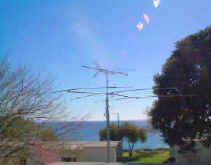
When was the last time you thought about getting on 20 m and being part of the Handiham net? Don’t be embarrassed to admit that you haven’t thought about it for a long time. Neither have I, as a matter of fact, so you are not alone. The 20 m net died several years ago when our last regular net control volunteer Mike Knox, WA0KKE, finally had to throw in the towel.
What happened?
Like many things in our technologically-driven existence, there was no single cause for the demise of the Handiham net. A prime suspect certainly had to be the relentless, never-ending sunspot minimum that we are trying to claw our way out of with limited success, even now in 2010 when the sun should be really perking up. As most of you know, the higher solar activity associated with more sunspots creates ionospheric conditions that favor really good high-frequency radio propagation. In a really good solar maximum, the HF bands crackle with strong DX signals and one can “work the world” with just a few watts of power on bands like 10 and 15 m. Sad to say, it has been so long since we have seen those conditions that many operators have simply drifted away from regular HF operation, especially if they did not have room for wire antennas that would allow them to tune 160 through 40 m, bands that remain usable even during solar minimum conditions.
The 20 m band sits astride the critical part of the HF spectrum that just barely remains inside the “always useful” zone. At sunspot minimum, it is generally crowded with DX seekers and anyone else simply looking for an open band with capability of working stations at some distance during daylight hours. Even then, 20 isn’t always reliable when solar storms wipe out the bands. So what happened was that the conditions on 20 simply didn’t favor continued scheduled net activities. The net control station would be faced with terrible band conditions and fewer and fewer check-ins. In spite of my efforts to find another net control station, no one was interested, and I guess I don’t blame them. Who wants to preside over a net with no stations checking in?
But we can’t ignore other factors that came into play during the deterioration of the HF bands during the sunspot minimum. The rise of the Internet followed by the spread of broadband connectivity made EchoLink much more practical and reliable than HF communications. The VHF and UHF repeater systems with EchoLink capability came into their own as HF activity deteriorated. More and more people made the move to EchoLink. The Internet is also a huge factor in siphoning away people from ham radio – and most other leisure time activities. It’s not that the Internet is good or bad per se, it’s just that people only have so much time for all of the competing leisure time activities, and ham radio is simply finding a new “normal” in this very different world.
Another factor is that a daytime 20 m HF net is simply too hard to conduct when more and more people with disabilities are going to school and work, instead of the “bad old days” situation in which people with disabilities simply sat around housebound. We are glad that those days are gone, but Handiham members who work and go to school cannot be expected to have the time to check into a daytime net on any regular basis. You simply can’t count on enough folks having a day off from work or a school holiday to keep a critical mass of net participants.
So what to do?
I would suggest a change in net frequency and timing. We need at least consider moving our HF net to 160, 75, or 40 meters, and those bands are likely to be most useful in the evening. Because 160 requires a very long antenna, it is impractical for many users. 40 can get crowded, but requires the shortest antenna of the three. Of course we can consider reviving our 17 meter “non-net roundtable”, which was originally started by Alan, K2WS, but the sun will have to spit out a few more spots for that band to get where it needs to be. So what do you think? 160? 75? 40? Or something else? And what about the time and day?
I hope to hear from you about this suggestion soon. Please drop me an email, and I’ll share your thoughts with our readers and listeners.
New at the Hong Kong Electronics Fair: Wouxun KG-UV920R

The Hong Kong Electronics Fair opened today, October 13, and runs through October 16.
Amateur radio is about to be introduced to a brand-new entry in the mobile dual-band radio category, the Wouxun KG-UV920R. Although at this time we have little in the way of product specs, the Wouxun dual-band handheld radio that was demonstrated at Handiham Radio Camp early this year created quite a lot of interest because of its built-in speech frequency readout for blind users. The KG-UV920R features dual-frequency display and cross-band repeater capability. It comes with more than a thousand memory channels. It also includes an unusual receiver that covers the short-wave bands! We are waiting for a more detailed specification document so that we can tell if speech frequency readout will be a feature – and we sure hope that it is! At this time, no pricing is available.

Handiham World for 06 October 2010
Welcome to Handiham World!
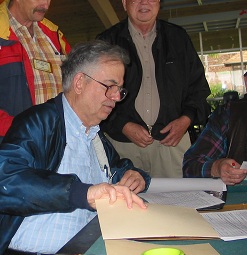
Photo: John Hoenshell, N0BFJ, enjoys being a VE and handles the paperwork at radio camp sessions and also volunteers during VE sessions at Dayton HAMVENTION. He believes that team members with disabilities can participate in a successful session.
Can a VE session be more than just a process of overseeing test takers in a room and handling their FCC paperwork?
This morning I had a different, but VE-related, question from one of our blind members. She was asking how she might participate in a VE session if she became a volunteer examiner. She mused that being a VE sounded interesting and that she would like to participate, but she wondered if it would be practical since she couldn’t see a room full of test takers. Since this topic comes up from time to time, I thought I’d take another look at what a VE session is about. While I am by no means an “expert” VE by experience, I can relate to testing in general – I was trained as a teacher, after all – and I have observed people with disabilities for decades. I have been present at many VE sessions over the years, especially at Handiham radio camps, but have only relatively recently become a VE myself.
I got to thinking about the very best VE sessions I had observed. What made them stand out from the others? It was more than the success of the candidates, though that always helps. It was more than the team arriving prepared and being able to process the paperwork efficiently, too. It was more than promoting the session and arranging a good location, though those things were important.
But what was it?
Well, let’s discuss the typical VE session a bit.
Our blind Handiham member is right in assuming that a blind VE cannot observe a room full of test takers as a sighted person might do during a VE session. That does not mean that a blind VE cannot participate. At our radio camp VE sessions, I suggest that blind VE team members sit at the tables where the exam is being read by volunteer readers to blind test takers. This assures that the exam is being proctored so that all rules are followed. A sighted VE simply looking at a room of test takers cannot know what is being said at each table in this kind of an adapted test session. Blind VE team members understand how tests are given to blind candidates and are potentially better at this kind of observation than anyone else.
The paperwork table is probably one place a blind VE would not be as useful. In every VE session, the team leader should try to match skills & capabilities with the tasks at hand. If there are no blind test takers to proctor, a blind VE might instead be part of the meet & greet team, setting candidates at their ease and answering the usual questions about what to expect during the testing, any rules of conduct (no smoking, quiet please, bring test to table at the side of the room when finished, etc.) As testing progresses and candidates start to turn their exams in for grading, a blind VE can then be stationed outside the testing room to answer questions that candidates might have. Typical information requested ranges from when they can use their new privileges if they pass an element upgrade to the location of the rest rooms.
Another job that every VE team has is communicating test results to the waiting candidates. There is no reason a blind VE cannot help with this job – and a savvy VE team leader will know who is best-suited for the hardest job – the delivery of the bad news. If a blind VE can handle telling a candidate that they didn’t pass but can do so in such a way as to help that person accept the news in a positive way, the entire VE team will be grateful! You don’t have to see to help candidates, successful or not, learn more about your ham radio club. Post-testing is a great time to talk with candidates and invite them to club and ARRL membership, and yes, even Handiham membership if they have a disability.
For the excited new Technicians and Generals, you might start a conversation about which radios are best, pointing out the availability of the club’s repeater system or the best ways to check out the the HF bands during the improving sunspot cycle.
In the end, a successful VE session is one that provides an opportunity for the candidates not only to pass their exams, but to leave the test site with the information and enthusiasm that will carry over to participation in the club and regional activities as well as getting on the air! When you look at a VE session as more than just three team members overseeing a room of test takers, you can easily find places for blind VE team members to be a part of this most rewarding of volunteer activities.
I hope to hear you on the air soon.

A dip in the pool
No one told you there was going to be a quiz, right? I thought it would be fun to pick a question out of the question pool and see how many of us can remember the right answer. Ready? Here we go:
E6A02
What type of semiconductor material contains more free electrons than pure germanium
or silicon crystals?
A. N-type
B. P-type
C. Bipolar
D. Insulated gate
Did you pick answer A, N-Type? That’s the right choice, and easy to remember if you think of “N” standing for “negative” and an excess of electrons in a material would give it an overall negative charge.

Handiham World for 29 September 2010
Welcome to Handiham World!
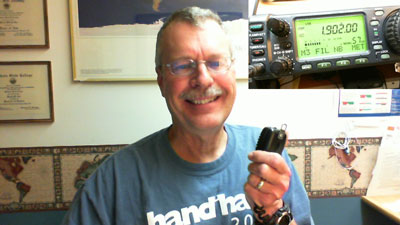
At this time of year I am always taken by surprise at how quickly the daylight hours fade every day here in the northern hemisphere. That means more hours of darkness and more HF radio fun in the evenings, as we mentioned last week when we extolled the virtues of 160, 80, and 40 m for long-distance communications. Things are also looking up in the daytime communications department, because my Windows sidebar gadget, “Full Sun 2.1” by John Stephen, shows me the face of the sun becoming more regularly dotted with sunspots. More sunspot activity means that the shorter wavelength HF bands like 10 and 15 meters will soon become much more reliable for very long distance daytime contacts.
If you have a Technician Class license, now is the time to consider an upgrade to General Class so that you can really use and appreciate all of these HF bands at a time when conditions favor some really great operating.
What makes me think about this upgrade business today of all days, when I am busy with your weekly E-letter and podcast is that tonight I will be teaching a two hour General Class course on rules and regulations. The course is open to anyone, but of course Technician Class license holders would probably be the most interested since they have already completed their first license and are familiar with ham radio terminology and operations, at least on the VHF and UHF bands. While some HF frequencies are open to Technician Class licensees, pretty much everyone realizes that an upgrade to General is a necessity if one is really going to enjoy shortwave operation.
One advantage that I feel that I have in teaching rules and regulations is that those who have passed the Technician are already familiar with the fact that we are regulated by the Federal Communications Commission and that the section of the rules governing the Amateur Radio Service are called Part 97. Anyone with a license should already know about frequency charts and about how the various levels of license allow for operation in different band segments. Everyone is already familiar with the fact that transmit power levels are regulated and that examinations are given by a VE team. Starting with this foundation of basic knowledge makes the General Class study regimen that much easier. I always start out the course by assuring my students that the examination for General Class will be 35 multiple-choice questions without any Morse code testing. Yes, I know that the code requirement has been gone for quite awhile now, but I still encounter students who either don’t quite believe it or simply haven’t gotten the news. One thing I have learned over years and years of teaching is that one cannot assume that the students know all of these basics on the first day of class!
Although I am very familiar with teaching into a microphone for our blind Handiham students, these courses taught in front of a class of students from the general public will only occasionally have a blind participant. This is going to sound a little bit odd, but I have to remind myself that I will now be expected to provide some visual learning cues as I speak and answer questions. For a traditional teacher of amateur radio at a typical radio club course the situation is reversed and that teacher may have considerable difficulty working with blind students. It all serves to remind me that the first time I meet my students I am going to have to assess them to find out how they learn and be flexible enough to adapt my teaching style accordingly. In teaching amateur radio courses, flexibility is the key. Your students will help guide you if you are open-minded enough to listen to them – just as we always tell new operators to listen on the bands before transmitting.
When I see a classroom full of students who are interested in amateur radio, I know that they are motivated to learn. After all, amateur radio classes are completely voluntary and these people could be doing something else instead of sitting in a ham radio class. This is a tremendous advantage and opportunity for me – and you – as teachers in amateur radio. Our students want to learn. We need to make sure that we are prepared to teach by having our teaching materials and any audiovisual equipment ready to go at the beginning of class so that we can move right into the topic at hand and make sure that we use the time as efficiently as possible.
Today we have the Internet and all of its amateur radio resources as study aids for post-class reinforcement of each week’s classroom topic. Since I am teaching rules and regulations and the radio club has chosen the ARRL General Class License Manual as the official study guide, I will be referring my students to the section of the ARRL website that provides further information about that particular book, including extra study material, any corrections that might need to be made in the text, and – most importantly – a question pool organized to follow the book. Not everyone knows about this special question pool, so I never assume that my students have discovered it on their own. Believe me, it makes quite a difference to be able to follow the question pool in the same order as the chapters in your textbook. I also freely recommend other amateur radio websites that might help with either studying or practice examinations.
One disadvantage of having to teach the chapter about rules and regulations is that it is not considered a “fun” topic. When one thinks about rules and regulations, it brings to mind memorizing really dull legal-sounding rules and lots of frequency limits. I won’t deny that there is some of that, but your job as an instructor is to help the students learn how to learn. That might mean pulling out the US Amateur Radio Bands frequency chart and helping the students to make sense of a page full of data that might otherwise seem overwhelming. One trick is to divide the frequency bands into the ones where there are no special General Class subsections and those that do have subsections. Breaking the frequency chart down in this manner can help your students remember which bands they may get questions on regarding frequency limits. Of course there is going to be some memory work no matter what you do in the classroom to help the students organize their thinking. I tell my students in no uncertain terms that they will have to sit down and do some memorization and that they will do it as homework. My volunteer instructors at Handiham Radio Camp have told me for years that studying at home is vital to ultimately passing the examination during the VE session at camp. Fortunately most radio club classes meet weekly for 8 to 10 weeks, giving your students much more time to study at home. Just be sure that they understand what to study and help them develop good study habits.
My classes are always interactive. I don’t prefer to lecture from a podium for an hour and then have a question-and-answer session. Most people learn best if their questions are answered the instant they pop into their heads. If you wait to have a question and answer session you will find that many of your students have forgotten questions that might’ve come up during the lecture. A better way to conduct the class will be as a discussion that can be interrupted to answer questions. Time will be a factor, so a good teacher learns to manage this kind of interactive classroom experience in order to keep the class moving along while still allowing the students to participate actively during the entire class period.
Since my class is going to be in a two hour time frame, I am going to plan for a mid-class break. Your students will be more alert if they can attend to personal needs and walk around a bit instead of having to sit for an extended period of time.
Finally, when you are wrapping up your class, your students may feel overwhelmed with all of the material that you have managed to cram into the evening’s session. Once they return home and think about what they have learned, which may even take the rest of the week, they may have other questions that they wish they had asked during the class. That’s why I always provide my e-mail address and invite my students to ask questions whenever they think of them. My radio club teaches classes in Technician and General, offering the first license in the spring of the year in conjunction with an emergency weather spotter course. The upgrade class to General is offered in the autumn. All of the classes are taught by a team of volunteer instructors so that no one instructor will be tasked with many classes to prepare for over the course of 8 to 10 weeks.
I hope your radio club is offering classes as well. Over the years I have received the sad news from time to time that a radio club is dissolving and distributing its assets to worthy causes like the Handiham System. While I am always glad to receive support for our program, I really hate to see an amateur radio club closing its doors. I suspect that one of the biggest factors in the demise of these clubs was the absence of an education program to teach amateur radio classes. A club without an educational program is a club that is not building a base of new amateur radio operators in their community. This is a recipe for an aging club membership that will eventually diminish to a few members and eventually the plug will be pulled on the club. Don’t let that happen to your club. Volunteer to help with an education program. If you have never been an amateur radio instructor, you may want to sit in on a class taught by one of your other club members or even a neighboring radio club’s class. The idea is to learn how to teach and then get out there and do it. Rest assured that your efforts will be rewarded by the new members you will bring into the amateur radio community. You will have more members in your club, and these new members will have new ideas. Eventually they will become instructors themselves and they will also serve in leadership positions and provide new club programs. They will be the ones who will take up the mantle of “Elmers” who will be able to keep amateur radio healthy and growing into the future.
I always feel honored when I am asked to teach one of our classes. I hope you will feel that way, too.
I hope to hear you on the air soon.
73,
Patrick Tice, WA0TDA
Handiham Manager
[email protected]
A dip in the pool
No one told you there was going to be a quiz, right? I thought it would be fun to pick a question out of the question pool and see how many of us can remember the right answer. Ready? Here we go:
G1A01 [97.301(d)]
On which of the following bands is a General Class license holder granted all amateur
frequency privileges?
A. 20, 17, and 12 meters
B. 160, 80, 40, and 10 meters
C. 160, 30, 17, 12, and 10 meters
D. 160, 30, 17, 15, 12, and 10 meters
Do see how sneaky I can be? In my opening remarks I specifically referred to teaching my students about dividing the frequency chart into bands where General Class licensees have full privileges and bands that have frequency restrictions. Think about which one of these is the correct answer and we will provide it at the end of this newsletter and podcast.

Handiham World for 22 September 2010
Welcome to Handiham World!
Happy Autumn!
Now that autumn has returned and the equinox is upon us, conditions on the amateur radio bands begin to favor some of the longer wavelength parts of the HF spectrum like 160, 80, and 40 m. True, there is still a great deal of interference from thunderstorms that pop up in the warmer climates, but the interference isn’t nearly so bad as it had been during the height of summer. The longer nights also mean less ionospheric D-layer absorption on those bands, which translates into more opportunities for long-distance contacts. In short, from this point forward we will see rapidly changing conditions on some of the bands where regional HF nets typically meet on a daily basis. This, as you might expect, can lead to potential interference as skywave propagation begins to move out from a few hundred miles to over 1000!
With more and more of our Handiham members earning their General Class tickets and becoming more involved with HF operation, we now have an opportunity to learn how the HF bands change from season to season. As always, we recommend doing plenty of tuning around and listening on the various bands to learn when there are band openings and how the more experienced operators are taking advantage of them.
One of my favorite bands has always been the 75 m band, and I have made plenty of random contacts but also enjoy checking into my favorite regional net, PICONET, on 3.925 MHz Monday through Saturday. Interestingly enough, this net has long been associated with Handihams — way longer then I have been with the Handiham program. Propagation on 3.925 MHz during the 9 AM to 11 AM central time “morning net” is generally the best, because during the previous overnight hours thunderstorms have quieted down and the bands are generally less noisy. As the day wears on, D-layer absorption increases and signal levels drop. There is also an afternoon session, from 4 PM to 5 PM, in the summer. In the winter, the PICONET expands its afternoon session to 3 PM to 5 PM, since conditions for sky wave propagation are better. But this can pose a problem: Skywave is so good that a New York net on the same frequency can now be heard in the Upper Midwest. No doubt the New York stations are also hearing us. Generally this overlap of nets isn’t a problem, but sky wave can work against you when the band “goes long” and stations from over 1000 miles away begin to sound as loud as the stations a hundred miles away. This situation calls for flexibility on the parts of net participants. If it is possible to use a directional antenna, a rarity on 75 m, interference can be mitigated by turning the antenna to favor only the stations in your area. Switching between wire antennas that favor particular directions might also help, as well as using a wire antenna instead of a vertical antenna. The wire antenna will most likely have a higher angle of radiation that will favor closer stations, while the vertical will have a lower angle of radiation that will favor the stations over 1000 miles away. Flexibility on the part of the net control stations is also called for. If interference is a problem, a net control station should consider cutting the net a little short or changing frequency just a bit. Of course this is not always easy when you have a net running and if you, as the net control station, want to change frequency everyone will have to understand the plan and change with you. It can be a challenging job for a net control station to herd everyone to another nearby frequency without having some strays!
160 m is especially useful over the winter months. While there are not as many structured nets on that band, you can run into “regulars” — stations that often get together on the same frequency about the same time every evening. In the summer 160 m is good for propagation in a regional area during the nighttime hours. In the winter, like the 75 m band, 160 m lengthens out and long-distance contacts are possible. If you are planning to try to earn a certificate like Worked All States on 160 m, winter conditions are your friend. Most evenings at 8 PM Central Time there is an informal get-together on 1.902 MHz. Most net participants are members of the Handiham affiliated Stillwater Amateur Radio Association.
40 m is a good band summer and winter and during sunspot lows and sunspot highs. It benefits by reduced thunderstorm interference during the winter months. You can work DX on the 40 m band, and an advantage it has over 160 m and 75 m is that a wire antenna for 40 m will be able to fit into most suburban lots. Furthermore, a vertical antenna for 40 m can be quite efficient and requires less inductive reactance to make it tune, as compared to a 75 or 160 m vertical. As always, cutting ground losses through an extensive radial system will yield good results.
Of course the sunspot cycle is on the way up and we can expect more DX to appear on 14 MHz and higher frequencies, but please don’t forget about 160 through 40 m. With winter conditions approaching here in the northern hemisphere, opportunities for fun on these bands are not to be missed!
I hope to hear you on the air soon.














