Posts Tagged ‘couragecenter’
 Handiham World for 19 January 2011
 January 19th, 2011 |
  Author:
 Welcome to Handiham World!
Last week we promised: I replace my Internet router and configure EchoLink port forwarding. Will I ever be on EchoLink again? Tune in and find out!
Today we begin with our “Connecting with EchoLink” segment. I see that last week has turned into “this week”, and I have kept up my schedule and replaced my old Belkin-N wireless router with a hopefully more reliable D-Link DIR-655 wireless N router. Although I liked the Belkin, it had some odd quirks like simply ending its wireless transmissions when it felt like it and refusing to bring up the access screen through the browser so I could check the settings. I decided to hang on to it for a spare since it mostly works, but isn’t really reliable enough to keep as a primary unit.
Like most households, ours has multiple Internet-enabled devices. There is a mix of wireless and wired clients on our home network, so a wireless router these days typically has at least four LAN jacks along with the usual wireless capability. You can tell that there are two ham operators interested in technology in our household, because we have all sorts of gizmos that need Internet connectivity to work. When my son Will, KC0LJL, is home from college, it is not unusual for us to host a LAN party with a few of his friends visiting us and logging in to play online games.
I’ve owned several wireless routers in the past, upgrading to allow for better wireless coverage or more robust security, or to add more custom configurability. So here we are at the latest choice, the D-Link DIR-655. After a lot of web research and reading user comments, especially those on Amazon.com, I settled on the DIR-655 because it had lots of configuration options, excellent wireless range, is compliant with the IEEE 802.11N standard for faster data transfer, and was reasonably priced at less than $75. I also like the D-Link products I already own.
The router arrived in due course, and yes, I did open the box and read the setup directions. I suspect that most manufacturers offer a CD-based automated installation system, as D-Link does. I have configured many devices, so I elected to instead connect the router via a LAN cable to a computer and do the configuration through a web browser. My reasoning was that any kind of “typical” installation that might be configured via the CD would not suffice for my special needs, like configuring EchoLink. Typically one gets into a router by opening a web browser and typing in router’s ip address, which is usually something like 192.168.0.1. This will open the main login page on the router, and you go in with the “admin” name and whatever the manufacturer says is the default password. Once, in, you will want to go through the housekeeping settings, such as setting your new password (write it down!), giving your wireless network a name, and setting the wireless security credentials. Usually the firewall settings can be left alone, but some applications, like EchoLink, will require that several ports be open. It is safe to do so, but you have to be careful to still maintain the other firewall settings. It is dangerous to turn off the firewall because it exposes your network to all sorts of bad guys with keyboards! Most routers have a “DMZ”, with is a “demilitarized zone”, that is outside the firewall. Although a computer on the network can be placed in the DMZ to avoid firewall issues, this is only a good idea for short term testing. I like to keep all of my computers and network devices behind the firewall.
Operating systems like Windows have their own firewalls. Incorrectly setting the Windows firewall to block EchoLink can also cause a problem of course, but since I knew my machine had already been working fine on EchoLink with the old router, I would not need to mess with any Windows firewall settings. It was time to head for the “Advanced” menu on the router configuration page and choose “Port Forwarding”.

In the screenshot above, I have entered the name of the application (EchoLink) for reference later on so that I know which app is dependent on which port forwarding rule. Under the “Ports to Open” column, I have entered 5200 in the TCP box and 5198,5199 in the UDP box. In the “Schedule” column I have used the pull-down menu to choose “Always” for 5200 and “Allow All” as the inbound filter setting for 5198, 5199.
So far, so good, but we are not done yet. Since the router can forward ports only to one computer on my network, I must decide which machine will be my primary EchoLink computer. Since the one I use for the ham shack applications has an IP address of 192.168.0.100, I need to enter that address in the IP Address box. I make sure the rule is active by checking the box to its left, and I then choose “Save Settings” and wait for the router to tell me that the settings have been applied. If you are wondering where I got the port numbers, all of this information about what EchoLink requires is on the EchoLink website.
Now I have to make sure that my computer will always have the same IP address when it talks with the router. Virtually all routers assume a typical user will not mind if an IP address changes from time to time. The “DHCP Server Settings” is our next stop. DHCP stands for “Dynamic Host Configuration Protocol”. That is fancy talk for the router being able to deal out IP addresses more or less at random within a range of addresses to all the various devices on the network. Each device on the network must have its own unique IP address. These can change “dynamically” as new devices enter the network, as might happen at a LAN party or when one switches on an Internet radio or iPod Touch. Since we have told the router to forward EchoLink ports to only one IP address, we now have to make sure that the single IP address our main EchoLink computer uses never changes in this dynamic system. Our setting here is to check the “Enable DHCP Server” box, and fill in the range boxes with 192.168.0.101 and 192.168.0.199. This allows the router to dish out IP addresses between and including those two numbers. Notice that I left the IP address of the EchoLink computer, which is 192.168.0.100, outside the range of dynamically assigned addresses.

Next, it is time to make reservations. No, we are not going out to dinner! We are going to the DHCP Reservations List, which allows us to tell the router that the IP address of the EchoLink computer is to be “reserved” just for that computer and no other. The “Enable” box is checked and the settings can be saved as before. It is now time to log out of the router and test EchoLink.

EchoLink can be started normally, and the “direct connect” option in setup should be enabled. The station list should come up. Locate the EchoLink Test Server and try to connect. If everything is working right, the connection should complete and you should hear the familiar, “Welcome to the EchoLink Test Server” announcement.
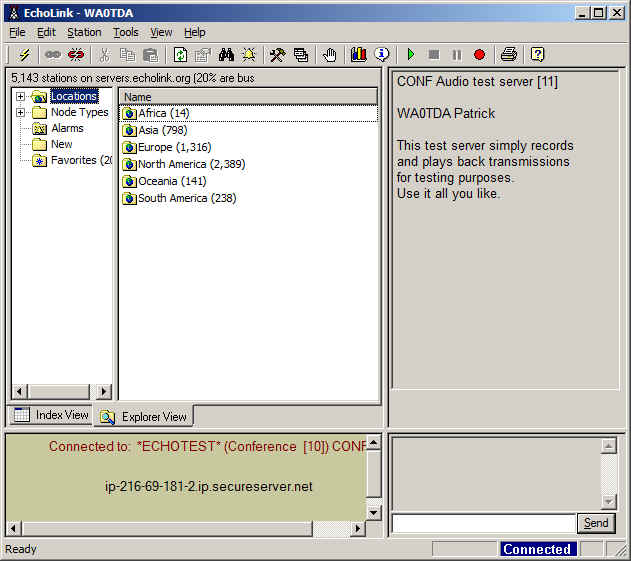
In the EchoLink screenshot, I am connected to the test server and there is confirmation text in the right side of the screen where the station list usually appears. I can toggle the spacebar to transmit and run a short audio test, in which the test server will echo what I have said back to me. This confirms that I can make connections and that my audio levels are set correctly. Since I had EchoLink working before and the router has nothing to do with the audio settings, I did not expect (nor did I find) any problems with levels.
Finally, I ran test connections with other stations and nodes. This was necessary because I have noticed that in some circumstances it is possible to connect to the test server without forwarding the ports. Connections to other nodes and stations will likely fail, however, until the ports are properly forwarded.
Resources that helped me with this setup were the very well-written support pages on the EchoLink website, the Portforward.com website, which lists a wide variety of routers and their configuration settings for EchoLink, and Lyle, K0LR, who gave me good advice about putting the static IP address outside the DHCP range. The Portforward.com website is one that is listed as a useful link within the EchoLink support pages.
What if you have a different router? That’s where the Portforward.com website will really be helpful. It gives directions that are specific to the model of router you have. What doesn’t change are the EchoLink port requirements, but making the actual settings can look quite different, depending on your router. Some, like my old Belkin, had a “Virtual Servers” page where settings were made. This sounds quite complicated, but like any complex task, it can be broken down into basic, easy to follow steps. I like the idea of learning my router’s setup, because that means that I will be able to make changes myself later on. I will feel good about being in charge of my own network, just as I know and control my amateur radio equipment. If something changes, I prefer to be able to diagnose the problem myself. It is something that, as radio amateurs, we should all try to do. Remember, you may be the only one available when a problem with your station or network needs attention!

Handiham World for 12 January 2011
Welcome to Handiham World!
Today it is time for adventures in “troubleshooting”.
Learning how to troubleshoot problems in your amateur radio station is one of the most important skills you will ever develop. The reason is that most of the time you are going to be the only person available to do anything about a problem that crops up. After all, you are the owner and operator of the station and are likely to be the one who discovers the problem in the first place. Amateur radio is a technical activity, and it has always been my feeling that a healthy curiosity about what makes things work contributes to our ability to learn how to troubleshoot problems logically. Of course fixing a problem is different, since you may not have the necessary parts at hand, be able to climb a tower yourself, or be able to replace a part that you cannot see or reach inside a piece of equipment. Still, there is a great deal of satisfaction to be had in knowing how things work and being able to figure out why they are not working at the moment.
For example, the day before yesterday I noticed in a routine check of my HF antennas that the end-fed wire and the Windom were both delivering plenty of signals, but the ground-mounted Butternut vertical out in the backyard was dead silent. There was not even a trace of the usual noise or static. I know from experience that when an antenna returns this kind of result, there is usually a break somewhere between the transceiver and the antenna, usually a connector or feed line problem.
So, how does one proceed with this kind of a problem? A consideration is whether or not any changes have been made recently in the configuration of the equipment in the ham shack. In other words, if you have recently installed a new antenna tuner or replaced a switch or some other component in the antenna and feed line system, you might want to consider the possibility that things were either not connected correctly or that a connecting cable in the shack is intermittent. Frankly, the first thing to consider (for me, anyway) is some kind of operator error. Did I disconnect something to run a test and then forget about it? Did I forget to flip a switch? Am I sure I pressed the right button on the automatic antenna tuner? I tend to like to eliminate “indoor” problems like these before pulling on my boots and winter gear and trudging out into the backyard, which happens to be full of snow this time of year.
Since I have made no changes to my equipment configuration here in the ham shack, and have triple-checked that I am operating the automatic antenna tuner and rig correctly, I guess there is nothing for it but to make an expedition out to the backyard. I know from experience that most of my antenna problems in the past have been weather-related in one form or another. After all, the antennas and their components are outdoors and can be damaged by ice, moisture intrusion, wind, and ultraviolet exposure. Since this particular symptom of the vertical antenna suddenly going completely silent is not something that happened gradually, I am going to be looking for a break in the feed line, and my prime suspect is going to be at the feed point near the base of the vertical.
A check of what can be seen at the feedpoint shows the connection to be intact. Next, it is time for a continuity check, so out comes my 30+ year old clunker Radio Shack VOM. This thing has been on more troubleshooting trips than I can remember, including trips up towers and many Field Days! The way the vertical’s feedpoint is configured is going to result in a dead short at DC. This is normal, because there is a copper coil across the feedpoint between the center conductor of the coax and ground. Thus, the “normal” condition is for the ohm meter to read a DC short when connected between the center of the coax and the braid. I pulled the coax off the back of the LDG tuner and checked for the expected DC short. The coax was open! This indicates a most unfortunate problem, a break somewhere in the feed line system between the feed point and the ham shack. Further troubleshooting will have to wait until the ground is clear of snow and thawed because the feed line is buried underground and in January in Minnesota the ground is like concrete.
Sometimes troubleshooting is like that. What you have to do is logically narrow down the possibilities so that you can focus your efforts on the part of the system where the fault most likely lies. In some cases, circumstances or conditions will not permit you to troubleshoot to a final conclusion or make repairs until those conditions or circumstances change. So I guess I am without my vertical antenna unless I run a second feed line over the snow and out to the antenna. A better bet is probably just to switch all of my operations to the remaining two wire antennas and to make use of the two Handiham remote base stations from time to time.
Although this story will be continued once the snow melts and the ground thaws out, it does put me in mind of an exceptional job of troubleshooting done by one of the members of my college ham radio club decades ago. If I remember correctly, a Johnson Viking Ranger transmitter was not working properly. Several attempts by various club members to figure out what was going on were unsuccessful. Finally one of the members decided to really devote some serious time to the problem and trace it down once and for all. Believe it or not, the fault was a broken wire underneath the chassis. In those days point to point wiring between tube sockets was common. Vacuum tube equipment was failure prone, and the most likely culprit was always the tubes themselves. In this case, a wire had broken inside the insulation, making the problem difficult to spot. Perhaps this short length of insulated wire was defective when it was manufactured and repeated heating and cooling of the transmitter as it was turned on and turned off ultimately caused the wire to open up inside the insulating jacket. The point of this story is that things like this sometimes happen, even to some of the most seemingly reliable and simple components in a system. I always admire the way engineers and technicians at NASA troubleshoot their way through complicated systems and come up with elegant and effective solutions to problems no one ever expected.
Next week: I replace my Internet router and configure EchoLink port forwarding. Will I ever be on EchoLink again? Tune in and find out!

Handiham World for 12 January 2011
Welcome to Handiham World!
Today it is time for adventures in “troubleshooting”.
Learning how to troubleshoot problems in your amateur radio station is one of the most important skills you will ever develop. The reason is that most of the time you are going to be the only person available to do anything about a problem that crops up. After all, you are the owner and operator of the station and are likely to be the one who discovers the problem in the first place. Amateur radio is a technical activity, and it has always been my feeling that a healthy curiosity about what makes things work contributes to our ability to learn how to troubleshoot problems logically. Of course fixing a problem is different, since you may not have the necessary parts at hand, be able to climb a tower yourself, or be able to replace a part that you cannot see or reach inside a piece of equipment. Still, there is a great deal of satisfaction to be had in knowing how things work and being able to figure out why they are not working at the moment.
For example, the day before yesterday I noticed in a routine check of my HF antennas that the end-fed wire and the Windom were both delivering plenty of signals, but the ground-mounted Butternut vertical out in the backyard was dead silent. There was not even a trace of the usual noise or static. I know from experience that when an antenna returns this kind of result, there is usually a break somewhere between the transceiver and the antenna, usually a connector or feed line problem.
So, how does one proceed with this kind of a problem? A consideration is whether or not any changes have been made recently in the configuration of the equipment in the ham shack. In other words, if you have recently installed a new antenna tuner or replaced a switch or some other component in the antenna and feed line system, you might want to consider the possibility that things were either not connected correctly or that a connecting cable in the shack is intermittent. Frankly, the first thing to consider (for me, anyway) is some kind of operator error. Did I disconnect something to run a test and then forget about it? Did I forget to flip a switch? Am I sure I pressed the right button on the automatic antenna tuner? I tend to like to eliminate “indoor” problems like these before pulling on my boots and winter gear and trudging out into the backyard, which happens to be full of snow this time of year.
Since I have made no changes to my equipment configuration here in the ham shack, and have triple-checked that I am operating the automatic antenna tuner and rig correctly, I guess there is nothing for it but to make an expedition out to the backyard. I know from experience that most of my antenna problems in the past have been weather-related in one form or another. After all, the antennas and their components are outdoors and can be damaged by ice, moisture intrusion, wind, and ultraviolet exposure. Since this particular symptom of the vertical antenna suddenly going completely silent is not something that happened gradually, I am going to be looking for a break in the feed line, and my prime suspect is going to be at the feed point near the base of the vertical.
A check of what can be seen at the feedpoint shows the connection to be intact. Next, it is time for a continuity check, so out comes my 30+ year old clunker Radio Shack VOM. This thing has been on more troubleshooting trips than I can remember, including trips up towers and many Field Days! The way the vertical’s feedpoint is configured is going to result in a dead short at DC. This is normal, because there is a copper coil across the feedpoint between the center conductor of the coax and ground. Thus, the “normal” condition is for the ohm meter to read a DC short when connected between the center of the coax and the braid. I pulled the coax off the back of the LDG tuner and checked for the expected DC short. The coax was open! This indicates a most unfortunate problem, a break somewhere in the feed line system between the feed point and the ham shack. Further troubleshooting will have to wait until the ground is clear of snow and thawed because the feed line is buried underground and in January in Minnesota the ground is like concrete.
Sometimes troubleshooting is like that. What you have to do is logically narrow down the possibilities so that you can focus your efforts on the part of the system where the fault most likely lies. In some cases, circumstances or conditions will not permit you to troubleshoot to a final conclusion or make repairs until those conditions or circumstances change. So I guess I am without my vertical antenna unless I run a second feed line over the snow and out to the antenna. A better bet is probably just to switch all of my operations to the remaining two wire antennas and to make use of the two Handiham remote base stations from time to time.
Although this story will be continued once the snow melts and the ground thaws out, it does put me in mind of an exceptional job of troubleshooting done by one of the members of my college ham radio club decades ago. If I remember correctly, a Johnson Viking Ranger transmitter was not working properly. Several attempts by various club members to figure out what was going on were unsuccessful. Finally one of the members decided to really devote some serious time to the problem and trace it down once and for all. Believe it or not, the fault was a broken wire underneath the chassis. In those days point to point wiring between tube sockets was common. Vacuum tube equipment was failure prone, and the most likely culprit was always the tubes themselves. In this case, a wire had broken inside the insulation, making the problem difficult to spot. Perhaps this short length of insulated wire was defective when it was manufactured and repeated heating and cooling of the transmitter as it was turned on and turned off ultimately caused the wire to open up inside the insulating jacket. The point of this story is that things like this sometimes happen, even to some of the most seemingly reliable and simple components in a system. I always admire the way engineers and technicians at NASA troubleshoot their way through complicated systems and come up with elegant and effective solutions to problems no one ever expected.
Next week: I replace my Internet router and configure EchoLink port forwarding. Will I ever be on EchoLink again? Tune in and find out!
Handiham World for 5 January 2011
Welcome to Handiham World!

You know how people seem to be drawn to making resolutions at this time of year? Losing weight, balancing the checkbook (if you even use one anymore), keeping the house clean, and all the usual things that seem to be hard to get done and awfully easy to leave until tomorrow – those are the usual New Year’s resolutions. Well, on New Year’s Day I was listening to National Public Radio, and I heard a discussion of resolutions, and I thought that they came up with a brilliant suggestion. Since making and keeping resolutions seems to be so difficult, why not quit making resolutions for yourself and instead just make them for other people?
Now, THERE’S an idea! Since I am so lousy at keeping my own resolutions, I will instead tell YOU what you should do. Not only will it be easier for me, you will benefit by my great wisdom and while I sit and drink coffee and eat donuts, YOU can be the one working out at the gym and eating celery. What could possibly go wrong?
So here are my New Year’s resolutions for you:
| You will get on the air every day, if you possibly can. I call this idea DOTA, which stands for “Daily On The Air”. Not only is this a good way to stay in touch with your friends, it is also a necessity if you want to be familiar with your equipment. I was discussing this with Linda, N7HVF, recently in an email exchange. We both agreed that it is hard to remember how to use some of the feature on your equipment if you don’t get on the air regularly, preferably every day. | |
| You will follow the Amateur’s Code to the best of your ability. The Amateur’s Code appears as regularly as clockwork in each new edition of the ARRL Handbook. It was written by Paul Segal, W9EEA, in 1928, and it is as good a set of guidelines today as it was then. To refresh your memory, the amateur is considerate, loyal, progressive, friendly, balanced, and patriotic. In the months ahead, we will be looking at each of these guidelines individually and discussing each in more depth. I will be happy to have my brand-new 2011 ARRL Handbook available to help us as a reference. It’s an awesome book, and the entire contents – every bit of text – is searchable in PDF on an accompanying compact disk. I’m sure they still have a good price on the Handbook at ARRL.org in case you want to pick one up. | |
| You will attend your local radio club meetings and do something to participate, whether it is writing an article for the club newsletter, taking a leadership post, being part of an ARES group, volunteering to plan or run an operation on Field Day, helping another club member with a project, or maintaining the club’s equipment, repeater, or website. | |
| If you are not a member of a radio club, you will find one and (hopefully) join up. | |
| You will be an ambassador for Amateur Radio by welcoming questions from non-hams about our hobby and by stepping up to the plate to showcase ham radio whenever you can, whether it is at a trade show, school classroom, or through a media outlet. | |
| You will resolve to give back as much as you get out of ham radio. Get in the habit of saying “yes” when someone asks you to serve, participate, help, whatever. One good way to do this is to be a net control station when someone asks for help covering their net session. | |
| If you are a member of the Handiham Radio Club, you resolve to participate in the Handiham nets as much as you can, and also help by suggesting club activities and then participating. | |
| Finally, you will practice good operating skills, and you will start by always using your callsign correctly and never saying “73’s” instead of the correct “73” when you finish a QSO. |
I hope these New Year’s resolutions keep you busy. If anyone has resolutions for me, I am holding my hands over my ears right now and saying, “Nyaa, nyaa, nyaa, I can’t heeeear you!”
Patrick Tice, WA0TDA Handiham System Manager [email protected]
Shortwave America – alive and growing in 2011

October 21st, 2008 – That’s the day Shortwave America was born. Several inspirations take responsibility for this now popular web publication coming to life, along with necessity being the mother of invention and the sharp mind of a seasoned writer in possession of a dream.
Dan Hensley, KC9NCF, has been an avid lover of radio communications since he was young. His father and mother were both licensed in the radio service long ago, and his father moved on to amateur radio in the 80s. It was in the late 80s that Dan was exposed to commercial radio by Doug Zelden; otherwise known as “Rabbi Doug” who was his grade school teacher and also a semi-regular character on the “Kevin Matthews” show back when WLUP AM – 1000 was still on the air. Doug was responsible for introducing Dan to Kevin and the gang at AM 1000. Ed Tyll then noticed Dan and had him in the studio twice, and then as a regular guest during his late night show via telephone.
In the early 2000’s, John and Jeff of “The John & Jeff Show” got to work with Dan for a short while. It was December of 2006 when Dan got his FCC Technician license, then following up with his General Class License at the last Handiham California Radio Camp in 2008.
Since that October day in 2008, Shortwave America has seen continued growth and has served the mission of keeping radio alive through station loggings, radio related observations, silliness and sarcasm. Mix all of this together with interviews of popular radio personalities, creative flow, ingenuity, hard work, devotion, and what you get is a recipe for success.
This past year, Shortwave America has been featured twice on the longest running short-wave radio show known to mankind; “The Happy Station Show” which was revived by Keith Perron at PCJ Radio. Shortwave America also saw the following highlights in 2010: The creation of a Numbers Station Monitoring Resource that became popular with everyone at Enigma2000 and the Spooks List, a focus on Communications Freedom In Iran that saw Canadian radio host, Shabnam Assadollahi as both an interview subject and a special guest with her interview of Dr, Mehrdad Emadi who is the Senior Economic Adviser to the European Union. As part of that communications freedom focus, Shortwave America also interviewed Mehrdad Emadi and Homayoun Mobasseri of NEDA For A Free Iran.
Pam Mark Hall, a popular Christian Contemporary Music Musician from long ago even promoted that three part series and became a fan of Shortwave America. There was a special focus on RadioReference in the context of their live audio feeds, a piece that went viral involving an 1800 foot tall radio tower climbing video, daily increasing international readership, and a piece that inspired a viral spoof of DXer’s Unlimited host, Arnie Coro.
Shortwave America has become popular with the users of a popular internet HF radio forum called HF Underground and its owner, Chris Smolinski; who also owns the Spy Numbers Database. Shortwave America has seen praise from the likes of Mr. Fahey who was responsible for uncovering and discovering the transponder used by the Chinese Government for operating what is known as “Firedrake” and then isolating the audio channels. That piece was done when it was publicized that the China Radio International Censor tape was publicly released. Other praise has been given by a veteran cryptographer, Pirate Radio Weekly, The Southgate Amateur Radio Club who featured Shortwave America in a piece about residents of Peoria, Illinois becoming upset about a ham who is building several towers in the area, Lisnews, and a list of other sources.
An important piece for Shortwave America that contributed to its growing popularity was “History Of The California Repeater Wars – Part 1” that included audio captured directly by Dan during one of the more disgusting skirmishes on the W6NUT repeater in Los Angeles. During the production of this piece, WA6ITF of Amateur Radio NEWSLINE was interviewed and generously provided some information as part of the focus of that work.
Shortwave America has become so wildly popular that it now has over nine thousand loyal readers and is looking to expand by way of an official website, an on-line product store, and will start giving access to six or more popular radio shows focusing on amateur and short-wave radio. Shortwave America has recently added two listening galleries that readers can use to listen to short-wave stations on-line and will soon feature an amateur radio listening gallery. The first listening gallery is devoted entirely to Radio Netherlands Worldwide. All listening galleries are located at the top of the Shortwave America homepage.
Shortwave America plans more interviews, a podcast, the possible addition of an international liaison team to assist in language translation and relations with readers from across the world. Shortwave America has recently added a reader’s hotline where readers, the general public, and members of the radio community can leave messages about anything that is radio related from breaking news stories to questions, comments, criticism, ideas, discoveries, and any other radio subject matter. You can call the Shortwave America hotline at: 1-206-666-8235.
Eventually, the hotline will become a toll-free 800 number if there is enough interest in it. A reader’s poll was just recently closed, and the stats there will be calculated to determine what the readers want to see, what can become a reality and how best to achieve those goals. Shortwave America is quickly becoming competitive with the most popular mainstream sites such as hfradio.org, RadioReference, hamisland, and will hopefully rival QRZ and E-Ham.
(Information from Shortwave America)

Handiham World for 5 January 2011
Welcome to Handiham World!
You know how people seem to be drawn to making resolutions at this time of year? Losing weight, balancing the checkbook (if you even use one anymore), keeping the house clean, and all the usual things that seem to be hard to get done and awfully easy to leave until tomorrow – those are the usual New Year’s resolutions. Well, on New Year’s Day I was listening to National Public Radio, and I heard a discussion of resolutions, and I thought that they came up with a brilliant suggestion. Since making and keeping resolutions seems to be so difficult, why not quit making resolutions for yourself and instead just make them for other people?
Now, THERE’S an idea! Since I am so lousy at keeping my own resolutions, I will instead tell YOU what you should do. Not only will it be easier for me, you will benefit by my great wisdom and while I sit and drink coffee and eat donuts, YOU can be the one working out at the gym and eating celery. What could possibly go wrong?
So here are my New Year’s resolutions for you:
| You will get on the air every day, if you possibly can. I call this idea DOTA, which stands for “Daily On The Air”. Not only is this a good way to stay in touch with your friends, it is also a necessity if you want to be familiar with your equipment. I was discussing this with Linda, N7HVF, recently in an email exchange. We both agreed that it is hard to remember how to use some of the feature on your equipment if you don’t get on the air regularly, preferably every day. | |
| You will follow the Amateur’s Code to the best of your ability. The Amateur’s Code appears as regularly as clockwork in each new edition of the ARRL Handbook. It was written by Paul Segal, W9EEA, in 1928, and it is as good a set of guidelines today as it was then. To refresh your memory, the amateur is considerate, loyal, progressive, friendly, balanced, and patriotic. In the months ahead, we will be looking at each of these guidelines individually and discussing each in more depth. I will be happy to have my brand-new 2011 ARRL Handbook available to help us as a reference. It’s an awesome book, and the entire contents – every bit of text – is searchable in PDF on an accompanying compact disk. I’m sure they still have a good price on the Handbook at ARRL.org in case you want to pick one up. | |
| You will attend your local radio club meetings and do something to participate, whether it is writing an article for the club newsletter, taking a leadership post, being part of an ARES group, volunteering to plan or run an operation on Field Day, helping another club member with a project, or maintaining the club’s equipment, repeater, or website. | |
| If you are not a member of a radio club, you will find one and (hopefully) join up. | |
| You will be an ambassador for Amateur Radio by welcoming questions from non-hams about our hobby and by stepping up to the plate to showcase ham radio whenever you can, whether it is at a trade show, school classroom, or through a media outlet. | |
| You will resolve to give back as much as you get out of ham radio. Get in the habit of saying “yes” when someone asks you to serve, participate, help, whatever. One good way to do this is to be a net control station when someone asks for help covering their net session. | |
| If you are a member of the Handiham Radio Club, you resolve to participate in the Handiham nets as much as you can, and also help by suggesting club activities and then participating. | |
| Finally, you will practice good operating skills, and you will start by always using your callsign correctly and never saying “73’s” instead of the correct “73” when you finish a QSO. |
I hope these New Year’s resolutions keep you busy. If anyone has resolutions for me, I am holding my hands over my ears right now and saying, “Nyaa, nyaa, nyaa, I can’t heeeear you!”
Patrick Tice, WA0TDA
Handiham System Manager
[email protected]
Shortwave America – alive and growing in 2011
October 21st, 2008 – That’s the day Shortwave America was born. Several inspirations take responsibility for this now popular web publication coming to life, along with necessity being the mother of invention and the sharp mind of a seasoned writer in possession of a dream.
Dan Hensley, KC9NCF, has been an avid lover of radio communications since he was young. His father and mother were both licensed in the radio service long ago, and his father moved on to amateur radio in the 80s. It was in the late 80s that Dan was exposed to commercial radio by Doug Zelden; otherwise known as “Rabbi Doug” who was his grade school teacher and also a semi-regular character on the “Kevin Matthews” show back when WLUP AM – 1000 was still on the air. Doug was responsible for introducing Dan to Kevin and the gang at AM 1000. Ed Tyll then noticed Dan and had him in the studio twice, and then as a regular guest during his late night show via telephone.
In the early 2000’s, John and Jeff of “The John & Jeff Show” got to work with Dan for a short while. It was December of 2006 when Dan got his FCC Technician license, then following up with his General Class License at the last Handiham California Radio Camp in 2008.
Since that October day in 2008, Shortwave America has seen continued growth and has served the mission of keeping radio alive through station loggings, radio related observations, silliness and sarcasm. Mix all of this together with interviews of popular radio personalities, creative flow, ingenuity, hard work, devotion, and what you get is a recipe for success.
This past year, Shortwave America has been featured twice on the longest running short-wave radio show known to mankind; “The Happy Station Show” which was revived by Keith Perron at PCJ Radio. Shortwave America also saw the following highlights in 2010: The creation of a Numbers Station Monitoring Resource that became popular with everyone at Enigma2000 and the Spooks List, a focus on Communications Freedom In Iran that saw Canadian radio host, Shabnam Assadollahi as both an interview subject and a special guest with her interview of Dr, Mehrdad Emadi who is the Senior Economic Adviser to the European Union. As part of that communications freedom focus, Shortwave America also interviewed Mehrdad Emadi and Homayoun Mobasseri of NEDA For A Free Iran.
Pam Mark Hall, a popular Christian Contemporary Music Musician from long ago even promoted that three part series and became a fan of Shortwave America. There was a special focus on RadioReference in the context of their live audio feeds, a piece that went viral involving an 1800 foot tall radio tower climbing video, daily increasing international readership, and a piece that inspired a viral spoof of DXer’s Unlimited host, Arnie Coro.
Shortwave America has become popular with the users of a popular internet HF radio forum called HF Underground and its owner, Chris Smolinski; who also owns the Spy Numbers Database. Shortwave America has seen praise from the likes of Mr. Fahey who was responsible for uncovering and discovering the transponder used by the Chinese Government for operating what is known as “Firedrake” and then isolating the audio channels. That piece was done when it was publicized that the China Radio International Censor tape was publicly released. Other praise has been given by a veteran cryptographer, Pirate Radio Weekly, The Southgate Amateur Radio Club who featured Shortwave America in a piece about residents of Peoria, Illinois becoming upset about a ham who is building several towers in the area, Lisnews, and a list of other sources.
An important piece for Shortwave America that contributed to its growing popularity was “History Of The California Repeater Wars – Part 1” that included audio captured directly by Dan during one of the more disgusting skirmishes on the W6NUT repeater in Los Angeles. During the production of this piece, WA6ITF of Amateur Radio NEWSLINE was interviewed and generously provided some information as part of the focus of that work.
Shortwave America has become so wildly popular that it now has over nine thousand loyal readers and is looking to expand by way of an official website, an on-line product store, and will start giving access to six or more popular radio shows focusing on amateur and short-wave radio. Shortwave America has recently added two listening galleries that readers can use to listen to short-wave stations on-line and will soon feature an amateur radio listening gallery. The first listening gallery is devoted entirely to Radio Netherlands Worldwide. All listening galleries are located at the top of the Shortwave America homepage.
Shortwave America plans more interviews, a podcast, the possible addition of an international liaison team to assist in language translation and relations with readers from across the world. Shortwave America has recently added a reader’s hotline where readers, the general public, and members of the radio community can leave messages about anything that is radio related from breaking news stories to questions, comments, criticism, ideas, discoveries, and any other radio subject matter. You can call the Shortwave America hotline at: 1-206-666-8235.
Eventually, the hotline will become a toll-free 800 number if there is enough interest in it. A reader’s poll was just recently closed, and the stats there will be calculated to determine what the readers want to see, what can become a reality and how best to achieve those goals. Shortwave America is quickly becoming competitive with the most popular mainstream sites such as hfradio.org, RadioReference, hamisland, and will hopefully rival QRZ and E-Ham.
(Information from Shortwave America)
Handiham World for 29 December 2010
Welcome to Handiham World!
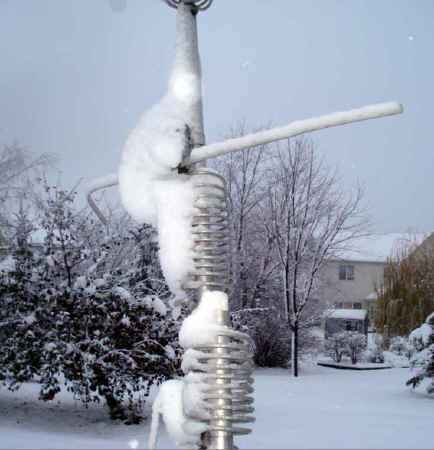
Photo: Snow is piled up on the WA0TDA Butternut vertical. Welcome to another new year.Can you believe it? It’s the last week of 2010, and we are tying the ribbons on another year here at Handiham headquarters. I can’t help but notice on the television, radio, and other media that a popular activity this time of year is the retrospective. Everyone seems to want to set out their own list of significant events that happened over the past year. Why should we be any different? At the end of the year it probably makes sense to take stock of what has happened, both good and bad, and where we think we might need to go from here.
Let’s get the bad out of the way first so that we don’t have to worry about it anymore. From our perspective, 2010 wasn’t exactly an easy year to get through. The lingering effects of the Great Recession were still very evident in the world of non–profits. We had to deal with budget cutbacks and staff cuts. The economists say that we are no longer in a recession, but some of the everyday conversations I have had throughout the past year in places ranging from the barbershop to the city park while walking the dog say otherwise. The nice lady who cuts my hair at the barbershop was also cutting back on Christmas gifts for her kids. Her husband had been laid off for some time now. A fellow dog walker mentioned the involuntary furlough from his work. Nonetheless, we still hold out hope that people will come through for us and support the Handiham program, and we certainly hope that the economists have their heads on straight and that they are right about everything getting better.
We consolidated our office move from Golden Valley out to Camp Courage at Maple Lake, Minnesota during 2010. Our office space is roomy and convenient for operation of the new remote base equipment available to our members via the Internet. 2010 also saw the move of Minnesota Radio Camp from Camp Courage North to our new headquarters at Camp Courage in Maple Lake. We all appreciated the new state-of-the-art cabin space, though we encountered some noise problems on the HF stations from florescent lighting fixtures. Holding the camp in the month of May didn’t work out quite as well as we planned, with somewhat windy weather limiting our time available to operate maritime mobile from the pontoon boat. The volunteers of the Stillwater Amateur Radio Association stepped up to the plate and really helped get the stations set up and operate the VE session. All told, I would have to rate the office move as much more difficult than the radio camp move, but both worked out quite well in the end. Our phone numbers and mailing address remained the same as before, which made things easier.
2010 saw the addition of the second remote base station, W0ZSW, which we located at our new headquarters. The existing remote base at Courage North, W0EQO, remained in operation and will continue to do so. Since the stations are hundreds of miles apart, they can be operated at the same time with no worries about interference with each other. Station reliability has been good over the past year with minimal downtime. Our users have been resourceful and have enjoyed the stations with very few requests for technical support.
Another resource added to our Camp Courage infrastructure was the W0EQO 2 m repeater, thanks to a loan of the equipment from Don, N0BVE, and installation and oversight assistance from other folks, including Matt, KA0PQW. This repeater has been in operation serving the Maple Lake area since last May. We are on track to get a new frequency pair and do some necessary upgrades.
2010 saw increased participation in our online audio lectures and a drop in cassette tape production. This is expected as Handiham members make the transition to web-based and digital audio. We made a few new Daisy book projects and we are trying to figure out how successful these were and where we will go with them in 2011. Ken, KB3LLA, helped us out quite a bit when we had Daisy questions. Our volunteers who read for us monthly, Ken Padgitt, W9MJY, and Bob Zeida, N1BLF, continued their efforts in support of making current amateur radio publications accessible to our blind members, enabling us to have material in a much more timely manner then it would be available from other sources.
Band conditions improved somewhat in 2010, but so far this new solar cycle has been lagging and HF band conditions along with it. Fortunately, the Handiham EchoLink net stayed healthy and enjoyed good participation throughout the year. Regular net control assignments were developed during 2010, and that extra organization really helped keep the net on track. Our net control volunteers did a wonderful job, though, as some have noted, there have been a few bumps in the road considering that some of our net participants are relatively new to amateur radio and EchoLink. Overall, I would judge the net to be a wonderful success over the past year and I am thankful that we have it available as HF band conditions continued to be marginal. The addition of the *HANDIHAM* high capacity conference server hosted by Mike, N0VZC, was a huge help in keeping the Handiham EchoLink net organized.
I would have to say that 2010 struck me as the year that Chinese handheld radios started coming into their own. Several models include self-voicing features that blind users will find helpful. One game-changer in this radio market is the low cost of even dual-band handheld radios coming from China. We will be watching this trend with a great deal of interest, especially the availability of self-voicing accessibility features. 2010 was the first year ever that a self-voicing Chinese handheld radio was demonstrated at Handiham Radio Camp, thanks to Larry, KA0LSG.
When I installed a new ICOM IC-7200 transceiver here in my own ham shack early this year, I was pleased to note that it came with a speech function already in the circuitry, which meant that there was no extra speech chip for blind users to purchase. Another trend in the new radios is the USB connector at the back to provide for rig control and porting of audio between the transceiver and the computer. This will make remote base control easier than ever. It also has the potential to allow users with disabilities to control more radio functions more easily via computer software.
ARRL put its excellent new website online during 2010. Overall, the availability of more amateur radio resources via the Internet was a positive trend because people with disabilities often use computers to gain access to information. We continued to keep the Handiham website updated and accessible as well, and continue to work toward simplicity of use and solid functionality so that our Handiham members will be able to make the most of everything that we put online. As far as I can recall, we had only one short web outage during 2010, which meant that the website was pretty reliable.
Overall I would have to describe 2010 as a year in which the Handiham system made significant strides toward serving members in new and better ways while continuing to hold fast to our values of helping people with disabilities to earn their amateur radio licenses and be part of a vibrant amateur radio community. Those things have always been at the core of what we do, and we have all pulled together to make the past year a success, even with not so good HF band conditions and the less than ideal economic situation. I guess I would have to say that I am pretty satisfied with where we are at the moment, and I am keeping my fingers crossed and hoping for 2011 to be a year full of good DX, lots of activity on the ham radio nets, and – as always – fun and friendship combined with learning and public service here in our Handiham community.
Patrick Tice, WA0TDA Handiham System Manager [email protected]
Predictions for the New Year
So where do you think the new year of 2011 will lead us in amateur radio? Will there be any stunning new technology introduced at Dayton HAMVENTION® in May? Will the sun burst to life with impressive sunspot numbers, resulting in fantastic DX conditions? Will any new assistive technology leap to the forefront as the “must-have” new gadget of the year?
I’m going to stick my neck out and share my prognostications for 2011. They may be flat-out wrong, but the weatherman is wrong lots of the time too, and he still has his job.
| Chinese handheld radios and newly-introduced mobile VHF/UHF radios will continue to create interest in the amateur radio market worldwide. The low prices for these units may produce some downward price pressure in the overall amateur radio equipment market. Whether this will ultimately mean lower prices for consumers in the short term with fewer choices later on, it is hard to say. Quality will remain somewhat less impressive in these Chinese radios compared to that of the Japanese manufacturers, at least in this coming year. | |
| The sunspot cycle will produce higher numbers, but still be sub-par compared to previous cycles when we enjoyed great HF band conditions. Still, it will be more fun to get on HF and work DX, and it will be easier to do so in 2011 than it was several years ago thanks to improving solar conditions. Bottom line: Now is the time to upgrade to General. | |
| This is an easy prediction because it happens every time there’s a change in the question pool. People will suddenly discover that they have been dragging their feet a little bit too long in studying for their General Class licenses and that they will be required to test from a completely new General Class question pool starting on July 1. I don’t know why this always seems to be a surprise, but I guess people just have a hard time remembering that the question pools are changed on a rotating basis. 2011 is the year for the new General Class. Just as predictable is the likelihood of a higher demand for VE sessions in late June. If you find yourself in this predicament, study now and test as early as possible. | |
| Remote base operation of HF stations will come back into the amateur radio consciousness as more and more equipment becomes available with easy computer connectivity, such as USB ports that can send and receive both rig control data and digital audio between the radio and the computer. This development will make it easier for people to consider setting up their own remote base stations. Meanwhile, EchoLink will remain a very strong contender, getting quite a bit of use around the world every day. These technological developments will continue to dovetail nicely with the goals and capabilities of an aging population of baby boomers looking toward retirement housing but not wanting to deal with huge antenna systems. | |
| 2011 just could be the year when the online-only magazine Worldradio really shines as a leader in the amateur radio publishing business. As everyone knows, publishing houses are caught in a tug-of-war between print and digital. People with disabilities have a stake in digital, because it has the potential to provide much more timely accessibility to more material than print publications ever could. It may be just a little too early to predict the availability of all amateur radio publications online, but I think the unmistakable trend in the publishing business is to at least augment print material with similar if not exact duplicates available online with either an advertising-based business model or a pay-for business model or some combination of the two. This will be interesting to watch. In 2010 the ARRL made its Technician, General, and Extra Q&A books available through Amazon’s Kindle reader. All of these ARRL publications have the text-to-speech Kindle option enabled, a great convenience for blind and low vision users. I will say for sure that I think 2011 will see more and more digital publications in the amateur radio realm. | |
| Repeater systems without Internet connectivity such as EchoLink, WIRES, or IRLP will continue to be underutilized during 2011. In 2010, some of these repeater systems barely had any activity at all. Other digital repeater systems will probably hold their own, but remain regional in nature and not reach most of the amateur radio users. | |
| Amateur radio operators may get a real public service workout this Spring as huge amounts of snowfall and heavy precipitation in March bring regional flooding here in the Midwest and in other parts of the country. There is already a great deal of snow on the ground in the upper Midwest and Spring flooding is a near-certainty. |
And my last big prediction:
| We will be ready to deliver an exciting new year of Handiham services beginning on Monday, 3 January 2011. |

Handiham World for 29 December 2010
Welcome to Handiham World!
Photo: Snow is piled up on the WA0TDA Butternut vertical. Welcome to another new year.
Can you believe it? It’s the last week of 2010, and we are tying the ribbons on another year here at Handiham headquarters. I can’t help but notice on the television, radio, and other media that a popular activity this time of year is the retrospective. Everyone seems to want to set out their own list of significant events that happened over the past year. Why should we be any different? At the end of the year it probably makes sense to take stock of what has happened, both good and bad, and where we think we might need to go from here.
Let’s get the bad out of the way first so that we don’t have to worry about it anymore. From our perspective, 2010 wasn’t exactly an easy year to get through. The lingering effects of the Great Recession were still very evident in the world of non–profits. We had to deal with budget cutbacks and staff cuts. The economists say that we are no longer in a recession, but some of the everyday conversations I have had throughout the past year in places ranging from the barbershop to the city park while walking the dog say otherwise. The nice lady who cuts my hair at the barbershop was also cutting back on Christmas gifts for her kids. Her husband had been laid off for some time now. A fellow dog walker mentioned the involuntary furlough from his work. Nonetheless, we still hold out hope that people will come through for us and support the Handiham program, and we certainly hope that the economists have their heads on straight and that they are right about everything getting better.
We consolidated our office move from Golden Valley out to Camp Courage at Maple Lake, Minnesota during 2010. Our office space is roomy and convenient for operation of the new remote base equipment available to our members via the Internet. 2010 also saw the move of Minnesota Radio Camp from Camp Courage North to our new headquarters at Camp Courage in Maple Lake. We all appreciated the new state-of-the-art cabin space, though we encountered some noise problems on the HF stations from florescent lighting fixtures. Holding the camp in the month of May didn’t work out quite as well as we planned, with somewhat windy weather limiting our time available to operate maritime mobile from the pontoon boat. The volunteers of the Stillwater Amateur Radio Association stepped up to the plate and really helped get the stations set up and operate the VE session. All told, I would have to rate the office move as much more difficult than the radio camp move, but both worked out quite well in the end. Our phone numbers and mailing address remained the same as before, which made things easier.
2010 saw the addition of the second remote base station, W0ZSW, which we located at our new headquarters. The existing remote base at Courage North, W0EQO, remained in operation and will continue to do so. Since the stations are hundreds of miles apart, they can be operated at the same time with no worries about interference with each other. Station reliability has been good over the past year with minimal downtime. Our users have been resourceful and have enjoyed the stations with very few requests for technical support.
Another resource added to our Camp Courage infrastructure was the W0EQO 2 m repeater, thanks to a loan of the equipment from Don, N0BVE, and installation and oversight assistance from other folks, including Matt, KA0PQW. This repeater has been in operation serving the Maple Lake area since last May. We are on track to get a new frequency pair and do some necessary upgrades.
2010 saw increased participation in our online audio lectures and a drop in cassette tape production. This is expected as Handiham members make the transition to web-based and digital audio. We made a few new Daisy book projects and we are trying to figure out how successful these were and where we will go with them in 2011. Ken, KB3LLA, helped us out quite a bit when we had Daisy questions. Our volunteers who read for us monthly, Ken Padgitt, W9MJY, and Bob Zeida, N1BLF, continued their efforts in support of making current amateur radio publications accessible to our blind members, enabling us to have material in a much more timely manner then it would be available from other sources.
Band conditions improved somewhat in 2010, but so far this new solar cycle has been lagging and HF band conditions along with it. Fortunately, the Handiham EchoLink net stayed healthy and enjoyed good participation throughout the year. Regular net control assignments were developed during 2010, and that extra organization really helped keep the net on track. Our net control volunteers did a wonderful job, though, as some have noted, there have been a few bumps in the road considering that some of our net participants are relatively new to amateur radio and EchoLink. Overall, I would judge the net to be a wonderful success over the past year and I am thankful that we have it available as HF band conditions continued to be marginal. The addition of the *HANDIHAM* high capacity conference server hosted by Mike, N0VZC, was a huge help in keeping the Handiham EchoLink net organized.
I would have to say that 2010 struck me as the year that Chinese handheld radios started coming into their own. Several models include self-voicing features that blind users will find helpful. One game-changer in this radio market is the low cost of even dual-band handheld radios coming from China. We will be watching this trend with a great deal of interest, especially the availability of self-voicing accessibility features. 2010 was the first year ever that a self-voicing Chinese handheld radio was demonstrated at Handiham Radio Camp, thanks to Larry, KA0LSG.
When I installed a new ICOM IC-7200 transceiver here in my own ham shack early this year, I was pleased to note that it came with a speech function already in the circuitry, which meant that there was no extra speech chip for blind users to purchase. Another trend in the new radios is the USB connector at the back to provide for rig control and porting of audio between the transceiver and the computer. This will make remote base control easier than ever. It also has the potential to allow users with disabilities to control more radio functions more easily via computer software.
ARRL put its excellent new website online during 2010. Overall, the availability of more amateur radio resources via the Internet was a positive trend because people with disabilities often use computers to gain access to information. We continued to keep the Handiham website updated and accessible as well, and continue to work toward simplicity of use and solid functionality so that our Handiham members will be able to make the most of everything that we put online. As far as I can recall, we had only one short web outage during 2010, which meant that the website was pretty reliable.
Overall I would have to describe 2010 as a year in which the Handiham system made significant strides toward serving members in new and better ways while continuing to hold fast to our values of helping people with disabilities to earn their amateur radio licenses and be part of a vibrant amateur radio community. Those things have always been at the core of what we do, and we have all pulled together to make the past year a success, even with not so good HF band conditions and the less than ideal economic situation. I guess I would have to say that I am pretty satisfied with where we are at the moment, and I am keeping my fingers crossed and hoping for 2011 to be a year full of good DX, lots of activity on the ham radio nets, and – as always – fun and friendship combined with learning and public service here in our Handiham community.
Patrick Tice, WA0TDA
Handiham System Manager
[email protected]
Predictions for the New Year
So where do you think the new year of 2011 will lead us in amateur radio? Will there be any stunning new technology introduced at Dayton HAMVENTION® in May? Will the sun burst to life with impressive sunspot numbers, resulting in fantastic DX conditions? Will any new assistive technology leap to the forefront as the “must-have” new gadget of the year?
I’m going to stick my neck out and share my prognostications for 2011. They may be flat-out wrong, but the weatherman is wrong lots of the time too, and he still has his job.
| Chinese handheld radios and newly-introduced mobile VHF/UHF radios will continue to create interest in the amateur radio market worldwide. The low prices for these units may produce some downward price pressure in the overall amateur radio equipment market. Whether this will ultimately mean lower prices for consumers in the short term with fewer choices later on, it is hard to say. Quality will remain somewhat less impressive in these Chinese radios compared to that of the Japanese manufacturers, at least in this coming year. | |
| The sunspot cycle will produce higher numbers, but still be sub-par compared to previous cycles when we enjoyed great HF band conditions. Still, it will be more fun to get on HF and work DX, and it will be easier to do so in 2011 than it was several years ago thanks to improving solar conditions. Bottom line: Now is the time to upgrade to General. | |
| This is an easy prediction because it happens every time there’s a change in the question pool. People will suddenly discover that they have been dragging their feet a little bit too long in studying for their General Class licenses and that they will be required to test from a completely new General Class question pool starting on July 1. I don’t know why this always seems to be a surprise, but I guess people just have a hard time remembering that the question pools are changed on a rotating basis. 2011 is the year for the new General Class. Just as predictable is the likelihood of a higher demand for VE sessions in late June. If you find yourself in this predicament, study now and test as early as possible. | |
| Remote base operation of HF stations will come back into the amateur radio consciousness as more and more equipment becomes available with easy computer connectivity, such as USB ports that can send and receive both rig control data and digital audio between the radio and the computer. This development will make it easier for people to consider setting up their own remote base stations. Meanwhile, EchoLink will remain a very strong contender, getting quite a bit of use around the world every day. These technological developments will continue to dovetail nicely with the goals and capabilities of an aging population of baby boomers looking toward retirement housing but not wanting to deal with huge antenna systems. | |
| 2011 just could be the year when the online-only magazine Worldradio really shines as a leader in the amateur radio publishing business. As everyone knows, publishing houses are caught in a tug-of-war between print and digital. People with disabilities have a stake in digital, because it has the potential to provide much more timely accessibility to more material than print publications ever could. It may be just a little too early to predict the availability of all amateur radio publications online, but I think the unmistakable trend in the publishing business is to at least augment print material with similar if not exact duplicates available online with either an advertising-based business model or a pay-for business model or some combination of the two. This will be interesting to watch. In 2010 the ARRL made its Technician, General, and Extra Q&A books available through Amazon’s Kindle reader. All of these ARRL publications have the text-to-speech Kindle option enabled, a great convenience for blind and low vision users. I will say for sure that I think 2011 will see more and more digital publications in the amateur radio realm. | |
| Repeater systems without Internet connectivity such as EchoLink, WIRES, or IRLP will continue to be underutilized during 2011. In 2010, some of these repeater systems barely had any activity at all. Other digital repeater systems will probably hold their own, but remain regional in nature and not reach most of the amateur radio users. | |
| Amateur radio operators may get a real public service workout this Spring as huge amounts of snowfall and heavy precipitation in March bring regional flooding here in the Midwest and in other parts of the country. There is already a great deal of snow on the ground in the upper Midwest and Spring flooding is a near-certainty. |
And my last big prediction:
| We will be ready to deliver an exciting new year of Handiham services beginning on Monday, 3 January 2011. |













