Posts Tagged ‘amateurradio.com’
 My Trusty Ol’ Heathkit HW-8
 February 16th, 2012 |
  Author:
  Reminiscing about my early days in ham radio, one of the things that really stands out is a gift my parents gave me 32 years ago — a Heathkit HW-8, an 80/40/20/15 meter QRP CW transceiver! It was an utter surprise to me; I never had the slightest inkling that it was coming. I was 12 years old and had never built anything like that before. How wonderfully mysterious all those parts looked as I pulled them out and set them on the dinner table!
Looking back on it now, I realize how patient my mother was to let me take over that table in the dining room. As I recall, I worked nonstop to build the little rig and its power supply. Ten days later, on January 3, 1980, it was finally ready. My dad took a look at it and said it was ready for the “smoke test.” You can imagine how I held my breath as we plugged it in and turned it on. I was waiting for something on the circuit board to go up in a puff of smoke! Nothing exploded, so I was ready to take it into the shack and hook it up to an antenna and straight key. “Ready” is an understatement — I was so excited to get that rig on the air I was nearly bursting at the seams!
I picked up the phone and called Dr. Bernard “Bernie” Northrup, KAØDKN, a friend of mine across town, to see if he would get on the air and give me a signal report. Dr. Northrup (later NØCIE, now a silent key) was a professor at Central Baptist Theological Seminary of Minneapolis and a fellow member at Fourth Baptist Church, Minneapolis. Not long before, he had gotten his license after hearing me talk incessantly about ham radio at church (I’m afraid back then I was more interested in ham radio than spiritual things.). Anyhow, I called him (around suppertime, I see by my log!) and he graciously agreed to get on the air.
And sure enough, my HW-8 worked! After a half hour with Dr. Northrup on 15 meters I was ready for my first “real” QSO, as I thought of it. Tuning around the band, I heard ZL4KI. My heart started thumping as I prepared to call him. Could he really hear me even though I was sending with no more power than that of a small flashlight? My hand was shaking as I tapped out ZL4KI ZL4KI ZL4KI DE NØART NØART NØART KN and waited, flushed with excitement. I could hardly believe it when I heard my callsign as he came back to me! To think that the signal from this little radio, built with my own hands, was being heard 8,700 miles away in Invercargill, New Zealand! Amazing!
Other radios have come and gone, but that trusty ol’ HW-8 is still with me. As a boy I brought it with me to church camp and set it up in the lodge, tapping out CW while the other boys played games. Once on a trip to Louisville, KY I set it up on the second floor of my grandparents’ house — with a TV-twin-lead dipole my father had built — and worked a station in Poland. When I moved into my first apartment as a newlywed, I set it up with that same dipole in my (below-grade!) apartment. On a couple of memorable, crisp, autumn days, I brought it to a local park with a thermos of hot cocoa, sat down on a carpet of pine needles, and thrilled to the sound of soft static and CW.
And last summer, when I just couldn’t wait until I got my shack set up at my new QTH, I set it up on the picnic table in my backyard with an OCF dipole tossed into the trees. Even though that antenna was so low its feedpoint rested on the picnic table, I still worked both coasts on 20m with my trusty ol’ Heathkit HW-8! What a great little rig. Thanks, Mom and Dad, for giving me such a great gift!
(Click here to view the HW-8 Manual)


Now I understand – Phase Locked Loops
Every now and then I come across great books or videos that explain a concept in such a way that it becomes immediately obvious what is going on. I’m a great believer in learning by demonstration or even better, learning by doing.
I came across another explanatory video recently that I thought was too good to keep to myself. It covers a topic that was a complete mystery to me: Phase Locked Loops. We utilize them in almost every modern transmitter and receiver yet most people I have talked to view them as a black box that, fortunately, does its job well and usually without interruption.
The video below does a good job on opening the black box and showing just what makes phase locked loops … well, lock.
Heathkit’s first amateur transmitter – Heathkit AT-1
The Heathkit AT-1 represents the commercial embodiment of the simple Master Oscillator Power Amplifier (MOPA) transmitter using a crystal controlled 6AG7 oscillator plus a 6L6 final output tube.
Although it was possible to design and build a simpler transmitter, the goals of output power and stability could become mutually exclusive when trying to operate with only one tube. For a novice class license holder of 1951 the Heathkit AT-1 represented a solid performing rig that would be relatively easy to construct and operate.
The Novice remained the primary entry license until the Morse code requirement was eliminated for Technician licenses in 1990. On HF it permitted code transmissions only, with a maximum power of 75 watts, (input to the transmitter’s final amplifier stage) on limited segments of the 80, 40 and 15 meter bands.
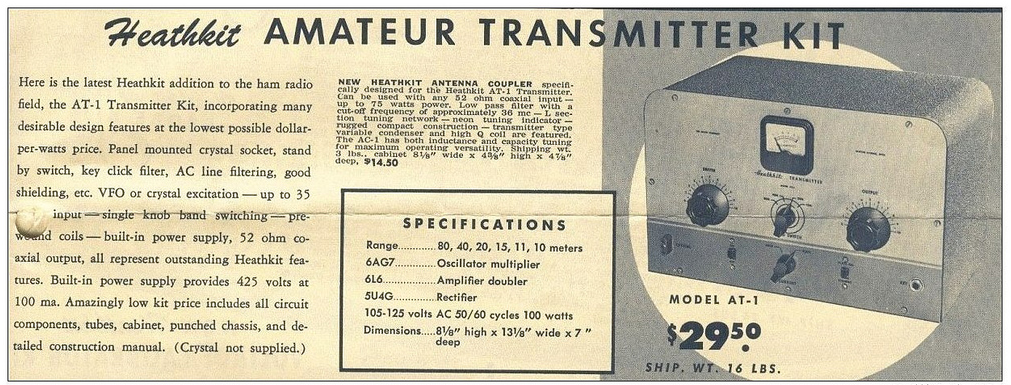 |
| For $29.50 and the loan of a few tools you could get some use out of that new novice license |
The earlier MOPA circuit from the ARRL handbook of 1941 below shows a layout remarkably similar to the circuit of the AT-1 although it is designed for plug in coils rather than the band-switching arrangement of the later Heathkit transmitter.
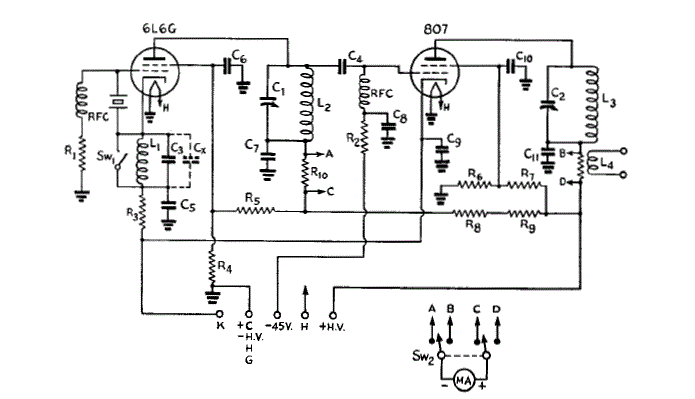 |
| MOPA transmitter using a 6L6 and an 807 as the power amplifier (ARRL Handbook 1941) |
For a little added complexity MOPA transmitters generally offered better stability of frequency and keying waveform than single tube crystal controlled or self exited rigs. The straight forward design of the AT-1 should have looked familiar to novice class hams after studying the ARRL handbook or other radio publications.
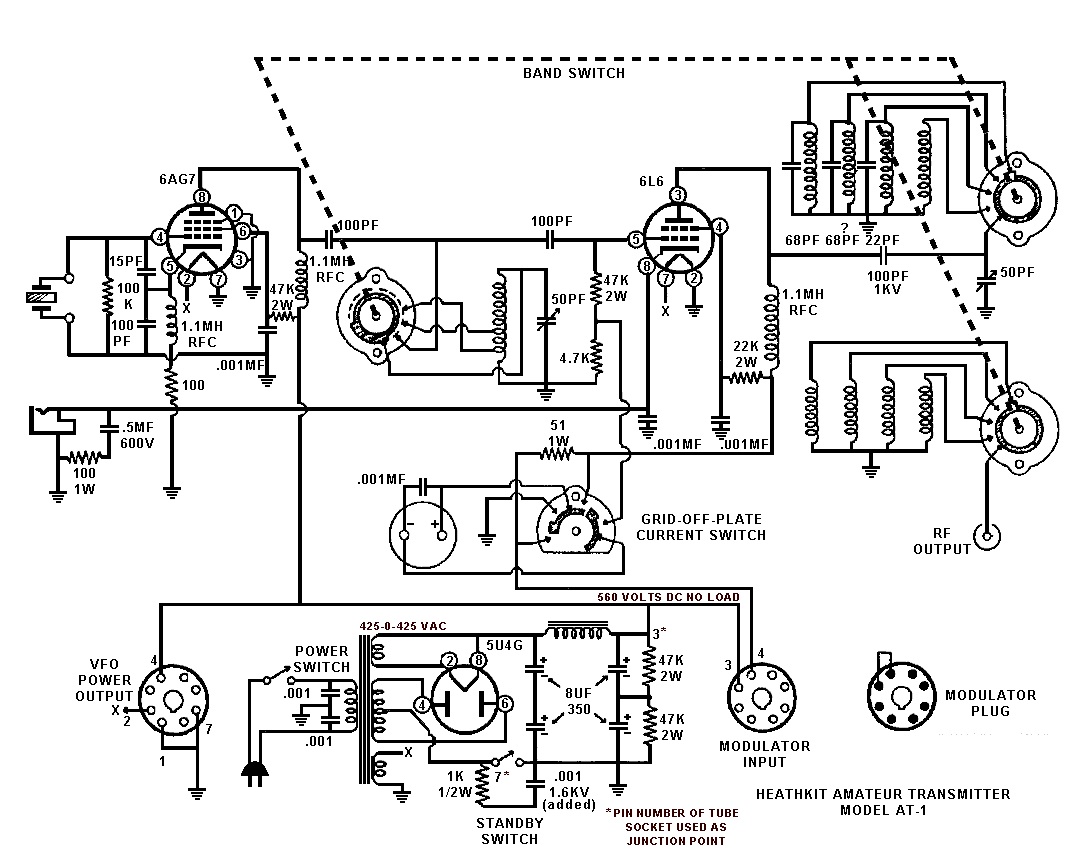 |
| Heathkit AT-1 Circuit diagram showing band-switching arrangement and link coupled output |
Once the novice had upgraded his license the AT-1 could be expanded by the addition of the Heathkit VF-1 variable frequency oscillator to allow transmission on any frequency within the allowed band.
 |
| The Heathkit VF-1 Variable Frequency Oscillator |
The VF-1 covered 160-80-40-20-15-11-10 meters and used an OA2 voltage regulator tube to provide a stable voltage for the oscillator. Ceramic coil forms, solid construction and high quality components were used to help increase stability.
 |
| The Heathkit AC-1 Antenna Coupler. Designed to attach to a single wire by the insulated post on the front panel. |
 |
| Heathkit AC-1 Antenna Coupler circuit diagram |
Although Heathkit did not produce a AM modulator for the AC-1 there is provision for modulator connection on the rear panel. The earlier ARRL manuals have several suitable circuits for modulators that would work with the AC-1. Most functioned by driving a modulation transformer with the output from an audio power amplifier. The secondary of the modulation transformer would be carrying the DC plate supply for the power amplifier tube plus or minus the instantaneous voltage of the audio waveform. By changing the plate voltage to the final amplifier tube the radio frequency output would be controlled by the amplified audio frequency resulting in amplitude modulation.
South Texas Balloon Launch Team launches balloon aimed at China
My daughter and I made the short trip to the No Label Brewing Company in Katy TX to watch the South Texas Balloon Launch Team launch a helium balloon aimed at Nanjing China. Thanks to Tom AE5QB for letting us know about this event!
To track the balloon in real time go to : http://aprs.fi/?call=a%2FKT5TK-11&_s=mb
From the press release of the South Texas Balloon Launch Team:
The South Texas Balloon Launch Team is pleased to announce the upcoming launch of its twenty-eighth, helium-filled, unmanned balloon in twenty one years. The purpose of this flight is to establish a world record for distance by floating a balloon from Katy, Texas to Nanjing, China.
The balloon will be released at approximately 3 P.M. CST on Saturday, February 11, 2012. The site of the launch is at the western end of the No Label Brewery complex at 5373 First St., Katy Texas, near the old rice grain silos.
The public is invited to this free event, with a special invitation to science students and teachers. Free helium-filled balloons will be available to the first 100 students. Sorry, no pets allowed in the balloon area.
The balloon payload package weighs only about five ounces (150 grams) and contains a high altitude GPS tracking system and a VHF amateur radio transmitter. To conserve weight and battery life, no camera equipment will be on board. The maximum altitude is expected to be above 100,000 feet, with horizontal speeds between 100 and 150 MPH. The balloon size will increase from about five feet to about 39 feet at maximum elevation. Recovery of the payload package is not expected.
Individuals may follow the balloon’s progress on the Internet by logging onto APRS, filling in the “track callsign” field with “kt5tk-11”, and change the “show last” to 24 hours.
The South Texas Balloon Launch Team is composed of about twenty active amateur radio “Ham” operators from a variety of occupations who donate their time and expertise.
We appreciate the continued support by No Label Brewing Company for our amateur radio projects.
The Road Home and Other Ham Radio Novels
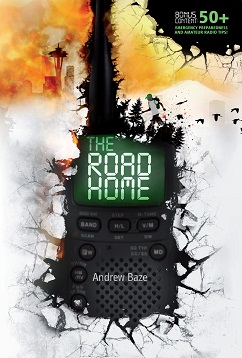

While this book is light reading, there is still some character development of the young man who is the main character of the story. Refreshingly, the boy’s father is his guide (rather than being marginalized or vilified as parents often are in teenage fiction). Not only does Mr. Baze inspire a young person to get a ham radio license, he succeeds in developing the moral imagination of his readers. The Road Home cultivates an affection for such admirable qualities as diligence, perseverance, courage, level-headedness, familial love, compassion, and a chivalric desire to avoid violence yet defend women from evil with deadly force when necessary.
You can read this book for free, if you have a Kindle and an Amazon Prime account, by borrowing it from the Kindle Owners’ Lending Library for Amazon Prime Members.
 Other novels that my children and I have enjoyed are those written by Cynthia Wall, KA7ITT: Night Signals, Hostage in the Woods, Firewatch!, Easy Target, Disappearing Act, and A Spark to the Past. These six books are a series chronicling the adventures of fictional characters Kim Stafford, KA7SJP, and her boyfriend Marc, KA7ITR. They are definitely aimed at children, but if you’re like me you’ll still read them — it’s so hard to find novels incorporating ham radio that you just can’t pass these up.
Another novel that incorporates ham radio is Cornbread Road, by Jeff Davis, KE9V. Mr. Davis released it as an audio-book in a series of podcasts in 2010-2011, and my wife and I enjoyed listening to it together. The podcast is not currently available but hopefully it will be back up soon. Cornbread Road is aimed at adults. The main character is a ham who gets involved with a secret society of ham radio operators led by a mysterious figure with a past, a ham who is an inventive genius and who is himself caught up in a web of international intrigue. While the plot may tax your ability to suspend disbelief, it is still an amusing story and throws in a little of everything in ham radio.
Do you have any ham radio novels to recommend? I dimly recall one or two that I nearly wore out as a child (back in the days when I would ride my bicycle to the local library and read my favorite books over and over), but I couldn’t tell you much about them now. If you know of any — and where to find them — please chime in with a comment!


Online Course: Introduction to Emergency Communication
As a pastor the months of December-January are the busiest of the year for me, so I haven’t done much with Ham Radio for weeks now. That is as it should be. As I’ve said before, we must keep our hobby in its proper place. But I haven’t let it completely die, and the hopper has slowly been filling up with things to share with you.
 One of those things is the ARRL’s online/mentored course, “Introduction to Emergency Communication.” I’ve registered for the next session of this course which begins on February 29 and runs through April 27. It cost me $50 as an ARRL member ($85 for non-members), but I think it’s worth the money in my situation.
Not that I have to go through this course to learn the material. Much of the material may well be common-sense or a review of what I already know after being a ham for so long. The rest I could pick up by simply reading this book or (probably better) this book. Or I could glean it all from the web or learn it from an experienced member of ARES. So why would it be worth $50 for me to go through a formal course of study?
The answer: for credibility with governmental agencies.
Like it or not, to gain respect from governmental agencies you need to prove that you’ve jumped through a few hoops — especially in a state like Minnesota. Several decades ago Minnesota figured out how important it is to train police officers well. As a former police trainer myself, I cringe when I see poorly-trained officers on COPS. Trust me — agencies that have invested in training are rarely interested in “help” from poorly-trained people, no matter how well intentioned.
So before we go to the local sheriff (who is in charge of emergency management for our county) and talk to him about ARES, we need to get our ducks in a row. Training is #1 — and to governmental workers, that means certification of some kind. Be ready to show Show them paperwork. Other things help too, like uniform vests, jackets, etc., but those things come second. (In fact, you can shoot yourself  in the foot with that stuff if you aren’t careful. Take it from me — as a former police officer I know what I’m talking about — if you overdo “the look” in your uniform, your amber light bars, etc. most cops will write you off as a wanna-be commando kid to be kept far away from the grown-ups. If you really want to impress them, wear a tie. Seriously!)
Furthermore, for certification to mean anything to governmental workers it needs to come from the biggest, most widely recognized institutions you can find. For ARES, that means FEMA and the ARRL. I know some hams don’t like the ARRL, and I may get pelted with comments about how terrible the ARRL is. But there it stands.
In order to register for this course you must first complete two free online courses offered by FEMA: IS-100.b, “Introduction to the Incident Command System (ICS 100)” and IS-700.A, “National Incident Management System (NIMS), An Introduction”. Whether or not you take ARRL’s course, you really ought to take these courses (especially the first one) if you ever want to participate in emergency services. I for one needed to brush-up on these things, and I appreciated how well they were done.
Once you successfully complete these online courses from FEMA (they don’t take long) you may register for the ARRL course on the ARRL website. Registration closes on Wednesday, February 15 for the session I’m enrolled in, and on Wednesday, March 15 for the session that begins on March 28. There is still plenty of room in my session — of the 30 seats available, only 21 have been taken as I write this on February 4.


Pop’s Shed and the Kingsley Radio AR7
After my grandfather passed away I spent a lot of time recalling the good times I had spent scrounging around his CB shack and hanging out with Pop “down the shed”. If you’ve spent time around old motorbikes, retired lawn mower engines, vacuum tube electronics and inches of dust you know what the shed smelt like and probably have a pretty good idea what it looked like as well. I used to be able to send Mum into fits by embedding a combination of oil, grease, dust and grinding compound into the knees and sleeves of my good clothes after spending the day “over south” (South Geelong)
Even now I can still walk into any old auto mechanics and the smell brings back dozens of memories as clear as day … but one memory in particular had been bugging me for a while now. On several occasions I had used a magnificent rack mounted shortwave receiver that had been hooked to a long-wire antenna between the shed and the house. It had several plug in coils housed in bright metal boxes, one for each band as well as a unique tuning dial that had windows around the circumference with numbers that updated as the dial was turned.
 |
| National HRO right? … Nope, its an Australian clone! |
For the longest time I was thinking what you are probably thinking now, I had been using a National HRO receiver right? Well, you’d be wrong … just as I had been for years! When I eventually asked my uncle about the receiver (I waited a long time as I feared it had been thrown out & honestly didn’t want to know if it had) he said, “The AR7?” … “Yes, its here in the garage covered in dust”. He went on to say that I could have the receiver if I could figure out some way to ship it … not a slight problem given the receiver, power supply and speaker are over 120 lbs!
Knowing now that I had been using a completely different receiver I set to work and found out what I could about this National HRO clone …
From : http://www.vk2bv.org/
The AR7 was produced during WW2 by Kingsley Radio of Melbourne for the R.A.A.F. These receivers were used in ground stations for long range communication over fixed circuits as well as for receiving signals from aircraft.
The AR7 was based largely on the National (USA) HRO model, a fact that did not go unnoticed by National. This was the subject of litigation during the war years. Over 3000 of these receivers were produced and for their time, produced excellent performance.
These sets were very popular with radio amateurs after the war and unfortunately subject to many modifications. The Wireless Institute of Australia station, VK2WI at Dural New South Wales was equipped with modifed AR7’s for many years. I seem to remember that very local operators could block the receivers completely, resulting in hurried phone calls!
An unmodified AR7 is a rare beast. The Department of Civil Aviation used these sets for many years in a highly modified form, requiring a new front panel. Refinements included squelch and crystal locked coil boxes.
From : http://www.shlrc.mq.edu.au/~robinson/museum/AR7/
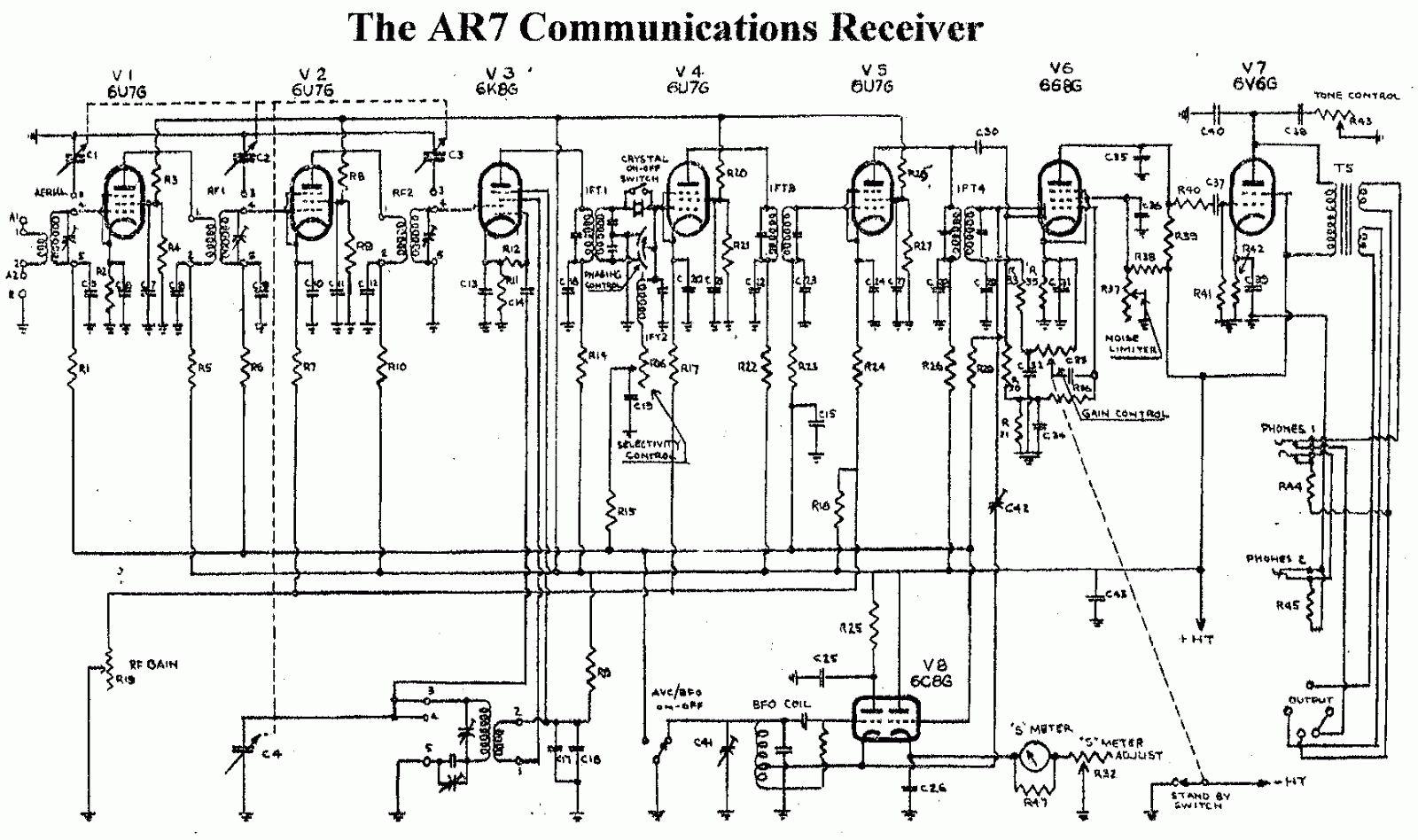
The AR7 is a communications receiver covering LF and HF bands. It was made in Australia during 1940 and bears an extremely close resemblance to the National HRO receiver. The receiver has a tuning range from 138 kcs to 25 mcs, with a gap of 45 kcs either side of the 455 kcs IF amplifier. The internal design is a single conversion superheterodyne receiver with 2 RF stages, 2 IF stages, a BFO and an “S” meter amplifier. The sensitivity is quoted as 1 microvolt. The front panel is stainless steel and it is a very distinctive looking receiver.
It is a good performer, sensitive, has a nice feel, is easy to tune, but hard to find the correct frequency, by reading the frequency from the dial number and coil box graph. It really needs a crystal calibrator. I use it for the weekly W.I.A. (Wireless Institute of Australia) broadcast, so it gets turned on once a week, and is so stable, than I don’t have to retune. It is very clear for AM but a bit fiddly for SSB.
The controls are: RF gain, BFO note, AVC/BFO switch, Adjust “S” meter, Tone, Tuning, Noise limiter, Selectivity, Crystal IN/OUT switch, Crystal Phasing, Audio gain. The Audio gain control has an OFF position which removes the HT so that the coil boxes can be changed.

It has two 6U7G RF stages, a 6K8G mixer, two 6U7G IF stages at 455 kcs, a 6G8G detector/AVC/audio preamplifier, and a 6V6G audio output amplifier. It has a 6C8G twin triode as a BFO and “S” meter amplifier. It also has a crystal filter. The IF alignment should be done very carefully, as any misalignment will reduce the effectiveness of the filter. It is best done with a sweep generator. The 6 volt valve heaters are connected in series, for 12 volt operation.
The external power supply and speaker, are usually mounted in a short 19″ rack, the AR7 at the bottom, the speaker in the middle, and the power supply at the top. The complete unit weighs about 118 pounds. The power supply was switchable between 12v and 240v.
The receiver was used as a ground monitoring receiver for aircraft. It was extremely stable. The model shown has an R.A.A.F. nameplate, and serial number 1786. The manual I have is a D.C.A. (Department of Civil Aviation) version and is a 1947 issue.
It has 5 plug in coil boxes. The coil boxes are: band A 140-405 kcs, band B 490-1430 kcs, band C 1.420-4.3 mcs, band D 4.25-12.5 mcs, band E 12.5-25 mcs. The Army version had an extra coil box covering 50-150 kcs. The large dial is a 20:1 reduction drive and has graduations from 0 to 500. It acts like a flywheel when tuning across the band, and has an effective scale length of 12 feet. The dial shaft goes into a right angle reduction gearbox and has 2 output shafts that drive 2 dual gang capacitors. The graph on the front of each coil box is used to covert the dial reading to frequency.














