Posts Tagged ‘amateurradio.com’
 Finished with “Introduction to Emergency Communication!”
 April 20th, 2012 |
  Author:
 Assuming my final assignments are acceptable to my mentor, I’m finally done with my online ARRL course! “Introduction to Emergency Communication (EC-001)” began on February 29, and it officially ends next Friday, April 27. I wrapped it up tonight since next week is going to be pretty full.
When I signed up for this course I had no idea I would learn so much. I highly recommend it to every ham, no matter how long you’ve had your license. The text really is well done, the assignments are far from busy-work (they took me places I’d never gone before, and probably wouldn’t have gone had I just read the book), and if all the mentors are like the mentor I had (Sena Frank, NI1Y), you’ll receive sound advice and have a great time.
Now I’d like to take the next course in the sequence! “Public Service and Emergency Communications Management for Radio Amateurs (EC-016)” is free, I see. But I’ll probably take a week or two off before taking that on. You can learn more about these online courses at http://www.arrl.org/online-course-catalog.
I’ll end this post with the syllabus of the course I just completed, so you can see what is covered:
Course Syllabus for Introduction to Emergency Communication (EC-001)
Section 1: The Framework: How You Fit In
1. Introduction to Emergency Communications
2. Amateurs as Professionals
3. Network Theory and Design
4. Emergency Communications Organizations and Systems
5. Served Agency Communications Systems
A. Served Agency Communications Systems
B. Working Directly with the Public
Section 2: The Networks for Messages
6. Basic Communications Skills
7. Net Operations:
A. Basic Net Operations
B. Introduction to Emergency Nets
C. Net Operating Guidelines
D. The FCC Ruling on Drills and Employees
8. The Net Control Station
9. Net Control Station Operator Practices
10. The Net Manager
11. Introduction to the National Traffic System
12. Specialized Net Operations
13. Severe Weather Nets
Section 3: Message Handling
14. Basic Message Handling – part 1
15. More Basic Message Handling – Part 2
Section 4: What Happens When Called
16. The Incident Command System
17. Preparing for Deployment
18. Equipment Choices
19. Emergency Activation
20. Setting Up, Initial Operations and Shutdown
Section 5: Considerations
21. Operations & Logistics
22. Safety & Survival
23. ARES® PIO: The Right Stuff
24. Alternative Communication Methods
25. What to Expect in Large Disasters
26. Hazardous Materials Awareness
27. Marine Communications
Section 6: Alternatives and Opportunities
28. Modes, Methods and Applications
29. Other Learning Opportunities
Final Assessment


The further adventures of the Heathkit AT-1
Work has been conspiring to eliminate my spare time but I was able to spend a few hours over the Easter holiday to clean up the shack and make space to put the Heathkit AT-1 on the desk again. I have been able to spend a little time going over parts that need to be replaced and making a list.
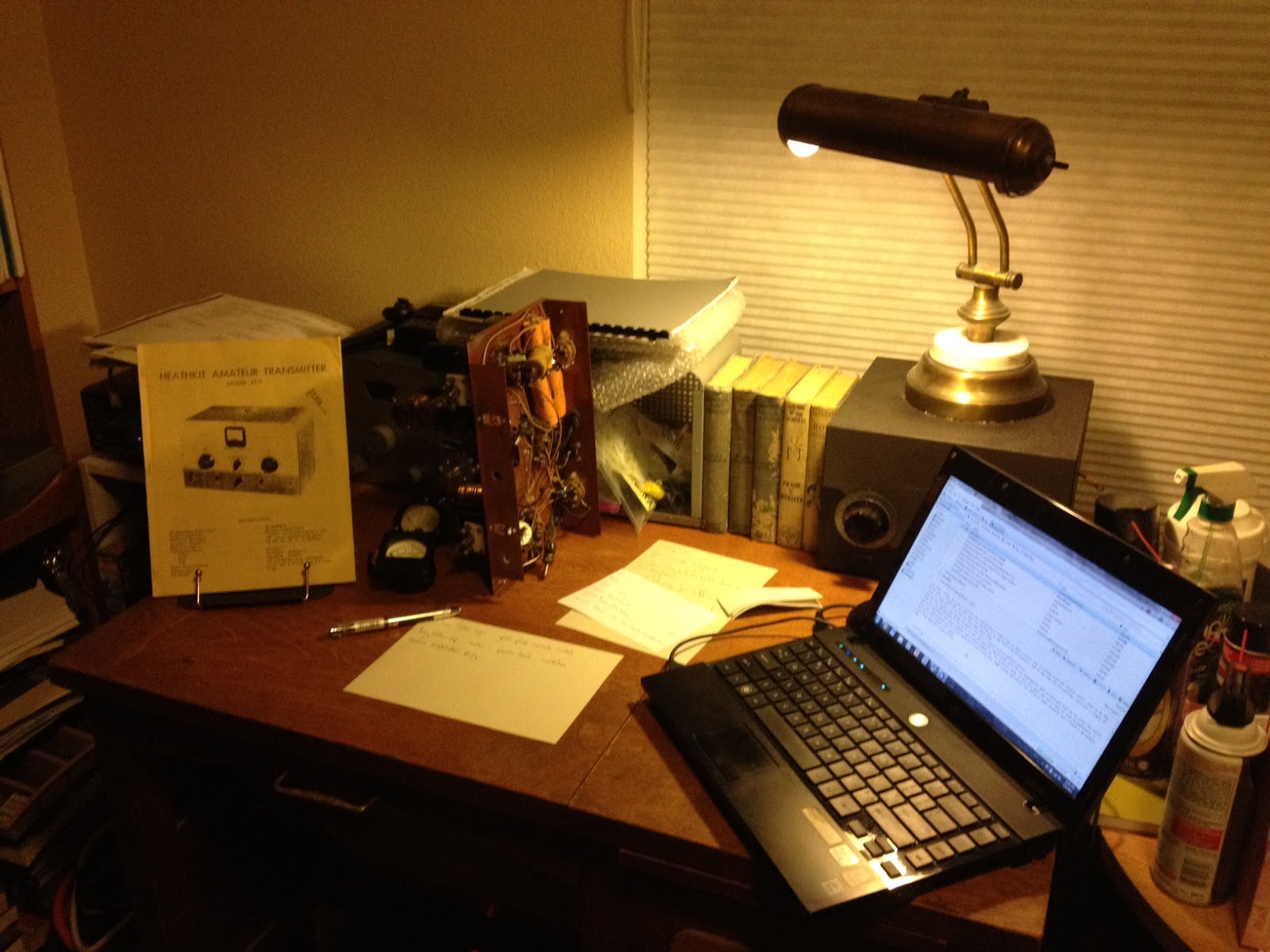 |
| The Heathkit AT-1 chassis with case and VFO-1 behind. |
There doesn’t seem to be any show stoppers although the wafer of the meter switch has broken in two and will need to be repaired. If I’m not able to repair it then thankfully it is fairly simple and replacement rotary switch can be substituted.
This isn’t going to be a museum quality restoration but the changes that were made to this transmitter in the past were sensible and if left in place are representative of period modifications. The original meter for example was not the highest quality and a Western or Simpson replacement would be an improvement. The original slide switches have been replaced with period snap-toggle switches which are also an improvement over the original.
The Heathkit VFO-1 however has been modified for grid-block keying which is a significant departure from the original and I plan to revert it back to cathode keying. Although a technical improvement it is not in keeping with the original design and needs to be undone. Everyone will have their own opinion but I think if I wanted modern circuits I’d get a more modern rig, so the VFO-1 will be returned to stock.
Hopefully I can carve out a bit of time here and there to work on this and slowly return it to working condition.
A Wasted Trip Thoroughly Unwasted
Last Saturday I picked up Andrew (KCØYFY) and his wife Joleen (KDØDOT) at 8:00 A.M. and headed for the monthly meeting of the West Central Minnesota Amateur Radio Club. It’s a 45 minute drive from Granite Falls, so we had plenty of time to talk. But once we got to the location of the meeting, our conversation took an abrupt turn. We were the only ones there!
Andrew asked, “You don’t think the meeting got canceled because of Easter weekend?”
I groaned. No way! “Here,” I said, grabbing my cellphone, “let me give Dean a call.” Dean (NYØI), the fellow who first invited me to join the club, is the Energizer bunny rabbit of ham radio — especially when it comes to building and maintaining the VHF/UHF repeaters out our way. But we quickly discovered that none of us had his phone number.
“Wait a minute!” I said. “We’re HAMS! Let’s call somebody on the radio!” What a novel idea. To think of using a radio instead of a cell phone to call another ham! I put down my cellphone and grabbed my HT. “NØIP monitoring,” I called on the local repeater.
“NYØI,” came back Dean! “The meeting has been rescheduled to next Saturday,” he explained when I inquired. “We published it on our Facebook page and announced it on the net. Sorry!” Again, I groaned. Down in Granite Falls I can’t hear the repeater they use for their net, and I long ago suspended my infernal Facebook account. “But how about I meet you for breakfast?” Dean asked.
I looked at Andrew and Joleen, who nodded. “Sure!” I replied. “Where do you want to meet?”
After getting directions to a small-town diner just up the street, we headed there and found a table. Within minutes, Dean arrived. When the waitress came by, he asked, “What’s your birthday special?”
“It’s your birthday?!” I asked. Sure enough, it was his birthday, and he had dropped everything to meet us at a moment’s notice. What a guy!
After a great conversation that ranged from ham radio to church life, Dean invited us up to the repeater site on the edge of town. We piled into our cars and headed over to the tower of the local FM broadcast station, where Dean pointed out three verticals mounted partway up. These were the antennas for the two repeaters he had there, he explained. Two huts crouched at the foot of the tower; one was the FM broadcast station’s, and the other the local sheriff’s (for their own repeater which used an antenna at the very top of the tower). Dean took us into this second hut, which also contained his two repeaters — one on 2 meters, and the other on 75 cm.
I had never seen a repeater in my life. Dean explained how they worked, and he told us about past equipment and current plans to improve what they had. Having been an HF CW guy all my life, I felt like a tourist in a foreign country — and I enjoyed every minute of it! After thanking Dean, the three of us headed back to Granite Falls.
On the long drive home, we continued the conversation we’d begun on the way there. The local ARES® Emergency Coordinator position is open, and Andrew is wondering if I might consider taking it. I promised him I’d contact the DEC and learn more about what is involved. Lots to think about!
As far as attending the club meeting that never happened, I suppose it was a wasted trip. But thanks to Andrew, Joleen, and Dean it most definitely was not wasted! After all these years as a ham, I’m finally meeting fellow hams in person. I wish I’d done it sooner.


The 2012 MNVOAD Training Conference: Lake County RACES/ARES®
This post was updated on 4/2/12 after Mr. Angelos kindly corrected me on several points.

Mr. Peter Angelos, KCØKRI
The 2012 MNVOAD Training Conference was well-worth attending! My favorite part, of course, was the presentation by Peter Angelos, KCØKRI, on the Lake County, MN RACES/ARES® response to the Pagami Creek Fire in September, 2011. His “keystone” speech was the first of the many sessions that day, and the only plenary session (the other 15 sessions were breakouts). While he focused upon RACES/ARES®, he also discussed principles that apply to any voluntary organization.
Here are my notes from Mr. Angelos’ presentation, in the order presented:
- The Pagami Creek Fire
- RACES/ARES® fills gaps in existing communication-systems, and reduces load on those systems.
- A lightning strike on 8/18/11 13 miles east of Ely started a fire that ultimately caused $23M in response expenses in Lake County. On 9/12/11 this became the largest fire in Minnesota since 1918, with 92,682 acres and over 800 workers assigned through 10/17/11. Fires are an annual occurrence in Lake County, the home of the famed BWCA (Boundary Waters Canoe Area); what made this fire unusual was its size.
- Cell phone coverage is the only phone service available in some parts of the area, and in some parts not even that. An 800 MHz public-safety trunked system using portable antennas was also set up to provide coverage.
- Many hours of training and dedication go into RACES/ARES® in preparing for an event like this.
- RACES/ARES® personnel stayed far behind the actual fire line.
- The Lake County RACES/ARES® group is a “spring chicken,” having been organized in mid-2009.
- On 9/12/11, RACES/ARES® was activated when the fire suddenly grew from 11,000 to 70,000 acres in only 24 hours due to winds gusting up to 35 mph. This drove the fire 16 miles in one day, toward a populated area. As evacuations increased, RACES/ARES® was activated. (In the Q & A that followed, one person asked how many messages were passed. Mr. Angelos said that only a handful of messages were actually passed. The activation of RACES/ARES® was a proactive attempt to prepare for a catastrophe in case this fire reached populated areas. When it became clear that this was not a threat, RACES/ARES® was deactivated.)
- As the smoke plume blew as far as Milwaukee, WI and Minneapolis, MN, the potential for health & welfare inquiries increased.
- A RACES/ARES® communicator was attached to the evacuation shelter manager. Hams were also located at the incident command post, staging area, evacuation checkpoints, and the EOC. The goal was to handle non-emergency traffic to take the load off police, fire, and rescue channels.
- The log of messages kept by RACES/ARES® is helpful for post-event evaluation.

Lake co. RACES/ARES® portable tower, AMCV and MCT deployed at a Canadian National RR mock fuel spill exercise in Two Harbors MN on September 14, 2010. Photo by BJ KDØHHW. (http://n0lcr.org)
The Lake County RACES/ARES® group uses two state-of-the-art vehicles, each outfitted with a PSN (Public Switched Network capable of establishing a cellphone network), as well as 2m/75cm FM/Packet and all HF modes including WinLink, WINMORE, Pactor, and other digital modes. One of these vehicles is a trailer of their own (the “MCT”), while the other is an RV (the “AMCV”) purchased by an 11 county consortium in the northeast Minnesota Arrowhead Region (with help from a grant). This vehicle can provide video conferencing and internet connection via satellite.
- The repeater network available is huge, extending from Ely, MN to Solon Springs, WI.
- RACES/ARES® deployed for a total of five days, suspending operations on 9/16/11 after contributing 633 man-hours. The Lake County RACES/ARES® group provided 445 of these hours, with the remainder provided by mutual aid from RACES/ARES® groups in four neighboring counties.
- The Relationships Necessary for Success
- The Lake County RACES/ARES® group would never have been invited to participate if it weren’t for the well-established relationships that had been built with Lake County Emergency Management and the Lake County Sheriff’s Office.
- Professional conduct and standard ICS documentation-procedures are essential for establishing credibility with served agencies.
- Served agencies expect to see stuff like this duty roster.
- None of this could have happened without the “four C’s” (communication, coordination, collaboration, and cooperation), the hallmark of VOAD. They couldn’t invite themselves to drills — they had to participate in non-emergency events like local marathons and sled dog races to demonstrate their capability and build relationships. Only then did they get invited to their first drill.
- Lake County RACES/ARES® volunteers are required to complete FEMA courses IS-100b, IS-200b and IS-700a.
- These hams are volunteers with the Lake County Emergency Management Department. They are required to have security background checks, they all have photo ID’s issued by Lake County, and they are even insured by the county.
- As a result of this relationship-building, the Lake County Emergency Manager got her amateur radio license (KDØHHW) and joined this RACES/ARES® group herself.
- So much credibility has been established with served agencies that this RACES/ARES® group has been entrusted with the housing and maintenance of the AMCV.
- Building these relationships is “complicated” but worth it. Their relationships are so good now, Mr. Angelos said, “We even have a Christmas pot-luck dinner together.”

Not only was this presentation of RACES/ARES® center-stage at the conference, but the Bloomington, MN Amateur Radio Association had a great display set up out in the vendor’s area, complete with a couple of Buddipoles and HF/VHF radios. Mr. Wayne Snyder, KCØZJB was kind enough to send me some photographs:
If you get a chance to attend a VOAD conference like this, I heartily encourage you to do so. Not only did I learn from KCØKRI’s presentation, I also learned quite a bit from several other breakout sessions. It is clear that ARES® work is not conducted in a bubble. To be efficient and effective (much less to even be invited to participate) in an emergency we must develop relationships with the agencies we serve, from governmental entities to other voluntary organizations. The time to do that is not at the time of the emergency itself, but long before. Conferences like this one can be a great way to learn from each other.


Now I understand – Measuring capacitance with a micro-controller
The excellent article by Rajendra Bhatt explains not only how capacitance can be measured but also how a micro-controller can be interfaced to an analog circuit to create a useful piece of test equipment.
 |
| Capacitance meter by Rajendra Bhatt |
I found the explanation of the RC time constant method of measurement as interesting as the micro-processor project itself and congratulate Raj on demonstrating a practical and workable real-life example of what can normally be a dry textbook subject.
SKYWARN Training, and a Word of Advice About Amber Lights
 Over the last 30 years I’ve attended quite a few SKYWARN Storm Spotter training sessions, and I’ve always found the time well-spent. When I lived in the Twin Cities, Metro SKYWARN was simply part of being an amateur radio operator — there, SKYWARN is primarily a ham radio operation, and I got involved when I was a teenager. Later as a police officer I attended SKYWARN training in that capacity, but it was obvious that cops and firefighters weren’t nearly as effective as the ham radio operators who formed the well-oiled machine of Metro SKYWARN.
It’s a bit different out here in rural Minnesota. While some parts of rural Minnesota are connected via a hub-and-spoke repeater system to KØMPX — located right in the Chanhassen office of the NWS — such is not yet the case here in Granite Falls. Out here the well-oiled machine of storm spotters is the local fire department. Until we get the local repeater EchoLinked to KØMPX, ham radio operators must rely upon their cell phones to call in storm reports (unless of course they’re firefighters, who have their own radio net).
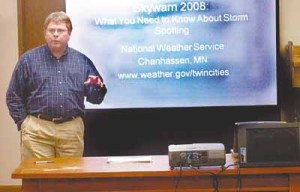
Todd Krause, KBØSGH, Warning Coordination Meteorologist with the National Weather Service, giving SKYWARN training in 2008. (Photo obtained from www.nujournal.com).
In any case SKYWARN training does come to our small town, thanks to the tireless efforts of Mr. Todd Krause, KBØSGH, a true gentleman and an excellent teacher. He’s on the road quite a bit in the spring of each year, putting on storm spotter classes all over Minnesota. Our class was two days ago, from 7:00-9:00 P.M., and the room was packed!
If you haven’t attended a SKYWARN class, or if it’s been a while since you have, I encourage you to find a training session near you (click here) and attend. This is the time of the year when these classes are offered, but we’re nearing the end of this year’s schedule — you’ll want to act quickly. In my experience you’ll need to attend this training more than once to really get the hang of it. It’s easy to identify the features of a storm by looking at pictures in the classroom, with the instructor right there to help you, but it’s much more difficult to do so out in the field. This class will help you distinguish between what really matters and what merely looks scary as you look up into the sky. More than once I’ve been with untrained people who freak out because of a scary-looking cloud, e.g. a rapidly rotating shelf cloud, and I’ve been able to calm them down by explaining what’s really happening.
One word of advice — if you do get into SKYWARN spotting, don’t go nuts decking out your car with amber lights and cheesy stickers/decals, okay? Even untrained observers know that stuff is for your ego, not for your storm spotting. They’re not impressed; they’re rolling their eyes. I don’t want to embarrass anybody in particular so I won’t provide any links, but a little Googling will show you how silly some storm spotters can be. I just saw one a few weeks ago with a bunch of amber lights on the rear deck of his car along with SKYWARN stickers and other home-made stickers proclaiming to the world that he is a Very Important Person as an Officially Certified Storm Spotter. Truly cringe-worthy! If you have this stuff, would you mind removing it? Maybe one SKYWARN sticker isn’t such a bad idea, but the other stuff is an embarrassment to the rest of us.
When I was a police officer I had all sorts of insignia and lights on my patrol car, but guess how much of it helped me when storm-spotting (with my 2m HT in my hand)? None of it. Ever. Flashing lights (including amber ones) can snarl traffic and even cause accidents if you use them, whether you’re driving or pulled over. Unless they’re absolutely necessary, they shouldn’t be used at all — and when it comes to storm-spotting, they’re almost never necessary. If you’re going to do your storm spotting from your car, drive the speed limit, obey all traffic laws, find a good vantage point where you can park safely, and you won’t even need the four-way flashers that came with your car.


Today’s QSO with KØLR, Who Gave Me My Novice Code Test in 1978
My online ARRL course, “Introduction to Emergency Communication,” is in full swing. I’m happy to say that it is pretty demanding. Not that the material itself has been especially difficult (yet), but the essay-assignments do require some thought — and other assignments are pushing me to do some new things on the air, like listening to several nets, critiquing an NCS (Net Control Station), and checking into a net (okay, I probably have checked into a net or two over the years, but it’s been so long that I hardly remember doing it).
Today I reaped some unexpected benefits from one of these assignments. Having been assigned to check into a formal net, I checked into the PICONET this morning. This was no small feat, since it was on 75 meters. My New Carolina Windom is only cut for 40 meters, and the automatic tuner on my Kenwood TS-440S has never been able to match it — the SWR is terrible! But using my old Drake MN-7 Matching Network, I was able to match it surprisingly well. So now I’m on 80/75 meters! I even made a CW contact with a fellow in Wisconsin, and got a decent signal report.

Lyle Koehler, KØLR, with Katharine Lord, KØTHY (photo copied from the PICONET website)
And after checking in this morning, I visited the PICONET website — and learned that Lyle Koehler, KØLR, would be the NCS for the PICONET this afternoon! Wow! Lyle is the ham who gave me my Novice code test back in 1978. I was only 10 years old, but I remember it like it was yesterday. I’ll never forget how I shook like a leaf on the couch in his living room while he sat beside me and tapped out 5 wpm code with a straight key and oscillator. When he told me I passed, I couldn’t wipe the grin off my face for the rest of the day!
So the thought of talking with Lyle again after all these years was enough to make me watch the clock, eager for the PICONET to open again at 1500 CDT. And sure enough, at the appointed hour I heard Lyle’s voice as he opened the net! I was his first check-in, and I took advantage of the net’s slow start to explain that he had given me my Novice code test over three decades ago. He remembered me!
What a pleasure to meet this fellow on the air after all these years.
















