Posts Tagged ‘amateurradio.com’
 Now I understand – Measuring capacitance with a micro-controller
 March 27th, 2012 |
  Author:
 The excellent article by Rajendra Bhatt explains not only how capacitance can be measured but also how a micro-controller can be interfaced to an analog circuit to create a useful piece of test equipment.
 |
| Capacitance meter by Rajendra Bhatt |
I found the explanation of the RC time constant method of measurement as interesting as the micro-processor project itself and congratulate Raj on demonstrating a practical and workable real-life example of what can normally be a dry textbook subject.
SKYWARN Training, and a Word of Advice About Amber Lights
 Over the last 30 years I’ve attended quite a few SKYWARN Storm Spotter training sessions, and I’ve always found the time well-spent. When I lived in the Twin Cities, Metro SKYWARN was simply part of being an amateur radio operator — there, SKYWARN is primarily a ham radio operation, and I got involved when I was a teenager. Later as a police officer I attended SKYWARN training in that capacity, but it was obvious that cops and firefighters weren’t nearly as effective as the ham radio operators who formed the well-oiled machine of Metro SKYWARN.
It’s a bit different out here in rural Minnesota. While some parts of rural Minnesota are connected via a hub-and-spoke repeater system to KØMPX — located right in the Chanhassen office of the NWS — such is not yet the case here in Granite Falls. Out here the well-oiled machine of storm spotters is the local fire department. Until we get the local repeater EchoLinked to KØMPX, ham radio operators must rely upon their cell phones to call in storm reports (unless of course they’re firefighters, who have their own radio net).
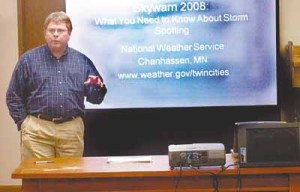
Todd Krause, KBØSGH, Warning Coordination Meteorologist with the National Weather Service, giving SKYWARN training in 2008. (Photo obtained from www.nujournal.com).
In any case SKYWARN training does come to our small town, thanks to the tireless efforts of Mr. Todd Krause, KBØSGH, a true gentleman and an excellent teacher. He’s on the road quite a bit in the spring of each year, putting on storm spotter classes all over Minnesota. Our class was two days ago, from 7:00-9:00 P.M., and the room was packed!
If you haven’t attended a SKYWARN class, or if it’s been a while since you have, I encourage you to find a training session near you (click here) and attend. This is the time of the year when these classes are offered, but we’re nearing the end of this year’s schedule — you’ll want to act quickly. In my experience you’ll need to attend this training more than once to really get the hang of it. It’s easy to identify the features of a storm by looking at pictures in the classroom, with the instructor right there to help you, but it’s much more difficult to do so out in the field. This class will help you distinguish between what really matters and what merely looks scary as you look up into the sky. More than once I’ve been with untrained people who freak out because of a scary-looking cloud, e.g. a rapidly rotating shelf cloud, and I’ve been able to calm them down by explaining what’s really happening.
One word of advice — if you do get into SKYWARN spotting, don’t go nuts decking out your car with amber lights and cheesy stickers/decals, okay? Even untrained observers know that stuff is for your ego, not for your storm spotting. They’re not impressed; they’re rolling their eyes. I don’t want to embarrass anybody in particular so I won’t provide any links, but a little Googling will show you how silly some storm spotters can be. I just saw one a few weeks ago with a bunch of amber lights on the rear deck of his car along with SKYWARN stickers and other home-made stickers proclaiming to the world that he is a Very Important Person as an Officially Certified Storm Spotter. Truly cringe-worthy! If you have this stuff, would you mind removing it? Maybe one SKYWARN sticker isn’t such a bad idea, but the other stuff is an embarrassment to the rest of us.
When I was a police officer I had all sorts of insignia and lights on my patrol car, but guess how much of it helped me when storm-spotting (with my 2m HT in my hand)? None of it. Ever. Flashing lights (including amber ones) can snarl traffic and even cause accidents if you use them, whether you’re driving or pulled over. Unless they’re absolutely necessary, they shouldn’t be used at all — and when it comes to storm-spotting, they’re almost never necessary. If you’re going to do your storm spotting from your car, drive the speed limit, obey all traffic laws, find a good vantage point where you can park safely, and you won’t even need the four-way flashers that came with your car.


Today’s QSO with KØLR, Who Gave Me My Novice Code Test in 1978
My online ARRL course, “Introduction to Emergency Communication,” is in full swing. I’m happy to say that it is pretty demanding. Not that the material itself has been especially difficult (yet), but the essay-assignments do require some thought — and other assignments are pushing me to do some new things on the air, like listening to several nets, critiquing an NCS (Net Control Station), and checking into a net (okay, I probably have checked into a net or two over the years, but it’s been so long that I hardly remember doing it).
Today I reaped some unexpected benefits from one of these assignments. Having been assigned to check into a formal net, I checked into the PICONET this morning. This was no small feat, since it was on 75 meters. My New Carolina Windom is only cut for 40 meters, and the automatic tuner on my Kenwood TS-440S has never been able to match it — the SWR is terrible! But using my old Drake MN-7 Matching Network, I was able to match it surprisingly well. So now I’m on 80/75 meters! I even made a CW contact with a fellow in Wisconsin, and got a decent signal report.

Lyle Koehler, KØLR, with Katharine Lord, KØTHY (photo copied from the PICONET website)
And after checking in this morning, I visited the PICONET website — and learned that Lyle Koehler, KØLR, would be the NCS for the PICONET this afternoon! Wow! Lyle is the ham who gave me my Novice code test back in 1978. I was only 10 years old, but I remember it like it was yesterday. I’ll never forget how I shook like a leaf on the couch in his living room while he sat beside me and tapped out 5 wpm code with a straight key and oscillator. When he told me I passed, I couldn’t wipe the grin off my face for the rest of the day!
So the thought of talking with Lyle again after all these years was enough to make me watch the clock, eager for the PICONET to open again at 1500 CDT. And sure enough, at the appointed hour I heard Lyle’s voice as he opened the net! I was his first check-in, and I took advantage of the net’s slow start to explain that he had given me my Novice code test over three decades ago. He remembered me!
What a pleasure to meet this fellow on the air after all these years.


Ham Radio and Mesh Networks
Lately I’ve been fascinated by the capabilities of mesh networks. The ability to quickly create ad-hock computer networks could be an invaluable resource for amateur radio operators in general and particularly for emergency communications (EMCOM)
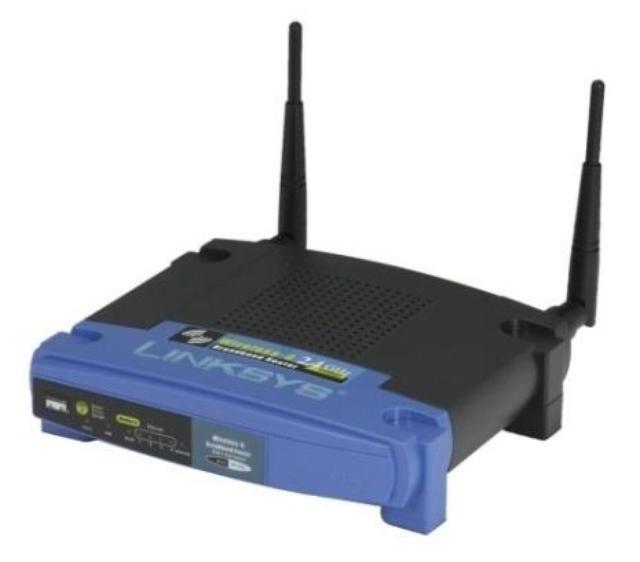
The particular device and software I have been experimenting with is the Linksys WRT54G router and HSMM-MESH firmware from http://hsmm-mesh.org/.
Installing the HSMM-MESH firmware changes the way the Linksys router functions and allows it to automatically connect to other HSMM routers in a mesh network. No special configuration is required after setting your callsign. All TCP/IP configuration is pre-configured, even down to automatically assigning addresses to connecting clients.

Mesh networks are highly fault tolerant. Every router in the network is aware of every other router and has the ability to move network packets through from one unit to another provided there is a link, or chain of linked routers, between them.
In the diagram to the right each router is represented by a numbered circle. If router number 6 were to fail then network packets that needed to move between router 1 and 7 would travel through routers 2 & 3 or 5 & 10 until 6 was repaired. All this happens automatically and quickly enough so that there is no disruption to the traffic.
Anything you can access on a normal computer network can be made to work on a mesh network. Some of the services that have been demonstrated include email, voice over IP (VOIP), video conferencing, file sharing, web servers & groupware applications.
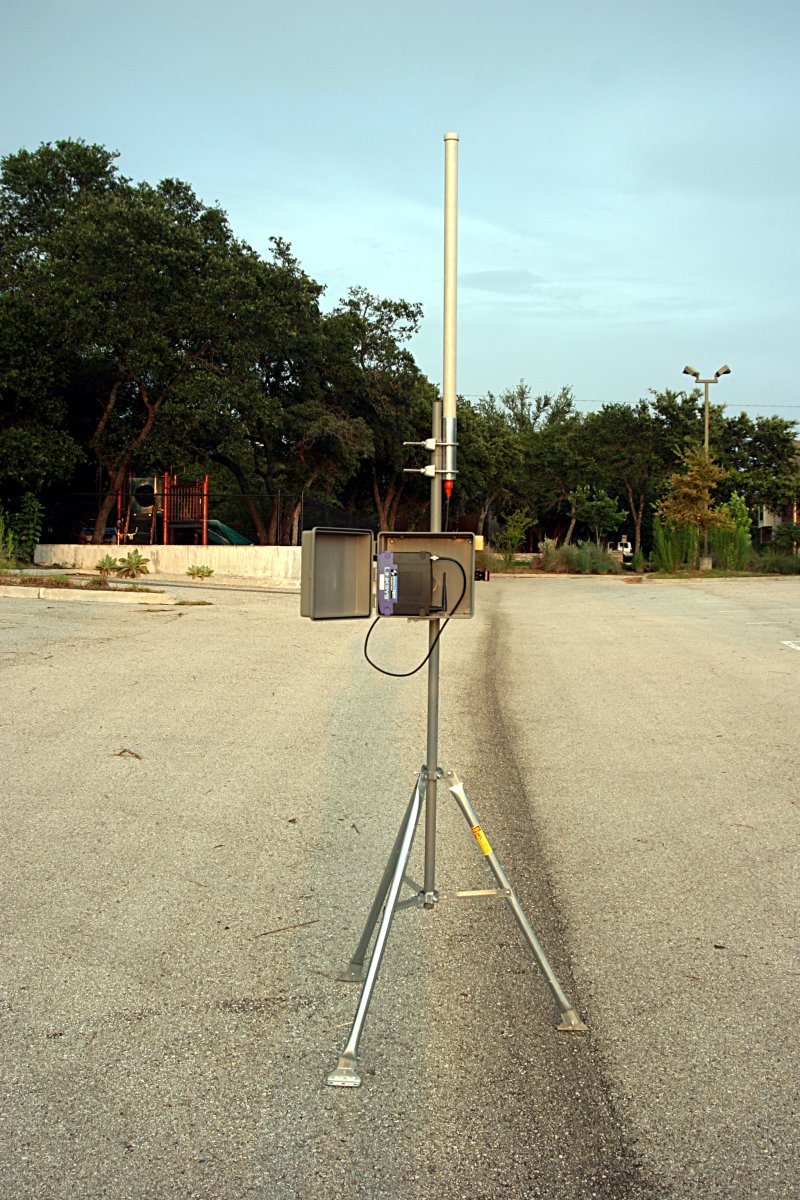 With simple modified antennas the modest output power from the WRT54G (100 to 200mW) can be used to reach distances of many miles or tens of miles with directional antennas. Mounting the router on a mast in a sealed enclosure can reduce losses from long cable runs while running off 12V power makes them compatible with ham radio power sources including solar and wind power.
The example to the left is from NG5V located on hsmm-mesh.org and consists of an omni-directional external antenna and a lawn sprinkler controller box from a popular home improvement store.
Did you know that … Frequencies used by channels one through six of 802.11b and 802.11g fall within the 2.4 GHz amateur radio band. Licensed amateur radio operators may operate 802.11b/g devices under Part 97 of the FCC Rules and Regulations, allowing increased power output but not commercial content or encryption.
I hope to acquire a few more WRT54G routers and put together a mesh network in the Katy TX area as a resource for experimentation and education in an area not normally touched upon by regular amateur radio operators. Who knows what the future holds & it behooves us to investigate this technology and bend it to our own needs.
The Amateur is Progressive … He keeps his station abreast of science. It is well built and efficient. His operating practice is above reproach.
Geomagnetic data reveal unusual nature of recent solar minimum
An interesting article appeared on physorg.com yesterday regarding changes in the Earth’s magnetic field and its relation to solar activity. Although short on detail it hints at significant changes going on within our sun.
Since the mid-1800s, scientists have been systematically measuring changes in the Earth’s magnetic field and the occurrence of geomagnetic activity. Such long- term investigation has uncovered a number of cyclical changes, including a signal associated with 27-day solar rotation.
This is most clearly seen during the declining phase and minimum of each 11-year solar cycle, when the Sun’s magnetic dipole is sometimes tilted with respect to the Sun’s rotational axis. With the Sun’s rotation and the emission of solar wind along field lines from either end of the solar magnetic dipole, an outward propagating spiral-like pattern is formed in the solar wind and the interplanetary magnetic field that can drive 27-day, and occasionally 13.5-day, recurrent geomagnetic activity.
Recurrent geomagnetic activity can also be driven by isolated and semipersistent coronal holes, from which concentrated streams of solar wind can be emitted.
During the most recent solar minimum, which took place from 2006 to 2010, however, several researcher groups noticed 6.7-day and 9-day recurrent changes in geomagnetic activity, and similar patterns in the interplanetary magnetic field, and the solar wind. Using modern data covering the previous two solar minima, these higher-frequency occurrences were judged to be unusual.
Love et al. analyzed historical geomagnetic activity records from 1868 to 2011 and find that the 6.7-day and 9-day recurrent changes were actually unique in the past 140 years.They suggest that the higher-frequency changes in geomagnetic activity are due to an unusual transient asymmetry in the solar dynamo, the turbulent, rotating plasma deep within the sun which generates the magnetic field.
More information: Geomagnetic detection of the sectorial solar magnetic field and the historical peculiarity of minimum 23-24 Geophysical Research Letters, doi:10.1029/2011GL050702 , 2012
Provided by American Geophysical Union
“Geomagnetic data reveal unusual nature of recent solar minimum.”
March 19th, 2012. http://www.physorg.com/news/2012-03-geomagnetic-reveal-unusual-nature-solar.html
Big Week, Small Handheld

Exultate Festival Choir and Orchestra Performing Handel’s Messiah at Benson Great Hall, Arden Hills, MN on 03/11/12.
What a week and a half it’s been! Last weekend we sang three performances of Handel’s Messiah. The last one, pictured here, was the best — truly out of this world.

NØIP walking near the Duluth Lift Bridge, 03/13/12.
Afterward, without even changing out of my suit, I drove to Duluth with my wife to stay in a bed and breakfast for a couple nights. It wasn’t purely vacation; since this is a busy week for me, I did have to get some work done on this trip. Still, it was sufficient to give me newfound vigor upon my return. A day and a half back in Granite Falls allowed me to do some calling and get some other work done, and then it was back to the Twin Cities for two recording sessions to make a 3-CD set of Handel’s Messiah.

Wouxun KG-UV6D Dual-Band Radio
During this time I tested out my new handheld, which arrived just a couple days before it all began. I went with the dual-band (2m/70cm) Wouxun KG-UV6D (ham radio version), available here. If you buy one of these you’ll want to purchase the USB programming cable to set up your Wouxun using your computer. You may also want to buy an adapter or two to connect antennas to it. I’ve included some photographs in the slideshow below showing two such adapters — 
This radio is working great! Setting up channels using my laptop was a snap, and the controls on the radio itself are pretty simple, too. Using a larger “rubber duckie” antenna I’m able to hit the repeater 12 miles away in Montevideo (though I’m not sure yet how I sound “You sound like you’re sitting right next to me,” I’ve just been told.). Using the car-top antenna I’m full-quieting on the repeater 30 miles away in Marshall, and I can hit the repeaters a little farther away in Willmar, too (though I’m not sure yet how I sound on them). I made a few contacts in Duluth and the Twin Cities this week, and heard good reports each time. So far all I’ve used is 2m, and I’m looking forward to a 70cm contact. While I’m still a confirmed HF CW man, I’m glad to finally have a VHF/UHF handheld that works! If and when my son gets his Technician license, I’ve promised him that I’ll buy him a matching Wouxun KG-UV6D. It would really come in handy around here for him and I to each have one of these.
Click to view slideshow.
All photographs taken by my faithful beloved XYL, Monica, except for the stock photo of the KG-UV6D.


Making a Type C Triode – Amazing Glasswork!
Ron Soyland is at it again and creating a Type C Triode vacuum tube. For a look at other creations click on Making a Spherical Audion Tube by Ron Soyland
A general purpose triode originally made for use by the Royal Air Force (Great Britain) in 1918 and designed by Captain H. Round of the British Marconi Co. around 1913. It is a triode that was meant for high gain high frequency use and has a 3 volt directly heated cathode.














