Posts Tagged ‘amateurradio.com’
 Finished With First Half of the Electronics Learning Lab (with Guest Blogger Antonio)
 May 3rd, 2012 |
  Author:
 My son, Antonio, has reached the midpoint of his work with the Radio Shack Electronics Learning Lab I wrote about last November. Just a few days ago he finished the first of the two workbooks (click here to view PDF). I really liked the second-to-last of the labs — a “fully adjustable siren.” Here’s the schematic, followed by my son’s take on this part of his homeschooling curriculum:

The End of Book One of the Learning Lab
The last lab of book 1: a frequency meter using 555 & 4046 chips.
I have reached the end of book one. It has taken me six months to complete the book. The things that I have learned are both great and valuable. To be able to understand parts (such as resistors, capacitors, and different types of ICs) has been a great help.
It has been a real joy to have my dad help me with my projects. We both learn something new each time we do a lab. With this lab you learn how to put together circuits. You also learn to think about what the circuit is doing. Once you really start to understand the basics you are able to figure out parts of the projects without looking at the step-by-step instructions.
Grade: A!
This lab kit has so many neat and interesting projects. You get to build things like light-dark meters, adjustable sirens and so much more. By using this lab I am able to build a code oscillator and many other useful things. Anybody who wants to know more about electronics or who has never learned about them should consider getting one of these lab kits from Radio Shack. Once again let me just say that I have really enjoyed working with this lab.


Neat Find in the QST Archives
When I was a boy my father paid for my membership in the ARRL, but when I got out on my own I let my membership lapse because of the cost. When I finally joined again last year, I mainly did it so I could use the outgoing QSL bureau. Since then, however, I have come to appreciate other benefits of membership. One of those benefits is full access to the QST Archives. They are a treasure-trove!
The other day while doing a little research for some blog posts that are in the hopper, on a whim I searched for “Granite Falls,” the small town where I live. Sure enough, I got a hit — from September, 1969. It’s just one photo and a caption, but it’s an eye-opener. It shows that once upon a time Amateur Radio was used in an emergency here. For sure I’ll be showing this to the Emergency Manager in our county:

September, 1969 issue of QST, p. 66. Copyright © 2012 American Radio Relay League, Inc. – All rights reserved.
Using QRZ.com I looked up the fellow on the right, WAØJRA, and sent him an email inquiring about Amateur Radio here in Granite Falls back in those days. I’m looking forward to his reply.
Have you searched the QST Archives for references to your own city? Try it!


Something old, something new.
Something old …
As a young boy in Australia my two favorite hangouts were my grandfather’s shed or practically anywhere that electronics were sold. The two largest electronic component retailers in my home town were Tandy (Radio Shack) and Dick Smith Electronics. They both sold kits, tools, ‘100 in 1 Labs’ and other assorted gear but Dick Smith eventually became known as the experimenters store due to their greater range.
 |
| Original Radio Shack calculator |
If you would like to make one of these yourself then Adafruit Industries has created a PDF document you can print and cut out for create your own resistor value calculator.
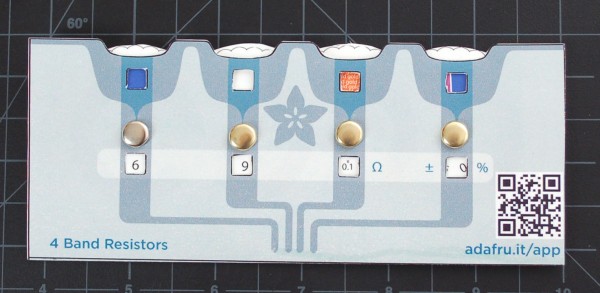 The PDF file is available from Adafruit Industries or a copy is also here. Once you print it out, a little cutting and folding should produce something like the example of the right. The Adafruit design uses brass paper fasteners (remember those?) but any fastener could be used that would allow the wheel inside to rotate freely. It would be best to print on heavy card stock if you have the ability as it will give the calculator some strength.
Something new …
If you happen to have one of those new fangled iDevices you can download Circuit Playground. It has a few more features than the old Radio Shack calculator and looks great on the iPad.
More features are being added but the list at the moment includes:
- Decipher resistor & capacitor codes with ease
- Calculate power, resistance, current, and voltage with the Ohm’s Law & Power Calc modules
- Quickly convert between decimal, hexadecimal, binary or even ASCII characters
- Calculate values for multiple resistors or capacitors in series & parallel configurations
- Store, search, and view PDF datasheets
- Access exclusive sneak peaks, deals & discounts at Adafruit Industries
You can download it from the iTunes Store or, if you have an Android, you can check out ElectroDroid for similar functionality.
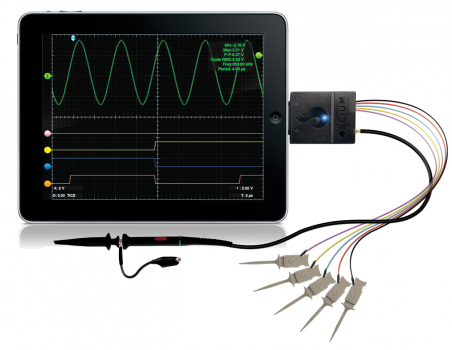
As time goes on there are more and more useful utilities available for electronic experimenters on iOS and Android devices. Since more and more equipment today is becoming computerized do iOS and Android devices represent the future of test equipment?
 |
| iMSO-104 iPad Oscilloscope |
Finished with “Introduction to Emergency Communication!”
Assuming my final assignments are acceptable to my mentor, I’m finally done with my online ARRL course! “Introduction to Emergency Communication (EC-001)” began on February 29, and it officially ends next Friday, April 27. I wrapped it up tonight since next week is going to be pretty full.
When I signed up for this course I had no idea I would learn so much. I highly recommend it to every ham, no matter how long you’ve had your license. The text really is well done, the assignments are far from busy-work (they took me places I’d never gone before, and probably wouldn’t have gone had I just read the book), and if all the mentors are like the mentor I had (Sena Frank, NI1Y), you’ll receive sound advice and have a great time.
Now I’d like to take the next course in the sequence! “Public Service and Emergency Communications Management for Radio Amateurs (EC-016)” is free, I see. But I’ll probably take a week or two off before taking that on. You can learn more about these online courses at http://www.arrl.org/online-course-catalog.
I’ll end this post with the syllabus of the course I just completed, so you can see what is covered:
Course Syllabus for Introduction to Emergency Communication (EC-001)
Section 1: The Framework: How You Fit In
1. Introduction to Emergency Communications
2. Amateurs as Professionals
3. Network Theory and Design
4. Emergency Communications Organizations and Systems
5. Served Agency Communications Systems
A. Served Agency Communications Systems
B. Working Directly with the Public
Section 2: The Networks for Messages
6. Basic Communications Skills
7. Net Operations:
A. Basic Net Operations
B. Introduction to Emergency Nets
C. Net Operating Guidelines
D. The FCC Ruling on Drills and Employees
8. The Net Control Station
9. Net Control Station Operator Practices
10. The Net Manager
11. Introduction to the National Traffic System
12. Specialized Net Operations
13. Severe Weather Nets
Section 3: Message Handling
14. Basic Message Handling – part 1
15. More Basic Message Handling – Part 2
Section 4: What Happens When Called
16. The Incident Command System
17. Preparing for Deployment
18. Equipment Choices
19. Emergency Activation
20. Setting Up, Initial Operations and Shutdown
Section 5: Considerations
21. Operations & Logistics
22. Safety & Survival
23. ARES® PIO: The Right Stuff
24. Alternative Communication Methods
25. What to Expect in Large Disasters
26. Hazardous Materials Awareness
27. Marine Communications
Section 6: Alternatives and Opportunities
28. Modes, Methods and Applications
29. Other Learning Opportunities
Final Assessment


The further adventures of the Heathkit AT-1
Work has been conspiring to eliminate my spare time but I was able to spend a few hours over the Easter holiday to clean up the shack and make space to put the Heathkit AT-1 on the desk again. I have been able to spend a little time going over parts that need to be replaced and making a list.
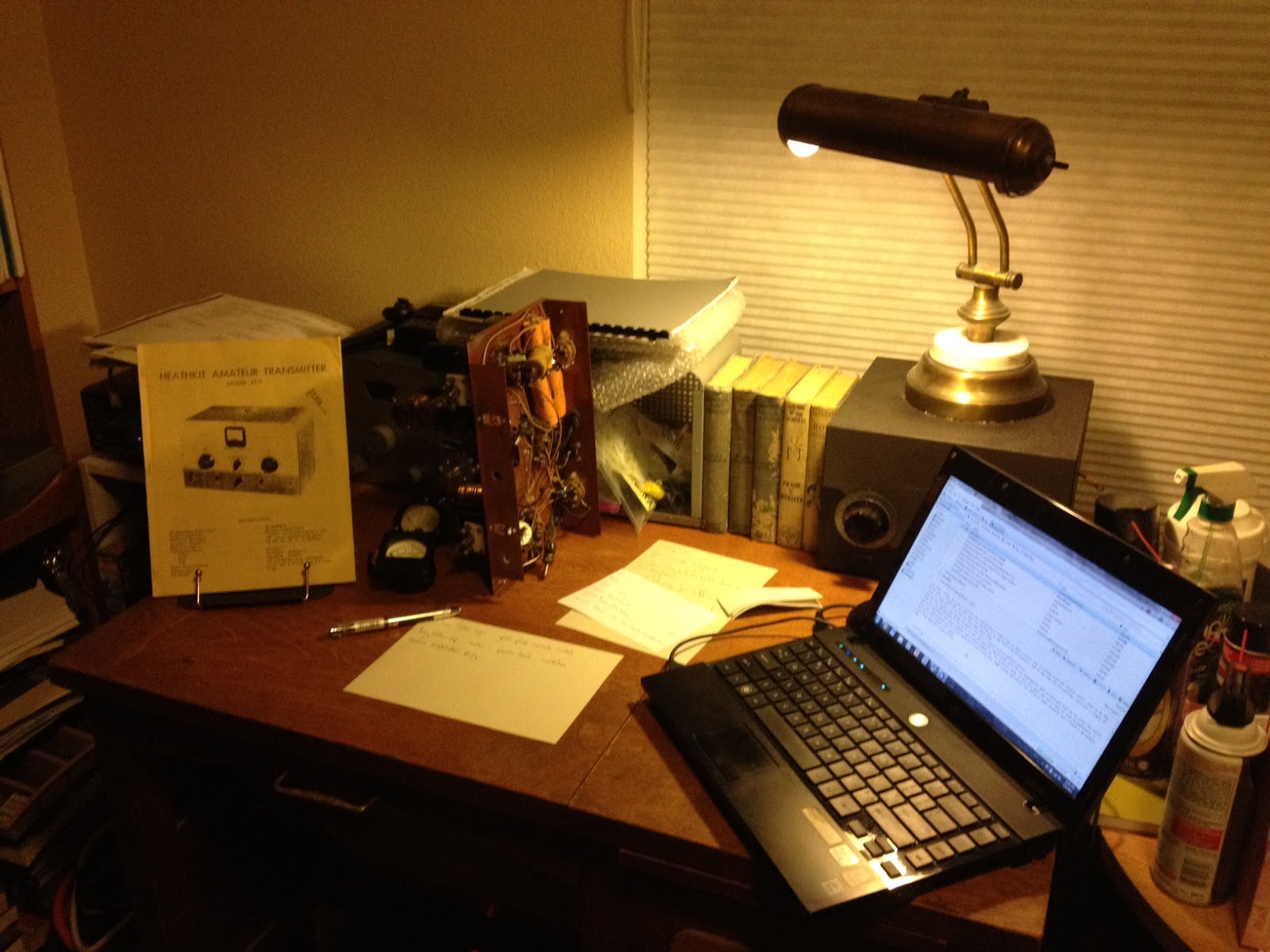 |
| The Heathkit AT-1 chassis with case and VFO-1 behind. |
There doesn’t seem to be any show stoppers although the wafer of the meter switch has broken in two and will need to be repaired. If I’m not able to repair it then thankfully it is fairly simple and replacement rotary switch can be substituted.
This isn’t going to be a museum quality restoration but the changes that were made to this transmitter in the past were sensible and if left in place are representative of period modifications. The original meter for example was not the highest quality and a Western or Simpson replacement would be an improvement. The original slide switches have been replaced with period snap-toggle switches which are also an improvement over the original.
The Heathkit VFO-1 however has been modified for grid-block keying which is a significant departure from the original and I plan to revert it back to cathode keying. Although a technical improvement it is not in keeping with the original design and needs to be undone. Everyone will have their own opinion but I think if I wanted modern circuits I’d get a more modern rig, so the VFO-1 will be returned to stock.
Hopefully I can carve out a bit of time here and there to work on this and slowly return it to working condition.
A Wasted Trip Thoroughly Unwasted
Last Saturday I picked up Andrew (KCØYFY) and his wife Joleen (KDØDOT) at 8:00 A.M. and headed for the monthly meeting of the West Central Minnesota Amateur Radio Club. It’s a 45 minute drive from Granite Falls, so we had plenty of time to talk. But once we got to the location of the meeting, our conversation took an abrupt turn. We were the only ones there!
Andrew asked, “You don’t think the meeting got canceled because of Easter weekend?”
I groaned. No way! “Here,” I said, grabbing my cellphone, “let me give Dean a call.” Dean (NYØI), the fellow who first invited me to join the club, is the Energizer bunny rabbit of ham radio — especially when it comes to building and maintaining the VHF/UHF repeaters out our way. But we quickly discovered that none of us had his phone number.
“Wait a minute!” I said. “We’re HAMS! Let’s call somebody on the radio!” What a novel idea. To think of using a radio instead of a cell phone to call another ham! I put down my cellphone and grabbed my HT. “NØIP monitoring,” I called on the local repeater.
“NYØI,” came back Dean! “The meeting has been rescheduled to next Saturday,” he explained when I inquired. “We published it on our Facebook page and announced it on the net. Sorry!” Again, I groaned. Down in Granite Falls I can’t hear the repeater they use for their net, and I long ago suspended my infernal Facebook account. “But how about I meet you for breakfast?” Dean asked.
I looked at Andrew and Joleen, who nodded. “Sure!” I replied. “Where do you want to meet?”
After getting directions to a small-town diner just up the street, we headed there and found a table. Within minutes, Dean arrived. When the waitress came by, he asked, “What’s your birthday special?”
“It’s your birthday?!” I asked. Sure enough, it was his birthday, and he had dropped everything to meet us at a moment’s notice. What a guy!
After a great conversation that ranged from ham radio to church life, Dean invited us up to the repeater site on the edge of town. We piled into our cars and headed over to the tower of the local FM broadcast station, where Dean pointed out three verticals mounted partway up. These were the antennas for the two repeaters he had there, he explained. Two huts crouched at the foot of the tower; one was the FM broadcast station’s, and the other the local sheriff’s (for their own repeater which used an antenna at the very top of the tower). Dean took us into this second hut, which also contained his two repeaters — one on 2 meters, and the other on 75 cm.
I had never seen a repeater in my life. Dean explained how they worked, and he told us about past equipment and current plans to improve what they had. Having been an HF CW guy all my life, I felt like a tourist in a foreign country — and I enjoyed every minute of it! After thanking Dean, the three of us headed back to Granite Falls.
On the long drive home, we continued the conversation we’d begun on the way there. The local ARES® Emergency Coordinator position is open, and Andrew is wondering if I might consider taking it. I promised him I’d contact the DEC and learn more about what is involved. Lots to think about!
As far as attending the club meeting that never happened, I suppose it was a wasted trip. But thanks to Andrew, Joleen, and Dean it most definitely was not wasted! After all these years as a ham, I’m finally meeting fellow hams in person. I wish I’d done it sooner.


The 2012 MNVOAD Training Conference: Lake County RACES/ARES®
This post was updated on 4/2/12 after Mr. Angelos kindly corrected me on several points.

Mr. Peter Angelos, KCØKRI
The 2012 MNVOAD Training Conference was well-worth attending! My favorite part, of course, was the presentation by Peter Angelos, KCØKRI, on the Lake County, MN RACES/ARES® response to the Pagami Creek Fire in September, 2011. His “keystone” speech was the first of the many sessions that day, and the only plenary session (the other 15 sessions were breakouts). While he focused upon RACES/ARES®, he also discussed principles that apply to any voluntary organization.
Here are my notes from Mr. Angelos’ presentation, in the order presented:
- The Pagami Creek Fire
- RACES/ARES® fills gaps in existing communication-systems, and reduces load on those systems.
- A lightning strike on 8/18/11 13 miles east of Ely started a fire that ultimately caused $23M in response expenses in Lake County. On 9/12/11 this became the largest fire in Minnesota since 1918, with 92,682 acres and over 800 workers assigned through 10/17/11. Fires are an annual occurrence in Lake County, the home of the famed BWCA (Boundary Waters Canoe Area); what made this fire unusual was its size.
- Cell phone coverage is the only phone service available in some parts of the area, and in some parts not even that. An 800 MHz public-safety trunked system using portable antennas was also set up to provide coverage.
- Many hours of training and dedication go into RACES/ARES® in preparing for an event like this.
- RACES/ARES® personnel stayed far behind the actual fire line.
- The Lake County RACES/ARES® group is a “spring chicken,” having been organized in mid-2009.
- On 9/12/11, RACES/ARES® was activated when the fire suddenly grew from 11,000 to 70,000 acres in only 24 hours due to winds gusting up to 35 mph. This drove the fire 16 miles in one day, toward a populated area. As evacuations increased, RACES/ARES® was activated. (In the Q & A that followed, one person asked how many messages were passed. Mr. Angelos said that only a handful of messages were actually passed. The activation of RACES/ARES® was a proactive attempt to prepare for a catastrophe in case this fire reached populated areas. When it became clear that this was not a threat, RACES/ARES® was deactivated.)
- As the smoke plume blew as far as Milwaukee, WI and Minneapolis, MN, the potential for health & welfare inquiries increased.
- A RACES/ARES® communicator was attached to the evacuation shelter manager. Hams were also located at the incident command post, staging area, evacuation checkpoints, and the EOC. The goal was to handle non-emergency traffic to take the load off police, fire, and rescue channels.
- The log of messages kept by RACES/ARES® is helpful for post-event evaluation.

Lake co. RACES/ARES® portable tower, AMCV and MCT deployed at a Canadian National RR mock fuel spill exercise in Two Harbors MN on September 14, 2010. Photo by BJ KDØHHW. (http://n0lcr.org)
The Lake County RACES/ARES® group uses two state-of-the-art vehicles, each outfitted with a PSN (Public Switched Network capable of establishing a cellphone network), as well as 2m/75cm FM/Packet and all HF modes including WinLink, WINMORE, Pactor, and other digital modes. One of these vehicles is a trailer of their own (the “MCT”), while the other is an RV (the “AMCV”) purchased by an 11 county consortium in the northeast Minnesota Arrowhead Region (with help from a grant). This vehicle can provide video conferencing and internet connection via satellite.
- The repeater network available is huge, extending from Ely, MN to Solon Springs, WI.
- RACES/ARES® deployed for a total of five days, suspending operations on 9/16/11 after contributing 633 man-hours. The Lake County RACES/ARES® group provided 445 of these hours, with the remainder provided by mutual aid from RACES/ARES® groups in four neighboring counties.
- The Relationships Necessary for Success
- The Lake County RACES/ARES® group would never have been invited to participate if it weren’t for the well-established relationships that had been built with Lake County Emergency Management and the Lake County Sheriff’s Office.
- Professional conduct and standard ICS documentation-procedures are essential for establishing credibility with served agencies.
- Served agencies expect to see stuff like this duty roster.
- None of this could have happened without the “four C’s” (communication, coordination, collaboration, and cooperation), the hallmark of VOAD. They couldn’t invite themselves to drills — they had to participate in non-emergency events like local marathons and sled dog races to demonstrate their capability and build relationships. Only then did they get invited to their first drill.
- Lake County RACES/ARES® volunteers are required to complete FEMA courses IS-100b, IS-200b and IS-700a.
- These hams are volunteers with the Lake County Emergency Management Department. They are required to have security background checks, they all have photo ID’s issued by Lake County, and they are even insured by the county.
- As a result of this relationship-building, the Lake County Emergency Manager got her amateur radio license (KDØHHW) and joined this RACES/ARES® group herself.
- So much credibility has been established with served agencies that this RACES/ARES® group has been entrusted with the housing and maintenance of the AMCV.
- Building these relationships is “complicated” but worth it. Their relationships are so good now, Mr. Angelos said, “We even have a Christmas pot-luck dinner together.”

Not only was this presentation of RACES/ARES® center-stage at the conference, but the Bloomington, MN Amateur Radio Association had a great display set up out in the vendor’s area, complete with a couple of Buddipoles and HF/VHF radios. Mr. Wayne Snyder, KCØZJB was kind enough to send me some photographs:
If you get a chance to attend a VOAD conference like this, I heartily encourage you to do so. Not only did I learn from KCØKRI’s presentation, I also learned quite a bit from several other breakout sessions. It is clear that ARES® work is not conducted in a bubble. To be efficient and effective (much less to even be invited to participate) in an emergency we must develop relationships with the agencies we serve, from governmental entities to other voluntary organizations. The time to do that is not at the time of the emergency itself, but long before. Conferences like this one can be a great way to learn from each other.















