Posts Tagged ‘amateurradio.com’
 Have Handheld, Will Travel — First Stop: University of Notre Dame!
 May 23rd, 2012 |
  Author:
 My wife and I are on the way to Toronto, Ontario for a wedding. Right now I’m dashing this off before laying my head down to sleep in the apartment of a dear friend of ours in South Bend, Indiana. She’s a PhD student at Notre Dame and will be hitching a ride with us since she’s the maid of honor. My daughter, one of the bridesmaids, is already in Toronto since she went out a day ahead of us with the bride’s family. My son had to stay home since his passport didn’t show up in time — he was disappointed but getting to stay with friends made up for it.

NØIP at the Gates of the University of Notre Dame
Anyhow, I brought along my Wouxon KG-UV6D. I would have brought along my HW-8 but space was at a premium. I didn’t use my HT on the drive (I simply didn’t have time to figure out the repeaters on the way and program them on my radio), but once we got into South Bend I hit two repeaters that both came in full-quieting — one a 2m repeater in town and the other a 70cm repeater belonging to the University of Notre Dame Amateur Radio Club. I’m sorry to say that despite many calls I have yet to hear anybody on the two repeaters. Perhaps it has something to do with my timing; the academic year has just ended and things are unusually quiet around here.
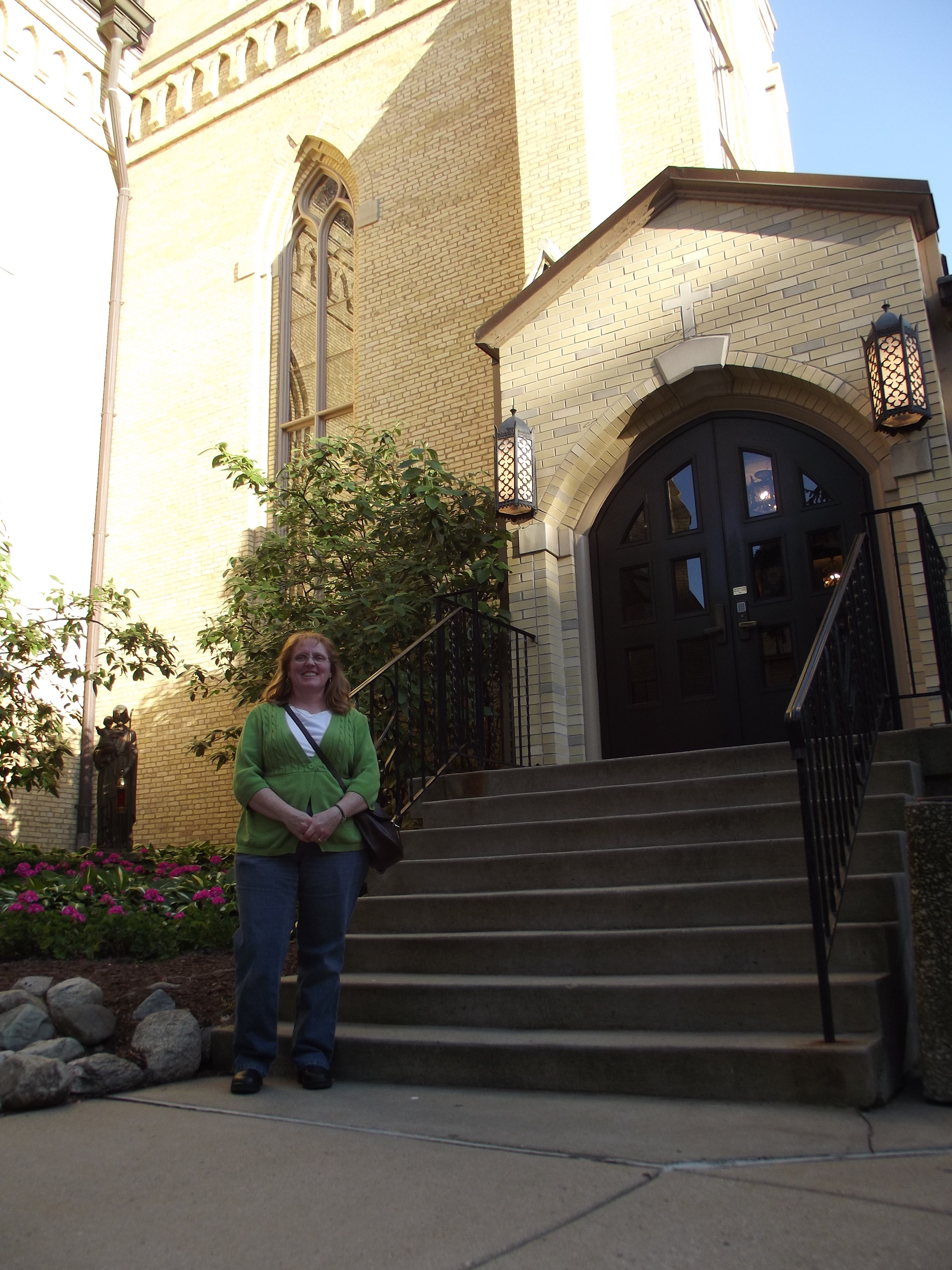
My XYL outside the Basilica, University of Notre Dame
I had high hopes of setting up an impromptu visit to the Jerome Green Amateur Radio Station (click here), but I also knew my hopes weren’t realistic since it was a last-minute idea. Next time I’ll try to remember and search out such opportunities in advance.

Basilica, University of Notre Dame
We had a great time exploring the Notre Dame campus, touring the grotto, basilica, and bookstore. (Already bitten hard by the academic bug, I nearly melted when I got near the philosophy section!) Eventually we went out for a late supper at Fiddler’s Hearth, which serves up the best Reuben I’ve ever had in my life (and I’ve had a few).

Basilica, University of Notre Dame
Next stop, Toronto! I am using this website (click here) to find repeaters by clicking on a Google map, so I have the frequencies, offsets, tones, etc. all printed out and in the car with me.
If only I had that HW-8 with me . . .


ARES® & Incorporation: ARRL’s Policy
Just Google “County ARES, Inc.” (click here) and you’ll see that there are lots of ARES® groups out there who have incorporated. It sure seems like a great idea because it allows you to file for 501(c)3 status, opening doors for donations of cash and equipment, free website hosting for non-profits,  and grants that require 501(c)3 status.
But to do this correctly we must ensure compliance with ARRL policy — ARES® is ARRL’s program, not ours! We’re not free to just do whatever we feel like. Here are the two challenges we’re facing:
- The ARRL insists that local ARES® groups not incorporate
- “ARES®” is a registered trademark of the ARRL that cannot legally be used in the name of another corporation without the ARRL’s permission
According to this document (click here) on the ARRL website:
ARES® and Amateur Radio Emergency Service® are registered trademarks of the ARRL. Any use of these trademarks must have the registered trademark notation (circle R®)
ARES® is a program of the ARRL. Local ARES® groups under the direction of the ARRL field organization or its appointees (SEC, DEC, EC) cannot be organized as a club or incorporated as this will conflict with the ARES® program. [emphasis added]
I emailed the ARRL asking how we should go about incorporating an entity for 501(c)3 status to support the ARES® group here. ARRL Membership and Volunteer Programs Assistant Manager Norm Fusaro, W3IZ, kindly replied. Here is an excerpt from his helpful response:
The Amateur Radio Emergency Service – ARES is a program of the ARRL. ARES is not an entity. The ARES brand is trademarked by the ARRL and may be used with permission from the ARRL.
The job of Emergency Coordinator is a political position in which the EC promotes the ARES program and supports training among the local Radio Amateurs in the community. This is done mostly through the local clubs.
The Emergency Coordinator’s job does not involve fund raising or corporate management. Equipment such as repeaters, generators, etc are supplied by the local Amateur Radio community and clubs. ARES supplies training and coordination. Note the job title Emergency coordinator not manager.
Forming a club or corporation is not only beyond the duties of the EC but also conflicts with the basic ARES requirement.
- The only requirement to belong to ARES is an Amateur Radio License and a desire to serve.
- There is no requirement to join any club or organization.
- There are no dues to participate in ARES.
So I’m not out in left field for wanting some kind of entity to support the local ARES® group — the ARRL clearly depends on local clubs to supply equipment for ARES® work. As far as the EC not getting involved in fund raising, well, I obviously need to wear more than one hat at this stage of the game. There are only a dozen or so hams in the whole county at this point.
The nearest club is pretty far away, so it makes sense to form a new “club” to serve this purpose. The ARRL wants the club to be distinct from the local ARES® group; okay, we can do that. We’ll just clearly state the purpose of our “club” is to support the local ARES® group. You can find a good example of this wording over at the Wisconsin ARES/RACES “501(c)3 Links and Information” Page (click here).
As Mr. Fusaro pointed out, membership in this “club” must never be a prerequisite to participation in the local ARES® group.
I think the name of this “club” should clearly reflect it’s purpose. If the local hardware store has a generator to donate, surely the idea of donating it to the “Yellow Medicine County Amateur Radio Emergency Service®” would be more appealing than donating it to the “Yellow Medicine County Amateur Radio Club.” But my brother, an attorney, has explained to me that since “ARES®” and “Amateur Radio Emergency Service®” are registered trademarks of the ARRL, they cannot legally be used in an entity’s name without permission from the ARRL.
I’m assuming we don’t have permission to use “ARES®” in our “club” name, but I’ve asked for clarification on this. If not, we could always name it something similar, e.g. “Yellow Medicine County Amateur Radio Emergency Corps/Support/Operators Association, Inc.” or something like that.
I don’t want this post to turn into an ARRL-bashing session, but if some of you readers have some helpful insight and/or experience with ARES®-related incorporation, I’d love to hear it.


The Joy of Elmering (with Congratulations to KK4FKM for His First QSO!)
I got some good news and some bad news Tuesday. The bad news came when Dean, NYØI, let me know he couldn’t get into my EchoLink station. A little investigation proved that my radio is deaf; the problem is either the feedline or the antenna itself. What a disappointment.
But the good news I got that day was so good that it more than made up for the bad news. I got a taker on my offer to be a CW Elmer! Michael, KK4FKM, found me listed over at the SKCC Elmer Page and sent me an email. Great timing — I easily pushed my antenna woes to the back of my mind and set up a SKED with him for yesterday afternoon on 20m.

The Key I Used to Work KK4FKM: The Kent SP-1
At the appointed hour I called KK4FKM KK4FKM KK4FKM DE NØIP NØIP NØIP KN. I wasn’t sure I’d hear him since the band was unusually noisy and KK4FKM was running QRP. But sure enough, there he was!
He was buried pretty deep in the QRN; I quickly flipped on my CW filter to isolate his signal. I managed nearly solid copy on the first go-around, but I couldn’t make out his subsequent transmissions. I was booming in there, though, so he had the opportunity to copy plenty of code.
Afterward we chatted by phone. I was moved when Michael told me this was his first QSO! What an honor to be his first contact. Impressive, too, that Michael’s first QSO was by CW, especially considering that he has his General — he could have gone straight to HF SSB if he wanted to, but instead he went the extra mile and tapped out his first QSO on a straight key, QRP no less. Well done!
It turns out that Michael and I have even more in common than our appreciation for CW. He is a police officer in a department about the same size as the one in which I served, and he is a Baptist, too. After a delightful conversation, we set up another SKED before bidding one another farewell.
This is one QSL that I would send if it cost me a hundred stamps! It’s in the mailbox. Congratulations, KK4FKM!
If you ever have a chance to Elmer, go for it. And if you could use an Elmer, don’t hesitate to seek one out. You’ll be doing him a favor. Of all the things we can do in this hobby, Elmering might just be the most delightful one of all.


My New EchoLink Station: NØIP-R
[Update 6/8/12: The problem was the coax. Thanks, Antonio, for getting it fixed! (click here for story).]
[Update 5/16/12: Yesterday my EchoLink radio went deaf. For some reason the SWR has soared — the problem is with the transmission line and/or the antenna. Happily the antenna has a lifetime warranty, so if that’s the problem it won’t cost me anything. The hard part is getting at it!]
Finally! My EchoLink station, in the works for a month and a half, is on the air and on the Internet. If you want to give it a whirl, go right ahead! It’s listed as NØIP-R, node 695717.
The idea for this EchoLink station sprang from the SKYWARN class I attended a month and a half ago. I was lamenting the fact that Granite Falls, the city where I live, didn’t have access to the hub-and-spoke repeater system used by the Chanhassen office of the National Weather Service (click on the map to learn more):

Granite Falls is about half-way between Madison and Redwood Falls on the left side of this map.
So I asked Dean Herzberg, NYØI, if there were any plans to connect his nearby repeater to the NWS station with EchoLink. Dean replied, “No plans, but I would surely authorize the connection. I can’t, but you could!”
Um, me? It hadn’t dawned on me that I could do this myself. But once Dean gave me the nudge, I was off and running (or at least hobbling enthusiastically). I thought, hey, I already have a Linux/Ubuntu server running 24/7, and I have an old Yaesu FT-1500M in a box — all I need is an interface and a radio.

Finished EchoLink station. Gotta tidy up those wires!
So I bought a RigBlaster Plug-n-Play USB interface from Ham Radio Outlet and a dual-band antenna off eBay from Edison Fong, hooked it all together and gave it the ol’ smoke test.
It worked! At first I just set it up on a simplex frequency and connected to the EchoLink test server, with the antenna propped up against the wall. That way I could work out a few bugs at low power and in relative privacy.
The whole thing went on the back burner for about a month due to other priorities, but finally I punched some coax through the exterior wall into my bedroom. That’s where the server has been for a couple years, so that’s where the station went (I have a very patient wife!). I terminated the coax with an SO-239 bulkhead connector mounted on a blank wall-plate. On the exterior of the wall I applied hi-tech IPORS caulking compound (Individually Packaged Orally Reconstituted Sealant, i.e. chewing gum!).

Dean Herzberg, NYØI, mounting antenna.
But I just couldn’t bring myself to mount the antenna up there on the peak of my gable. Part of it is because I’m slightly handicapped, but mostly it’s because I would rather give up my ham license than go to the edge of my roof up that high. NYØI to the rescue! I’ve written about Dean before on this blog. He’s a great guy who would give you the shirt off his back. Well, Dean came over a couple days ago and put up my antenna for me, then joined my family for lunch. He’s a MN State Trooper and I’m an ex-cop from the Twin Cities, so we had plenty in common to talk about.
I’ve had to fiddle with the settings in EchoLink to get it to work right, but it seems to finally be working great. The two hardest things to get right were decoding DTMF tones properly and keeping two repeaters from chasing their tails when EchoLinked. After finally figuring out the right DTMF settings, I nearly pulled my hair out trying to test them with my HT. Finally I realized that I was de-sensing my Yaesu FT-1500M every time I transmitted with my HT! When I went a block away, it worked fine.
Now the National Weather Service office can EchoLink directly to Dean’s repeater so that they can hear SKYWARN spotters here in Granite Falls. Alternatively we can link his repeater with the repeater in Madison, to which the NWS already EchoLinks during severe weather — all you have to do is punch in the right DTMF code, and my EchoLink station will dutifully link them up.
Now I just need to get a better smartphone so I can run that EchoLink app . . .
Here are some photos of Dean mounting my antenna and of the station itself:


Dropping in on MN Section Traffic Manager WØLAW, the Legendary Lawman

Robert Meyer, WØLAW
When I moved out here several years ago, it didn’t take long before my phone rang with a radiogram delivered by Robert Meyer, WØLAW. He lives about a half hour away in the city of Marshall, and is the Minnesota Section Traffic Manager. Robert is a well-known traffic handler, consistently ranking at or near the top of the list for traffic handled each month in this state. He retired as chief jailer of the Lyon County Sheriff’s Office a couple years ago, hence his call sign.
I’d never met Robert in person before, but I’ve wanted to. Having heard through the grapevine that he had just had his new tower’s foundation poured, I decided to look him up last Saturday when I was in the neighborhood for my son’s classical guitar recital. Even though my son and I took him by surprise, he welcomed us warmly and gave us a tour. What a nice fellow!
Robert led us around to his backyard, a beautiful parcel of lush green grass with songbirds feeding tamely at several bird-feeders. A couple of wire antennas hung from his current tower, disappearing into some trees and a river valley beyond. The footing for his new tower, nestled up against the back of his house, was massive!
As we stood there discussing antennas and songbirds, I mentioned to Robert that I’ve always wanted to handle a radiogram but have never mustered the courage to do it. He could have laughed at me, but instead he kindly encouraged me to give it a try and then invited my son and I into his house so he could find “a few things” to help me.
You should see Robert’s shack! When you step inside the front door of his house, it’s in plain view — a most excellent man-cave adjoins his living room. Pretty soon my son and I were marveling at his equipment, stuff we might never see again except in catalogs! Delving into his well-organized file cabinet, in short order Robert came up with a couple of reference sheets and a booklet to help me handle traffic. He also tore off most of an ARRL radiogram pad and gave it to me, refusing to allow me to pay for it.
Click to view slideshow.
I’m grateful for Robert’s hospitality and generosity, not to mention his labor as Minnesota Section Traffic Manager. He represents a side of ham radio that has long been as mysterious to me as the dark side of the moon — QRO SSB NTS traffic handling. Once upon a time I wouldn’t have looked him up, but I think I’ve grown up a little since then. I’ve really come to appreciate the variety of people I meet in this hobby and the variety of activities they do.
Once upon a time my horizon was limited; if you were on HF CW I noticed you, especially if you were QRP, but I didn’t pay much attention to the rest of the ham world. I was cheating myself. I’ve loved CW, but I’m starting to like SSB and digital modes, too. I’ve loved QRP, but I’m also starting to appreciate what QRO can do (and the skill it takes to handle it). I’ve always preferred HF, but as I get to know the local hams I’m becoming surprisingly fond of VHF FM.
So I’m glad I looked up Robert, the legendary lawman — and I’m really glad he welcomed my son and I so warmly. Can you imagine getting a surprise visit from a blogger who snaps a picture of your shack for the world to see? That’s a bit much! Thanks, Robert, for being so nice to us and for being such a good sport.


Please Consider Donating to Get YMC ARES® Started
 Would you please help launch the Yellow Medicine County, MN Amateur Radio Emergency Services® Group? Even just a few bucks from each of my readers over at amateurradio.com (where this blog is syndicated) would be a tremendous help. I just accepted the position of Emergency Coordinator here, and I’m really starting from scratch. There are only a few active hams in our county right now (I’ll be trying to recruit more, believe me), and we’re strapped for cash. Even with sacrificial spending on our part we’re going to have trouble scraping together the approximately $500 needed to get incorporated and apply for 501(c)3 status. This status will:
- make future donations tax-deductible (helpful when trying to raise money)
- allow ARES® volunteers to deduct mileage and other expenses (helpful when trying to recruit and retain new members)
- make us eligible for grants that are otherwise unattainable
If you would like to donate, just click the button below. I’m using my wife’s PayPal account for now (once we’re incorporated, YMC ARES® will have its own account), but your donation will be tracked and every penny will go toward the YMC ARES® Group. If we reach $500, I’ll post an update right away and take down the appeal for donations in the sidebar of my blog.

Thank you so much for considering this!


Olivia — the Magic Mode
I have to give credit to Gary L. Robinson, WB8ROL, for the title of this post. I met him on the air tonight using Olivia 500/16, and pretty soon I was reading his article about this mode . . . but I’m getting ahead of myself.

Olivia 500/16. Image obtained from http://www.oliviamode.com.
My introduction to Olivia took place yesterday afternoon at a meeting in a little coffee-shop in Marshall between the MN ARES® ASEC, Section 5 DEC, Lyon Co. EC, and myself (at which I accepted the position of Yellow Medicine Co. EC, but that’s another story). They explained that FLDIGI is the software they are training people on, that every Thursday evening at 8:00 P.M. there is a MN ARES® digital net on 80 meters, and that they are using Olivia 500/16 for this net.
Well, my power of recall being what it is, I’d forgotten all about it till I heard the clock chime 8:00 while I was doing the dishes (after dining on my wife’s fabulous slow-cooked chicken). “Honey,” I asked, “would you mind if I left the rest of the dishes to you? I’d like to go check out a net on the radio.” I sure am blessed with a sweet wife — she took over without batting an eye while I dashed downstairs and started hooking up my laptop to the interface while firing up FLDIGI.
Sure enough, there was the net. I “listened” (How do you say it? Read?) for nearly an hour, and finally checked in right as the net was closing.
Well, tonight before going to bed I decided to try it again. This time I went up to 20 meters where I had a nice ragchew with Gary, WB8ROL (my first “real” QSO). We hit it off right away — his career path took him from law enforcement to programming just like mine did, we both have bad backs, and we both like cats and penny-whistles — but what really got my attention was his website: www.oliviamode.com. This fellow is a veritable evangelist for this mode! If you haven’t read his QST article about Olivia, click here and enjoy “Ghost QSOs — Olivia Returns from the Noise.”
I can attest to what Gary writes about in that article. As the band began to fade, his signal dropped until I couldn’t hear it at all. All I could hear was static; I assumed I’d lost him. Not only couldn’t I hear him, I couldn’t see anything on the waterfall display. But incredibly, letter after letter appeared on the screen as Gary typed his last message!
Olivia really is “the Magic Mode!”















