Posts Tagged ‘amateurradio.com’
 The unfortunate & epic saga of the perfect military radio
 June 20th, 2012 |
  Author:
  |
| The long awaited but ultimately unwanted GMR radio |
As my day job starts to include more long term projects & project management I was particularly intrigued by an article in arstechnica.com. The article is, “How to blow $6 billion on a tech project“, although the title may be more inflammatory than technically accurate.
The article covers the 15 year development of an advanced & unified military radio communications system that suffered from multiple issues including scope-creep & a rapidly changing underlying technology.
If you are involved with a group that is working to develop a product or service you’ll really get something from this article. If you interested in radio systems, military or otherwise, you’ll find this interesting as well.
Its hard to image the frustration people suffer when contributing to a project that is mismanaged unless you have been there yourself. I hate to think of the wasted effort that resulted when people found out How to blow $6 billion on a tech project
I Love It When a Plan Comes Together

Three of Mr. Fagen’s beautifully-restored, award-winning aircraft. Photo copied from fagenfighters.com.
Weeks ago I called Fagan Fighters & Warhawks, Inc. inquiring if they could use help with communications at the Ray Fagen Memorial Airshow on Saturday, June 16. The answer was yes! They had a gap in their communications between the airport and their remote parking lots. I put out a request for volunteers and started doing some tests. The challenges I faced were:
- Terrain and distance: The first overflow lot was at a casino located quite close to the airport but down in a valley. The other overflow lots were located in the City of Granite Falls itself, down in a valley and far enough away to make it impossible for handhelds to communicate with the airport.
- Intermod: The AWOS (Automated Weather Observing System) station on the airport blows away my handheld on some 2 meter frequencies.
- Manpower: Out here in the sticks finding ham-volunteers is not easy.
Repeater coverage is patchy out here and not an option for handhelds at the airport. It quickly became apparent that to conquer terrain and distance we would need to set up a station on high ground running either as a net control station or as a cross-band repeater. Since I wanted to run a net anyway, I elected to simply run a simplex net. CTCSS would be necessary to combat intermod at the airport. I drove around until I found a likely spot at the top of a bluff roughly midway between the airport and the City of Granite Falls (where some overflow lots were located), and I secured permission from the property owner to set up a net control station for the airshow. After tests demonstrated significantly better performance on 70cm than 2m, I settled on 70cm, specifically MN ARES simplex channel HU-CHARLIE, 443.000 PL 203.5. I worked with a fellow at the airport and tested to make sure we would not interfere with their radios, then announced the plan by email to the group of volunteers who were forming up.
I was overwhelmed by the willingness of these volunteers (KCØPMF, ABØRE, KDØQEA, KCØQNA, KØNUT, KCØYBG and KCØYFY) to drive all the way out here, especially considering that they knew they’d be stuck in parking lots during the airshow. We needed their help since there aren’t very many active hams around here that I know of. Including myself we had eight hams lined up for Saturday morning.
After filling a cooler with water bottles, pop and ice I zipped over to the airport early on Saturday to find out who was in charge of parking. When I introduced myself to him I found out he had not heard anything about our involvement. I gulped, then explained that a ham would be assigned to shadow him and relay messages between him and remote lots. I encouraged him to ask anything he wanted of his shadow and we’d try to get it done for him.
 When I set up as net control high on the bluff around 10:30 A.M., I assigned tactical call signs to make things easier: the ham shadowing the parking-director was AIRPORT-1, his partner was AIRPORT-2, the hams at the hayfield lot were HAYFIELD-1 and HAYFIELD-2, the hams at the gate were GATE-1 and GATE-2, and the ham at the casino was CASINO-1. At first I wasn’t sure just how helpful we would really be, but pretty soon we were very busy! Without us the parking-director had no way of knowing how full the lots were getting (information he needed to redirect traffic to the next lot) nor where the greatest demand for buses was at any given moment. We helped him with these things as well as a couple of miscellaneous tasks, including a search for two missing children (who were soon found). We finally shut down at 4:00 P.M. after the flow of traffic died, and then we all met at the airport office for a debriefing.
The parking-director said that at first, when I introduced myself to him that morning, he was a little irritated because he had no idea we were coming. I don’t blame him! My fault for not tracking him down. But after having worked with us, he said, “I don’t ever want to do another airshow without you guys!” He was positively glowing as he continued to praise us. I credited the volunteers who did the real work that day, and I encouraged the parking-director to spread the news about what we can do. This was a great opportunity to demonstrate our capabilities and work out some kinks in communicating in this area, too.
So many things came together to make this happen. Not only did these volunteers drive in from up to 80 miles away, but several others helped me prepare. Alfio Levy, KJ6JGS, went the extra mile and priority-shipped the Kenwood TM-V71A rig I bought from him last week so that I could get it installed in my pickup in time for the airshow. Caleb Streblow, the fellow who is courting my daughter, machined a bracket for me last week so that I could get a dual-band antenna mounted on my pickup. And Andrew Rosenau, KCØYFY, lent me his crimper, supplied me with Anderson Powerpole connectors, zipcord and fusing, and helped me with testing our radios around the area prior to the event. My thanks to all!


My Son Passed His Tech!
My 16-year-old son, Antonio, has been studying hard for his Technician license, and yesterday evening three VE’s — Dean, NYØI, Scott, KBØNLY, and Terry, KCØQED — paid us a house call. When they showed up, I was out in the driveway installing a dual-band antenna on my pickup. They crowded around, watching me, helping where they could, and chatting while Antonio grilled steaks in the back yard. Pretty soon the aroma of grilled ribeye had our mouths watering!

Terry, KCØQED, left, and Antonio (nervously contemplating the exam), right
After one of the biggest feasts we have ever had, the testing began. Antonio was pretty nervous at first, but he breezed through the test easily. Terry scored it, turned to me and gave me a thumbs up! While the other two VE’s scored Antonio’s test, I went and got the Wouxon KG-UV6D HT (with leather case, high-gain antenna, speaker-mic, and emergency AA-battery pack) I’ve had waiting for him. He smiled as he opened the box and started taking things out and putting them together.  Antonio called Grandpa Mitchell, NØARQ, to share the good news. Just for fun he also took the General exam, and surprised himself by coming closer to passing than he expected — now he wants to study for that!
Antonio is interested in ARES® (he got an ARES vest yesterday, too), but he’s also interested in other aspects of amateur radio. Yesterday evening he said he would like to start up our CW lessons again so he can work HF CW, and he also wants to join the ARRL and the West Central MN Amateur Radio Club.
Here’s a slide show with a few more snapshots from yesterday evening. Congratulations, Antonio!


YMC ARES Training Net Begins!
Last night at 8:00 P.M. I held our first Yellow Medicine County ARES Training Net. The plan is to do this every Monday night at 8:00 P.M. and to cover a specific learning objective each time. Dean Herzberg, NYØI, graciously agreed to let us use his 2 meter repeater in Milan for this.
Rather than trying to re-invent the wheel, I’m trying to mimic the Arizona Emergency Net. They have been doing some excellent work, and you can listen to recordings of their training nets online (click here for their archives).
Yesterday’s topic was “Tactical Call Signs.” After explaining the concept of tactical call signs, I assigned one to each operator, asking him to acknowledge it. Then I put the operators through a little exercise. I explained that I would call each one of them with his tactical call sign, and after he replied with his tactical call sign, I would ask him a question. When he answered the question, he was to conclude with his FCC call sign. This is standard format; signing with the FCC call sign tells net control that the operator considers the exchange complete. Here’s an example:
Net control: “EOC-1″
EOC-1: “EOC-1″
Net control: “EOC-1, what is your favorite mode?”
EOC-1: “My favorite mode is FM. NØJXI”
The stations who checked in did a great job. The whole net took only about 15 minutes; I tried to make it short, sweet, and to the point, and since we didn’t have many check-ins it didn’t last long.
All hams within range of the repeater are welcome to participate in this net, whether or not they are in Yellow Medicine County and whether or not they have registered with ARES. I do hope that this will draw some hams into ARES, though. Now that we have something like this going, it’s time to beat the bushes by sending out letters to local hams inviting them to take part.


Gremlins Lurk in the Junk Heap
Three weeks ago my EchoLink station went deaf. Thanks to the West Central MN Amateur Radio Club’s antenna analyzer, I figured out right away that the problem was in the feedline/antenna system. Ever since then I have been either too busy or too nervous to go on the roof, so it has remained a mystery . . . until this afternoon.

Antonio Mitchell checking SWR on the Edison Fong J-Pole
Antonio, my son, went up on the roof with the antenna analyzer while I watched from the ground. He did a great job taking all the tape and coax seal off the PL-259, disconnecting the coax from the antenna, and hooking up the antenna analyzer to the antenna with a patch cord. “One point two!” he called down to me. There you have it — it was the coax! I realized what I’d done. Here I had some brand-new coax in my field-kit, but I ended up grabbing a different coil of junk coax and got bitten by a Gremlin. I found the new, already-terminated coil of coax and Antonio swapped it for the bad length, carefully wrapping the PL-259 with coax seal and rescue-tape. In short order we had the station back on the air.
All that, and Antonio doesn’t even get to use it yet. Hopefully soon! Antonio has been studying hard for his Technician exam this week. He is eager to take the test.
Thanks, Antonio, for getting the EchoLink back up and running for all of us.


The Johnson 275W Matchbox Antenna Tuner
I had purchased a Johnson Matchbox from an estate a while back & decided that while I was home with the flu I would open it up and check on its condition.
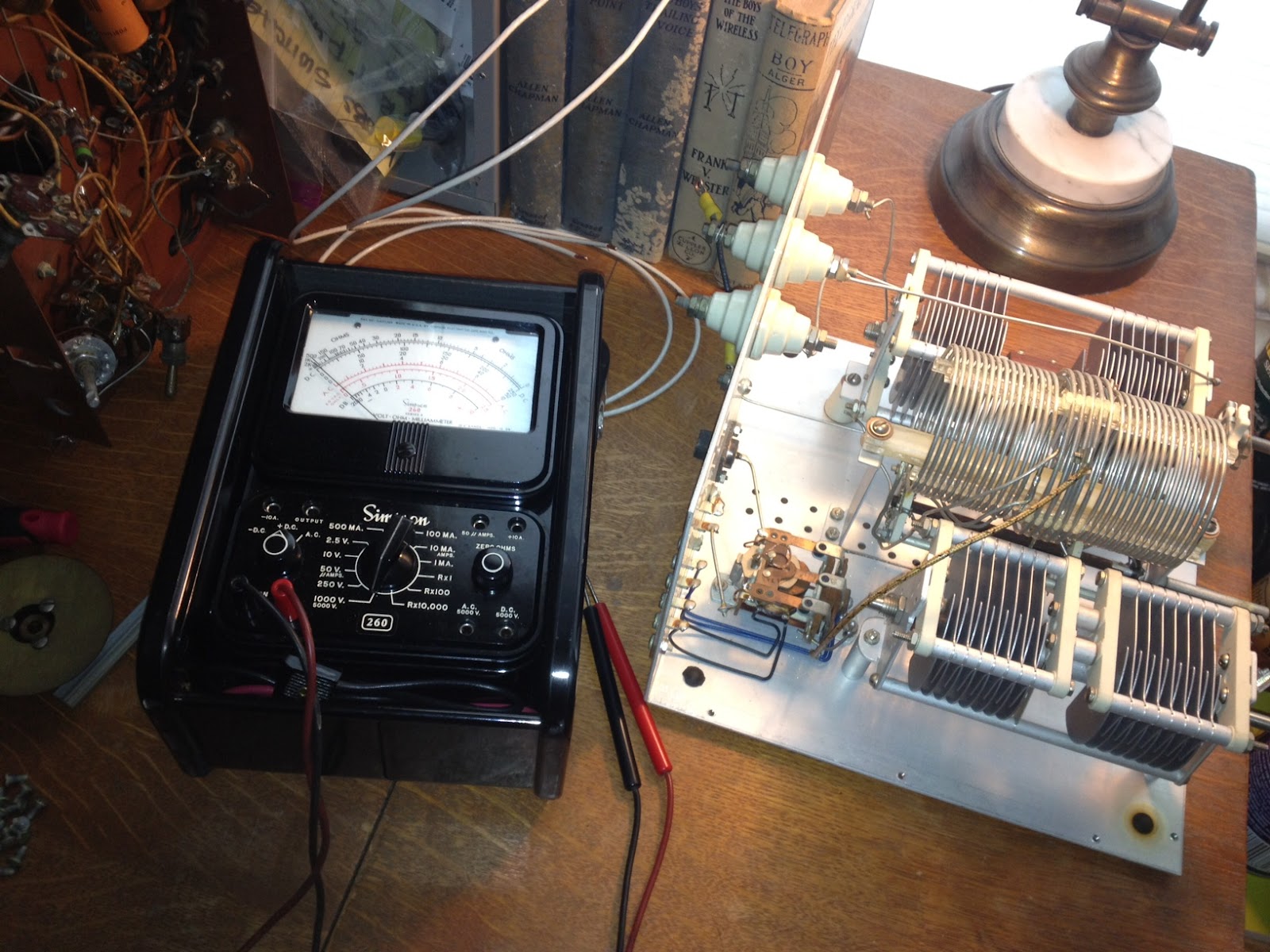 The Johnson Matchbox is found most commonly in two versions, the smaller “275W” unit and the larger Kilowatt Matchbox. Why did I use quotation marks around 275W? Well, these units were manufactured back in the good old days when men were men and transmitting voice meant using AM, not single side band. The conservative rating of 275W of AM translates into roughly 800W of peak SSB (Not really but close enough so you get the idea)
Unlike many who own a Matchbox I was hoping to keep it 100% original and that it would contain all its original components, including the antenna change-over relay and wiring for the high-impedance receiver antenna connections. I plan to use this Johnson Matchbox with a Heathkit AT-1 transmitter and Hallicrafters SX-25 receiver so the inclusion of an antenna change over relay and 300 Ohm receiver connections will make life MUCH easier. Something I didn’t realize until I had the unit apart (There are a LOT of screws holding this thing together) is that there is also a receiver control contact on the relay to break HT and mute the receiver during transmit which will work with my SX-25.
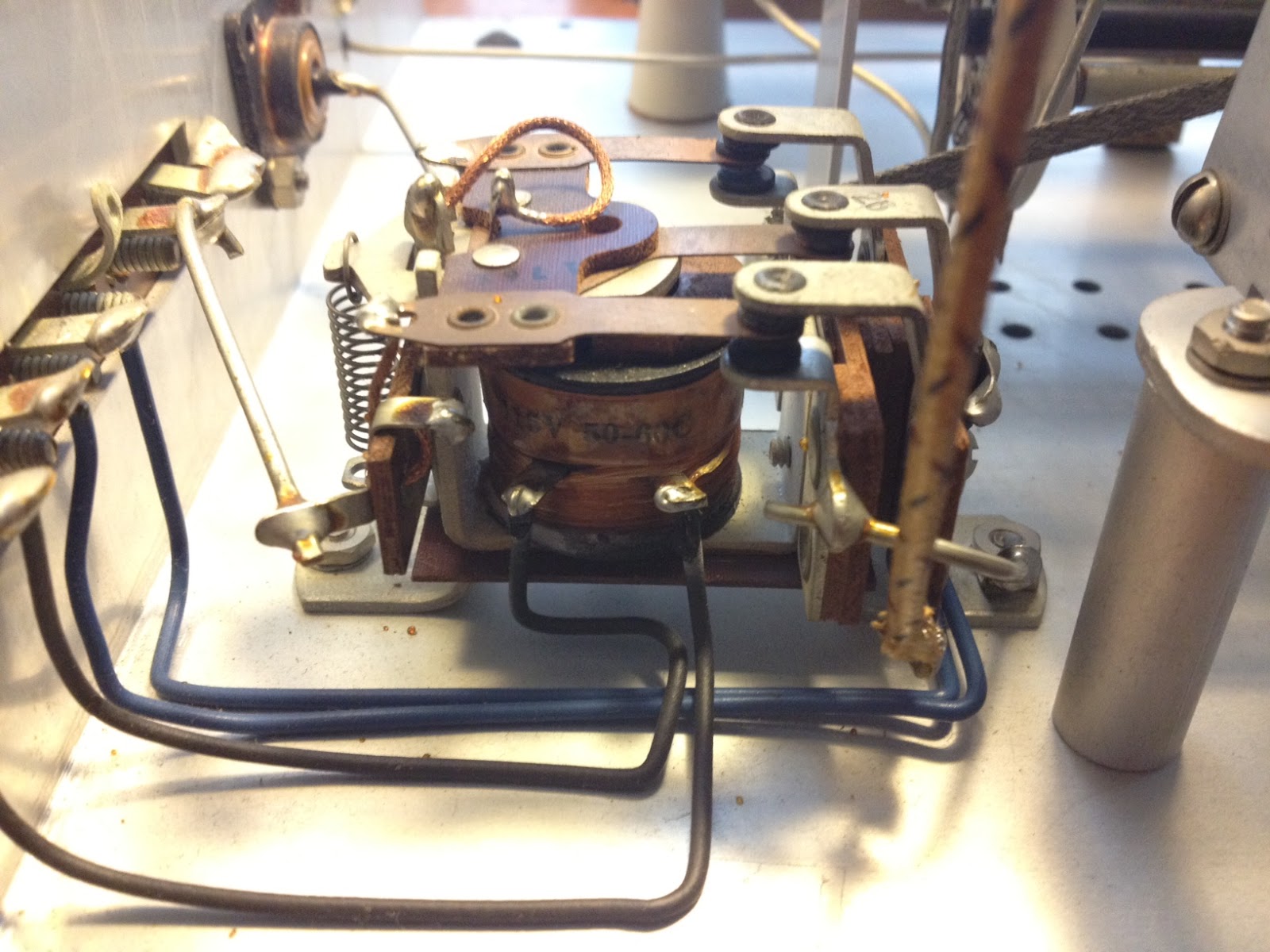 An initial inspection showed that the only modification was a small piece of plastic wedged into the relay contacts that held the relay in the transmit position. It was easily removed and the relay coil and contacts tested for continuity. The contacts seem a bit dirty which, from the little I have read online, seems to be a common problem.
Once the relay contacts and band-switch are cleaned I will button the unit back up and connect it to the loop antenna I have recently run around the eaves of the house. The loop has been a huge improvement to the long-wire and magnetic antennas I have run in the past, at least as far as reception goes … but that is a topic for another post.
West Central MN Amateur Radio Club
This morning was the monthly meeting of the West Central MN Amateur Radio Club. I joined this club about four months ago thanks to the invitation of Dean Herzberg, NYØI.

June 2, 2012 meeting of the West Central MN Amateur Radio Club. Photo taken by Antonio Mitchell.
It’s the first amateur radio club I’ve ever joined. I wish I’d joined one sooner! Certainly I wouldn’t have had to drive as far to attend club meetings while I lived in the Twin Cities. This club meets in Madison, about 45 minutes away from my house. It’s worth the drive, though. I get to put faces with call signs and catch up on local developments. Speaking selfishly, it’s already benefited me a great deal. Dean helped me mount my dual-band antenna on the roof, and he allowed me to borrow the club’s antenna analyzer, too. I hope I can return the favor somehow. That’s the sort of thing that happens in an amateur radio club.
My son, Antonio, came along this morning, hoping to take his Technician exam. Unfortunately the test-materials hadn’t arrived yet, so he was understandably disappointed. I invited the Volunteer Examiners to my house for dinner when the materials do arrive. Since my son has become adept at grilling, maybe he’ll be the one to serve them steak if they decide to make the trip.
One of the things we discussed this morning was the possibility of helping out at the airshow two weeks away here in Granite Falls. There is a gap that needs filled in their operations, namely the coordination of shuttles running between the airport and remote parking lots. It remains to be seen whether we can muster enough volunteers, but if we can it would be a great way to demonstrate our capabilities and practice working together for the day we assist in an emergency. I’m hoping we will get some more volunteers from another ARES® group nearby. It would really be neat if we had enough hams with APRS to put the shuttles on a map, but that’s a pretty tall order right now. I’ll be happy just to put one ham in each parking lot, one at the airport, and perhaps one NCS at the midpoint if we decide to use simplex. The local sheriff has a portable tower that he has offered for our use, and it might be just the thing for an NCS to use. All these details need to be worked out, but that’s exactly why these opportunities are so valuable — better to figure out how to do these things now rather than in a time of crisis.
If you aren’t a member of a local amateur radio club, I encourage you to look into one. It is well worth your while!















