Posts Tagged ‘amateur radio’
 Handiham World for 28 April 2010
 April 28th, 2010 |
  Author:
 Welcome to Handiham World!
When did “anything goes” become acceptable?

Today we are going to try something completely different. I want you to relax and close your eyes and empty your mind of all of the worries and details of what you are doing right now. Turn down the radio, turn off the television, and prepare to take a trip backward in time. Now, I don’t want to admit that I am “old”, but I have been an amateur radio operator for quite a few decades — since 1967, in fact. For me, this trip back in time will take me to those teenage years in the 1960s when amateur radio first appeared on my horizon and ultimately grabbed my attention with its promise of communications technology and cutting-edge connections to science and learning. These were the days of the great space race when science and technology were really cool things and everyone knows that teenagers go for the “cool” stuff. Gee, today I’m not sure the word cool is even so cool anymore.
Some of you will be older than I am and will be able to remember World War II and the exciting and interesting role communication played during those years. Others will be younger but will still be able to remember a time when they became fascinated with amateur radio and its promise of civic engagement in public service communications, new and exciting technologies, and a great way to make new friends.
One thing that will be common to all of us traveling backward in time today and remembering those first days of fascination with amateur radio will be a good feeling about those who helped us to learn amateur radio and the civil and friendly nature of the amateur radio service. Sure, there may have been more rules about Morse code and keeping a log book, but the more important consideration was the fact that the amateur radio bands were by and large a safe place for a teenager to hang out, for a kid to learn basic electronics, and even for a grandma to work DX.
In fact, no matter how old you are you can probably remember kindergarten or your first few grades of elementary school and how you learned basic civil behaviors like sharing, being polite, not talking while others are talking, and what is and what is not appropriate language and behavior. Your teacher would certainly not allow you to wear a cap in the classroom or get up and start running around during a history lesson. If one of your classmates let loose with a swear word, even a mild one, it would certainly result in a trip to the principal’s office and some sort of punishment. Oh, how we hated to stay after school on a sunny Spring day while the rest of our classmates headed out the school door to enjoy the rest of the afternoon.
Can you guess where this little essay is going?
Well, I have to bring you back to today and reality. Yesterday I was tuning around on the HF bands. Propagation has been rather poor these last few days and I was anxious to find out if there was something wrong with my station after I had been away on vacation for a couple of weeks. You never know; perhaps a feedline had gone bad or something had happened to the antenna system. Anyway, in the course of my travels up and down the HF spectrum I came across a conversation on the 20 m band. As is often the case, I could hear some of the stations on the frequency but not others. Listening for a while allowed me to find out whether propagation conditions allowed communication to the east and west coasts from my location in Minnesota.
It turned out to be a more or less informal roundtable net without a formal net control station. In this kind of a situation, stations just take turns and remember who is next in the roundtable discussion. It generally works pretty well in a small group situation where all of the stations can hear each other. Of course I would not consider entering this roundtable myself, because I could not hear at least two of the other stations, but it certainly wouldn’t hurt to listen along for awhile to see if propagation conditions would change.
That certainly proved to make for some interesting listening.
One of the stations started to go on what I could only describe as a rant about former VP Al Gore and how terrible he is and what a liar he is, and on and on and on. Another station picked up on that theme and spiced it up with several derogatory words that I can only say would not be acceptable in polite company — and that certainly would have gotten him sent to the principal’s office for detention had he been in Mrs. Cunningham’s third-grade class.
Of course at this point my ear was glued to the speaker. How bad could this train wreck of a QSO possibly get? It wasn’t long before I found out.
The roundtable continued along these lines of character-bashing and complaining with nary a single positive thing to say. In due course, one of the stations started tearing into President Obama, saying, “I won’t even call him president; just Obama.”
But wait, folks — that’s not all. This poor guy got himself so worked up about how awful President Obama is that he dropped the proverbial “F-bomb”. Mind you, this is all going out on the air for anyone and everyone with a short-wave receiver to hear. No one in the roundtable group complained about this jeremiad and inappropriate language, at least as far as I could tell. It seemed like everyone in the group was like-minded, joining together in their celebration of stupid, boorish behavior.
Okay, so that’s bad language being used on the air. My wife and I both drive and since we are often in the car together, we observe other drivers and their behavior. We have developed a theory about bad drivers: “When they’re bad, they’re bad.” What this means is that when we see a driver failing to signal or wandering around the road while using a cell phone or some other careless behavior, it is also highly likely that that same driver will exhibit bad behavior across the driving spectrum. For example, that same inattentive driver is more likely to blow a stop sign if they fail to signal and wander back and forth across the driving lane. “When they’re bad they’re bad.”
This same concept applied to the guy in the roundtable who dropped the F-bomb while trashing the President. He went on and on and on talking and talking even though band conditions were changing and the other stations in the roundtable complained over the top of him that they were only getting every third word or so. An operator who has one egregiously bad habit is more likely to exhibit other undesirable and perhaps illegal behaviors on the air, such as failing to comply with identification requirements as set forth in Part 97. When they’re bad they’re bad.
As part of our ongoing operating skills review, I think we need to not only revisit the necessity to comply with basic station identification rules, but we also need to recall a time long ago when we were taught in elementary school to be nice to each other and play well together. Courtesy, respect, thoughtful consideration of other people’s feelings — all of these things are basic to a civil society and good communications skills. Please don’t get me wrong; I am not saying that no one should discuss politics or political figures on the amateur radio bands. What I am saying is that respectful civil language is called for at all times when we are using the shared resource of the amateur radio spectrum. Anyone could be listening. Furthermore, coarse, rude, or inflammatory language demeans and degrades the amateur radio experience for all of us — even for those who were participating in that ghastly roundtable on 20 meters. A coarsening of language pulls everyone down and makes it more difficult to have an honest discussion about any topic.
I don’t care what your politics are or what your religious or other personal preferences might be. When I first got started in amateur radio, I read and heard from others of the time that it was always best to stay away from topics like sex, religion, or politics while on the air. Of course times have changed. Commercial talk radio and cable television news channels cross over into territory where we don’t want to go. Bad language and insulting and demeaning comments along with sexual innuendo might have found their way into these other services, but they are still not welcome in the amateur radio service. If you want to talk about politics, there is no rule against your doing so. If you want to talk religion, you can do that as well. The thing to remember is that as an amateur radio operator you have an obligation — a duty, if you will — to maintain the amateur radio bands as a place for anyone to safely visit for a listen. Political discourse can be polite and civil. Name-calling and bad language will only ruin the bands for everyone else.
So that is my operating skills lesson for today. Think before you speak and always be polite and civil even when you disagree with someone else. Share the bands and remember that children or newcomers to the short-wave bands may be listening anywhere and at anytime. Always be kind and helpful.
And won’t you please use your callsign? Use it every 10 minutes during a conversation and at the end of a series of transmissions to comply with the legal requirements, but use it even more than that to help avoid confusion about who is talking and when. When I teach the Technician class for my local radio club, I tell these new hams to be, “Use your callsign often — you won’t wear it out.”

QRP TTF 2010 * Disappointed in Orlando!
On the road again… happy feet dance! K4UPG is loaded and ready for a good day by the lake operating the QRP To The Field event for 2010.

K4UPG ready to roll to QRP TTF site

Loaded with ALL the options!
Then came the wind knots in the antenna launching rig! I wanted to get a doublet up as high as possible. Took nearly 2 hours to get my antennas up in the air. LESSON LEARNED: It is really helpful to have another person along to help untangle all the knots that wire and string seem to make all by themselves. Getting the antenna up quickly is a key to portable ops. Grrrrr!

One of several tangled messes that delayed the antenna deployment
LESSON TWO: After a delayed start, I spent a lot of time moving my portable table to keep out of the direct sun! With temperatures in the upper 80′s it was HOT and direct sun causes my Sierra to drift a bit which makes qso’s more difficult. Need to get a sun shade setup and not waste time moving my position.
The band conditions were pretty poor and I did not hear as many stations as I had hoped. The ones I did work were tough going and seemed like others could not hear me responding to their CQ’s. I didn’t even hear a lot of Florida QSO party ops, but sounds like others that were farther away did. In 5 hrs I managed three whole qso’s with TTF stations. I did hear one Polar Bear– Martin operating as VA3OVQ but he could not hear me when I replied to his CQ.

Warning sign about 30 feet from my operating site!
It was fun to be outdoors and playing radio! I did not get eaten by our neighborhood gator either! Maybe next time out will be better contact-wise.
Handiham World for 21 April 2010
Welcome to Handiham World!
Did you miss us last week?

Image: Pat, WA0TDA, in the ham shack
Your weekly Handiham World E-Letter and the Friday audio notification were on holiday at the very same time that I was on Spring break. What a coincidence that was, eh? I am grateful for our volunteers who still help us to maintain continuity in the Handiham program even when paid staff are out of the office for one reason or another. Volunteers quite simply keep things running behind the scenes as they work with those who need text read into audio format, tapes made and sent out, or a friendly phone call to explain a learning concept or how to operate a radio. Volunteers who give us hands-on help with projects and equipment really make a huge difference in how we are able to serve our Handiham members. When Nancy or I, the Handiham program’s only paid staff, take vacation or have to attend meetings or training related to other aspects of our work, we do still get somewhat behind in our member contact and program administration duties. It can be a little frustrating to have so much work to do and so little time to get it all done. If it weren’t for the volunteers, the Handiham program would never have survived for all of these decades — since 1967. We are so grateful and appreciative for all of the hard work our volunteers do every day.
Thank you, volunteers!
Patrick Tice, Handiham Manager
[email protected]
Camp Courage to go on the air with a new repeater system

Image: ICOM 706 Mark 2G displaying the new repeater frequency of 145.23 MHz
Can you believe it? Handiham Radio Camp begins exactly one month from today, on May 21. As part of our preparations to build a solid amateur radio presence at Camp Courage, our new location near Maple Lake, Minnesota, we are ready to install a 144 MHz repeater that will be on the air 24-7, available not only during the week of camp but all the rest of the year, each and every day. Not only that, but the repeater will be Echolink-enabled. That will provide a valuable resource to any amateur radio operator living or traveling near Camp Courage.
We chose 2 m for several reasons. Many of our Handiham members already have 2 m handheld radios and can bring them to camp. A handheld radio will work perfectly at low power because the repeater will be right at camp and very easy to access. Another very practical reason is that a couple of years ago we received the gift of a used repeater. It needed some repair, and thanks to our volunteer Claire Robinson, K0CJ, we got it in excellent working order. It wasn’t actually put on the air because we didn’t really have a place for it. However, we did get it prepared to go on the air using a pair of 2 m frequencies that is shared and unprotected for purposes of repeater coordination here in Minnesota. Several weeks ago volunteer Don Rice, N0BVE, was helping me with another project at our new headquarters office and I showed him the repeater. Don has taken the initiative to locate the necessary repeater parts such as a duplexer so that we can get the repeater on the air prior to radio camp next month. Dave, N0KP, donated a tone board and tuned the duplexer. There was still the question of an antenna, and Matt Arthur, KA0PQW, has led an effort to procure a new 2 m antenna so that we can do the project right. Several donors have stepped up to the plate to help us with the cost of the antenna, and I will write more about them and the project later on, once we have done the installation. I will also have some photos to share with you.
This new repeater system is not intended to be a wide-area repeater, and the signal will probably not exceed a 20 mile radius from the transmitter. However, reception will be rock-solid at radio camp and the nearby surrounding area. Furthermore, the availability of Echolink on this repeater will make it a fantastic resource that will allow us to stay in touch with Handiham members who cannot make the trip to radio camp but who want to talk with their friends during radio camp week.
In recent years we have had a repeater system and a simplex Echolink node available at radio camp, thanks to Lyle Koehler, K0LR, and Don, N0BVE. These systems operated only during radio camp week and had to be set up and taken down for every camp session. This added to the work that we needed to do during every camp session. The addition of a permanent repeater system will be a welcome improvement to our new headquarters location at Camp Courage.
The new repeater will operate on a frequency of 145.23 MHz with a negative offset and a tone of 114.8 Hz. The antenna will be a Hustler G7 with a gain of seven DB.

Handiham World for 07 April 2010
Welcome to Handiham World!
Media Hit: NPR reports that ham radio is experiencing a surprising and healthy growth

Image: Phil Temples, K9HI, operates on the HF bands at a recent Handiham Radio Camp session.
We consider any mention of ham radio on a network like National Public Radio to be a real media hit! NPR is reporting that far from being a fading 20th-Century technology, ham radio is instead experiencing healthy growth. The story appeared on the NPR network’s “All Things Considered” afternoon show on April 5, 2010.
There was some interesting listener feedback today – we heard one fellow who took the story to task for not including a mention of amateur radio’s role in emergency communications. You will also find many interesting comments on the NPR website.
HF band conditions remain generally poor as solar wind buffets ionosphere

Image: SOHO solar view as of 7 April 2010.
Spaceweather.com reported last Monday that a solar wind struck Earth’s magnetosphere at approximately 0800 UT and sparked the strongest geomagnetic storm of the year. The event registered 7 on the K index scale.
The ham radio HF bands remain in exceptionally poor shape, with widespread outages. Aurora activity is continuing. Strange whistling sounds are being heard on the HF bands, and usually reliable net frequencies have been nearly wiped out by poor propagation and noise.
One Handiham Remote Base user reported that the station wasn’t working right – he could only hear noise. Of course not all of us have experienced the effects of a widespread solar wind and the resulting poor HF conditions. This morning the Remote Base was checked on 75m, and stations are being heard somewhat better than they were in the past two days.
Today’s Spaceweather.com reports: “NOAA forecasters estimate a 45% chance of geomagnetic activity and a 10% chance of severe geomagnetic storms around the Arctic Circle during the next 24 hours. The source of this activity is a fast and gusty solar wind stream that has been blowing around Earth for two days.”
FCC loses in case regulating Internet service providers

Washington Post: Comcast on Tuesday won a legal challenge against the Federal Communications Commission, in a ruling by a federal court that undermines the agency’s ability to regulate Internet service providers. For more information, visit the Washington Post online.
April Events by N1YXU

As you look through the events page for this month, you will notice there are quite a few activities. I confess my bias in the “Editor’s Pick of the Month” since a good friend of ours is one of thirteen operators who are currently in Iraq. Check out the details, and be sure to listen for them.
Regards,
Laurie Meier, N1YXU
[email protected]
Nets and Emergency Communications Review by WA0TDA

Photo: Patrick Tice, WA0TDA, in his ham radio shack.
Nets & Emergency Communications – second in our series of an operating basics review.
By Patrick Tice
[email protected]
This web outline is based on a PowerPoint presentation that I use to teach these concepts to prospective new hams who have enrolled in the Technician Class course. We are presenting it here because the skills and terms related to nets and emergency communications are so basic to good operating that we can all do with a review. Read the rest on handiham.org, or listen to the audio version.

Handiham World for 31 March 2010
Welcome to Handiham World!
Before we do anything else, I’d like to share last week’s Midwinter Madness Hamfest with our readers. After that, we have a special edition of the Handiham World that is dedicated to operator improvement.
Midwinter Madness Hamfest Photos

Our thanks to the Robbinsdale ARC for table space at Midwinter Madness, the closest Hamfest to Handiham Headquarters! Photo credit: RARC.
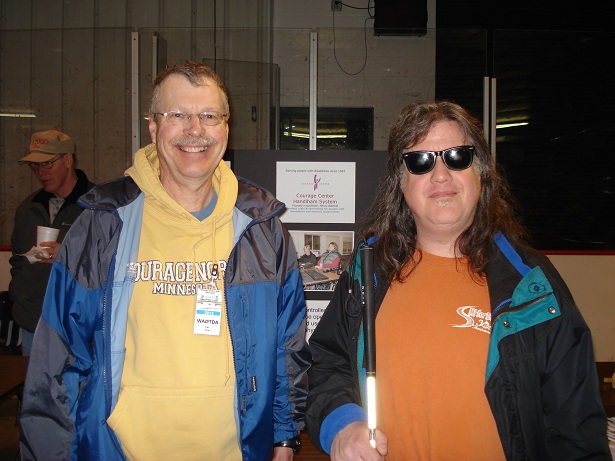
Pat, WA0TDA, and Matt, KA0PQW pose in front of the Handiham table. Photo by Susan Tice.
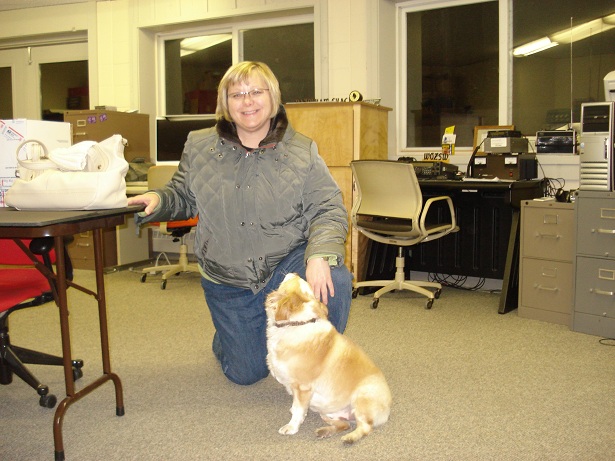
Susan Tice and Jasper get ready for the hamfest by helping to pack the booth equipment at Handiham Headquarters. Asked if it was a tough job, Jasper said, “ruff”. WA0TDA photo.
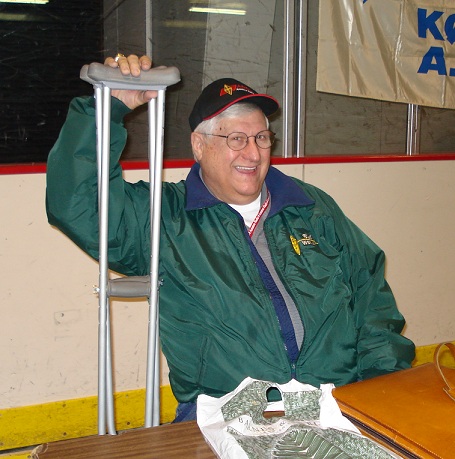
Bob, W0LAW, ARRL Minnesota Traffic Manager, mugs it for the camera at the ARRL booth, right next to the Handiham booth. WA0TDA photo.
Now, to our special feature: Communicating with other hams: It’s all about exchanging information.
Ready to review the basics? Good! Let’s get started.
The basics
Start with callsigns: My callsign is WA0TDA.
Every other station has one, so you will use both of them to initiate a contact:
“W0ZSW, this is WA0TDA”.
Identify!
• Use your callsign.
• Speak clearly & slowly.
• Use phonetics when conditions make hearing difficult.
• Position your microphone correctly.
• Repeat (or ask for a repeat) of the information as necessary.
When you are done talking… (Read more on the Handiham website, or listen to the audio podcast.)

MEN OF ADVENTURE by Dan Caesar NI9Y PB #218
These last two Polar Bear adventure radio sprints in January and February was quite an experience operating QRP (5 watts or less) outside in the snow. I never thought I would never do anything like this in freezing weather. There I was knee deep in snow; with a wind chill around 15 degrees, under an open air shelter at Cobus Creek Park, located in the northwest corner of Elkhart County in January. I was invited by Bob, KB9IVA, who said it would be fun. So I got my portable gear and winter parka and headed out to the site. When I arrived Bob wasn’t there. I got out of the warm car and looked over the snow covered picnic table. The bright sun reflected off the stone on the side of the building helped warm things up a bit.

First one gets the warmest spot!
Then the sun disappeared and it became colder. The heated outhouse was open so I warmed up for a few minutes.

QRP in the parking lot!
It was too cold for me to set up outside so I operated in my mobile on 40 meters. Bob arrived in a snowmobile outfit with a bag full of tools, and his ICOM-703 and MP-1 portable all band vertical antenna.
The antenna would not tune properly so I ran 25 feet of RG-59U coax from my mobile antenna to the picnic table. Then the portable battery pack ran out of juice. So I took my emergency car starter battery and hay wired a connection to the ICOM-703 and we were back on the air. When it’s cold radios and batteries don’t work properly. Wires become stiff, batteries quickly discharge, and the straight key was difficult to use. Not to mention your exposed fingers feel frostbitten. I had forgotten my gloves but you couldn’t send CW with them on anyway.

Our vertical in the park!

Cold stiff hands on a very cold key! YIKES!
I was more prepared for the February sprint but didn’t count on blowing snow. Participating in this sprint was, Bob, WA9S Keith, and Steve KB9ZVJ and I Ni9Y. Keith arrived late and operated inside his Jeep. I Made a half-dozen contacts from Utah to Colorado to the East coast with my HB1-A 4 watt transceiver using a 50’ end-fed wire only 27 inches high. Then the wires snapped off my battery pack. So we quickly repaired the pack with a new connector and we were back in business again.

2 Cold QRP Guys operate in the Feb 2010 PBMME
Bob had his IC-703. His headphone band cracked in two in the cold. Bob’s straight key was almost brittle and hard to use with gloves on. Steve operated SSB with his Yaesu rig, powered by a riding mower battery, feeding a sloping 20 meter dipole about 5 feet high.

A snow proof antenna for 20m

Last man sending!
It was getting too cold for me so I packed up and left as the snow began to really come down. Steve saw me packing so he packed up and so did Bob. Keith stayed behind moving to the picnic table and made more contacts in a small blizzard. Then Park Ranger paid a surprise visit to find out what in the world was going on. The ranger was satisfied that we weren’t suspicious characters after Keith explained the situation. The ranger failed to notice Keith had wrapped his antenna rope around the door handle on women’s entrance to the outhouse. There was no way anyone could open that door. The ranger probably thought we were a bunch of nuts playing radio in the snow. It was fun and we probably will do it again next season. Only next time I will be more prepared for polar bear weather. Oh yes I forgot to say this was the POLAR BEAR MOONLIGHT MADNESS event. You can read all about on their website http://www.n3epa.org/Pages/PolarBear.htm. Polar Bears all over the country and in Europe participated in the madness. The final polar bear event was held March 20th but I took a pass on that one because all the snow is gone so it wouldn’t be as much fun operating in warm spring weather!!!
The MEN OF ADVENTURE will soon take off again. Barry, WD4MSM says “QRP To The Field” has just been announced for 2010. He recalled that we took part in the 2009 version that had as its theme “The Great Depression.” We operated from the WPA site of Monkey Island in Mishawaka (the bridge to Monkey Island was built by the WPA).
This looks as if it might be an ideal outing for us. Saturday, April 24, 2010
Spicer Lake Nature Preserve http://www.sjcparks.org/spicer.html
Small picnic shelter available; Trees for antenna support if needed;
Restrooms (heated and immaculate) just steps away; Ample parking for hundreds!
Just minutes from South Bend; Plenty to do for family members and visitors (trails, grills, visitor center, two lakes, etc.); Handicap accessible trails and parking immediately next to the suggested operating position.
You to can join the MEN OF ADVENTURE even if you don’t have a QRP rig. Just show up to learn about portable operation and how to put up antennas where they don’t belong. Who knows maybe you to will be just as nuts as the other members of the group are? Present company accepted.
That’s it for this edition.
73’s Dan, email DAN
p.s. Consider operating the special event KØS Strange Antenna Challenge Special Event — May 29-31, 2010.
Start Date & Time: Saturday, May 29, 2010, 1000Z
End Date & Time: Monday, May 31, 2010 at midnight (local time zones)
This is not a serious event. We are all out here for fun! K0S will employ out-of-the-ordinary antennas to promote Amateur Radio and making do with what might be available during an emergency. Individuals and clubs may participate as “satellite stations” by using anything but wire or pipe for a radiating element and adding “/K0S” to their call signs. Details are on the KØS, Strange Antenna Challenge Web site. Strange antennas used in past events, dating back to 2002, have included folding chairs, paint easels, ladders, tape measures, dog kennels, fences, cots and chicken fencing with a trampoline as a ground plane. “More people share in the fun each year,” says Erik Weaver, N0EW, a Strange Antenna Challenge founder. “I hope you give me a call this year with your very own strange antenna. Now let’s play radio!”
Handiham World for 17 March 2010
Welcome to Handiham World!
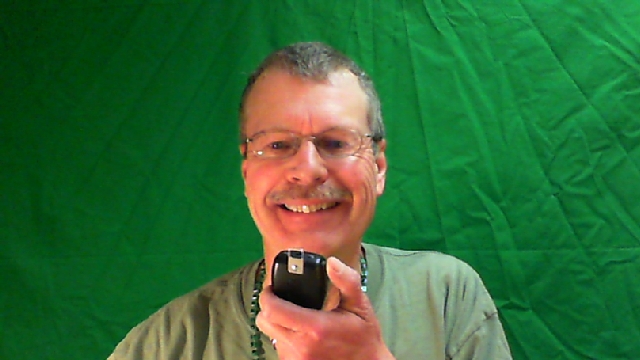
Photo: Pat, WA0TDA, with microphone, sports a green T-shirt, green beads, and a green screen background for St. Patrick’s Day. Hey, if Chicago can dye a river green, we can do this!
Happy St. Patrick’s Day, everyone. This is the first time in my memory that the Irish holiday has fallen on the same day as our weekly newsletter and podcast, so why not just use it as an excuse for a fun way to start our weekly column?
I’m not sure if there are any special ham radio events associated with St. Patrick’s Day, but I do know that there are plenty of parades and other civic events. St. Patrick’s Day is always a big deal in cities like Boston, Massachusetts and St. Paul, Minnesota where there are historical Irish roots. Any time you have a parade or civic event there is an opportunity for amateur radio support in the form of communications. While I know of no amateur radio support for parade activities during today’s activities here in the Twin Cities, amateur radio volunteers do support plenty of other worthwhile civic events. Marathons, bicycle races, walkathons, and other types of parades or large events that cover considerable territory are all candidates for amateur radio communications support.
These types of activities are similar in many ways to the volunteer work that amateur radio operators do in emergencies. However, there is a difference in that many of the communications in an event are much more routine and may be structured in a more informal way than communications in an emergency where a command structure is set up under very specific guidelines. In a public service event, which is what these non-emergency activities are called, your radio club may decide to participate as a group and call for volunteers. It always helps when public service communicators have some training and experience, but public service communication may be a less demanding place to get started than in emergency communications. It all depends on the event and the person in charge of communications. Some events are so large and complicated or cover so much territory or have potential for generating emergency response-style situations that they may be looking for volunteers who are more familiar with a structured incident command system. On the other hand, some events are more easily managed with semi-formal organization and communication. While good operating practice is essential for either, you may want to get your feet wet by helping with communications at one of these smaller events in the realm of public service.
Good communications basics will include knowing how to identify your station, including identification by location if that is the most efficient way to identify and it is what your group has agreed to do. This is called a tactical identification. Of course you do still have to use your FCC-issued callsign periodically as specified by Part 97 rules. A tactical identification might be something like “rest stop five”. At the end of a series of transmissions and every 10 minutes you do have to use your regular callsign. There are many other things to learn about public service communications that will help you learn “on the job” as you gain experience and work toward being a capable volunteer in ARES, able to handle more demanding formal communications within an incident command structure.
In many ways, amateur radio is like other learning activities. If you were to have to learn calculus or how to speak Chinese, you would not begin with differential equations or interpretation of ancient Chinese texts. You would instead choose to begin at, well, the beginning! You would start with simple concepts and easy tasks, practicing and learning incrementally, gaining knowledge every time you study or practice. Amateur radio is a huge and complicated activity when you consider all of the different licensing classes, the many different types of technology, multiple modes of operation, and extraordinary array of on the air activities. No one expects you to get your first license and be able to do everything — and that goes for being a public service communicator. You need to start at the beginning, perhaps volunteering at an event like a St. Patrick’s Day parade. Don’t forget to wear green, and a reflective vest if you are on the parade route.
For Handiham World, I’m…
Patrick Tice, [email protected]














