Posts Tagged ‘amateur radio’
 Handiham World for 2 March 2011
 March 2nd, 2011 |
  Author:
 Welcome to Handiham World!
Lyle, K0LR, and I have made really good progress with the W0ZSW remote base beta test, so this afternoon the station will go off the air as I prepare to transport it to its new location at Camp Courage. We still have a few problems to iron out, so the old TS-570SAT will probably have to go back on the air for a while.
When I get out to camp tomorrow, I will be working to get the network problem repaired. After that, we can get the TS-570 back on line and into service for our members. Now, you must be wondering what issues still remain with the TS-480HX setup, right?
Well, there are several:
 | The TS-480HX is, of course, the 200 Watt version of the popular TS-480 series by Kenwood. Most users opt for the SAT version, which runs 100 Watts. We figured that the 200 Watt version would add some extra punch to the signal, and it would be especially useful in the summertime when interference levels from summer thunderstorms around the country are higher. The problem is that the W4MQ rig control software keeps dropping the power level back to 100 Watts. Of course this is not a deal-killer, since the 3 dB drop in signal strength is not going to be a problem most of the time. I have posted the issue on the N2JEU remote base development website in hopes of getting some help with this issue. |
| The receiver audio equalization always defaults to “high boost”, which makes the sound a little on the screechy side for my taste. Those with hearing deficits may prefer the high boost, though, so this is not necessary a bad thing. To get a mellower sound you have to change the receiver equalization to “normal” after logging in. When you log out, it returns to the default “high boost” setting. We would prefer that it worked the other way around, where the normal audio setting would be the default. |
| The radio is supposed to turn off shortly after the control software on the host machine is disconnected from the W4MQ interface by the control operator’s log off. Instead, the radio may indeed turn off, but it always turns itself back on after about a minute even though no one is using it, whether through the W4MQ software or to listen to the receiver via Echolink. This is a bit of a headache, because we would rather the radio were off when not being used. Left to its own devices, the radio will run 24/7. This problem seems unique to our new beta test setup since we don’t have any problem with the W0EQO station or the old W0ZSW station using the TS-570SAT. |
Those are the main concerns with the new system. As you can tell, since the radio and computer are actually working quite well otherwise, we could put the station on the air any time. Still, I’d rather try to get things working just a little better and have the system the way it should be as we “go live” so to speak.
If I am unsuccessful getting the network problem resolved, W0ZSW will be offline for a while but hopefully the Echolink receive function will still be enabled through a proxy server.
I provide a short overview video of the W0ZSW remote base beta test on YouTube. Look for WA0TDA’s channel.
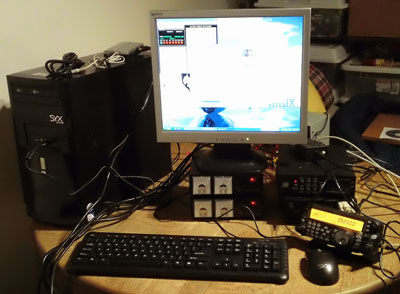
Photo: The W0ZSW beta station as featured on YouTube.
Patrick Tice, WA0TDA Handiham System Manager [email protected]

Handiham World for 2 March 2011
Welcome to Handiham World!
Lyle, K0LR, and I have made really good progress with the W0ZSW remote base beta test, so this afternoon the station will go off the air as I prepare to transport it to its new location at Camp Courage. We still have a few problems to iron out, so the old TS-570SAT will probably have to go back on the air for a while.
When I get out to camp tomorrow, I will be working to get the network problem repaired. After that, we can get the TS-570 back on line and into service for our members. Now, you must be wondering what issues still remain with the TS-480HX setup, right?
Well, there are several:
| The TS-480HX is, of course, the 200 Watt version of the popular TS-480 series by Kenwood. Most users opt for the SAT version, which runs 100 Watts. We figured that the 200 Watt version would add some extra punch to the signal, and it would be especially useful in the summertime when interference levels from summer thunderstorms around the country are higher. The problem is that the W4MQ rig control software keeps dropping the power level back to 100 Watts. Of course this is not a deal-killer, since the 3 dB drop in signal strength is not going to be a problem most of the time. I have posted the issue on the N2JEU remote base development website in hopes of getting some help with this issue. |
| The receiver audio equalization always defaults to “high boost”, which makes the sound a little on the screechy side for my taste. Those with hearing deficits may prefer the high boost, though, so this is not necessary a bad thing. To get a mellower sound you have to change the receiver equalization to “normal” after logging in. When you log out, it returns to the default “high boost” setting. We would prefer that it worked the other way around, where the normal audio setting would be the default. |
| The radio is supposed to turn off shortly after the control software on the host machine is disconnected from the W4MQ interface by the control operator’s log off. Instead, the radio may indeed turn off, but it always turns itself back on after about a minute even though no one is using it, whether through the W4MQ software or to listen to the receiver via Echolink. This is a bit of a headache, because we would rather the radio were off when not being used. Left to its own devices, the radio will run 24/7. This problem seems unique to our new beta test setup since we don’t have any problem with the W0EQO station or the old W0ZSW station using the TS-570SAT. |
Those are the main concerns with the new system. As you can tell, since the radio and computer are actually working quite well otherwise, we could put the station on the air any time. Still, I’d rather try to get things working just a little better and have the system the way it should be as we “go live” so to speak.
If I am unsuccessful getting the network problem resolved, W0ZSW will be offline for a while but hopefully the Echolink receive function will still be enabled through a proxy server.
I provide a short overview video of the W0ZSW remote base beta test on YouTube. Look for WA0TDA’s channel.
Photo: The W0ZSW beta station as featured on YouTube.
Patrick Tice, WA0TDA
Handiham System Manager
[email protected]
First 12m contact in a long time

Grand Cayman (photo by NASA)
On Wednesday I was working from home and took a little time on the K3 during a break. On 15m I heard a strong signal from ZF2UL who was making North American contacts one after the other. Bob, ZF2UL, then said they were going on to the 12m band and gave the frequency they were QSYing to. I followed and continued listening. After a short run of QSOs there was a brief hiatus in the replies to “QRZ?”, at which point I called with my 10W on SSB. I soon obtained a reply and a 55 report and my first contact with Grand Cayman was logged.
Good to see the higher frequency HF bands are opening up more regularly. It has been a long time since I made a contact on 12m.


Handiham World for 23 February 2011
Welcome to Handiham World!
Last week was pretty busy and included a painful and inconvenient fall on the ice, so I was really late with the usual Technician Class audio lecture, which finally came out yesterday. We have only the final safety lecture to finish this week, then the Tech class is completed, aside from some possible review lectures. Lyle, K0LR, and I have been working on the remote base station. As we reported earlier, the W0ZSW remote went silent at Camp Courage when a router failed. The Echolink system continued to work, but the W4MQ remote control interface did not. I have been intending to put a new station into service anyway, and had done the preliminary setup at Camp Courage. The old TS-570 station did not support audio frequency announcements for our blind members, and the old computer was sometimes a bit sluggish. The new station features a Kenwood TS-480HX with the VGS1 voice chip and a Systemax computer from TigerDirect that is well-resourced and speedy. An LDG AT-200 Pro autotuner does the job of matching, and twin SEC 1235M switching supplies power the 200 Watt station. The rig to computer sound interface is a RIGblaster Nomic. Those of you who have compared the two Kenwood radios know that the HX model runs 200 watts but does not include the internal automatic antenna tuner. The HX mode l also requires a much larger power supply than does the 100 watt SAT model. In this case, we are using two switching power supplies, as is recommended in the manual. Only one of these supplies would have been required for the 100 watt radio. There definitely are some choices to make when deciding to buy one radio or the other. Operation and rig control through software is otherwise pretty much identical whether one uses the HX or the SAT models. Outside the shack, you have to make sure that your feedline, any baluns or other matching devices and accessories, and your antenna can all handle the higher power.
Lyle and I began putting the project together months ago, but it stalled after I did a preliminary setup on Nancy’s desk at Handiham headquarters. The idea was to set the new station equipment up in parallel to the old station, which would allow us to initially do testing with little or no interruption to the existing station. The problem was that I got really busy, making it difficult to devote time to testing the new station and getting the equipment to work the way we wanted. Every time I went to the office, something new would come up. The project sat and sat. Then a router failed at the main camp Internet distribution point. The station was inaccessible via the Internet, so we shut it down and I got serious about testing the new equipment, which I packed up and brought to our secret, undisclosed testing location. (Hint: It’s really close to my QTH.)
Last weekend proved to be pretty productive, and Lyle and I made some good progress. The station is now up and running during daylight hours (approximately 7:00 to 22:00 hours USA Central Time.) Users must visit the W0ZSW setup pages again and re-enter the IP address information for W0ZSW only. We would appreciate feedback from users. You will notice immediately upon connecting that the VGS1 voice module is now enabled and providing voice frequency readout. The antenna currently in use is a crummy Windom that doesn’t tune on all bands. Checking into PICONET on 3.925 MHz is pretty easy, though. Transmit is disabled on 160 m, where the antenna cannot tune. All of this will be fixed once the station is moved back to its regular location at Camp Courage when the router out there is replaced.
Remote base users who are already registered but who need a link to the W0ZSW setup pages may email me. (The links are available in the members section of the website.) Use of the stations is a member service that is not open to the public.
One other consideration: W0ZSW Echolink receive, which is open to any licensed amateur, is working intermittently due to a port forwarding issue. The W0EQO-L Echolink control is working well and should be used instead.
Oh, and be careful on the ice. The combination of a low coefficient of friction and gravity almost did me in, but I’m feeling great now, thank you very much. Spring can come anytime, though.
Patrick Tice, WA0TDA
Handiham System Manager
[email protected]

Ottawa Amateur Radio Club Presentation

Just before the start of the OARC meeting (photo copyright of the OARC)
Last week I drove through a snowy evening to give a presentation to the Ottawa Amateur Radio Club (OARC). The meeting was in one of the rooms in City Hall and I have to admit it was my first time attending the OARC.
I was greeted by Dave, VE3TLY, the president and others and it certainly seems to be an active club. There was a report on the club construction project and talk about the upcoming Canadian Ski Marathon and the amateur radio support that is given.
My talk was on D-STAR in the Ottawa Area and started with some D-STAR principles, covered a little on the local repeater VA3ODG and finished off with a look at the current projects and developments. A pdf of the slides are here:> OARC Presentation PDF.
I finished off with a demonstration and tuned the HT to module B of repeater VA3ODG and chatted with a small group that had assembled there. There was some luck as using the repeater with Maurice-Andre, VE3VIG was Greg, VA3OMP, using his FREE STAR* repeater as well as a station connecting in from Florida. This nicely illustrated the linking to the repeater from outside the local area and use of a different (FREE STAR*) network, which I had just earlier mentioned in my talk.
After the demonstration there was some good questions and comments from the audience. The meeting officially wound-up and over coffee I had pleasant discussions with a number of the club members.
A great evening and thanks to the OARC for inviting me and making me so welcome.


Handiham World for 16 February 2011
Welcome to Handiham World!
Take a video tour of the KA0PQW ham shack

The tour, available in both YouTube video and in MP3 audio from the Handiham website, lasts about nine minutes. Matt describes all of the equipment in his ham shack, which also has some audio equipment for his radio show, which is done on a non-amateur radio feed. The impressive setup includes a repeater! Matt knows the layout of the shack very well, and is of the opinion (which I share) that we should all know enough about our operating area to use the equipment independently. Furthermore, a system of “a place for everything and everything in its place” serves the efficient amateur radio operator well, because when things are where you expect them to be you can grab that first spot in the DX pileup or quickly silence a radio when the phone rings. In an emergency, you certainly want to concentrate on communicating, not on trying to find a microphone or an accessory in a pile of clutter. Since Matt is blind, he needed to develop his own system of knowing where things are in the ham shack. Being organized in this way is a discipline that we can all use to be better amateur radio operators.
Visible in the video, but not mentioned in the audio, is the electrical breaker box in one corner of the room. There is also a basement window, which lets in some natural light. The repeater rests on some 2 by 4 boards, lifting it above the basement floor.
Ready for a tour? Those of you listening to the audio podcast can just keep listening, because we will go right to the audio tour. If you are reading the HTML version, you can follow the link to the story on Handiham.org, which has embedded video.

Handiham World for 16 February 2011
Welcome to Handiham World!
Take a video tour of the KA0PQW ham shack
The tour, available in both YouTube video and in MP3 audio from the Handiham website, lasts about nine minutes. Matt describes all of the equipment in his ham shack, which also has some audio equipment for his radio show, which is done on a non-amateur radio feed. The impressive setup includes a repeater! Matt knows the layout of the shack very well, and is of the opinion (which I share) that we should all know enough about our operating area to use the equipment independently. Furthermore, a system of “a place for everything and everything in its place” serves the efficient amateur radio operator well, because when things are where you expect them to be you can grab that first spot in the DX pileup or quickly silence a radio when the phone rings. In an emergency, you certainly want to concentrate on communicating, not on trying to find a microphone or an accessory in a pile of clutter. Since Matt is blind, he needed to develop his own system of knowing where things are in the ham shack. Being organized in this way is a discipline that we can all use to be better amateur radio operators.
Visible in the video, but not mentioned in the audio, is the electrical breaker box in one corner of the room. There is also a basement window, which lets in some natural light. The repeater rests on some 2 by 4 boards, lifting it above the basement floor.
Ready for a tour? Those of you listening to the audio podcast can just keep listening, because we will go right to the audio tour. If you are reading the HTML version, you can follow the link to the story on Handiham.org, which has embedded video.













