Posts Tagged ‘amateur radio’
 Extra, Extra, Extra…Read all about it!
 August 28th, 2011 |
  Author:
  I realize it was just Wednesday, 24 August when I blogged about reaching the 50% mark in the amateur extra training course I’ve been attending. I also realize it’s been less than a month (21 days to be exact) since I blogged about getting serious about extra….Again!! I have some great news I’ll share with you all in just a minute.
When I first got my license in August 2007, I knew I wanted to upgrade to the general class and I wanted to do it in relatively short time. I will admit that I quickly grew bored with working local VHF/UHF repeaters and while I did manage to work 10m HF, the QSO’s made on that band were few and far between. I became intrigued in PSK31 after watching Randy Hall’s K7AGE Youtube videos. Within a few weeks of earning my technician license, I was actively reading and preparing for general. I tested for my general ticket on 5 January 2008, just four months after getting my ticket.
Something else I need to admit is once I had my general in hand, I was satisfied. I had all the HF privileges that I believed I needed and wanted. I was happy as a pig in mud with being able to work PSK31, RTTY and of course phone on all the bands generals have access to. I even remember a conversation with a colleague from my office who was also a general. We both discussed how general was all we felt we would ever need.
Now keep in mind this was inside of my first six months of the hobby. In May of 2008 I started the Practical Amateur Radio Podcast and the Elmer bug bit me. Also, it was through the podcast and social media sites like Facebook and Twitter where I really became friends with many hams who were either already extra class or working to become extra class.
I believe it was very soon after I started the podcast and really started to get more involved with my Elmer activities that I realized I did see more to the hobby than staying at general. Sometime during the summer of 2008 I picked up the ARRL extra class study guide and started reading. But sadly over the last three years the ARRL extra class study guide spent more time on the shelf than it did in my hands.
Now jump forward three years and as I blogged on 8 August, I had once again pulled the book from the shelf and began studying. The approx. 50% of the material I had previously read all came back to me relatively easy. Plus the SCARS Echolink training was adding additional knowledge and confidence to my overall process. Again, just as I blogged last Wednesday, I truly felt on-track to take the exam in late September or early October. While I didn’t state this in writing, my unofficial target date was prior to October 4. On October 4 I turn 45 years old. Birthday present to myself???
On Thursday (just one day after the blog update) I had been passing the sample tests from QRZ in the high 80’s to low 90 range. My ideal practice score is in the upper 90’s as I don’t feel I am the best at taking exams. I told my wife that I couldn’t see a reason for me to delay taking the exam and she supported my decision to take a chance. She actually suggested I go into the exam thinking it was just another practice exam. If I didn’t pass, I still had several weeks of the SCARS class to continue to build my understanding of the material (this has always been my #1 goal versus memorization). Another reason to give it a try is my schedule at work is also starting to pickup speed again. I was recently promoted and had a few added responsibilities sent my way. I feared if I delayed, something would happen and I would lose the momentum.

I went to bed on Friday night feeling pretty nervous, but feeling confident. I slept remarkably well and woke up with enough time to enjoy some coffee and a bagel and just ease into the morning. I didn’t take any sample tests…I just enjoyed the peacefulness of the morning. With a cup of coffee for the road (a roadie) I started the 25 mile journey to Franktown, Colorado for the Colorado ARES sponsored VE session. By 9:45 AM, I had the CSCE in my hand and had finally made extra.
In closing, I don’t view the extra class as the only true ham class. For those who are technician, general, advanced….if you are happy then this is what matters. You are just as much a part of this hobby and service as anyone else is. However, if you are interested in upgrading I say go for it. I’m glad I finally got serious about it and followed through….ALL THE WAY through.
Finally, thanks to all who over the past several weeks have taken the time to post comments to the blog and even email me to lend words of encouragement. This meant a lot to my study and preparation process. I felt like I had all of you with me yesterday cheering me on as I worked through the 50 questions and answers.
Until next time….
73 de KD0BIK/AE
NASA TV Video of Hurricane Irene [VIDEO]
The main thing most people are talking about on the local radio shows and TV morning shows is Hurricane Irene. Giving updates, information on being prepared and of course comparing it to other past hurricanes. Kim and I are pretty much ready, we’re going to get a couple coolers to keep perishables cold should we lose power. Needless to say, here is some video of the storm from NASA TV.From the NASA YouTube Channel:
From almost 230 miles above the Earth, cameras on the International Space Station recorded new video of Hurricane Irene, which is strengthening as it takes aim on the southeast Bahamas, and possibly, the Eastern Seaboard of the United States. The video was captured at 4:08 p.m. EDT on August 23, 2011, as Irene moved west-northwest.
73.
Rich also writes a Tech blog and posts stories every Tuesday and Thursday on Q103, The Rock of Albany’s website, as well as Amateur Radio stories every Monday thru Friday on AmiZed Studios and hosts a podcast called The Kim & Rich Show with his fiance’ Kim Dunne.
Hurricane Irene is Coming – Nets Are Already Active
With the news of Hurricane Irene, a Category 3 storm, moving into a category 4, Greg, G0DUB, reminds us on the IARU Region 1 website, that hurricane watch frequencies are active and gathering info on the storms. These are used by Hams in North and Central America for tracking and deal with the storms and reminds us about creating QRM near these frequencies.

Photo Courtesy of NASA
- 14.300MHz is used by the Maritime Mobile Service Net daily for gathering info on weather reports from Maritime Mobiles for forecasters as well as handle traffic from these Maritime mobiles.
- 14.325MHz is for the Hurricane Watch Net which is established whenever a storm could come into contact with the U.S. mainland. They also gather info for the National Hurricane Center.
- 14.265MHz is the frequency for the Salvation Army Team Emergency Radio Network which handles health and welfare traffic for those affected in a disaster area as well as disaster relief response should a hurricane hit.
From the Southgate ARC website, here are some of the other frequencies to keep in mind as well:
Frequencies used in Cuba: 7.045, 7.080, 7.110 MHz, 3.740 MHz
Frequencies used in Central America;
Red Centro Americana : 7.090 and 3.750MHz
Guatemala: 7.075 MHz
Nicaragua: 7.098 MHzMexico (FMRE): 3.690 and 7.060 MHz
Also keep in mind local frequencies if it is an area where the hurricane may hit. Simplex as well as repeater. If you are in an area where Irene may hit, I wish you luck in getting through this. I know I’ll be watching and listening.
73.
Rich also writes a Tech blog and posts stories every Tuesday and Thursday on Q103, The Rock of Albany’s website, as well as Amateur Radio stories every Monday thru Friday on AmiZed Studios.
Extra Study Update

I thought it was about time to provide a brief update into my study preparation for my extra class upgrade. First, I did just want to say a very special and heartfelt, “Thank You” to all who have contacted me either via email, commented on the blog post or via Facebook, Twitter and/or Google+. Your words of encouragement have helped to push me and most importantly have helped me to believe in myself.
I certainly don’t mean to sugarcoat the difficulty (or even lack of difficulty) there is in achieving the extra class ticket. Some have found it extremely difficult and others extremely easy. I would safely and squarely place myself in the middle of that spectrum. This, like many other things in life, is made much easier when you look at it through positive lenses. It is the many comments I’ve received which have taught me that this is just like anything else in life. Look at it negatively and it will be difficult to impossible, but look at it positively and it can be achieved.
As I mentioned in this blog post from early August, I’m participating in an online (via Echolink) study program hosted by SouthCARS and we are 50% of the way through the program. We meet twice weekly on Sunday and Tuesday evenings again via Echolink. Volunteer SouthCARS members help moderate the sessions and help provide both encouragement and inspiration as they help educate us in the material.
The program works like this. Before each session we (the students) are tasked with reading about 60-70 of the questions which make up the question pool. During each session, the instructors select about 15-20 of the questions to cover. They read the question and the correct answer. But then spend several minutes providing detailed information regarding the subject of the question. Many times this extra information comes from firsthand experiences and after a few minutes, it really becomes clear as to what the particular content of the question is about.
Because many of the questions in the extra class question pool relate to each other, once you have a good grasp of one question, the knowledge and the “ah ha” moments just click right into place. The SouthCARS Elmers are always good about answering questions from the questions not covered.
In addition to the homework and the online sessions, I’m also actively taking the practice tests for the information we’ve covered in the sessions. This is helping to keep my mind sharp around those areas covered several weeks back. I’m spending approx. 1-2 hours per day in reading the ARRL extra class manual, reading the question pool and doing the study questions for the info covered. I’m going to owe my wife a nice dinner and perhaps tickets to the theater for her being so supportive.
So when do I plan to take the exam? This is still a very good question. One thing I can say today, which I couldn’t or certainly didn’t want to say back in early August, is I’m certainly better prepared on the information we have covered so far. Having said that, if I can maintain my pace and continue as planned, I believe I could be looking at being ready to take the exam around the early October timeframe. Yes…October 2011. 
Look for another update from me regarding my study/preparation process around the 75% mark. But for now, I need to get back to my studies and keep those brain cells “extra” energized.
Until then….
73 de KD0BIK
Shakin’ – Not The Eddie Money Song – Earthquake Hits Albany, NY [VIDEO]
While I was at my “regular job” yesterday, I along with countless others on the east coast, felt a 5.9 magnitude earthquake. I was leaning against a table helping someone with setting up a new computer and felt the table start to move. The first thing that ran through my mind was someone was shaking the table. It was almost surreal.

Courtesy Google Maps
No one else really realized what was going on or even felt it. And I didn’t even think it was an earthquake till I saw on twitter what it really was. But because of that, I have decided to post a few links to information to have in case a bigger quake should hit. And even a little video from a couple of my co-workers.
First up, I found an article from the San Fransisco Gate on making a preparedness kit. It’s usually a good idea to have these around on a regular basis anyways for not just an earthquake, but any other kind of disaster that could happen. Food, water, a First Aid kit and a radio with some extra batteries are a good idea to have, along with clothing and important documents to take with you. You could also buy a premade kit, but those seem to be way more expensive compared to what you could do with just what you have at home.
But as Ham Radio operators, some of us are prepared for even more, having generators to power the house, as well as battery backups for the radios and computers. These kind of things are on the “To Do” list for when I do get a house with the YL. For now, I’m ready with the basic kit.
This little “rumbler” was just a reminder that even here in the Northeast, that we can feel the effects of an earthquake too. While It was thankfully a “small” one by comparison to many others that have caused countless deaths and millions or even billions of dollars of damage, it’s still a kind of sobering thought that these can happen. But, there is a side of humor too it as well, as shown in this video from my co-worker Brian Sinkoff, who is host of a local sports talk show and program director of the ESPN radio affiliate here in town. Even my program director Rob Dawes gets in on the act. But note at the :20 second mark of the video, you see a quick pan of the camera and you get a glimpse of Rob standing in the door way, which from what I understand is something you should do in a quake.You can’t miss him in his bright yellow shirt. I have to remember to call him out compliment him on his fashion sense.
73.
Rich also writes a Tech blog and posts stories every Tuesday and Thursday on Q103, The Rock of Albany’s website, as well as Amateur Radio stories every Monday thru Friday on AmiZed Studios.
Handiham World for 24 August 2011
Welcome to Handiham World!
[email protected]
Handiham Manager

But first – Help us win the Dr. Dave Challenge!
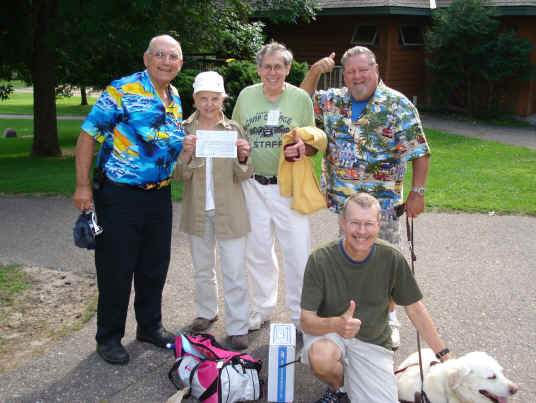
Photo: Bill, K9BV; Lucy, KE6QNX, Dr. Dave, KN0S, Bill, N6HBO & Guide Dog Heldy, and Pat, WA0TDA (kneeling in front.) Thumbs up for a pass for Lucy at the VE session.
Nancy can take credit card donations via the toll-free number, 1-866-426-3442, or accept checks sent to our Courage Center Handiham address:
Courage Handiham System
3915 Golden Valley Road
Golden Valley, MN 55422
Be sure to put a note saying “Dr. Dave Challenge” somewhere in the envelope or on the note line of the check. If you donate online as detailed toward the end of your weekly e-letter, be sure to designate to Handihams and then send me an email letting me know you donated to the Dr. Dave fund: [email protected].
Thank you so much for your support!

Randy, K7AGE Visits TWiT Open House [VIDEO]
I’ve seen a couple of stories about this video already, so I figured I would post it too, and get Randy a little more traffic to the YouTube video. Randy headed to Petaluma, CA, and hung out at the TWiT Brickhouse with Bob Heil, K9EID and Leo Laporte, W6TWT, for the first day of the new Ham shack in the Brickhouse Studio.While Randy was there, he of course recorded some video and shared it with everyone else. There was also a special event station on the air for the open house, which I talked about last week. I’m curious if anyone who reads me, also worked the special event? If you did, please share in the comments. I would love to hear how it went. But now, Lights! Camera! ACTION!
73.
Rich also writes a Tech blog and posts stories every Tuesday and Thursday on Q103, The Rock of Albany’s website, as well as Amateur Radio stories every Monday thru Friday here on AmiZed Studios.













