Posts Tagged ‘amateur radio’
 South Texas Balloon Launch Team launches balloon aimed at China
 February 11th, 2012 |
  Author:
 My daughter and I made the short trip to the No Label Brewing Company in Katy TX to watch the South Texas Balloon Launch Team launch a helium balloon aimed at Nanjing China. Thanks to Tom AE5QB for letting us know about this event!
To track the balloon in real time go to : http://aprs.fi/?call=a%2FKT5TK-11&_s=mb
From the press release of the South Texas Balloon Launch Team:
The South Texas Balloon Launch Team is pleased to announce the upcoming launch of its twenty-eighth, helium-filled, unmanned balloon in twenty one years. The purpose of this flight is to establish a world record for distance by floating a balloon from Katy, Texas to Nanjing, China.
The balloon will be released at approximately 3 P.M. CST on Saturday, February 11, 2012. The site of the launch is at the western end of the No Label Brewery complex at 5373 First St., Katy Texas, near the old rice grain silos.
The public is invited to this free event, with a special invitation to science students and teachers. Free helium-filled balloons will be available to the first 100 students. Sorry, no pets allowed in the balloon area.
The balloon payload package weighs only about five ounces (150 grams) and contains a high altitude GPS tracking system and a VHF amateur radio transmitter. To conserve weight and battery life, no camera equipment will be on board. The maximum altitude is expected to be above 100,000 feet, with horizontal speeds between 100 and 150 MPH. The balloon size will increase from about five feet to about 39 feet at maximum elevation. Recovery of the payload package is not expected.
Individuals may follow the balloon’s progress on the Internet by logging onto APRS, filling in the “track callsign” field with “kt5tk-11”, and change the “show last” to 24 hours.
The South Texas Balloon Launch Team is composed of about twenty active amateur radio “Ham” operators from a variety of occupations who donate their time and expertise.
We appreciate the continued support by No Label Brewing Company for our amateur radio projects.
Handiham World for 08 February 2012

A few days ago I spotted a story in a small town newspaper that turned out to be a letter to the editor. It was written by an amateur radio operator who was admonishing his fellow amateur radio operators to please monitor their local repeaters in case there would be an emergency. He had an example of an actual emergency when a call was sent out via a repeater but there were no responses.
I have lost count of the number of times I have driven cross country myself, monitoring the various repeaters along the way and throwing my call sign out here and there, but getting nothing but silence in return. Others have mentioned this phenomenon as well. Amateur radio repeaters are very, very, VERY quiet these days. I often wonder if any of them get used more than a few times a week.
Conventional wisdom about repeaters used to be that you wanted them to be available during the “drive time” rush hour traffic in case they might be needed to report some kind of emergency. These days, it is a rare motorist indeed who does not travel with a cell phone. The cell phone is much more likely to be a more efficient way to reach emergency service personnel quickly than the local amateur radio repeater system. Yes, it is nice to have the repeater system as a backup because cellular service as not always available and is prone to overloading and failure during emergencies. But on a typical day cell phones work as expected and do absolutely everything they are needed to do. In fact, I suspect that most amateur radio operators use their cell phones more regularly than VHF mobile radios.
While there may be exceptions to the quiet repeater phenomenon in a few areas, I have heard nothing in the past few years to change my belief that most amateur radio repeater systems in large metropolitan areas are grossly underutilized. As I have said in the past, if a repeater system is to remain healthy (an actively used system) it requires a critical mass of regular users. One or two voices crying in the wilderness is not enough to save a repeater system from oblivion. Successful repeater systems host scheduled net activities, have a cadre of informal users who meet on the frequency regularly, and are maintained to high engineering standards so that the user base can enjoy reasonable reliability.
One thing that a repeater owner can do to make sure that the system is used often and doesn’t fade into obscurity is to connect it to a VoIP system like EchoLink, IRLP, WIRES, or Allstar Link Network. Unfortunately, there are amateur radio operators out there who don’t understand this technology and fear that it will somehow ruin the repeater system or dominate it to the point that the repeater will be unavailable for local users.
This, my friends, is nonsense. All you have to do is listen on a connected repeater system on a regular basis and you will find out that the repeater is used much more often than an unconnected repeater system but not to the point of overuse. I have virtually abandoned repeater systems that are not VoIP connected because they have no activity. They sound exactly the same whether the radio is turned on or turned off! If your club’s repeater system is one of these dead zones, I urge you to bring up the possibility of connecting it to the world via VoIP. There may be a few old fogies who will fulminate and fuss, but unless they are regulars on your local repeater all day long and are leaders in keeping the system maintained and active, I think you can safely call their bluff.
For Handiham World, I’m…
Patrick Tice, [email protected]
Handiham Manager

Handiham World for 01 February 2012

Because the station will be staffed by real live humans (members of the Handiham affiliated Stillwater Amateur Radio Association, SARA), the Remote Base station W0ZSW will be off line for the duration of the contest. The W0EQO repeater will be active and connected to the Handiham Conference Server.
W0ZSW Remote Base service will be restored at 6:00 PM CST (2400 UTC) on Saturday, February 4, at the end of the contest. W0EQO Remote Base at Courage North will remain in service throughout the contest.
The SARA members are also going to help us assess equipment and clean and organize the Handiham station area and storage room. We will also check the station infrastructure and prepare some of our computer equipment with digital mode software for the upcoming Minnesota Radio Camp session in June.
We hope to hear you on the air!
For Handiham World, I’m…
Patrick Tice, WA0TDA
Handiham Manager

QST Going Digital
You’ve probably heard the news by now. Last week the American Radio Relay League (ARRL) announced what many of us hoped would eventually happen. In June 2012, QST will be available in an on-line, digital edition version. Now before anyone panics, QST will still be available in the same print version we all know and love. So in addition to receiving the print version, ARRL members will also have access to the digital version at no additional cost.
This news truly excites me. There are a few monthly publications which I subscribe to in digital only format. Some of these publications are only available this way. However, many other magazines (and some supporting our very own hobby) have recently introduced digital content. CQ Magazine is an example of this. However, even if you subscribe to the paper version you must still pay extra for the digital version.
Our hobby is unique (so are those individuals who participate in it) and as I stated, while some of the monthly publications I subscribe to are just fine in digital only versions, I must admit that for now I still want QST, CQ, RadCom and Practical Wireless delivered to my mailbox in paper form. However, if you think I won’t use the new QST digital version, you would be wrong.
The ARRL is going to do more with the digital version of QST than simply scan the magazine in and create a .PDF. There will be content available via the digital version (and methods of delivering that content) which won’t be available in the paper version of QST. Want a magazine article to jump out at you? With the additional features available in digital content delivery, readers will have access to click links from articles, watch video, listen to audio, print, share and search across the entire edition. All of this included in the regular cost of membership.
Again, while other magazine publishers charge (and charge full price as well) for both a print and digital version. I proudly take my hat off to the ARRL for doing this the right way and making both editions available. This is another example of why I’m proud to not only be an ARRL Member, but a Life Member.
Until next time…
73 de KDØBIK
Handiham World for 25 January 2012

The new handiham.org is up and running. I hope you like it, but I am sure open to suggestions if there is something you find that does not work. In the meantime, the old website is still alive, but it is at the URL handiham.net. The two sites are different, but many of our users have not yet registered with the new site, and will probably just find it easier to log in at handiham.net until they have time to get set up in the new handiham.org. So if you visit handiham.org and find that your log in credentials don’t work, the reason is that the new site uses an entirely new database and re-registration is necessary. I have done this in advance for some users, but have not had the time to devote to manually entering so much data. If you wish you can use the create an account link to enter your own data, but please remember that this is a Handiham member service, so I would appreciate it if you used the credentials you already registered with us for the old website. That way, I can check against our database and approve your account because I will know it is really you, not some spammer who wants access to the site. Most of our users registered with their callsigns, except for those studying for a first license. Please stick with your existing username from the old site and, unless you have a different email address, the same email you registered with us in the first place. Be sure you always keep your email address up to date. If you are not a Handiham member, you may still enjoy the public portion of our website without logging in. If you are a Handiham member and need access, please use the Create Account link and apply for access. I will review and approve as soon as possible.
Another change is that our QST audio digest for February 2012 is available to our blind members in DAISY format from the members section. DAISY is the same special format used by the Library of Congress and other organizations providing specialized adapted audio to blind users. It is a single zip file, the preferred method for download simplicity. It will play on DAISY players and the the new Library of Congress player. The complete issue of QST generally takes a month to a month and a half to be released from the Library of Congress, so our audio digest gives blind hams some of the time-sensitive information at around the same time print subscribers to QST are reading their copies.
VOLLI, our volunteer hours logging system, has stopped functioning. We ask that Handiham volunteers simply email Nancy their hours on a regular basis. The best way is to fire off an email as soon as you finish a project. For example, if you volunteer at a hamfest giving out our literature, when you get home just send Nancy a message letting her know the volunteer activity and the hours you spent at the fest. For recording a big project, such as an audio tutorial or a book for our blind members, you might want to keep a log of your hours and then inform Nancy of the total when you complete the recording project.
The Handiham Radio Club and Handiham Volunteer mailing lists have both gone into the bit bucket! I should have thought about that before changing the domain name, but I forgot that detail. We still have the ability to set up mailing lists, so I will see what we can do. That project will have to wait just a little while because I want the website project to be further along and secure before taking on another task.
So that’s my update for this week. I expect to release a new General Class audio lecture on Friday, but we will see what time is available. We are always looking for help from talented volunteers who can record audio, teaching into a microphone. Be on the lookout for an upcoming two part “With the Handihams” series in Worldradio online about how to record using the open-source software Audacity. It is cross-platform, running on Windows, Mac, or Linux!
Handiham Manager

Pop’s Shed and the Kingsley Radio AR7
After my grandfather passed away I spent a lot of time recalling the good times I had spent scrounging around his CB shack and hanging out with Pop “down the shed”. If you’ve spent time around old motorbikes, retired lawn mower engines, vacuum tube electronics and inches of dust you know what the shed smelt like and probably have a pretty good idea what it looked like as well. I used to be able to send Mum into fits by embedding a combination of oil, grease, dust and grinding compound into the knees and sleeves of my good clothes after spending the day “over south” (South Geelong)
Even now I can still walk into any old auto mechanics and the smell brings back dozens of memories as clear as day … but one memory in particular had been bugging me for a while now. On several occasions I had used a magnificent rack mounted shortwave receiver that had been hooked to a long-wire antenna between the shed and the house. It had several plug in coils housed in bright metal boxes, one for each band as well as a unique tuning dial that had windows around the circumference with numbers that updated as the dial was turned.
 |
| National HRO right? … Nope, its an Australian clone! |
For the longest time I was thinking what you are probably thinking now, I had been using a National HRO receiver right? Well, you’d be wrong … just as I had been for years! When I eventually asked my uncle about the receiver (I waited a long time as I feared it had been thrown out & honestly didn’t want to know if it had) he said, “The AR7?” … “Yes, its here in the garage covered in dust”. He went on to say that I could have the receiver if I could figure out some way to ship it … not a slight problem given the receiver, power supply and speaker are over 120 lbs!
Knowing now that I had been using a completely different receiver I set to work and found out what I could about this National HRO clone …
From : http://www.vk2bv.org/
The AR7 was produced during WW2 by Kingsley Radio of Melbourne for the R.A.A.F. These receivers were used in ground stations for long range communication over fixed circuits as well as for receiving signals from aircraft.
The AR7 was based largely on the National (USA) HRO model, a fact that did not go unnoticed by National. This was the subject of litigation during the war years. Over 3000 of these receivers were produced and for their time, produced excellent performance.
These sets were very popular with radio amateurs after the war and unfortunately subject to many modifications. The Wireless Institute of Australia station, VK2WI at Dural New South Wales was equipped with modifed AR7’s for many years. I seem to remember that very local operators could block the receivers completely, resulting in hurried phone calls!
An unmodified AR7 is a rare beast. The Department of Civil Aviation used these sets for many years in a highly modified form, requiring a new front panel. Refinements included squelch and crystal locked coil boxes.
From : http://www.shlrc.mq.edu.au/~robinson/museum/AR7/
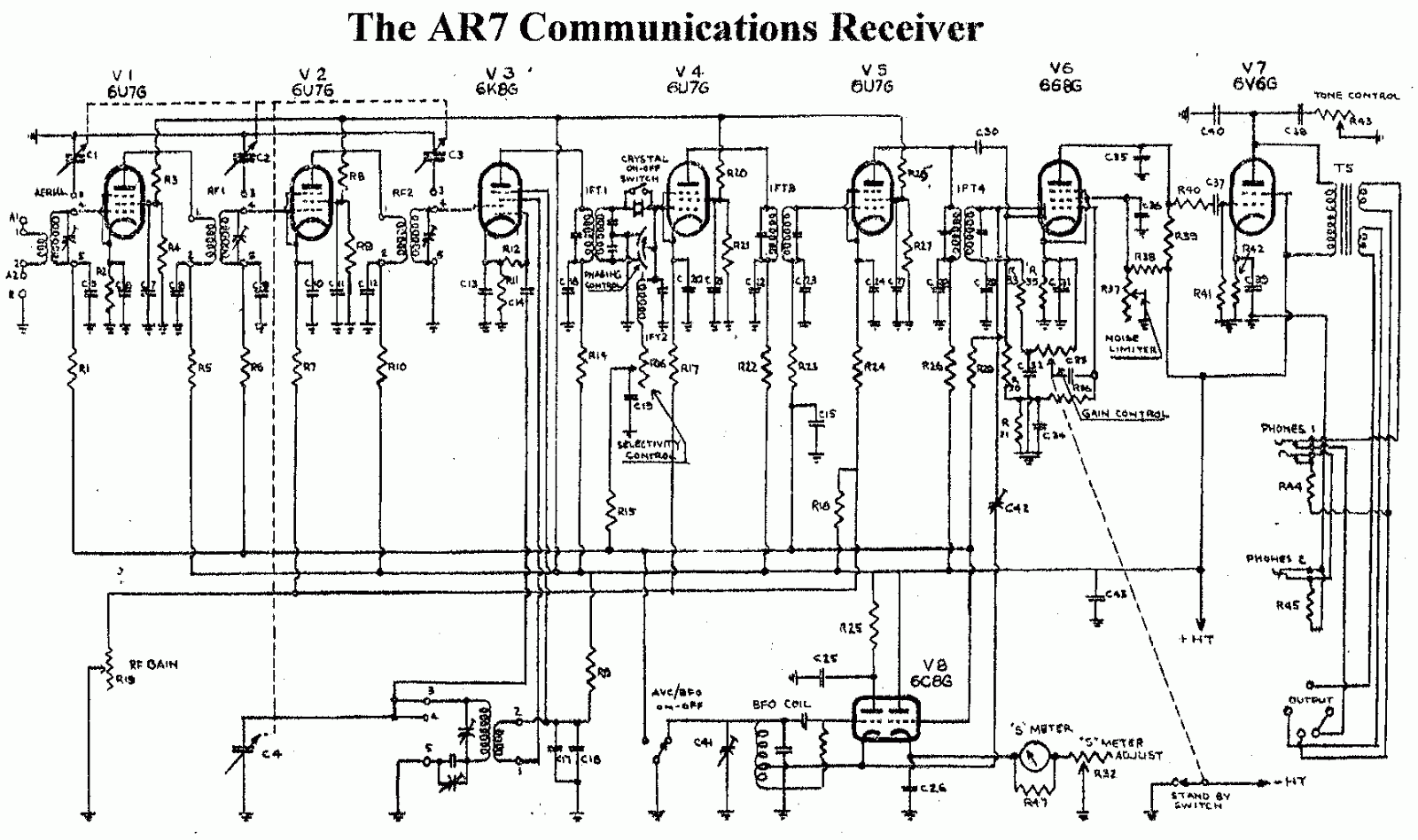
The AR7 is a communications receiver covering LF and HF bands. It was made in Australia during 1940 and bears an extremely close resemblance to the National HRO receiver. The receiver has a tuning range from 138 kcs to 25 mcs, with a gap of 45 kcs either side of the 455 kcs IF amplifier. The internal design is a single conversion superheterodyne receiver with 2 RF stages, 2 IF stages, a BFO and an “S” meter amplifier. The sensitivity is quoted as 1 microvolt. The front panel is stainless steel and it is a very distinctive looking receiver.
It is a good performer, sensitive, has a nice feel, is easy to tune, but hard to find the correct frequency, by reading the frequency from the dial number and coil box graph. It really needs a crystal calibrator. I use it for the weekly W.I.A. (Wireless Institute of Australia) broadcast, so it gets turned on once a week, and is so stable, than I don’t have to retune. It is very clear for AM but a bit fiddly for SSB.
The controls are: RF gain, BFO note, AVC/BFO switch, Adjust “S” meter, Tone, Tuning, Noise limiter, Selectivity, Crystal IN/OUT switch, Crystal Phasing, Audio gain. The Audio gain control has an OFF position which removes the HT so that the coil boxes can be changed.

It has two 6U7G RF stages, a 6K8G mixer, two 6U7G IF stages at 455 kcs, a 6G8G detector/AVC/audio preamplifier, and a 6V6G audio output amplifier. It has a 6C8G twin triode as a BFO and “S” meter amplifier. It also has a crystal filter. The IF alignment should be done very carefully, as any misalignment will reduce the effectiveness of the filter. It is best done with a sweep generator. The 6 volt valve heaters are connected in series, for 12 volt operation.
The external power supply and speaker, are usually mounted in a short 19″ rack, the AR7 at the bottom, the speaker in the middle, and the power supply at the top. The complete unit weighs about 118 pounds. The power supply was switchable between 12v and 240v.
The receiver was used as a ground monitoring receiver for aircraft. It was extremely stable. The model shown has an R.A.A.F. nameplate, and serial number 1786. The manual I have is a D.C.A. (Department of Civil Aviation) version and is a 1947 issue.
It has 5 plug in coil boxes. The coil boxes are: band A 140-405 kcs, band B 490-1430 kcs, band C 1.420-4.3 mcs, band D 4.25-12.5 mcs, band E 12.5-25 mcs. The Army version had an extra coil box covering 50-150 kcs. The large dial is a 20:1 reduction drive and has graduations from 0 to 500. It acts like a flywheel when tuning across the band, and has an effective scale length of 12 feet. The dial shaft goes into a right angle reduction gearbox and has 2 output shafts that drive 2 dual gang capacitors. The graph on the front of each coil box is used to covert the dial reading to frequency.

Occupy Ham Shack
The subject of this blog post (#occupyhamshack) relates to a new Twitter hash tag which started up a few weeks ago. A Twitter hash tag is typically used within a Twitter Tweet or message and is commonly used as a search term. Depending on the Twitter client you use, you can add columns which will automatically list any tweet showing the particular hash tag. Other common amateur radio hash tags are #hamr #hamradio #arrl #dx #sota. The hash tag #occupyhamshack was started by David Kozinn, K2DBK and it’s gained in popularity. Check out David’s blog site here.
While social media is not a replacement for amateur radio, I’m pleased to see amateur radio gaining a large presence in social media circles. I’m finding more and more hams becoming members of these various sites and the ability to share knowledge is becoming a power tool. I also believe it is helping to introduce the magic of amateur radio through these media platforms.
If you haven’t joined and participated in social media, I strongly encourage it. You can follow me on the platforms I frequent by clicking the icons in the upper right-hand corner in the section titled “Follow Me”.
Now go #occupyhamshack and get on the air…
Until next time…
73 de KDØBIK













