Posts Tagged ‘amateur radio’
 The Baofeng Experience
 August 6th, 2016 |
  Author:
 Last week I cleared the dust out of my blog and podcast websites and briefly discussed ordering the Baofeng UV5RA HT from Amazon. While this model was released several years ago, Amazon has them available brand new for $26.06. This includes the HT, charging stand and hands-free kit. Here’s the link to the Amazon product page for the Baofeng UV5RA HT.
I guess it’s been several years now since these cheaper (I guess less expensive might be the more PC way of describing these) Chinese made hand-held radios came onto the market here in the US. Fellow hams began showing these off at local club meetings and I began reading reviews of these radios on various amateur radio blog sites from around the world.
For the most part, the opinions expressed all seemed to have a common theme around pricing, ease of use and durability/reliability. Many viewed the low cost of ownership to be favorable over any durability issues. I guess the idea of use it, abuse it and toss it comes to mind. I also seem to remember a strong sentiment of “steer clear” when discussing these units.
I could see all sides of the argument. But I also fully understand some folks just getting into the hobby may be on a limited budget and may not have the resources to afford the latest and greatest from ICOM, Kenwood or Yaesu. As time went by, I really didn’t hear complaints regarding the durability/reliability of the radios. But certainly most everyone I spoke to all said that the programming of the radio was often a challenge and the provided user manual was of little to no help.
As for me and my reasons for not entertaining the idea of these cheaper Chinese made radios all boiled down to the fact that I really didn’t need another HT. I already own more HT’s than I have hands, so I just didn’t see the need.
So what changed?
Last week I was thinking about future topics to discuss on the Practical Amateur Radio Podcast and was researching just how many different HT models were available and the price range. This research led me to all the usual amateur radio dealers as well as a quick check of Amazon. I simply searched for Baofeng and that’s when the UV5RA popped up. With my Amazon Prime membership and a $3.00 credit, I could actually get this HT home for less than $25.00. Deal!
I decided I would gain some first hand experience with at least one of these cheaper Chinese made HT’s and share my knowledge with all of you reading this blog and later on the podcast.
Reverse Bait and Switch???
So my package shipped from Amazon as expected and was delivered on Saturday. I opened the package and inspected the contents. Immediately I noticed something was different.
If you look at the Amazon product page for the Baofeng UV5RA you’ll see the photo below. This is the Baofeng UV5RA. However, the HT shipped to me looked nothing like this.

Instead of receiving the UV5RA (as shown above), I received the UV-82 (shown below).

Initially I was slightly upset. We’ve ordered a lot of items from Amazon. While this was my first amateur radio purchase, it was also the first time I didn’t receive exactly what I believed I ordered. However, after doing a little more research I discovered the following:
First, while the Amazon store page for the Baofeng UV5RA doesn’t match what I actually received. If you carefully read the product description, under the section “What’s in the Box?” you’ll see the Baofeng UV-82 listed.
Second, from what I understand…the UV-82 is an upgraded (newer) Baofeng hand-held. If I read this Baofeng product comparison chart correctly, the UV-82 includes an updated PCB, commercial grade case and other enhancements as compared to the UV-5R models.
Third, the UV-5RA is a 4 watt model with the UV-82 offering 5 watts output.
Did I get what I paid for? Well…not really….but advantage appears to be all mine. I can’t guarantee what will happen if you order the same model I ordered…but from all appearances you’ll also receive the UV-82. Just no guarantees. Alternatively, you can purchase the UV-82 via Amazon (listed as UV-82) for $28.80. It’s a few dollars more than what is listed on the UV5RA product page, but you’ll be guaranteed to receive the UV-82 if that is the model you desire.
How I plan to use the new radio
Before I go into my initial thoughts/review/feedback (what ever you want to call it), I think I should clarify exactly how I plan to use this new Baofeng UV-82 transceiver.
This radio is not replacing anything I currently own. My main go-to HT is the Yaesu VX-8 which I have the GPS module installed. I also own an older Yaesu VX-6 (which I should probably sell) and also the ICOM IC-92 D-STAR HT which I also rarely use.
I actually plan to program a few local repeaters, simplex and NOAA weather frequencies into the Baofeng and leave it at my office. For less than $25.00 I am really just considering this a weather radio that will do a little bit more.
Initial Thoughts
I’ve had the UV-82 now a few days and feel comfortable in sharing some of my initial thoughts on just what I think of this radio. I’ll break my thoughts down under a few different categories.
Over all Design
The overall design of the radio (my opinion) is fine. The radio fits nicely in my hand (not too small, not too big). It sort of reminds me of an older Nokia cell phone from the time when cell phones weren’t smart.
Channel Mode/Frequency Mode
If I’m honest, I really dislike having to power the radio off to switch from channel mode back to frequency mode. While it’s simple enough, just hold down the Menu button while you switch on the radio. All my other HT’s have a button which toggles between the two modes. However, as previously stated…this radio will be programmed with a few local repeaters, simplex and NOAA weather frequencies. For the most part, the radio will be used to listen to weather information from the national weather service.
Case Quality
While I’ve not taken a hammer to the case (nor do I plan to) and I’ve not performed a drop comparison from the top of my building (I don’t plan to do that either). The overall case quality appears to match that of my Yaesu rigs. As I’ve previously stated, the radio fits nicely in my hand. It’s easy to grip and the included belt clip has a nice firm spring. While I don’t plan to use this HT as I use my Yaesu, I also wouldn’t have an issue clipping this onto my belt or pack and heading down the trail.
Stock Rubber Duck Antenna
What’s In Your Rubber Duck? Well this was answered by Bob, KØNR and I would highly recommend reading his excellent review where he reveals the “inner workings” of several popular stock rubber duck antennas (including the Baofeng UV-5R).
But what can really be said about ANY stock rubber duck antenna? Regardless if the radio brand is Yaesu, ICOM or Baofeng, you will greatly improve the radio by installing an aftermarket antenna. I use the Diamond SRH77CA on my Yaesu VX-8 and it works great. But at the moment, I have no plans to replace or upgrade the Baofeng rubber duck.
Screen
The LCD screen on the UV-82 is slightly smaller than what I’m used to on the Yaesu VX-8. But to be honest, if I don’t have my reading glasses with me 24×7 these days…and the screen size doesn’t rival the Dallas Cowboys Jumbotron, I’m not able to see anything.
Dual PTT functionality
The UV-82 features dual PTT switch functionality. This is a bit odd (compared to my other HT’s). I suppose in time I will get used to it.
FM Broadcast Band
If this is something you care about, the UV-82 features a button on the side which switches the radio to the FM Broadcast band.
Built in Flashlight
If you are in the need of a hand-held amateur radio transceiver WITH a built-in flashlight, then the UV-82 is the rig for you. A conveniently placed button on the side will turn on/off the flashlight.
User manual
This is the radios weakest link and is perhaps not worth the paper they used to print it. It could be written in Chinese and even non-Chinese speakers would obtain as much knowledge by reading it.
But seriously, the entire user manual is 29 pages long. Not one page actually covers how to program the radio. Thankfully YouTube exists and many others before me figured it all out and shared their knowledge.
Ease of Programming
The UV-82 offers 182 different channels which can be programmed (once you figure out how to program them). Unfortunately, Baofeng (in their infinite wisdom) pre-programmed 20 channels (1-21). As you can’t edit a pre-programmed channel, you’ll need to delete these which can be done one-by-one in the menu.
While I believe it might be a daunting task for any brand new ham (or soon-to-be brand new ham) to sit down with an HT, User Manual and Repeater Directory and successfully program the radio. The Baofeng (unfortunately) really makes it impossible. This is part of what I was talking about during the Practical Amateur Radio Podcast (episode 70). As I’ve always recommended the Nifty Ham Radio Guides for ALL radios, I think it is a must have for the Baofeng.
Alternatively, if the UV-82 is going to be your primary hand-held and you’ll want/need to reprogram often. I would highly recommend purchasing the programming software and cable from RT Systems. While I don’t plan to purchase the the cable/software for the Baofeng, I do own the software and cables for all my other rigs.
In Summary
While I’ve not discussed each and every feature/benefit of the Baofeng UV-82 in this blog article. I’ve identified a few key areas which I’ve discovered and most importantly have feedback/opinions on regarding. More importantly, as I’ve previously mentioned…I don’t plan to heavily use this radio. But having said that, I also wouldn’t have an issue with clipping it to my belt and heading down the trail either.
The opinions within our hobby of what makes a great first radio for a beginning ham are strong. Some are pro the HT and some are against the HT. If you are just starting out in our wonderful hobby, on a tight budget and looking to pickup a radio which won’t break the budget and allow you to enjoy the hobby…then I certainly recommend the Baofeng UV-82. After all, the package contains everything (transceiver, antenna and power source) you’ll need to get on the air. Get your ham radio license and join the fun of the worlds best hobby.
Until next time…
73 de KDØBIK (Jerry)
The Baofeng Experience
Last week I cleared the dust out of my blog and podcast websites and briefly discussed ordering the Baofeng UV5RA HT from Amazon. While this model was released several years ago, Amazon has them available brand new for $26.06. This includes the HT, charging stand and hands-free kit. Here’s the link to the Amazon product page for the Baofeng UV5RA HT.
I guess it’s been several years now since these cheaper (I guess less expensive might be the more PC way of describing these) Chinese made hand-held radios came onto the market here in the US. Fellow hams began showing these off at local club meetings and I began reading reviews of these radios on various amateur radio blog sites from around the world.
For the most part, the opinions expressed all seemed to have a common theme around pricing, ease of use and durability/reliability. Many viewed the low cost of ownership to be favorable over any durability issues. I guess the idea of use it, abuse it and toss it comes to mind. I also seem to remember a strong sentiment of “steer clear” when discussing these units.
I could see all sides of the argument. But I also fully understand some folks just getting into the hobby may be on a limited budget and may not have the resources to afford the latest and greatest from ICOM, Kenwood or Yaesu. As time went by, I really didn’t hear complaints regarding the durability/reliability of the radios. But certainly most everyone I spoke to all said that the programming of the radio was often a challenge and the provided user manual was of little to no help.
As for me and my reasons for not entertaining the idea of these cheaper Chinese made radios all boiled down to the fact that I really didn’t need another HT. I already own more HT’s than I have hands, so I just didn’t see the need.
So what changed?
Last week I was thinking about future topics to discuss on the Practical Amateur Radio Podcast and was researching just how many different HT models were available and the price range. This research led me to all the usual amateur radio dealers as well as a quick check of Amazon. I simply searched for Baofeng and that’s when the UV5RA popped up. With my Amazon Prime membership and a $3.00 credit, I could actually get this HT home for less than $25.00. Deal!
I decided I would gain some first hand experience with at least one of these cheaper Chinese made HT’s and share my knowledge with all of you reading this blog and later on the podcast.
Reverse Bait and Switch???
So my package shipped from Amazon as expected and was delivered on Saturday. I opened the package and inspected the contents. Immediately I noticed something was different.
If you look at the Amazon product page for the Baofeng UV5RA you’ll see the photo below. This is the Baofeng UV5RA. However, the HT shipped to me looked nothing like this.

Instead of receiving the UV5RA (as shown above), I received the UV-82 (shown below).

Initially I was slightly upset. We’ve ordered a lot of items from Amazon. While this was my first amateur radio purchase, it was also the first time I didn’t receive exactly what I believed I ordered. However, after doing a little more research I discovered the following:
First, while the Amazon store page for the Baofeng UV5RA doesn’t match what I actually received. If you carefully read the product description, under the section “What’s in the Box?” you’ll see the Baofeng UV-82 listed.
Second, from what I understand…the UV-82 is an upgraded (newer) Baofeng hand-held. If I read this Baofeng product comparison chart correctly, the UV-82 includes an updated PCB, commercial grade case and other enhancements as compared to the UV-5R models.
Third, the UV-5RA is a 4 watt model with the UV-82 offering 5 watts output.
Did I get what I paid for? Well…not really….but advantage appears to be all mine. I can’t guarantee what will happen if you order the same model I ordered…but from all appearances you’ll also receive the UV-82. Just no guarantees. Alternatively, you can purchase the UV-82 via Amazon (listed as UV-82) for $28.80. It’s a few dollars more than what is listed on the UV5RA product page, but you’ll be guaranteed to receive the UV-82 if that is the model you desire.
How I plan to use the new radio
Before I go into my initial thoughts/review/feedback (what ever you want to call it), I think I should clarify exactly how I plan to use this new Baofeng UV-82 transceiver.
This radio is not replacing anything I currently own. My main go-to HT is the Yaesu VX-8 which I have the GPS module installed. I also own an older Yaesu VX-6 (which I should probably sell) and also the ICOM IC-92 D-STAR HT which I also rarely use.
I actually plan to program a few local repeaters, simplex and NOAA weather frequencies into the Baofeng and leave it at my office. For less than $25.00 I am really just considering this a weather radio that will do a little bit more.
Initial Thoughts
I’ve had the UV-82 now a few days and feel comfortable in sharing some of my initial thoughts on just what I think of this radio. I’ll break my thoughts down under a few different categories.
Over all Design
The overall design of the radio (my opinion) is fine. The radio fits nicely in my hand (not too small, not too big). It sort of reminds me of an older Nokia cell phone from the time when cell phones weren’t smart.
Channel Mode/Frequency Mode
If I’m honest, I really dislike having to power the radio off to switch from channel mode back to frequency mode. While it’s simple enough, just hold down the Menu button while you switch on the radio. All my other HT’s have a button which toggles between the two modes. However, as previously stated…this radio will be programmed with a few local repeaters, simplex and NOAA weather frequencies. For the most part, the radio will be used to listen to weather information from the national weather service.
Case Quality
While I’ve not taken a hammer to the case (nor do I plan to) and I’ve not performed a drop comparison from the top of my building (I don’t plan to do that either). The overall case quality appears to match that of my Yaesu rigs. As I’ve previously stated, the radio fits nicely in my hand. It’s easy to grip and the included belt clip has a nice firm spring. While I don’t plan to use this HT as I use my Yaesu, I also wouldn’t have an issue clipping this onto my belt or pack and heading down the trail.
Stock Rubber Duck Antenna
What’s In Your Rubber Duck? Well this was answered by Bob, KØNR and I would highly recommend reading his excellent review where he reveals the “inner workings” of several popular stock rubber duck antennas (including the Baofeng UV-5R).
But what can really be said about ANY stock rubber duck antenna? Regardless if the radio brand is Yaesu, ICOM or Baofeng, you will greatly improve the radio by installing an aftermarket antenna. I use the Diamond SRH77CA on my Yaesu VX-8 and it works great. But at the moment, I have no plans to replace or upgrade the Baofeng rubber duck.
Screen
The LCD screen on the UV-82 is slightly smaller than what I’m used to on the Yaesu VX-8. But to be honest, if I don’t have my reading glasses with me 24×7 these days…and the screen size doesn’t rival the Dallas Cowboys Jumbotron, I’m not able to see anything.
Dual PTT functionality
The UV-82 features dual PTT switch functionality. This is a bit odd (compared to my other HT’s). I suppose in time I will get used to it.
FM Broadcast Band
If this is something you care about, the UV-82 features a button on the side which switches the radio to the FM Broadcast band.
Built in Flashlight
If you are in the need of a hand-held amateur radio transceiver WITH a built-in flashlight, then the UV-82 is the rig for you. A conveniently placed button on the side will turn on/off the flashlight.
User manual
This is the radios weakest link and is perhaps not worth the paper they used to print it. It could be written in Chinese and even non-Chinese speakers would obtain as much knowledge by reading it.
But seriously, the entire user manual is 29 pages long. Not one page actually covers how to program the radio. Thankfully YouTube exists and many others before me figured it all out and shared their knowledge.
Ease of Programming
The UV-82 offers 182 different channels which can be programmed (once you figure out how to program them). Unfortunately, Baofeng (in their infinite wisdom) pre-programmed 20 channels (1-21). As you can’t edit a pre-programmed channel, you’ll need to delete these which can be done one-by-one in the menu.
While I believe it might be a daunting task for any brand new ham (or soon-to-be brand new ham) to sit down with an HT, User Manual and Repeater Directory and successfully program the radio. The Baofeng (unfortunately) really makes it impossible. This is part of what I was talking about during the Practical Amateur Radio Podcast (episode 70). As I’ve always recommended the Nifty Ham Radio Guides for ALL radios, I think it is a must have for the Baofeng.
Alternatively, if the UV-82 is going to be your primary hand-held and you’ll want/need to reprogram often. I would highly recommend purchasing the programming software and cable from RT Systems. While I don’t plan to purchase the the cable/software for the Baofeng, I do own the software and cables for all my other rigs.
In Summary
While I’ve not discussed each and every feature/benefit of the Baofeng UV-82 in this blog article. I’ve identified a few key areas which I’ve discovered and most importantly have feedback/opinions on regarding. More importantly, as I’ve previously mentioned…I don’t plan to heavily use this radio. But having said that, I also wouldn’t have an issue with clipping it to my belt and heading down the trail either.
The opinions within our hobby of what makes a great first radio for a beginning ham are strong. Some are pro the HT and some are against the HT. If you are just starting out in our wonderful hobby, on a tight budget and looking to pickup a radio which won’t break the budget and allow you to enjoy the hobby…then I certainly recommend the Baofeng UV-82. After all, the package contains everything (transceiver, antenna and power source) you’ll need to get on the air. Get your ham radio license and join the fun of the worlds best hobby.
Until next time…
73 de KDØBIK (Jerry)
Review – BTech UV-50X3 (Tri-Band)
by John ‘Miklor’
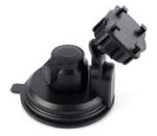
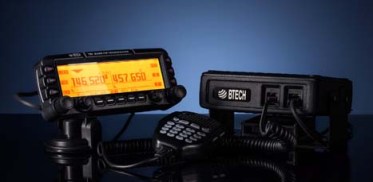
Included with the radio are: 50X3 Weight: Main Chassis 2.1kg (4.6 lbs) Specifications The 50X3 is FCC Part 90 certified for commercial use in the US. Control Head The suction mount is about the best I’ve ever used. It requires a smooth metal or glass surface, but the silicon rubber cup will not let loose. My control head has been mounted atop my computer for over a month, and it is going nowhere. The button functions are displayed on the LCD screen for easy function identification. The PTT button on the upper right is for Momentary or Toggle PTT. One press turns the TX on, next press turns it off. Setting to Toggle is convenient if running a net or using a mobile headset. 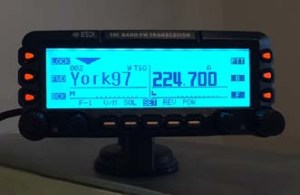 Cooling The 220 ham band transmit range is limited to 222-225MHz. The receiver is capable of being programmed above and below those frequencies, but may be outside of the performance range due to the ham band specific filtering.
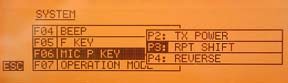
Microphone The radio comes with a full function keypad style microphone. On the right side are two slide switches that control the Lock and Lamp feature, and on top of the microphone are two frequency Up and Down buttons. Along with a 16 button DTMF style keypad are 4 programmable function keys. Choices are Squelch Off, TX Power, Rptr Shift, Reverse, and Tone Call. There are two microphone input jacks. One on the control head, the other on the main unit. There is also a built in microphone element inside the control head. Although the audio quality is excellent, the sensitivity is that of a standard microphone. The OTA reports were excellent with plenty of audio, so there’s no reason to shout. A nice feature in the audio section is an adjustable microphone gain control. There are 5 settings available. Min, Low, Normal, High, and Max. Normal is great for speaking in a normal volume an inch from the microphone. Running a net with VOX and a headset, you can bring it up a bit. Driving in an off road vehicle, you just might need to set it back.
Receiver Along with the standard VHF / 220 / UHF frequencies, the receiver covers: 0.5-1.7 MHz (AM Radio) The control head has built in speakers, as well as one in the main module. An external speaker jack in the rear also allows for a larger speaker if desired. The jack provides for either mono or stereo output. (each receiver can have it’s own speaker). I found a menu setting to adjust the tone of the speaker as well. Although there is more than ample audio output, when the volume control is all the way down, the radio is silent, as it should be. Cross Band Repeat The radio takes full advantage of the independent receiver by including a Cross Band Repeat function. I entered the VHF and UHF frequencies, power level and tones, selected the Cross Band mode, and was ready to go. The audio levels are preset and the audio quality reports were excellent. Cross band repeating using a 220MHz frequency was not possible. This is more than likely a precaution due to the minimal frequency separation. Display The control head has a large 5″ LCD with your choice of background colors. Options include White-Blue, Sky-Blue, Marine-Blue, Green, Yellow-Green, Orange, Amber, and White. The brightness and contrast are also menu selectable.
Unless you are only entering a few channels, I would recommend the optional PC05 programming cable. The UV-50X3 uses the CHIRP programming software. Scanning in the VFO mode allowed me to scan either the VHF, 220MHz, or UHF band. In the Channel mode, the scan would select any channel in the list regardless of band. Power Cable There are radios that draw less power whose power cables use thinner wire, lower value fuses, and can be plugged into accessory plugs. Do NOT use these cables, even though they may be plug compatible. The 50X3 draws twice the current, and will blow the fuses and possibly overheat the wire. The cable on the 50X3 appears to match that of the hi-power Yaesu, Icom, Kenwood series. ONLY use the proper cable for the radio. Base Station Operation For mobile drive testing, I teamed this radio with a Nagoya Tri-Band TB320A and SB-35 NMO mag mount and the results were excellent. Conclusion Some of the added advantages to the US market are the FCC Part 90 certification, local US support, and exclusive program support using CHIRP software. The radio can also be shipped worldwide by contacting BTech directly. This is definitely one of the nicest mobile transceivers I’ve used; and yes, I’ve owned the “big 3”.
More Information: Miklor.com |
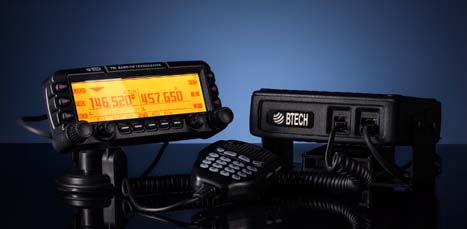 Four years after its initial design, the VGC 6600PRO has evolved into the BTech UV-50X3, a full featured Tri-Band mobile that delivers a full 50W on VHF and UHF, with addition of a 220 MHz module that delivers 5W output. The 220 MHz module was specifically designed and filtered for 222-225MHz US ham band operation. I mention this as there are currently radios being advertised as Tri-Band operating in the range of 240-260MHz that are not adaptable to frequencies below 240MHz due to their internal filtering.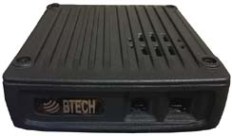




Episode 70 Practical Amateur Radio Podcast
Episode 70 of the Practical Amateur Radio Podcast has been released and is available for download either through iTunes, Android, any other RSS podcatcher software or direct via the PARP website.

As PARP begins the 9th season, the release schedule in the last two years certainly has not been the most timely. My work/life schedule, some health issues (which are all resolved) and a few personal issues have mostly kept me silent. But thanks to the very best listeners who have stayed in touch and continued to encourage me to return…I’m committed to doing everything possible to keep PARP alive.
While PARP was not the first amateur radio related podcast, I do remember a time when the number of active ham radio based podcasts could be counted on one hand. Today it might take two hands and perhaps one foot. This is fantastic and as I’ve always said, I have never viewed other amateur radio based podcasts as competition. We should all be doing what we do for the sake of the hobby and service of amateur radio.
PARP 70 covers some thoughts and ideas to get you thinking about our overall individual preparedness when it comes to emergency communications.
I truly appreciate the listeners (many have been listening since episode one in 200 and continue to ask for more episodes. As the PARP motto states, the Practical Amateur Radio Podcast….Creating Elmers one podcast at a time. If you learn something while listening to a PARP episode, please share that knowledge with others. This is the spirit of amateur radio.
I plan to keep PARP on a monthly release schedule. Episode 71 should release in late August just before the 2016 Colorado QSO Party which I’m anxiously looking forward to. Hopefully the bands will improve some by then.
Until next time…
73 de KD0BIK (Jerry)
No More Hara
The news just came crashing down from the ARRL that the 2016 Dayton Hamvention would be the last to be held in the Hara Arena. The home of the Dayton Hamvention since 1964 is closing. Hamvention 2017 will be held at a new, yet-to-be-disclosed location in the Dayton area.
I wish I could share with all my readers all the wonderful memories I have of Hara Arena. But unfortunately, this was something I kept putting off year after year after year. This is really unfortunate for me, as I am one who truly appreciates most of the history behind our hobby.
But oh well, right? We live….we learn…we endeavor to not repeat the errors of our ways.
Is there a silver lining in all this? As the news regarding Hara Arena began to surface on Twitter. I had to chuckle a the following tweet “Forget “no code” hams. We will soon complain about “no Hara” hams!” T-Shirts are already available to help drive this fact home. 

Well…one thing is for sure. The 2017 Dayton Hamvention will most certainly be an event none of us will want to miss. While I may have missed out on being able to say I went to the Hamvention at Hara. I certainly don’t want to miss out on saying I attended the first Hamvention at the new venue.
Well I really didn’t intend to release two blog postings today. Again I wish I had lots of memories to share about Hara. But I’m sure many other amateur radio bloggers will fill in the gap soon enough.
I hope to see you in 2017 in Dayton at the Hamvention in the yet-to-be-disclosed location.
Until next time…
73 de Jerry (KDØBIK)
Affordable HT and Howdy
Hello fellow hams. Yes it’s been awhile since anything spewed from my blog site. I’ve just not had time in recent months to do much of anything related to the hobby of amateur radio. But once again I am easing back in as I hear it calling my name (or my callsign)…..
Like most hams, I have more radios that I truly know what to do with. This is especially true in the hand-held or HT department. I own a few Yaesu HT’s and one ICOM D-STAR HT. As I only have two hands…..anyway
Yea, PARP is also going to return from the ashes and in looking at some of the topics I want to cover in the next several months I decided to journey to a place I’ve never been. Yep…that is the world of the Chinese inexpensive hand-held radio.
As PARP is 100% commercial free and fully self-funded by the bank of KDØBIK (and Mrs. KDØBIK) I have always done my best to only make purchases for things that I believe I’ll actually use when it comes to podcast topics.
If you look through my ham shack you’ll find lots of ham radio goodies. I would estimate a solid 95% of all my gear has been purchased in person at my local HRO (Ham Radio Outlet). For us hams in the greater Denver area, we are very fortunate to have a candy store here. I’ve always realized the importance of “buying local” whenever possible. But as I say again, PARP has no sponsors and I really didn’t think I needed yet another HT. So I began comparing prices.
This price comparison exercise eventually led me to Amazon and eventually led me to an older Baofeng UV5RA 2m/70cm dual-band HT which comes complete with charging stand and hands-free kit for a whopping $26.06. With free two-day shipping via my Amazon Prime membership and an almost $3.00 credit I had floating around, the total purchase price was just too low to pass up.
So if you are in the market for another HT, on a limited budget and/or don’t mind the fact this is an older model…then check out this Amazon link.
As I write this early on Friday morning, my new Baofeng UV5RA will arrive sometime on Saturday. I’ll spend some time with it and as I said will most likely discuss this and other inexpensive Chinese HT’s on a future episode of PARP.
Bottom line, this new HT won’t replace any of my other models. My Yaesu VX8x is my main “go to” HT. But I’ll most likely program a few local repeaters along with the NOAA weather frequency and just leave this Baofeng at my office. This way as I watch those summer afternoon storms build, I can also monitor the weather info and perhaps some of our fellow storm chasers.
I’ll report back my findings and experiences at a later time…
Until next time…
73 de KDØBIK
Thirty Minutes of Dazzle: The Sun in UHD 4K by SDO (NASA)
Take a front-seat view of the Sun in this 30-minute ultra-high definition movie in which NASA SDO gives us a stunning look at our nearest star.
This movie provides a 30-minute window to the Sun as seen by NASA’s Solar Dynamics Observatory (SDO), which measures the irradiance of the Sun that produces the ionosphere. SDO also measures the sources of that radiation and how they evolve.
SDO’s Atmospheric Imaging Assembly (AIA) captures a shot of the sun every 12 seconds in 10 different wavelengths. The images shown here are based on a wavelength of 171 angstroms, which is in the extreme ultraviolet range and shows solar material at around 600,000 Kelvin (about 1 million degrees F.) In this wavelength it is easy to see the sun’s 25-day rotation.
The distance between the SDO spacecraft and the sun varies over time. The image is, however, remarkably consistent and stable despite the fact that SDO orbits Earth at 6,876 mph and the Earth orbits the sun at 67,062 miles per hour.
Scientists study these images to better understand the complex electromagnetic system causing the constant movement on the sun, which can ultimately have an effect closer to Earth, too: Flares and another type of solar explosion called coronal mass ejections can sometimes disrupt technology in space. Moreover, studying our closest star is one way of learning about other stars in the galaxy. NASA’s Goddard Space Flight Center in Greenbelt, Maryland. built, operates, and manages the SDO spacecraft for NASA’s Science Mission Directorate in Washington, D.C.
Charged particles are created in our atmosphere by the intense X-rays produced by a solar flare. The solar wind, a continuous stream of plasma (charged particles), leaves the Sun and fills the solar system with charged particles and magnetic field. There are times when the Sun also releases billions of tons of plasma in what are called coronal mass ejections. When these enormous clouds of material or bright flashes of X-rays hit the Earth they change the upper atmosphere. It is changes like these that make space weather interesting.
Sit back and enjoy this half-hour 4k video of our Star! Then, share. 🙂
73 dit dit













