Posts Tagged ‘amateur radio’
 My Rebuttal Regarding the Petition by ARRL to the FCC to Expand Technician-Class Privileges
 April 2nd, 2018 |
  Author:
 This is my reply to many responses that I have been receiving on my original blog entry, located at this AmateurRadio.com website,(my shortened URL: https://g.nw7us.us/arrl2fccR2) as well as to the original video, posted in that blog entry.
I wish to reply to all of those who are against the idea of expanding the privileges of the Technician-class licensee, the expansions including the ability to operate Voice and Digital in limited slices in a subset of lower-than-Ten-Meter amateur radio shortwave allocations.
It seems to me, that…
…the issue is not one of Technician-class licensees wanting more privileges, as a whole. What the ARRL is addressing is the *lack* of desire by most current Techs to upgrade.
The logic behind the idea of expanding privileges concludes that if you give them a taste of lower-shortwave propagation and excitement (by moving past the CW-only restriction on the lower tech allocations), then they *will* want to upgrade.
This logic is already proven as applicable by the fact that the General class exists! All that this proposal will do is allow the Tech to experience what could be very attractive–just like for the General. If it worked in the past with Novice, Technician, General, Advanced, and Amateur Extra (exposing to all of HF, even if by way of a CW-only requirement), then it will work, now. The difference is that the CW-only requirement on lower HF bands is highly restrictive because the mode is no longer needed to operate on any frequency, and, most will not take the time to learn it just to see if they WANT to explore the lower HF bands, or ever upgrade.
The bottom line is that we should make the Tech ticket more relevant. The expansion is not dumbing down, nor does it give away the farm.
I discuss this original point in the two videos that were lower down in the original post:
[embedyt] https://www.youtube.com/watch?v=ty9HINa3nAg[/embedyt]
and,
[embedyt] https://youtu.be/83I3EEQxfZA[/embedyt]
Thanks for reading, watching the videos, and having a useful dialog about this very important change to the amateur radio regulations in the USA.
P.S.,
That aside: This may, in the long term, reveal one of two possible truths:
1. There is no real need for three license classes. Two would suffice. General and Amateur Extra, or Technician (merged with General) and Amateur Extra.
2. There is no real need for three license classes. One would suffice. Make the test hard enough to cover the Extra-class material, and all material under that class, and merge everyone into one tested class. I believe that this has been tried in other countries, and it appears to work well.
I’ll be crucified for stating those ideas, but, hey, this is just a hobby.
Opinions About ARRL Petition to FCC: Expand Technician HF Privileges!
In this video, I expound on another point of view regarding the ARRL petition to the FCC. The petition requests an expansion of operating privileges of Technician-class operators in the USA. The ARRL believes that giving broader shortwave access, using digital communications, to Technicians, will better entice the Techs to upgrade to General or Amateur Extra. In this video, I discuss this a bit.
If you are wondering why I’ve made a few videos about this topic, when the topic has been the hot item on many forums already, I believe that the drama will not cease until well after the FCC makes a decision, because this is a relevant topic, and one that has a significant impact on the amateur radio community at large. It is not a trivial conversation about which type of coax is best suited for Arctic field activity.
After some replies came from various viewers, I clarify my point. I stand corrected.
I failed to mention that there are a limited few slices of VOICE (SSB) spectrum on HF that the petition seeks for the Tech licensee. The ARRL states, “ARRL has asked the FCC to expand HF privileges for Technician licensees to include limited phone privileges on 75, 40, and 15 meters, plus RTTY and digital mode privileges on 80, 40, 15, and 10 meters.”
More specifically, “ARRL proposes to provide Technician licensees, present and future, with phone privileges at 3.900 to 4.000 MHz, 7.225 to 7.300 MHz, and 21.350 to 21.450 MHz, plus RTTY and digital privileges in current Technician allocations on 80, 40, 15, and 10 meters. The ARRL petition points out the explosion in popularity of various digital modes over the past 2 decades. Under the ARRL plan, the maximum HF power level for Technician operators would remain at 200 W PEP. The few remaining Novice licensees would gain no new privileges under the League’s proposal.” Reference: http://www.arrl.org/news/arrl-requests-expanded-hf-privileges-for-technician-licensees
My point holds: give some reason to desire to upgrade to a higher class. Do this by granting HF operations on lower bands (lower in frequency than 10 Meters), with more than a CW-only privilege.
If a tech can only use CW on 80m, but doesn’t know CW, then it is likely she won’t ever try making contacts on 80m. Hence, no exposure to the magic of 80-meter DX. If, however, the Tech can dabble with digital or limited SSB, on 80m, then she gets a real, practical exposure to the magic, and may well upgrade. Why do you think a General, who has limits, would ever upgrade? What am I missing here?
The following video expands this idea:
[embedyt] https://www.youtube.com/watch?v=83I3EEQxfZA[/embedyt]
The truth is, I see a strong argument for just ONE license, permanent. Or a temporary entry-level training ticket, then the permanent. But, that would make us like some other countries. That can’t be good.
The original video to which this new video continues is here:
[embedyt]https://www.youtube.com/watch?v=BWSAvDWE3Js[/embedyt]
Some viewers are asking me why I am making a video while driving. They try to convince me that talking while driving is too distracting. My answer is here:
[embedyt]https://www.youtube.com/watch?v=pyNHKViyCGE[/embedyt]
73 de NW7US
#POTA Activation of JD Mac Arthur SP in South Florida
This, my second POTA activation, was a much bigger su ccess (39 qso’s in an hour) than the first (a mere dozen), despite #2 being on a weekday afternoon vs. Sunday for #1. I attribute this to my savvy scheduling to avoid ARRL’s DX Contest and at the same time, ARRL’s respectful consideration for a Big Gun like me in not trying to compete! As the Borg said, “Resistance is Futile.”
The other big factor was getting a few hams to spot me on the clusters. I was quite surprised, and thrilled actually, to be the subject of a pileup for a few minutes. Imagine, lil’ ol’ me, being sought after; I hardly knew how to handle the fame!
Things started kinda slow, my first contact being a ham about two miles away; I’m thinking, oh boy, this’ll be a long afternoon. Will I ever get the requisite ten qso’s to count a POTA activation? I tried to spot myself but on Dxsummit.fi it is so awkward to do on your smartphone. With ten thumbs like me, mistakes are made. I did ask several hams to spot me and soon a few did, and then I was in demand, even at 4pm on a Tuesday afternoon. I never knew there were so many retired or unemployed hams sitting around bored during the day. From South Florida I worked hams in NY, CT, MI, PA, MN, AZ, CA, England and Spain!
I used my link dipole antenna up approx 24′ at the apex, set for 20m. By closing a pair of links, it can be reset for 30 or 40 meters. I built this antenna a while back, and tuned and trimmed it carefully for each of these bands, so no tuner necessary. I’ve tried a PAR EndFedz and a homebrew Buddipole for HF and this is the best for me, thus far.


From left to right: the dipole (made of speaker wire) rolled up on custom deluxe wire winder; middle, the handsomely crafted center SO; and right, the links for 30m, left open so antenna resonates at the shorter 20m cut. Note “stress relief” at the SO and use of safety pins to carry the tension of the dipole when hoisted. Below is pic of my antenna launching tool; it was too heavy at first so I drank half the contents. Also below is a pic of my tie down line, fluorescent builder’s twine. I’ve decided to be stealthier in the future and will change that out for something that’ll blend better.


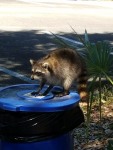
I want to be stealthier so I don’t draw attention to my station and my suspicious behaviors. Even though I have a right to be there at a picnic table not all Park Rangers got the memo and some may think they should run me off. Last week a Ranger did stop by and I thought “well, here we go,” but actually he just wanted to chat; his Dad had been a ham, so I tried to recruit him. I had another visitor, too; note to self, don’t operate so close to garbage cans!

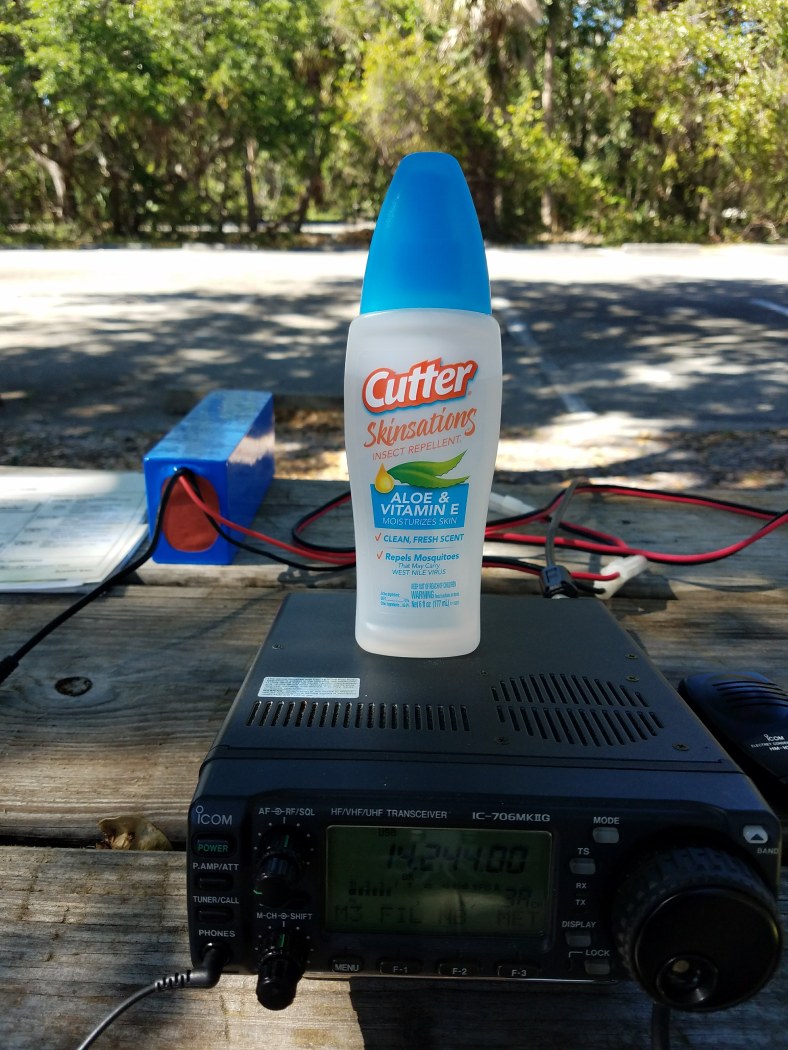
And finally, a note to the wise for operating out of doors in Florida; bring your bottle!
This is Wayne, k4wk, http://www.hamdom.com. Thanks for listening; you’re in the log.
QST Article – “Live Trees Affect Antenna Performance” – implications for #POTA #SOTA
In February 2018’s QST was a very interesting and scholarly article, the cover story actually, on the effects of live trees on the performance of both vertical and horizontal antennas. Things to ponder:
- Living wood (trees, as opposed to dry dead wood such as boards) absorbs EMF from vertically polarized antennas.
- Living wood resembles human tissue in terms of dielectric properties, so wearing your HT on your belt will greatly reduce your effective antenna power. Presumably, unless you’re a real fathead like me, talking into HT held at your face should not be too bad.
- A single vertical tree has next to no effect on horizontal antennas, such as dipoles.
- A forest, containing lots of vertical trees, is even worse than a single tree like in your backyard, so for us backpackers and hikers, we need to find a clearing when trying to use our HT’s in the woods.
- Worse, a forest will affect both vertical and horizontal antennas so when we’re operating in the field, for POTA or SOTA for example, we should look for a Goldilocks spot with enough trees to launch the, say, dipole, but not too many. Better in Winter after leaves fall, though.
This is Wayne, k4wk, http://www.hamdom.com. Thanks for listening; you’re in the log.
What? ARRL Petitions FCC to Expand Privileges of Technician-Class Amateur Radio Operators
I have my opinion on ARRL asking FCC to grant more HF privileges to Technician-class licensees.
I verbalize them in this video:
[embedyt]https://www.youtube.com/watch?v=BWSAvDWE3Js[/embedyt]
After you hear my comments, please leave your comments.
Thanks, 73 de NW7US dit dit
My #POTA Pickle, or How I Learned to Stop Worrying and Love the ARRL #DX Contest
Sunday March 4th was a beautiful and slightly cool (mid-seventies) day in Jupiter, Florida and was the day I selected for my first #POTA activation (parksontheair.com). I picked the 11,000 acre Jonathan Dickinson State Park, KFF-1887, just six m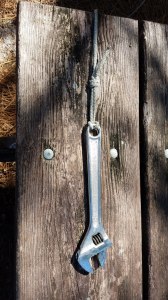 iles from my Florida QTH. I scouted out locations a few days earlier and chose the picnic area near the river, with cooperating pine trees with handy limbs. Using my unique antenna launch tool (see pic) on only the second try I hit my target limb and hoisted the “high” end of an EndFedz antenna cut for 20 meters. My battery was charged, I had my sandwich, I even had a cushion for the hard picnic table bench seat. Right on time I was ready to spot myself, all settled and happy. Do you hear a “but” coming?
This was 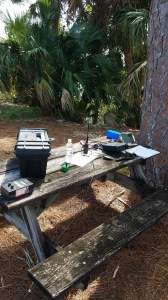 also the weekend ARRL chose, without checking with me, for their hugely popular annual DX Contest. There were a few thousand hams on 20m, most, it seemed, with a kilowatt and a pretty good beam competing with me barefoot with a dipole up all of fifteen feet. I spotted myself on DXSummit.fi but apparently nobody cared. I raised my friend Rick on the local repeater and got him to listen for me at 14.244 a few miles away and we could barely hear one another on ground wave. We were in a wall of sound (and I was learning the value of a filter for sideband.)
So there’s my POTA Pickle; I’m in the right place and all set to operate POTA but cannot compete with a thousand big gun stations. Well golly, let’s join in on the fun then.
First I took down the End Fedz that just doesn’t work that well for me and put up my link dipole made from lamp cord and began to hunt and pounce. Worked a dozen international stations in an hour and called it, after all, a good non-POTA day.
This is Wayne, K4WK, http://www.hamdom.com. Thanks for listening; you’re in the log.
Ham Radio Deluxe 6.4.0.794 Released
I just received some good news from Mike, WA9PIE. He writes in an email:
The first release of Ham Radio Deluxe for 2018 (Ham Radio Deluxe version 6.4.0.794) is now available for download. Please download it from the Download pages on our website at:
https://www.hamradiodeluxe.com
This release includes a number of important changes including the addition of the Icom IC-7610, resolves a Logbook exit problem, resolves “sort on LOTW date”, API for QSO Forwarding now populates Logbook with My Station data, a number of fixes for the Kenwood TS-480, applications remember screen position, enable CI-V address to be entered directly, and a number of stability enhancements.
The full release notes can be found here:
http://ReleaseNotes.hamradiodeluxe.com
I would like to acknowledge and thank Mike Blaszczak (K7ZCZ) and our beta team on their hard work in getting this release out.
All those who have purchased Ham Radio Deluxe at any time in the past should download and install this version in order to benefit from all bug fixes. You are entitled to them. Our clients who are covered by an active Software Maintenance and Support period are entitled to Feature Enhancements.
As announced previously, we expect to release as many as 9 releases in 2018. There will be no releases between 1-Nov and 1-Jan. We continue to focus on reducing our development backlog with five developers dedicated to all applications in the suite.
Please watch these newsletters for updates. Pass these updates along to your friends. Newsletters will also be posted on our website’s blog at:
https://www.hamradiodeluxe.com/blog
Thank you es 73 de Mike, WA9PIE
HRD Software, LLC













