Posts Tagged ‘6m’
 The Magic Lives
 January 8th, 2015 |
  Author:
  With the Bz component of the Interplanetary Magnetic Field turning southwards yesterday, an unexpected incoming stream from the sun was able to interact more intensely with the earth's magentic field , producing some fairly active auroral conditions overnight. The 'K' index numbers rose as high as '7'...a rare event, indicating a major disturbance. By dawn, much of the activity was winding down and the ensuing F2 MUF spike was not far behind.
I hope that you were one of the alert 6m operators (not me sadly) able to take advantage of the quick F2 lift. Several stations on the east coast were worked or heard in Europe (EA8, EA7, EA3, IK5, CT1, G3, EI4) while in the afternoon, lucky band-watchers found several loud KH6's to work.
 |
| Courtesy: http://www.on4kst.com/index.php |
The 6m prop map reveals the unexpected level of mid-winter activity....as of Wednesday evening, the Bz is still pointing south and the K has risen to level 4.
What might Thursday bring?
New Year’s Eve Magic
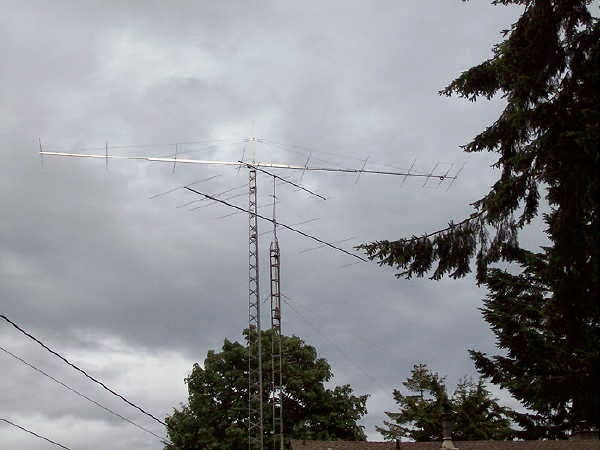 |
| 9el LFA at VE7DAY |
During the last solar rotation, flux values rose to near-Cycle highs and quickly plummeted, along with any hope of finding that six-meter Holy Grail...long-haul F2 propagation. Many six meter ops quickly found other things to do.
One person that didn't stop watching, and never does, was John - VE7DAY, in Campbell River, B.C., on Vancouver Island. John is VE7's iron man of 6m and spends almost 100% of his radio time seeking the magic.
For the past few winters, John has pointed his beam towards the south Pacific at around sunset, and called CQ from the VE7 black hole....on Tuesday evening he was justly rewarded.
At 00:50 UTC on the 31st, John's CQ was answered by Roger, ZL3RC in Christchurch, on New Zealand's South Island...12,021km from Campbell River.
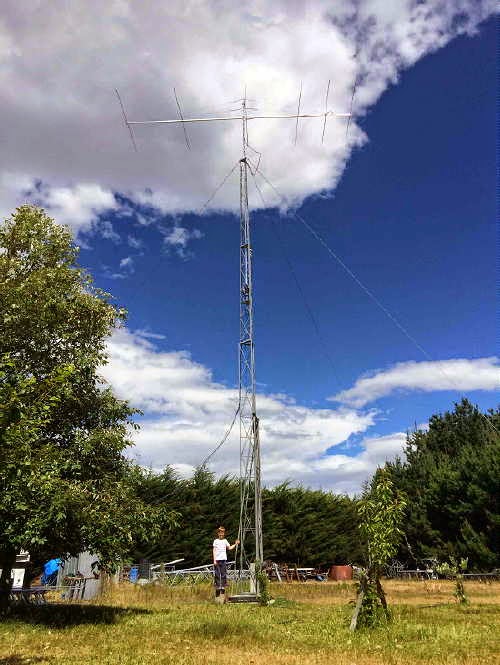 |
| 6el Yagi at ZL3RC |
One minute later, John worked Chris, ZL2DX, in Martinborough, on the North Island.
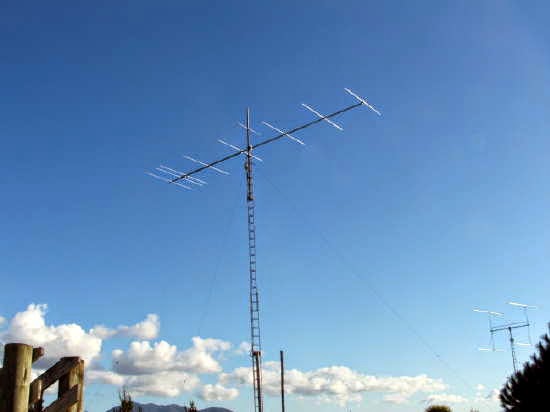 |
| 8el Yagi at ZL2DX |
At 0111 UTC, John completed the hat-trick by working Paul, ZL4PW, in Oamaru, back on the South Island.
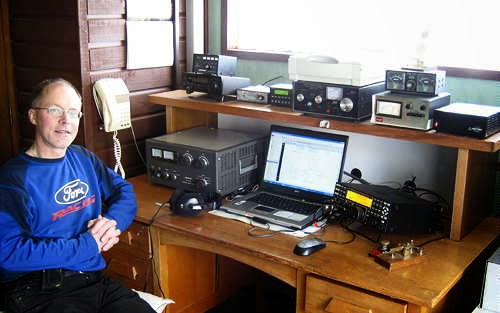 |
| Paul, ZL4PW / 7el at 7m |
"Decades ago, many DXers believed that Argentina was the world DX hot spot. DXers and contesters seemed to do the best down there. When I was in Brazil, one of the places I lived in was the state of Mato Grosso do Sul, PT9-land. It was only about an hour-and-a-half's drive to the Paraguay border, so conditions there were pretty near like those in Argentina, which was also nearby. I ran 100 watts to a vertical wire taped to a bamboo rod... and thought my QTH must have been included in the hot spot area.
I think now we are becoming aware of another hot spot, this one being in North America on Vancouver Island. I'm speaking, of course, of the your QTH, John! You seem to be doing quite well from that location. Keep it up!!
I see you worked clear down to ZL4. I'm envious. I've been looking for a ZL4 contact for a long time. Today when the band was open to ZL, I was on the road returning from Tacoma. Well, I'm glad you were able to work that great DX.
I will change the Distance Scoreboard to indicate the new records you established today. Congrats!
73, Paul K7CW"
With the present dismal solar flux and low solar activity, it is not likely that these contacts were via the F2 mode, but you wouldn't know it from the size of John's signal, recorded by ZL3RC. Being in the middle of our secondary sporadic-E season, north of the equator and at the peak of the major Es season down-under, I think a better candidate is an Es-link from both sides into the Trans Equatorial afternoon 'bubble'....certainly Es from both ends into whatever is happening in the ionospheric cauldron at the equator!
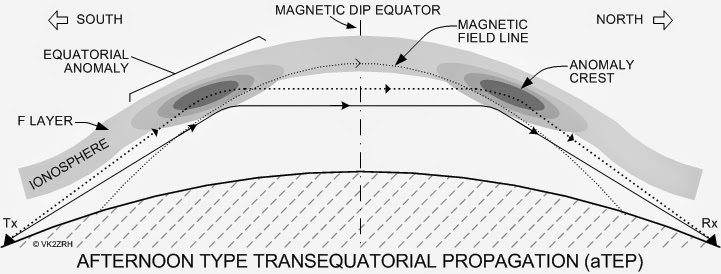
All four stations were running high power and big antennas, and with a little help from the seasonal E, it all seems to have come together nicely.

Congrats to all involved, and especially John, as all of the other 6m ops in this part of the country, including myself, were asleep at the switch it seems!
Well, No Magic Today

... it seems. It really does take an extraordinary amount of F-layer density to reflect rather than refract 6m RF. With this afternoon's somewhat late arrival of an earlier CME, perhaps tomorrow's F2 spike will be higher.
The global ionospheric (foF2) map today, around 1100 local time, shows a critical frequency of about 12MHz over central North America. This is the frequency at which RF, when shot straight up, will be reflected straight back to earth. This number can generally be used to find the F2 MUF when multiplied by 3.6, which, in today's case would be around 43.2MHz.
 |
| Courtesy: http://www.ips.gov.au/HF_Systems/6/5 |
With the solar flux continuing to remain high, so are my hopes for the next few days but I suspect that any openings could be missed, should you blink!
Cycle 24 6m F2!
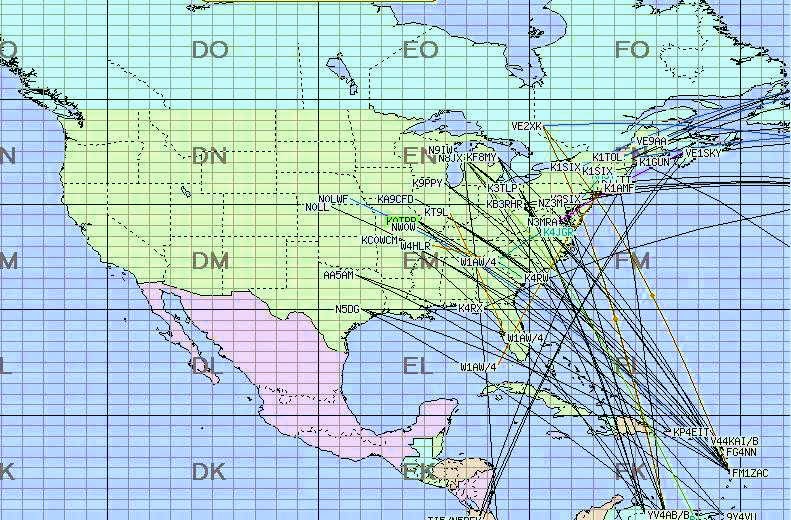 |
| Courtesy: http://www.dxmaps.com |
It's still one hour from sunrise here on the west coast but the 6m fireworks have started on the east coast....Cycle 24 F2 ! Will it reach us today?? ...fingers are crossed.
Waiting For The Magic
 |
| Courtesy: http://www.noaa.gov/ |
The last time the sun did this, at the end of November, I was able to work two stations in Florida on F2 during a short surge in the MUF that had been hovering in the 46-47MHz range. Maybe we'll all get lucky again soon if solar activity continues to climb.
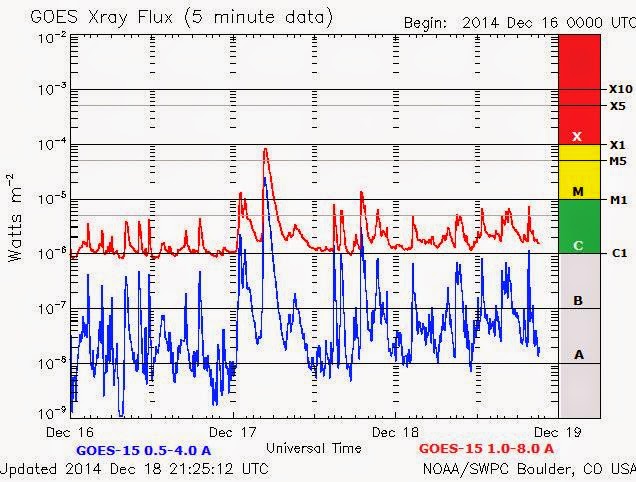 |
| Courtesy: http://www.noaa.gov/ |
Today's rise in the MUF was a disappointment as the highest I saw was about 43MHz, for a brief few moments. The MUF then dropped back below 37MHz but continued to surge into the high 39's.
This short video, made today at around noon, shows the MUF surging....the band full of signals one moment and then empty the next. The region between 10m and 6m is chalk-full of commercial FM activity (police, fire, utility, etc) and makes and excellent way of monitoring the trend in MUF growth...at times it seems that the F layer is alive and breathing as it trys, usually without success, to climb higher and higher. One of stations in the video appears to be from Maryland, on the typical E-W propagation path seen at this time of the year. My receiving antenna is my normal 4-el 6m Yagi, which must be horribly inefficient at this frequency yet...notice how strong signals can be when they are propagating right at the edge of the MUF:
Cycle 24….Still Teasing
 |
| Courtesy: http://www.noaa.gov/ |
With the solar flux index remaining relatively high over the past week, the F2 MUF has been spending most of the day in the mid 40MHz region. For 6m operators, it's always a good sign to see the MUF climb this high as it only takes a nudge to keep it climbing, hopefully to reach that magical 50MHz level.
The region between 10m and 6m is chalk-full of commercial two-way FM activity, particularly from 39MHz on up. With the skip zone running east-west, oftentimes the distinctive Boston accent or the unmistakable Bronx chatter can be heard...police, taxis, fire departments...sometimes even with sirens blazing away in the background. Other times, things will be further south, with accents favoring easily-recognized southern drawls.
Early this morning at 0641Z, a small M1.8 flare added some extra fuel to the F2 fire, resulting in an unusually early-morning rise in the MUF.
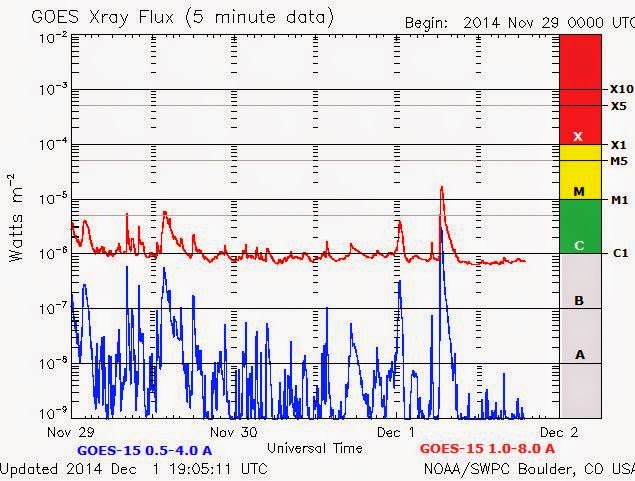 |
| Courtesy: http://www.solarham.net/xray2.htm |
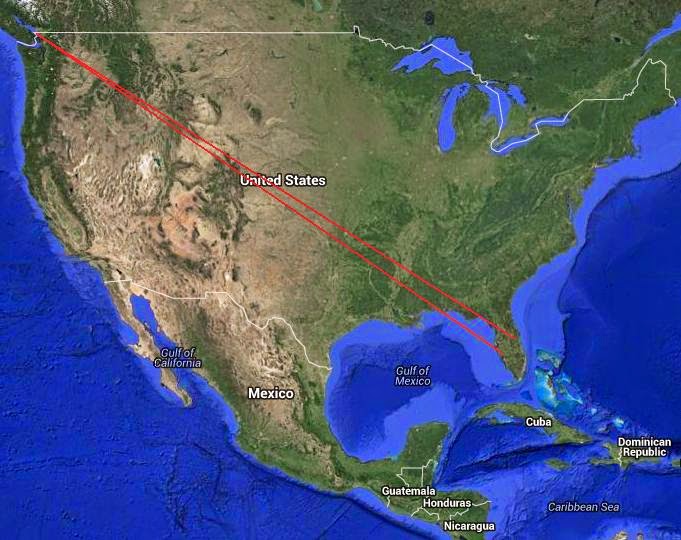
By 0900 local time, it was hovering around 46-47MHz when I started to hear the 22-watt W4CLM beacon near Atlanta, Georgia. Warming-up the transmitter and calling a few CQ's on 50.098, I was soon answered by Bob, N3LL, in EL86 on the west coast of Florida ....a nice single-hop (2600mile) F2 QSO. Another CQ brought KJ4E in EL98, to the northeast of Bob.
 |
| Courtesy: https://maps.google.com/ |
From here, things went south fast and for some reason, the normally slow climb halted as the MUF quickly retreated to the low 40MHz regions...it was all over.
The end of the opening can be clearly seen in the geomagnetic activity recorded at the Kiruna Magnetometer (Sweden). The circled area indicates the period of high MUF:
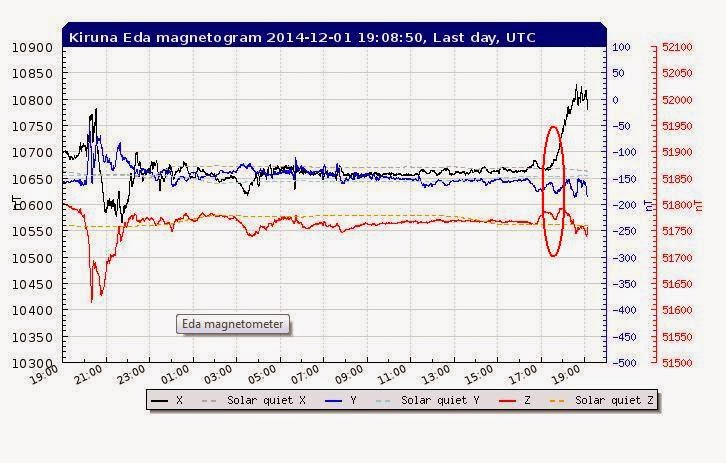
...but what started the sudden spike in the MUF today...was it the earlier flare or the suddenly south-going 'Bz' component of the Interplanetary Magnetic Field as seen about an hour earlier?
 |
| Courtesy: http://www.solarham.net/solarwind.htm |
I wonder what surprises tomorrow will bring?
Solar Flare Magic
 |
| Courtesy: http://www.noaa.gov/ |
Cycle 24 continues to behave like few others! The slowly-decaying cycle released a major solar flare at 2247 UTC Friday....afternoon on the west coast. Topping-off at X3.1, it was the sixth-strongest of the cycle and originated from sunspot 2192, the largest in the past 24 years.
 |
| Courtesy: http://www.noaa.gov/ |
Since then, there have been three more major flares from this same region, one at X1.0 (on Saturday) and the most recent (this morning) at X2.0. Oddly enough, none of these flares have produced CME's as little plasma release has been detected. Any associated auroral events will be very weak or unlikely in spite of region 2192 being geoeffectively positioned at the time of the flares.
However, the near light-speed arrival of Friday's emitted UV radiation caused a fast rise in the muf as spotty signals from various regions of South America were soon being heard on 6m in North America.
The most prominent signal was that of CX7CO (Carlos), in Montevideo, Uruguay. Thanks to the ever-alert KE7V, who posted news of the sudden arrival of Carlos, he was widely worked around North America including the west coast, a region that is usually left-out of the action. Known to have worked Carlos from here were myself, VE7XF, VE7DAY, KE7V, K7CW and possibly others outside of my hearing range. Shortly after working the west coast, Carlos was heard working JA's as his signal became weaker.
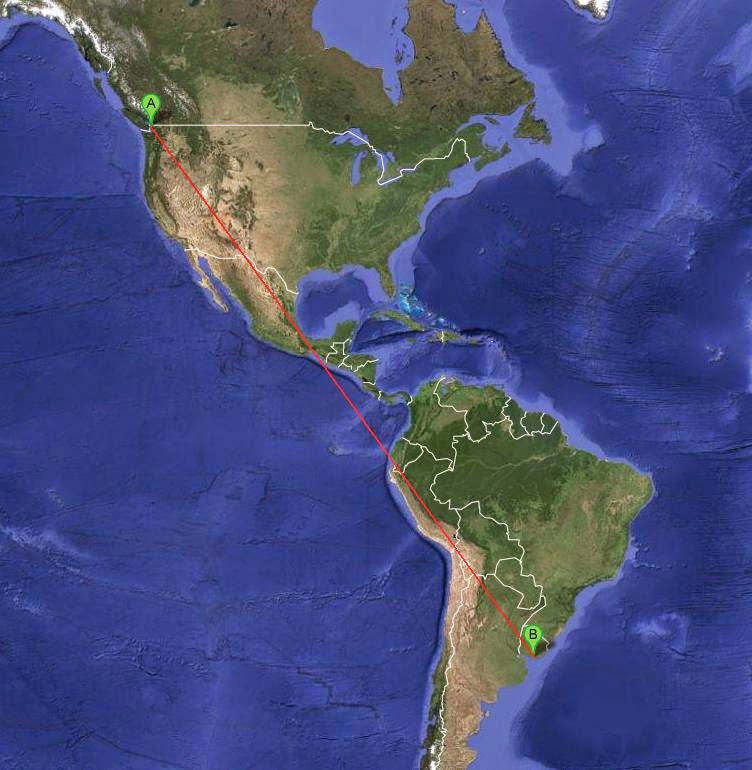
The distance from Mayne Island to Montevideo is 11,425km (7100 miles), which would tend to indicate that the contacts were a result of F2 propagation. Some have suggested a Sporadic-E-to-TEP link but I have my doubts...several 'TEP markers' were not present and there were no signs of any Es activity from this area. Although his signal peaked at 569, it is not uncommon for F2 signals to be weak, unlike the bone-crushing levels they can sometimes reach.
 |
| Courtesy: https://maps.google.ca/ |














