Posts Tagged ‘630m’
 e-Bay PCB Thermal Transfer Paper
 August 18th, 2014 |
  Author:
 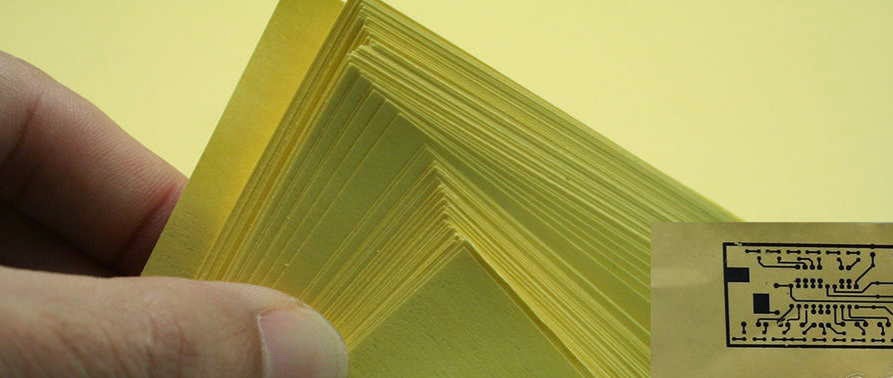 This past weekend I had the first opportunity to try my e-Bay purchased thermal transfer paper. It was to be used in my iron-on PCB work as a hopeful improvement over what I had been using...just ordinary printer paper. Supposedly the shiny photo quality papers were proving to be good performers but are expensive. Some have reported good results with glossy magazine paper but my one experience with that was not a pleasant one. Unknowingly, when I had removed the magazine page, a small amount of the sticky adhesive used in the binding process was still on the sheet. Running it through the printer caused it to melt and smear some of the laser cartridge's toner and for the next several weeks, any printing I did had a slight black streak along one edge...doh!
 My new paper from China (free shipping!) was pretty inexpensive and if it offered even a slight improvement, would be well worthwhile. This first use of the paper would be a circuit board for my earlier test-bed GW3UEP 630m transmitter. I had finished designing a PC pattern for it, using MS Paint, and was anxious to see the results.
 |
| Courtesy: http://www.gw3uep.ukfsn.org/ |
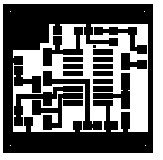
I know that a lot of folks turn up their noses at MS Paint but I have always found it to be a very versatile piece of software and have used it for making PC layouts for many years. I also use it for drawing all of the schematics appearing on my website.
After printing the pattern (printer set for maximum resolution and darkest print) and ironing-on the pattern , I allowed the board to cool for several minutes before immersing it, along with the now firmly attached yellow paper, into cold water. The first thing I noticed was how easily the paper came away from the board. It actually 'un-peeled', much like a good quality price tag sticker...you know.... the ones that don't take forever and come off in tiny bits and pieces. It peeled off smoothly with no paper residue left on the board. This was a huge improvement already. There were just a few traces of toner left on the paper as almost all had been transferred to the board.
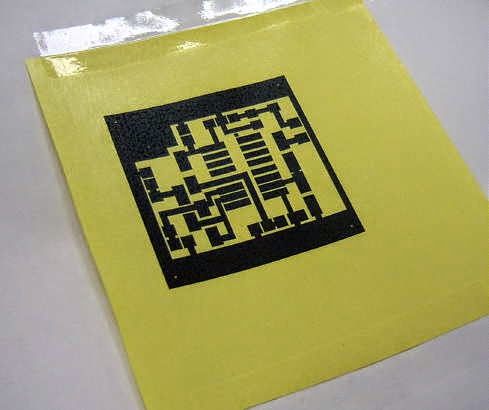 Once dried, a close examination revealed that I had pressed a little too hard with the iron and there was some evidence of 'squeeze-out' along the edges of some lines. I also found one or two very small thinner areas that probably required going over with a permanent-ink black marker pen just to make sure that those spots did not get etched. Over all I was extremely pleased with the paper and will be using it from now on.
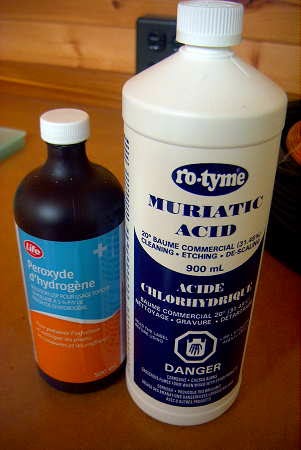
Another recent change in my PC etching regime has been a switch from the old Ferric Chloride standby to a combination of Hydrogen Peroxide and Muriatic acid. Not only does it seem to etch more cleanly (no undercutting) but it also etches very quickly and without any solution warming needed. This board was completely etched in just over 4 minutes.

The chemicals used in this method are inexpensive and are readily available at the drugstore and at the hardware store. There are numerous web-descriptions of this particular etching process but this site seems to cover the basics nicely.
The completed board turned out as shown here:
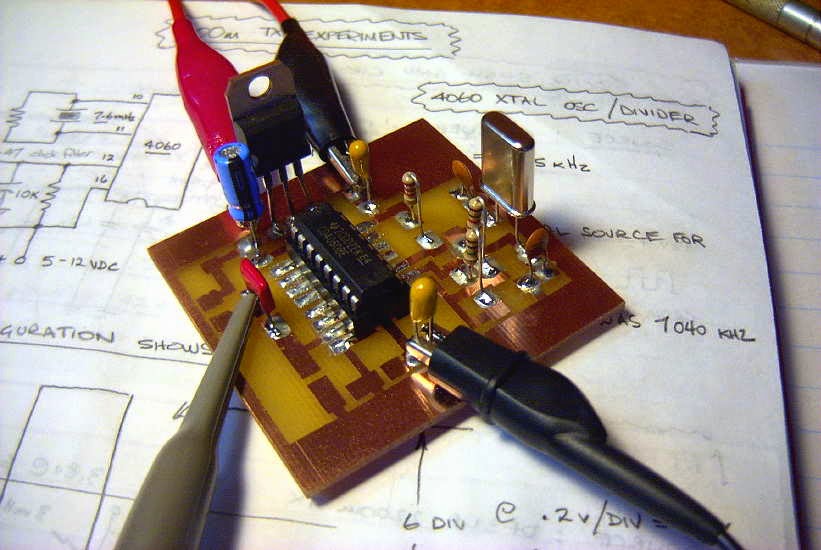
The CD4060 not only functions as a crystal oscillator but also as a versatile frequency divider. As well as fundamental frequency output, ten different 'divide-by' functions are available depending in which output pin is chosen. These range from divide-by 16,384 to divide-by 16. This circuit uses the latter, dividing the 7.6 MHz crystal down to 475 kHz at pin 7.

In summary, I can highly recommend the e-Bay yellow thermal transfer paper when used for this method of making PCB's and is much cheaper than buying photo-quality printing paper.
Special 630m Activity Night This Fall
"Special Event Planned this Fall on 630 Meters
Experimental operators on 600/630 meters will conduct a special event operation October 31-November 2. The Maritime Radio Historical Society (MRHS), which maintains the KPH/KSM commercial coast stations, will take part in the event.
“This event marks the 106th anniversary of the Berlin Treaty that created the international distress frequency at 500 kHz,” said ARRL 600 Meter Experimental Group Coordinator Fritz Raab, W1FR. “This will be a CW event.”
Raab said some stations will operate beacons on the experimental band, transmitting anniversary messages, while others will simulate the sort of maritime communication that once occurred in this part of the medium-wave spectrum. They will call CQ on a designated calling frequency and then change frequency to complete the contact. Silent periods will be observed.
The activity will occur between 465 and 480 kHz and between 495 and 510 kHz. “Different licensees have different frequency authorizations,” Raab noted. “The designated calling frequencies are 475 kHz for the lower band, and 500 kHz for the upper band.”
Raab noted that this may be the last such event that includes operations on 500 kHz itself. “This band is not being included on new experimental licenses, as it is supposedly reserved for a new maritime-data service,” he explained. He said he anticipates that more information will be released as the event draws closer. "
Not seeing any mention for Canadian activities in the event, I contacted the organizer and ARRL 600m Experimental Group Coordinator, Fritz Raab (W1FR). I asked Fritz if it would be possible for the three active Canadian 630m stations (VE7BDQ, VO1NA and myself) to 'officially' become part of the planned activities. I suggested to Fritz that the three of us could offer the chance for amateurs in both Canada and the U.S. to actively communicate with some of the 630m Canadian stations by working in the 'crossband' mode. Each of the three stations would have their own assigned transmit frequency and, following CQ's, would listen on specified HF frequencies for any answering stations. Fritz was delighted to add us to the program and the next '630 m Activity Night' announcement will include all of the details including exact frequencies.
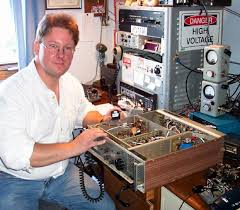 | |||
| Joe - VO1NA |
VO1NA will be transmitting from Torbay, Newfoundland and should be very well heard throughout eastern North America. Joe will be listening for replies on both 80 and 40m CW.
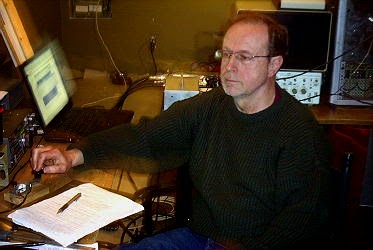 |
| John - VE7BDQ working 2200m - 160m crossband at VA7LF |
VE7BDQ will be transmitting from Delta, B.C., south of Vancouver. John will be listening for callers on 80m CW only. Being a retired Canadian Coast Guard RO, John has many years of experience manning the 500kHz watch when 600m maritime activity was in its prime.
VE7SL will be transmitting from Mayne Island B.C., midway between Vancouver and Victoria, on Vancouver Island. Like Joe, I plan to listen for callers on both 80 and 40m CW.
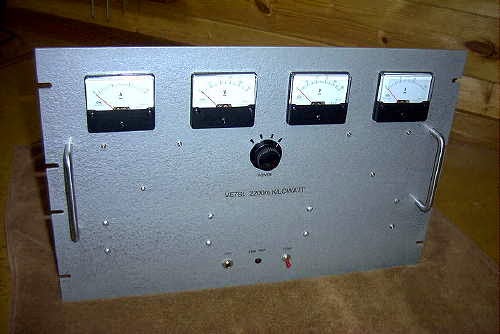 |
| VE7SL - 2200m / 630m TX |
All three Canadian stations are able to muster the maximum allowed eirp for 630m and with the improved propagation of late October, the opportunity for some interesting crossband contacts should be realized on both ends of the continent.
There will be more details well before the event but hopefully you can become part of the fun by giving some of the crossbanders a call on their HF 'QSX' frequencies....and if you know of anyone that might like to participate, please let them know about the upcoming event as, like so many on-the-air activities, the more the merrier!
VE7 630m CW Beacons Report
 Saturday night's CW beaconing by myself and VE7BDQ on 630m CW produced a number of interesting heard reports from various directions. It seems as though most receiving stations were bothered by the high level of thunderstorm QRN, very common at this time of the year and usually the limiting factor in reception. The Vaisala lightning map indicated various pockets of lighting in the PNW and a solid wall further to the east. Being located near any of these cells would make it difficult to hear anything at all and all but impossible nearer the wall.
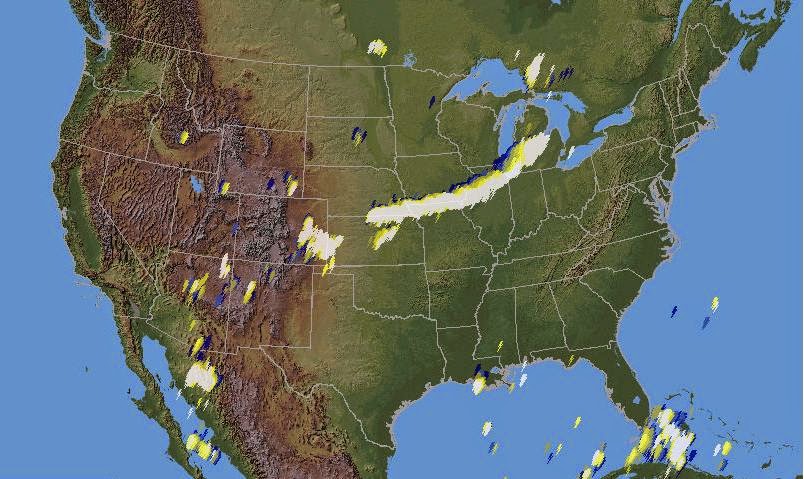 |
| Courtesy: vaisala.com |
Nevertheless, reception reports, often of both beacons, were received from Washington, Oregon, Utah, British Columbia, Alberta and as far east as Saskatoon, SK. It seemed like stronger signals were reported from the east rather than from the south or south-east which is more often the case. I suspect that the lower level of lightning in this direction, rather than enhanced E-W propagation, was the main reason for the nice 'over the Rockies' reception.
Thanks to the following enthusiasts who were kind enough to listen and to report on Saturday night's activities, hopefully I haven't missed anyone:
KK7UV (Steve) MT *
W7SWL (Bob) AZ *
VE6TA (Grant) Alberta
AA7U (Steve) OR
VA5LF (Sean) Saskatchewan
VA7JX (Jack) British Columbia
WY3B (Mike) HI *
W7WKR (Dick) WA
K7WV (Tom) WA
KU7Z (Mark) UT
W7OIL (Dan) WA
G0NSL (Brian) UK *
Colin Newell, British Columbia
* stations reporting no reception
It appears that even under fairly severe conditions (mid-summer QRN), small backyard antenna systems and 100W can propagate well enough for CW contacts on the 630m band. The band is certainly much more prop-friendly than 2200m and quiet winter conditions will be even better. In the meantime I hope to make some crossband contacts with anyone that might like to try that mode.
“Night of Nights” + VE7 CW Beacons – tonight
As many of you are aware, tonight from 0001Z-0700Z (1701- midnight PDT) is the annual 'Night of Nights' reactivation of many maritime CW MF stations operating near the 630m band. With Canadian amateurs recently getting 472-479KHz operating privileges, VE7BDQ and myself will both be operating CW beacons during the event.
VE7BDQ will transmit on 474.00 KHz while VE7SL will be on 473.00KHz. Both stations will be at the 100W power level.
Reception reports of either station would be gratefully received and confirmed by QSL if requested. Hopefully the usual noisy summer conditions will not detere listener activity.
I have more information on the 'Night of Nights' activity posted in an earlier blog if you are not aware of the event.
500KHz Lives Again – 2014 Night of Nights
 |
| Courtesy: Maritime Radio Historical Society |
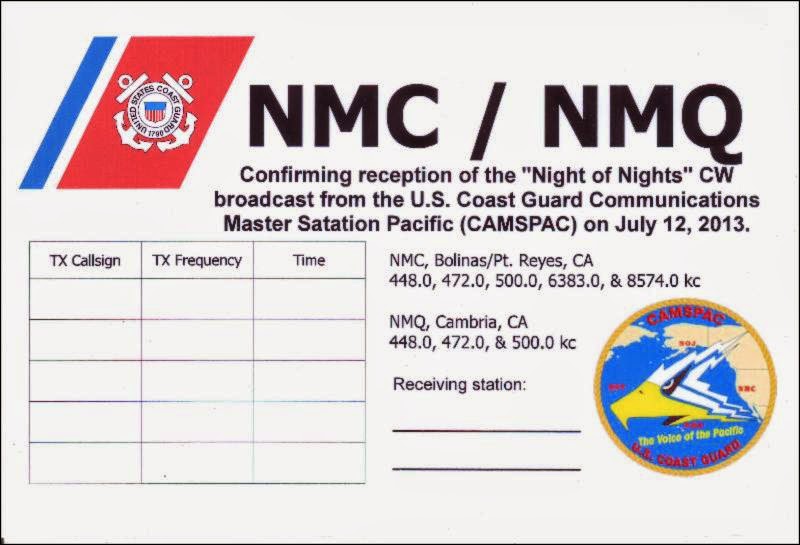
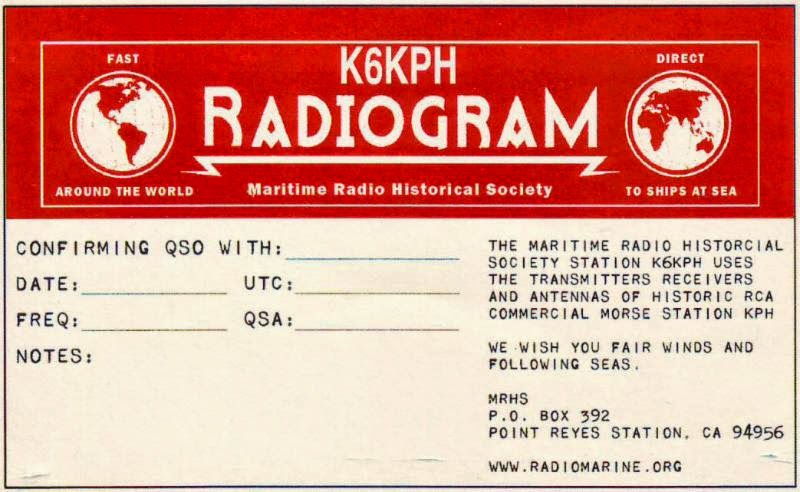
This year's annual Maritime Radio Historical Society's event, to mark the anniversary of the end of maritime CW in 1999, will take place Sunday, July 13, from 0001Z until 0700Z (Saturday, July 12, from 1701 until midnight PDT). This year's event may be historic in itself in that it will likely be the final year for any of the U.S. Coast Guard stations to ever be heard again on CW, as the equipment and wiring for this mode is now being dismantled.
 |
| Courtesy: Maritime Radio Historical Society |
Commercial CW land station transmitters from WLO (Mobile, AL), KLB (Seattle, WA), KFS (San Francisco, CA), KPH (Bolinas, CA) and KSM (Pt. Reyes, CA) should be active near 500KHz as well as on HF.
(late update: due to operator illness, KLB will not be participating)
USCG stations NMC (Bolinas/Pt. Reyes), NMQ (Cambria /Pt. Reyes) and NMW (Astoria / Pt. Reyes) will also be transmitting below 500KHz as well as on HF. QSL's confirming reception of CG stations as well as for K6KPH and KSM will be available following the event.
K6KPH, the MRHS's amateur radio station located at the Pt. Reyes, CA site, will also be active on the HF bands during the event.
For a nice historical 'look back', the MRHS has some great stories associated with HF and MF maritime operations. Further details of the event detailing times and exact frequencies are available from MRHS newsletter #45.
Lastly, if you never had the opportunity to listen to '500' back in its heyday then you will surely enjoy this recording made by K2NP in March,1966 and presented with thanks to N1EA. Listening to this 500KHz action reminds me of 20m CW during the annual DX contest! What land stations can you identify in the pileups? Hopefully, when all North American amateurs gain access to the band, it will sound like this once again.
630m….Our Newest Band’s Great Heritage
Listening and working on 630m over the past few weeks was not my first exposure to this part of the spectrum. Years ago I spent many hours listening to maritime traffic on 500KHz CW on a little Sony ICF-2010 and an outboard ferrite bar loop antenna. 500KHz was the International MF distress frequency as well as the calling frequency for ship-to-shore CW traffic. Ships calling land stations would be directed to 'QSS' to a working frequency once they had established contact on 500. These working frequencies were smack in the middle of what is now our 630m amateur band.
On winter nights with good propagation, I could often hear ships out near Hawaii or down in the Gulf of Mexico. Even better nights would produce ships along the eastern U.S. seaboard. Our new band has great potential for some exciting DX opportunities...much more so than the 2200m LF band. Hopefully the U.S. will get the band soon. In the meantime, it is up to Canadians to get the North American ball rolling!
Big signals from the land stations, particularly those operated by the USCG, dominated the band. Digging into my old QSL collection turned up a number of cards from '500'.

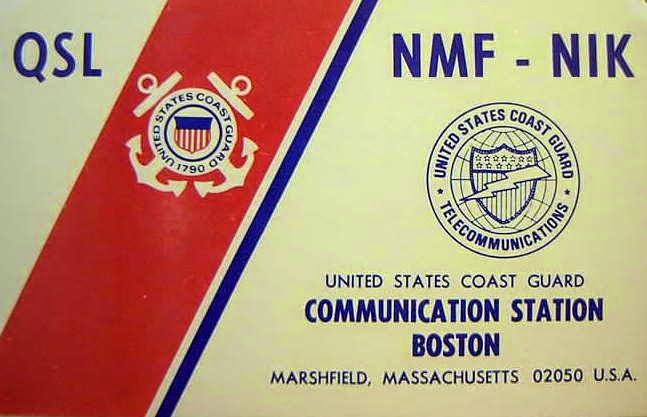
From what I could tell, most of the ship Radio Officers used a hand key on the MF transmitter while on HF, most used bugs or keyers. The quality of hand-keyed CW ranged from perfection to abysmal and some nights it sounded as though the ship's oiler had been strapped to the seat and told to send CW. Most traffic consisted of provisioning requests or berthing information, as ships usually only used MF when arriving or departing their port.
The ship's RO would often respond to a 'reception report' and happily fill in a prepared QSL. The cards were often returned with pictures and long handwritten letters, describing their radio equipment or life at home.
Although CW Maritime operations have long been discontinued, the 'Primary' user of the 630m band is still the Maritime Service!
In the US and in Canada, the 472-479 kHz band is part of the larger 435-495 kHz segment allocated on a primary basis to the Maritime Mobile Service and on a secondary basis for government Aeronautical Radionavigation.
I'm not exactly sure what the Maritime is doing on MF these days or what they plan to do, but I suspect it may be related to DGPS activity down the band. Canadian amateurs are Secondary users of 630m and as such, must not create interference with the primary user. I suspect that it might not be a great idea to create interference with the secondary users as well, although there are no NDB's in this section of the band in North America.
On winter nights with good propagation, I could often hear ships out near Hawaii or down in the Gulf of Mexico. Even better nights would produce ships along the eastern U.S. seaboard. Our new band has great potential for some exciting DX opportunities...much more so than the 2200m LF band. Hopefully the U.S. will get the band soon. In the meantime, it is up to Canadians to get the North American ball rolling!
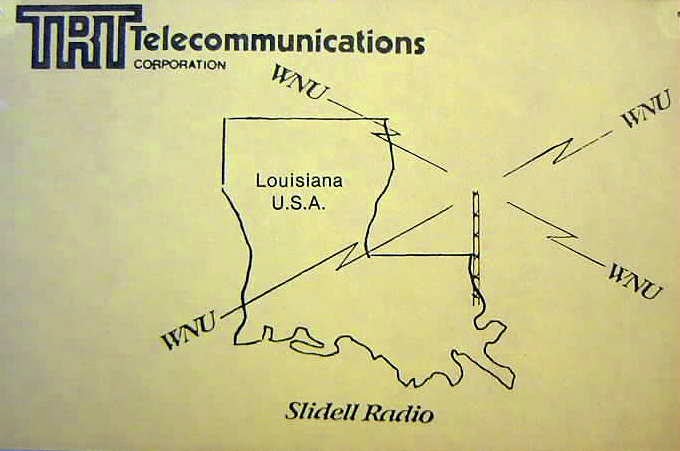
Big signals from the land stations, particularly those operated by the USCG, dominated the band. Digging into my old QSL collection turned up a number of cards from '500'.
 |
| WNU - Slidell Louisiana |
From what I could tell, most of the ship Radio Officers used a hand key on the MF transmitter while on HF, most used bugs or keyers. The quality of hand-keyed CW ranged from perfection to abysmal and some nights it sounded as though the ship's oiler had been strapped to the seat and told to send CW. Most traffic consisted of provisioning requests or berthing information, as ships usually only used MF when arriving or departing their port.
The ship's RO would often respond to a 'reception report' and happily fill in a prepared QSL. The cards were often returned with pictures and long handwritten letters, describing their radio equipment or life at home.
 |
| M/V Belforest - Bulk Carrier |
Although CW Maritime operations have long been discontinued, the 'Primary' user of the 630m band is still the Maritime Service!
In the US and in Canada, the 472-479 kHz band is part of the larger 435-495 kHz segment allocated on a primary basis to the Maritime Mobile Service and on a secondary basis for government Aeronautical Radionavigation.
I'm not exactly sure what the Maritime is doing on MF these days or what they plan to do, but I suspect it may be related to DGPS activity down the band. Canadian amateurs are Secondary users of 630m and as such, must not create interference with the primary user. I suspect that it might not be a great idea to create interference with the secondary users as well, although there are no NDB's in this section of the band in North America.
Using The KØLR ‘Antenna Meter’ on 630m
If you plan to become active on Canada's new 630m ham band, one of the first things you're probably thinking about is an antenna and how to make it resonant. Without the proper instruments, determining antenna resonance below the broadcast band can sometimes require a combination of good luck and black magic!
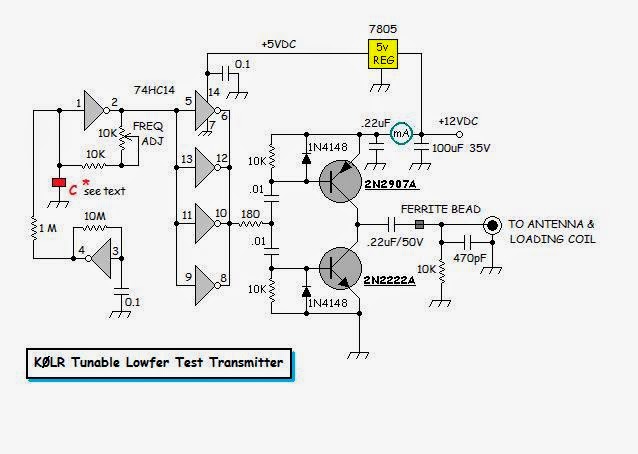
One of the most useful pieces of gear for me has been a simple 'antenna meter' designed by Lyle Koehler, KØLR, who was very active at one time on the 185KHz 'lowfer' band. Although the original circuit was designed to cover a lower frequency range, it can easily be modified to cover the 2200m and 630m bands.
The device is actually a low power (~1/2w) VFO-controlled transmitter designed to look into a 50 ohm antenna system. Since most LF antennas are matched to 50 ohms, either through a separate matching transformer or by tapping up from the bottom of the antenna's loading coil, the 50 ohm feedline from the antenna system is simply connected to the antenna meter's output and the VFO tuned for maximum deflection of the meter. The resonant frequency is then directly read from the calibrated scale of the antenna meter's dial. With most backyard LF antennas having a very narrow bandwidth along with a high-Q, the meter peak is quite sharp and easy to find. Look for a peak meter reading between 50-70ma as you sweep the VFO across the antenna. Normal current values will be very low until resonance is hit.
KØLR's original article gives more details and can be found here.
The 470pf capacitor (C in my diagram) determines the basic frequency range. To modify the circuit for dual range (both 2200m and 630m), I added a SPDT switch at pin 1 of the IC so that I could switch the value of "C". For coverage down to and below 136KHz, I used ~ 725pf (a 680pf + 47pf in parallel) while high end coverage up past 500KHz required just 250pf (220pf + 27pf in parallel). These values should get you very close to the required ranges and once installed it is an easy task to calibrate the tuning scale by listening to the signal on a receiver or measuring it with a frequency counter. I also chose to install the 1M 'modulation' resistor that gives the signal a distinctive FSK note.
The meter will quickly tell you if your antenna is too high in frequency (capacitive) or if it is too low (inductive) so that the proper corrective measures may be taken to resonate it within the 630m band. Once resonant, attention can then be paid to bringing the impedance match as close as possible to 50 ohms and a 1:1 match. Depending on your method of impedance matching, there may be some interaction between tuning for resonance and impedance matching but a perfectly resonant 50 ohm system can be achieved with a little juggling.
Although not updated for several years, KØLR's website contains much good information regarding simple backyard LF antenna systems (both transmitting and receiving), preamps and weak signal receiving techniques. It is well worth a close look if you are designing a new 630m station.
One of the most useful pieces of gear for me has been a simple 'antenna meter' designed by Lyle Koehler, KØLR, who was very active at one time on the 185KHz 'lowfer' band. Although the original circuit was designed to cover a lower frequency range, it can easily be modified to cover the 2200m and 630m bands.
 |
| The KØLR LF Transmitter |
The device is actually a low power (~1/2w) VFO-controlled transmitter designed to look into a 50 ohm antenna system. Since most LF antennas are matched to 50 ohms, either through a separate matching transformer or by tapping up from the bottom of the antenna's loading coil, the 50 ohm feedline from the antenna system is simply connected to the antenna meter's output and the VFO tuned for maximum deflection of the meter. The resonant frequency is then directly read from the calibrated scale of the antenna meter's dial. With most backyard LF antennas having a very narrow bandwidth along with a high-Q, the meter peak is quite sharp and easy to find. Look for a peak meter reading between 50-70ma as you sweep the VFO across the antenna. Normal current values will be very low until resonance is hit.
KØLR's original article gives more details and can be found here.
The 470pf capacitor (C in my diagram) determines the basic frequency range. To modify the circuit for dual range (both 2200m and 630m), I added a SPDT switch at pin 1 of the IC so that I could switch the value of "C". For coverage down to and below 136KHz, I used ~ 725pf (a 680pf + 47pf in parallel) while high end coverage up past 500KHz required just 250pf (220pf + 27pf in parallel). These values should get you very close to the required ranges and once installed it is an easy task to calibrate the tuning scale by listening to the signal on a receiver or measuring it with a frequency counter. I also chose to install the 1M 'modulation' resistor that gives the signal a distinctive FSK note.
The meter will quickly tell you if your antenna is too high in frequency (capacitive) or if it is too low (inductive) so that the proper corrective measures may be taken to resonate it within the 630m band. Once resonant, attention can then be paid to bringing the impedance match as close as possible to 50 ohms and a 1:1 match. Depending on your method of impedance matching, there may be some interaction between tuning for resonance and impedance matching but a perfectly resonant 50 ohm system can be achieved with a little juggling.
Although not updated for several years, KØLR's website contains much good information regarding simple backyard LF antenna systems (both transmitting and receiving), preamps and weak signal receiving techniques. It is well worth a close look if you are designing a new 630m station.













