 |
 Another example
 1 July 2013 | by
 Another example working 1 watt. Nice video from WA2OQJ, thanks for sharing!
Paul Stam, PC4T, is a regular contributor to AmateurRadio.com and writes from the Netherlands. Contact him at [email protected].
Field Day – this the way to do it.
Field Day, as it should be. QRP, fun and good friends. This is a wonderful example of putting out the maximum effort to get the most out “of sending the very least!”
I’ve worked these fine folks individually many times over the years. It’s so nice to be able to put faces and voices to the people “behind the code”.
72 de Larry W2LJ
QRP -When you care to send the very least!
Larry Makoski, W2LJ, is a regular contributor to AmateurRadio.com and writes from New Jersey, USA. Contact him at [email protected].
Yet Another APRS Client
An apt title for this post, but also for the software in question. Yet Another APRS Client (YAAC from now on) is a new program written by Andrew, KA2DDO that has recently entered beta test status. I stumbled across it a few days ago and am now running it on my G4ILO-2 VHF iGate.
 |
| YAAC map display with US Geological Survey topographic data.) |
YAAC is written in Java so it runs equally well on Windows, Mac and Linux platforms as long as you have a recent Java runtime installed.
YAAC is open source software and uses open source mapping (Open Street Map – OSM). APRSISCE does too, but whereas it uses bitmap tiles, YAAC uses vector-based map data. This makes the maps look a bit different (more as if they were drawn by a spider.) You can easily add topographical data from the US Geological Survey (the screenshot above shows this.) YAAC also supports the use of scanned-in maps but I haven’t tried this.
YAAC is very easy to use. There is a wizard to help you set up the program, though there is also an expert mode that allows you to get to all the settings directly. There are far fewer things that can be changed than APRSIS32 has which is one reason it is easier to use, but YAAC’s user interface is more standard. A File menu is on the left of the menu bar, Help on the right, and all the configuration settings are on a multi-tabbed dialog box not nested in three levels of menus. YAAC would be an ideal program for someone new to APRS, which is not to belittle the program in any way as it does all the things that most users would be perfectly happy with.
YAAC supports a wide range of TNCs including TNC2 compatibles and the Kenwood mobiles. In APRS mode the Kenwood D700/D710 can only be used receive-only. In Packet mode the Kenwood can be used as a KISS TNC. Believe it or not I hadn’t realized it had this capability until Andrew pointed it out to me. Just two commands (KISS ON, RESTART) are needed to put the Kenwood into KISS mode. The other thing that confounded me for quite a while is that the Kenwood TNC expects hardware flow control. Once that setting had been made everything started to run perfectly.
 |
| YAAC’s “Radio View” |
One disadvantage of using the Kenwood D700/D710 in Packet mode is that the rig’s display doesn’t show any APRS information.However, Andrew has implemented a rather neat “radio view” which emulates the Kenwood display. The only extra thing that would make the emulation complete would be to limit it to only those packets received over the radio. With an APRS feed covering a wide area the display changes too quickly to be readable.

YAAC doesn’t provide as much information about APRS objects as APRSISCE does.The window on the right is what you get when you click on one of the G4ILO icons. When two or more stations are co-located the calls overwrite one another making them unreadable. APRSISCE manages to position the calls so they don’t overlap at all.
Because YAAC uses vector graphics it does a better job of displaying APRS icons and even orients the icons of moving objects in the direction of motion. Zoom in to street level and you’ll discover that icons are provided for points of interest. I was quite impressed when I saw what was displayed for our small town of Cockermouth. I think these objects come from OSM data.
 |
| Street-level display of Cockermouth including places of interest |
You might get the impression that I really like this new APRS client. It appears to be well designed, well written and is well supported by Andrew, its developer. It’s a very impressive piece of software. I originally intended just to try it out for a couple of days but I think I’ll stick with it for the time being.
Julian Moss, G4ILO, is a regular contributor to AmateurRadio.com and writes from Cumbria, England. Contact him at [email protected].
New Colorado 14er Event Shirt
 Thanks to Steve WG0AT, we now have a new design for the Colorado 14er Event Shirt. Steve gen’d up a new logo that has the Colorado 14er Event blended with Summits On The Air (SOTA), that is available on a variety of t-shirts, a coffee mug and maybe a few other items. The logo, shown to the left, is a fantastic graphic featuring Ham Radio at Altitude.
Go to Cafepress to view and purchase the items that are available.
73, Bob K0NR
Bob Witte, KØNR, is a regular contributor to AmateurRadio.com and writes from Colorado, USA. Contact him at [email protected].
Beware a lion on a parachute: My first attempt at tracking High Altitude Balloons on 434MHz
A few weeks ago, I enjoyed tracking two high altitude balloons launched from near Cambridge, across the channel across Belgium, Germany and then finally into Austria. On that occasion, I didn’t have the time to set up the software to attempt to receive the data from the balloons and upload them.
Earlier in the week, I noticed Dave Akerman M6RPI mention that there would be two balloon launches this Saturday. Both quite interesting – one was a fund raising venture for Purley Infants’ School and the second one was even more fun – an attempt to release Kingsley, the Reading FC mascot from a balloon at exactly 18.71 miles above the earth and have him drift down to earth on a parachute.
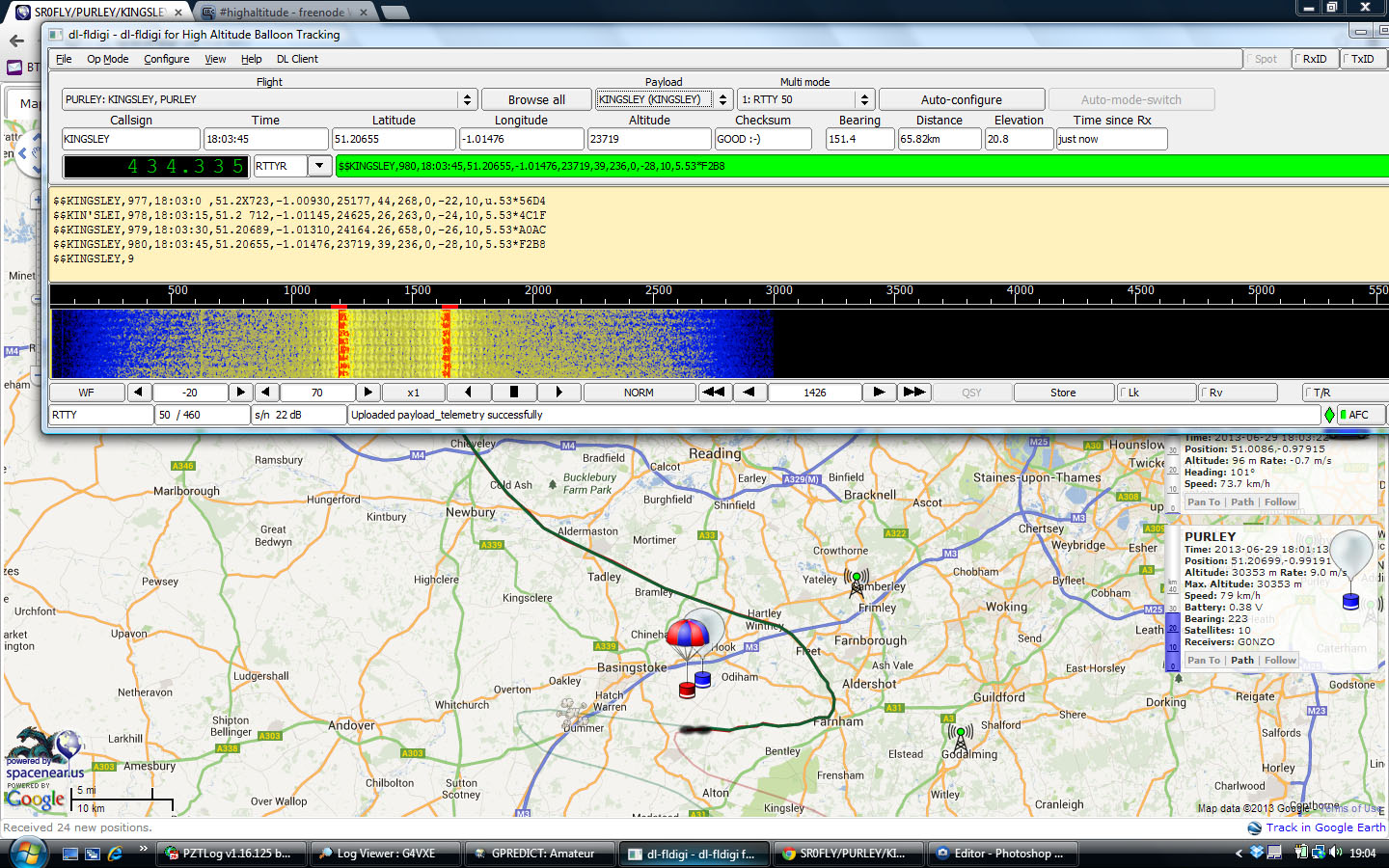
As ever, I didn’t really plan it, but at least I was downloading the DL-FLDIGI software as the balloons were being launched! Data about launches together with a plot about where the balloons currently launched are, is shown on the SpaceNear website
As the balloons were being launched from about 20 miles from me, I was reasonably confident I would hear them. I turned the 432MHz yagi (10 ele) towards the launch site. I picked the Purley balloon and tuned the FT847 to the appropriate frequency on 434MHz SSB. The balloons transmit a RTTY signal. Very soon, I could hear a weak signal.
I fired up DL-FLDIGI and filled in the station configuration details. After a bit of fiddling, I settled on setting the mode to RTTYR (the FT847 was on USB) and I was able to decode some data. Although I was receiving data and could see that it was being uploaded to the Spacenear site, I was getting a lot of bad checksums. Initially, I thought this was something I was doing wrong. However, I think it was because the Purley balloon must have been running quite low power. I will ask Dave about this.
However, when I tuned to the KINGSLEY balloon, signals were very much stronger and I was able to track it well as it rose to the target height, burst and then gently descended to a landing spot not too far from Basingstoke. It was fun tracking it very close to the horizon. Actually during part of the descent, the balloon’s transmit frequency was drifting fast – almost too fast for DL-FLDIGI’s AFC! However, I was able to persuade it to play after a bit more fiddling and a restart of the software!
Now, has anyone in Basingstoke seen a toy lion on a parachute? (actually, the good news is that Dave, M6RPI has recovered both payloads successfully, so Kingsley hasn’t had to sleep out rough..)
Tim Kirby, G4VXE, is a regular contributor to AmateurRadio.com and writes from Oxfordshire, England. Contact him at [email protected].
ICQ Podcast S06 E13 – Radio Safety (30 June 2013)
Series Six Episode Thirteen of the ICQ Podcast has been released. News Stories include :-
- RSGB Centenary
- New GB3WGI 144MHz transatlantic beacon goes live with G2FKZ legacy funding
- Dot, dash, full stop: Telegram service ends
- Moon bounce from Antarctica
- Duhallow Repeater Group
- 70MHz DXpedition to EU-013 Jersey
- 3rd UK High Altitude Society Conference
- California Radio Hams claim 77 GHz world record
- Band allocation at 5 MHz for Samoa
- 5 GHz Vehicle-to-Vehicle Communications
- Google Project Loon using 2400 and 5800 MHz
Your feedback and Martin Butler (M1MRB & W9ICQ) discusses Radio Safety.
Colin Butler, M6BOY, is the host of the ICQ Podcast, a weekly radio show about Amateur Radio. Contact him at [email protected].
ICQ Podcast S06 E13 – Radio Safety (30 June 2013)
Series Six Episode Thirteen of the ICQ Podcast has been released. News Stories include :-
- RSGB Centenary
- New GB3WGI 144MHz transatlantic beacon goes live with G2FKZ legacy funding
- Dot, dash, full stop: Telegram service ends
- Moon bounce from Antarctica
- Duhallow Repeater Group
- 70MHz DXpedition to EU-013 Jersey
- 3rd UK High Altitude Society Conference
- California Radio Hams claim 77 GHz world record
- Band allocation at 5 MHz for Samoa
- 5 GHz Vehicle-to-Vehicle Communications
- Google Project Loon using 2400 and 5800 MHz
Your feedback and Martin Butler (M1MRB & W9ICQ) discusses Radio Safety.
Colin Butler, M6BOY, is the host of the ICQ Podcast, a weekly radio show about Amateur Radio. Contact him at [email protected].
 Ham Radio Deluxe |
 W5SWL Electronics |
 Ham Radio Prep |
 KB3IFH QSL Cards  Hip Ham Shirts  HamRadioAuctions HamRadioAuctions Reliance Antennas Reliance Antennas Enigma Shop Enigma Shop |  morseDX  Ni4L Antennas  R&L Electronics R&L Electronics antennas.us antennas.us QRV QRV |
- Matt W1MST, Managing Editor
