 |
 Receiving SO-50 satellite signals on the UV-5R and NA771 antenna
 14 July 2013 | by
 During the week, I noticed that there were some good, overhead SO-50 passes in the evenings. The weather has been so good we have often been out in the garden later on. It’s been very simple, therefore to take the UV-5R and the NA771 antenna out into the garden and have a listen for the SO-50 satellite as it passes over.
Results have been good, with a number of stations received, including ES6DO, DG0BBE, DL9ZAD (who almost heard me!) and OM0AD. I am sure it will be possible to make a QSO when the conditions are right.
The FT817 and Elk gives much better results, but of course, the advantage of the UV-5R/NA-771 combo is that it is available very quickly and does not require any setting up!
Tim Kirby, G4VXE, is a regular contributor to AmateurRadio.com and writes from Oxfordshire, England. Contact him at [email protected].
Series Six Episode Fourteen – Friedrichshafen Amateur / Ham Radio Show
Series Six Episode Fourteen of the ICQ Amateur / Ham Radio Podcast has been released. The latest news and Ed Durrant (VK2JI) reports from the Amateur / Ham Radio Show - Friedrichshafen.
- UK Radio Ham plans Lunar CubeSat
- 915-921 MHz to be licence exempt in UK
- Olivier ON4EI back in Ireland
- Australian SKI DXepedition
- British Railways Amateur Radio Society GX4LMR
- Air waves are affecting the Airways
- 15-year-old develops body heat powered flashlight
- The CCXD Award - the ultimate award

Colin Butler, M6BOY, is the host of the ICQ Podcast, a weekly radio show about Amateur Radio. Contact him at [email protected].
Repeater work on Sandia Crest
I had the opportunity of a lifetime to traverse through the nation’s most RF dense mountaintop towersite, and possibly reduce my chances of having children by a large amount…in any case, today’s work was bucket loads of fun.
 |
| Towers lining the crest. [Wikimedia user Skoch3, Photo] |
The work at the site was simple — some regular maintenance to the W5MPZ D-STAR repeater and gateway.
So, I got up early and headed off to Ed’s (KA8JMW) place to pick up the caravan to the peak. We packed the truck with some server rack shelves and tools, and headed to pick up Brian (N5ZGT), then Chris (NB5T).
And then, the 10,768 ft (3,255m) summit.
The road was blocked by the Forest Service since the park was closed due to fire danger. Thanks to some prior planning, we had no trouble getting past.
And not two turns in to the curvy mountain road, we meet our first deer, head on. Thanks to Ed’s quick foot on the break (maybe he was practicing for QLF?) the deer zipped across the road, perhaps only with a bruised tail.
We were warned that with the lack of humans, nature tends to take over a bit
The one thing I though of going up the road is, what if you had this road all to yourself (like we did then) with a nice, fast rally car?
I think deer would have a problem with that.
Anyway, we got to the top, and met the first obstacle:

Chris dispatched the lock on the well-signed gate and we were in. At that point, we had entered the danger zone; the steel forest. With at least 26 FM stations, almost half being over 20 kilowatts, 33 TV stations, more than half over 100 kW, and an uncountable number of microwave dishes, log periodics, yagis, verticals, radomes, funny looking phased arrays and dipoles supported on dozens of massive towers, I swear I could hear KOB in my teeth.


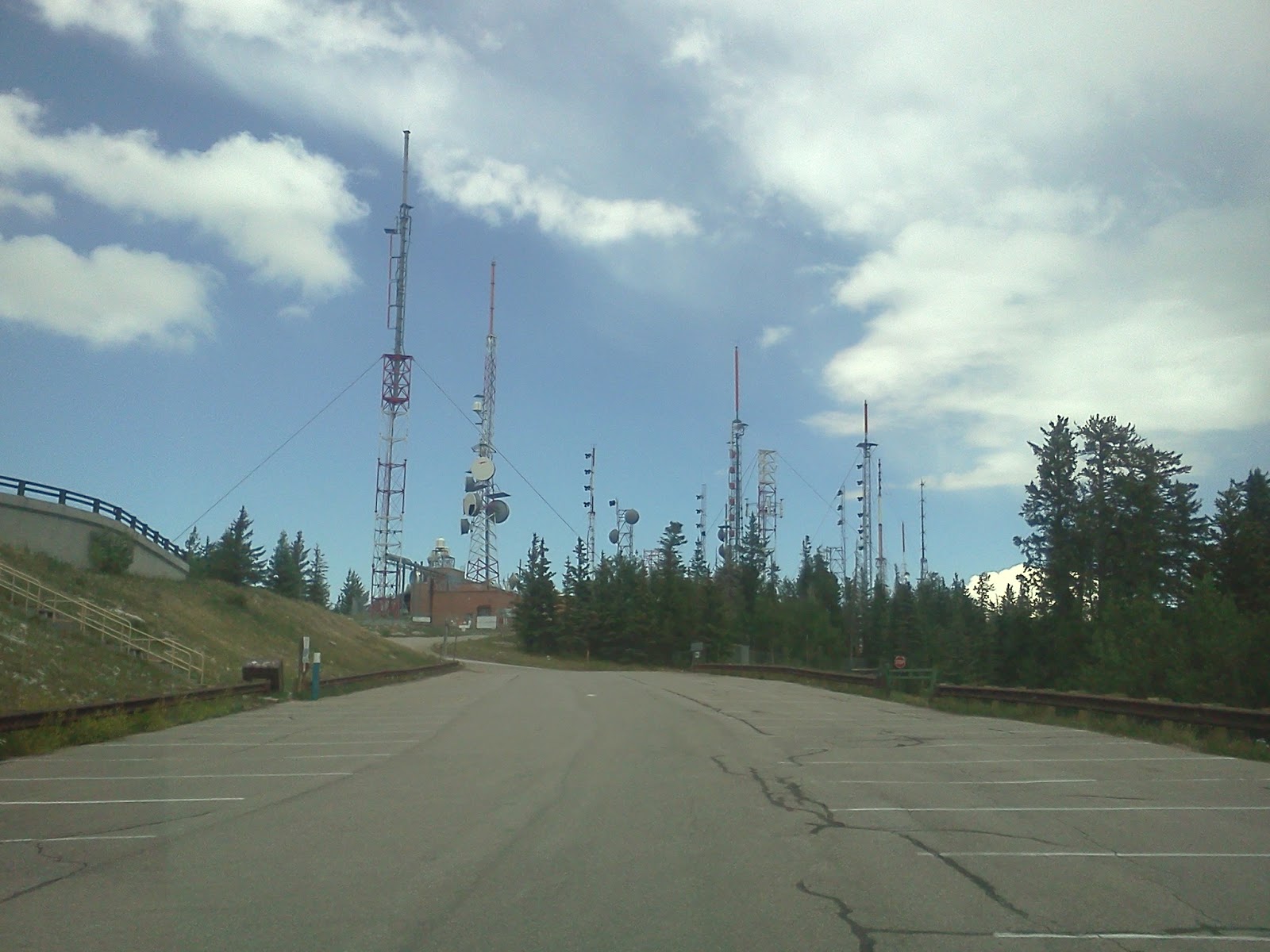
After driving through the entire site, we arrived at our final destination: the Sandia Nat’l Lab’s personal radio playhouse.

The guys began working on equipment, while I snapped photos and gazed in awe of the city of Albuquerque all within my field of view.
 |
| Chris, Ed, and Brian “working.” |

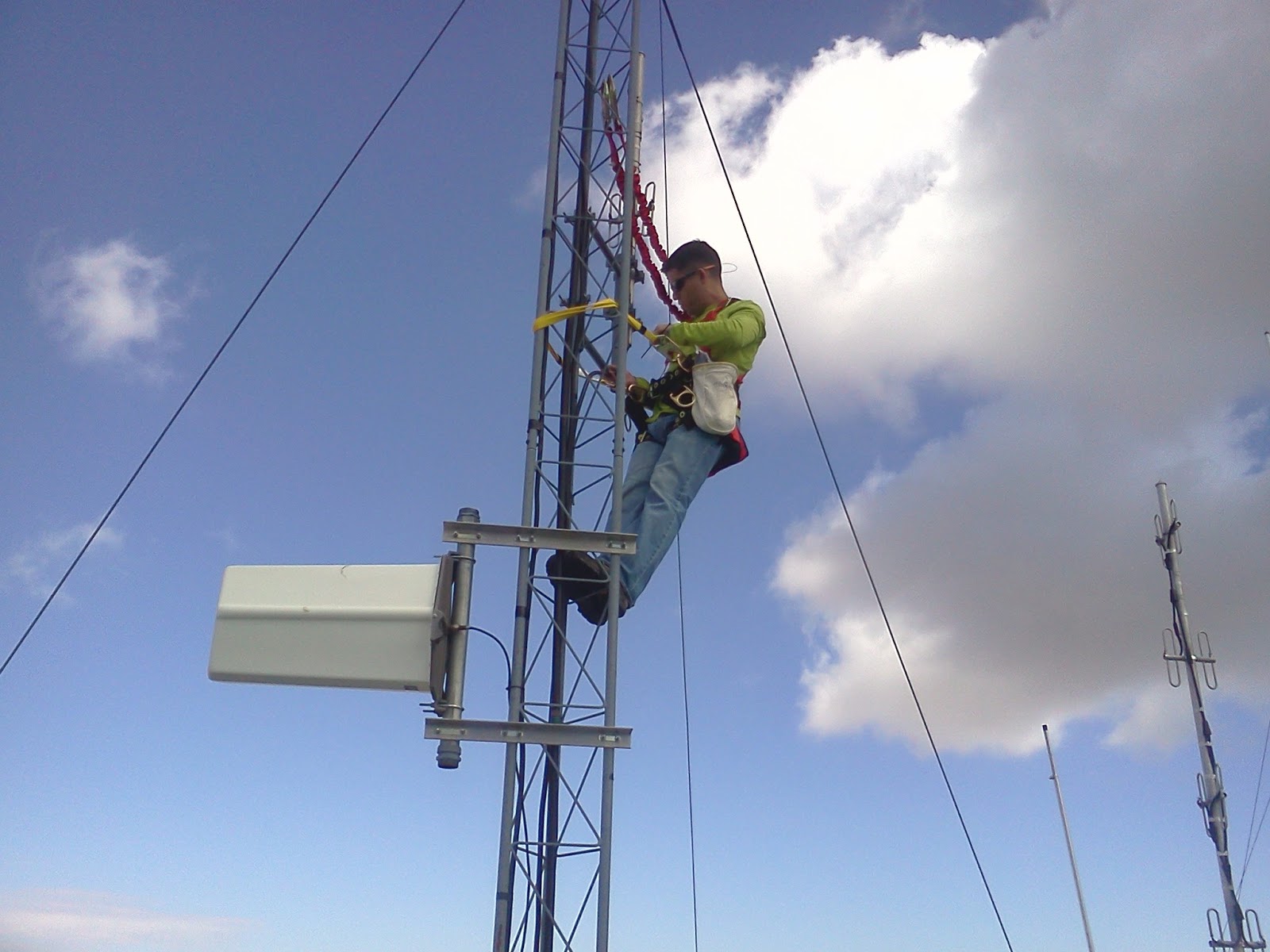
Brian took the job of tightening the D-STAR antenna, which he did adamantly, without falling, thanks to his fancy harness. It’s funny how dinky that antenna seems, but being over 3,000 ft ( 914m) above the rest of the world, it can see almost 100 radio miles (150km). With my 40w mobile radio, it comes in full signal in Socorro, NM, 75 miles (50km) away.
The team was successful of getting things done, cleaning up the shelves of an obtrusive monitor, keyboard and mouse (by going SSH only) and installing a NetIO internet-controlled AC power killswitch.
 |
| Before… |
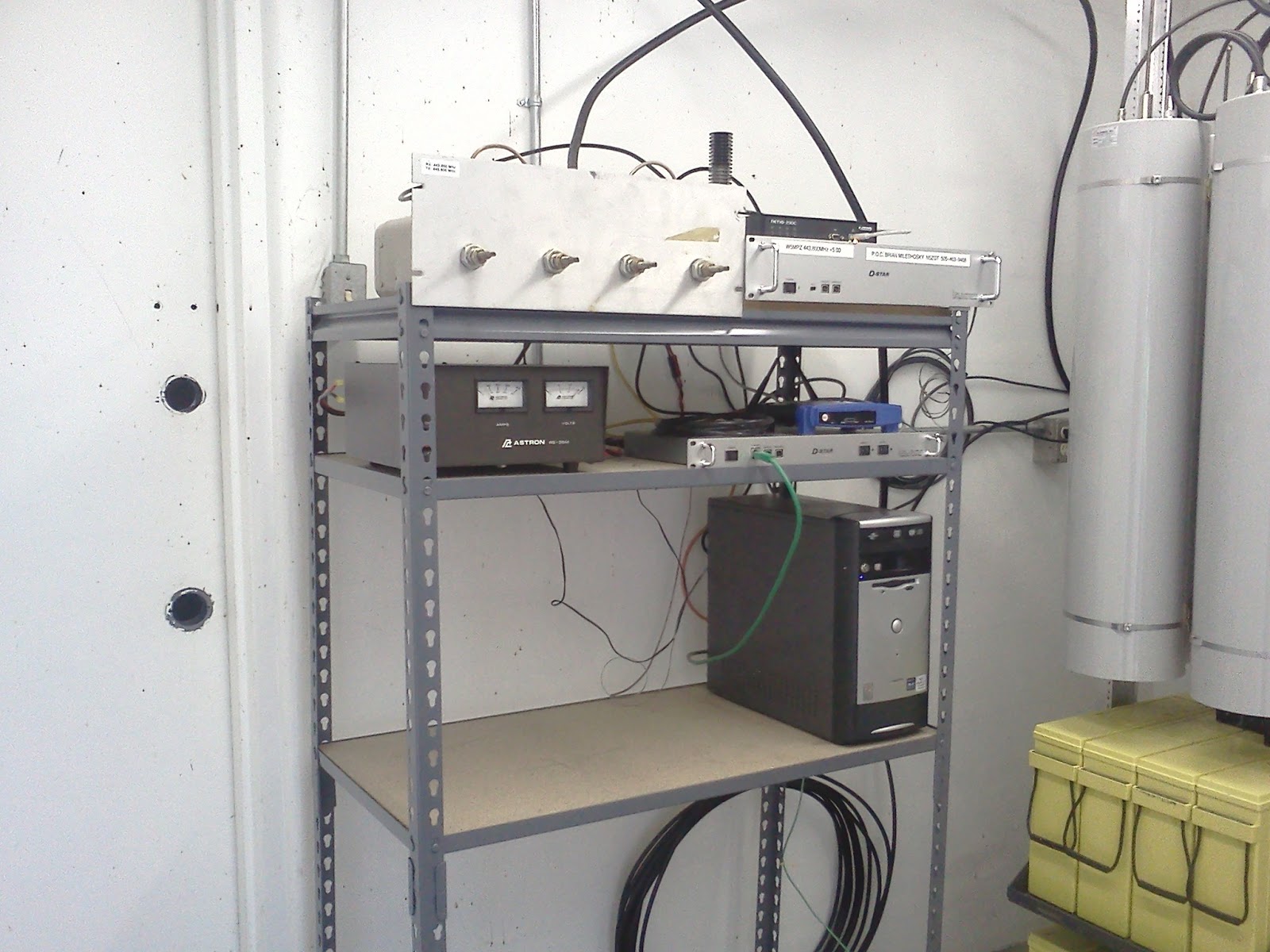 |
| After. Notice the new black box on the top right. That controls power for the whole thing via the web. |
The work was complete right on the dong of noon, and we had ribs for lunch. YUM! After that, Chris’s wife treated us to some homemade ice cream at his place, and we toured his shack, nestled on the edge of a HOA-restricted subdivision. That doesn’t stop him from loving ham radio!
Next on the list is to move this stuff to its permanent home on server racks. Sadly, I won’t be here, with only two weeks left in my VLA internship. I don’t wanna leave! 🙁
I would like to thank Ed James KA8JMW, Chris Aas NB5T and last but not least, Brian Mileshosky N5ZGT for taking me on this mighty heighty outing. Perfect timing for knocking another thing off my New Mexico to-do list.
The only part I forgot on that list was to bring a spectrum analyzer up there. It would have probably blown up in my hands.
 |
| Me, Ed, Chris and Brian on the edge of the crest. |
Sterling Coffey, NØSSC, is a regular contributor to AmateurRadio.com. He is ARRL Youth Editor and an electrical engineering student at Missouri S&T. Contact him at [email protected].
Back to Firefox
Goodbye Chrome. It was fun while it lasted. But in the last day or so Google Chrome has become so crash-prone that it is unusable. Suggested solutions amounted to disabling plugins and add-ons but my installation was pretty basic apart from AdBlock. Nevertheless I took the step of uninstalling Chrome completely and then reinstalling again. But it still crashes. Just trying to sign in to Yahoo is enough to crash it.
So it’s back to Firefox. I don’t have time for flaky browsers.
Julian Moss, G4ILO, is a regular contributor to AmateurRadio.com and writes from Cumbria, England. Contact him at [email protected].
Tracking flying things: decoding SSDV pictures from 30km high
This morning Dave Akerman launched another of his HAB flights from Brightwalton, a few km to the south of me. For the first time since I have been tracking the balloon flights on 434MHz, Dave’s payload was taking pictures and sending them back to ground. Several transmissions from two balloons were available, and as the balloons rose to about 10km, I just tracked their position and altitude.
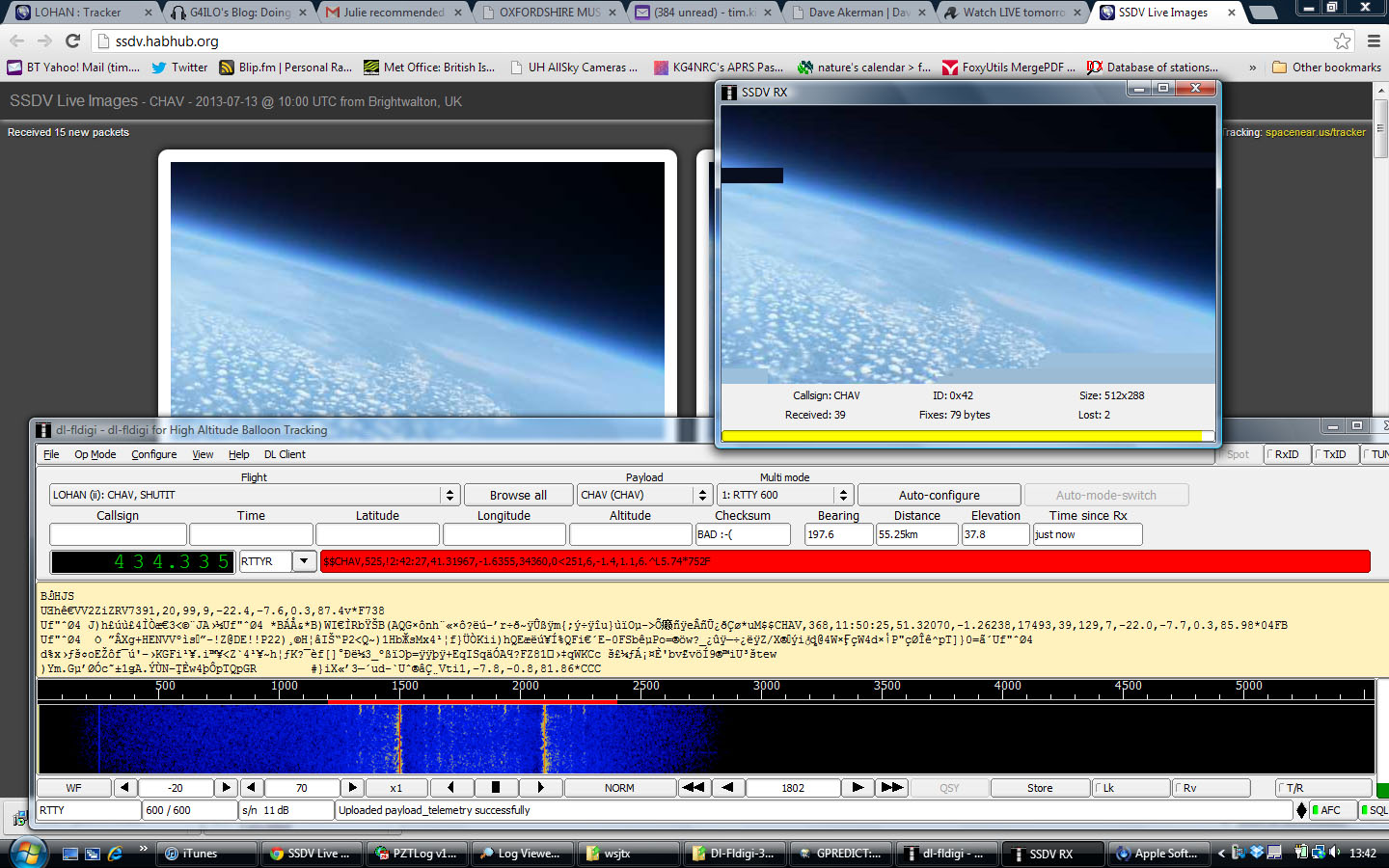
Then I wondered how I would get on decoding the data and pictures. I tuned the rig to the appropriate frequency and heard an interesting sounding signal. It turned out to be 600baud RTTY. I pressed Auto Configure on DL FLDIGI and was encouraged immediately to see that data started to be decoded.
Rather pleasingly, on the SSDV Habhub site I noticed my call listed against the pictures that my data packets, which DL FLDIGI uploads to the server, had contributed to. SSDV seemed a very robust protocol and quite often, I would get a solid data packet from the image, where perhaps a position report had failed.
I had not tried SSDV before, but it turns out that if you press S whilst in DL FLDIGI, you can see the image that you are downloading, Here you can see one of the better images that I decoded, when the balloon was around 30km high.
Tim Kirby, G4VXE, is a regular contributor to AmateurRadio.com and writes from Oxfordshire, England. Contact him at [email protected].
Amateur Radio Newsline Report 1874 July 12 2013
- Ham radio continues its relief efforts in India
- Canada and Portugal may soon have added operating spectrum
- ARRL says no to encrypted communications on the ham bands
- FITSAT One ham radio satellite deorbits
- The story of some strange radio signals from space
Upcoming SOTA Activation of W5N/BA-005 on 20 July
If you’re coming from sotawatch.org, welcome!
—Details—
Peak: W5N/BA-005 – 7284 [Socorro Peak]
Location: Socorro, NM, DM64mb
Time: 20 July 2013, 1700 UTC
Bands: anything I can manage. Likely 20m and up, and 2m
Mode: SSB preferred, but I want to try to muddle through some CW. I’ve never done CW without a computer (shame on me) so PSE QRS!
On 20 July, I plan to activate a nearby mountain for SOTA. This isn’t any regular mountain – the some parts of the road up to the peak is owned by EMRTC, or, simply speaking, its a bombing range. Therefore access is permit-only and this plan is tentative at the moment [edit — It’s a go!!]. However, at last night’s Socorro ham club meeting, I met a guy willing to be my escort, so I don’t get blown up, and to make sure I don’t steal anything, I suppose.
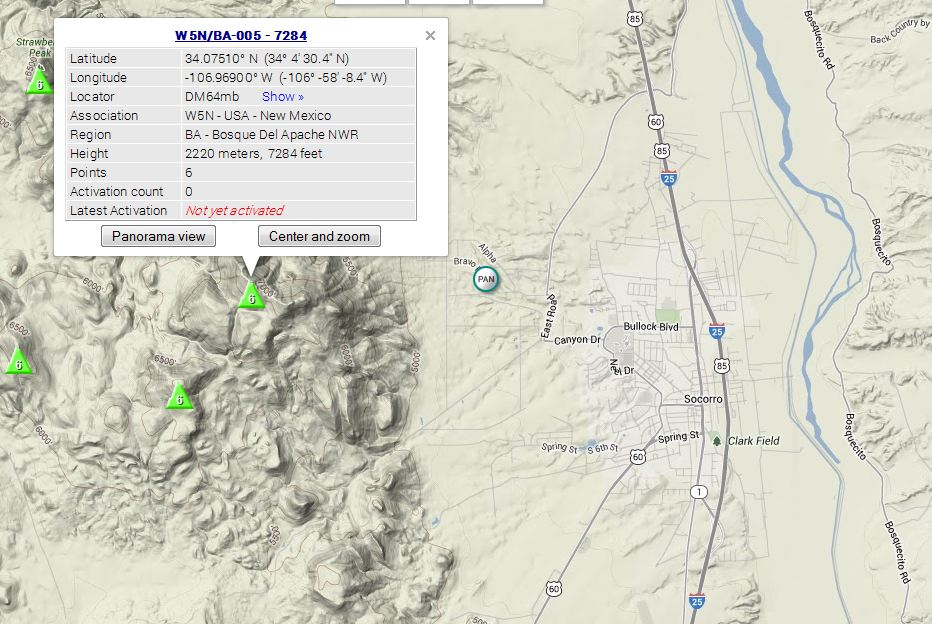 |
| Map of the area and the Summit. [http://sotamaps.wsstvc.org/] |
BA-005 is known as 7284 on the SOTA map, but the peak is commonly referred to as M-Mountain or Socorro Peak. A nearby peak which has a large, limestone M on it isn’t included in the database because it’s too near the taller peak.They only differ in elevation by about 60 feet.
This shorter peak is the home of the famous Elfego Baca Golf Shoot, where participants tee off at about 1500ft above and 2 miles awaythe hole. I think it’s a par 36 😀
Instead of golf, we’re going to shoot for some QSOs.
I’ll be using my new fangled End Fed Half Wave coupler and some conveniently placed towers. If those don’t work, then I’ll revert to some hamsticks. Stay tuned for more on the antenna project, and the summaryof the activation!
Sterling Coffey, NØSSC, is a regular contributor to AmateurRadio.com. He is ARRL Youth Editor and an electrical engineering student at Missouri S&T. Contact him at [email protected].
 Ham Radio Deluxe |
 W5SWL Electronics |
 Ham Radio Prep |
 KB3IFH QSL Cards  Hip Ham Shirts  HamRadioAuctions HamRadioAuctions Reliance Antennas Reliance Antennas Enigma Shop Enigma Shop |  morseDX  Ni4L Antennas  R&L Electronics R&L Electronics antennas.us antennas.us QRV QRV |
- Matt W1MST, Managing Editor
