 |
 The LinkedIn virus
 9 July 2013 | by
 I’m still getting the repercussions from the lapse in attention which resulted in LinkedIn sending invitations to anyone who has ever emailed me. Most people have just deleted or ignored them. A few were concerned that the email might have been a virus and contacted me to ask if I really had sent it. But now LinkedIn is emailing everyone who didn’t reply with a message saying I’m still waiting for them to accept the invitation.
A few people have been annoyed by these emails and have asked me to stop sending them. Unfortunately the deed was done a few weeks ago and I have no idea how to put a stop to it. If I had known that it was going to cause this much hassle I wouldn’t have even considered accepting someone’s invitation but hindsight is a wonderful thing that I unfortunately don’t possess and now there is no undoing it.
Julian Moss, G4ILO, is a regular contributor to AmateurRadio.com and writes from Cumbria, England. Contact him at [email protected].
Audio messed up
Paul Stam, PC4T, is a regular contributor to AmateurRadio.com and writes from the Netherlands. Contact him at [email protected].
Krun – a command line utility
Last week when I posted about using the new dual-mode version of WSJT-X I mentioned a utility I had used to put my Elecraft K3 into split mode before starting WSJT-X and returning it to normal operation after finishing. I’ve been asked to share information about it, so here you are.
The utility is called KRun, from K-Run. K for Elecraft radios (K2, K3 etc.) and Run because you use it to run another program. It was written to use with my Elecraft transceivers but I see no reason why it should not work with other radios that use a similar CAT command syntax such as Kenwoods. Don’t ask me if it can be used with your Yaesu or Icom radios because I know nothing at all about their command format.
If you run the utility it puts up a window listing its command line parameters.
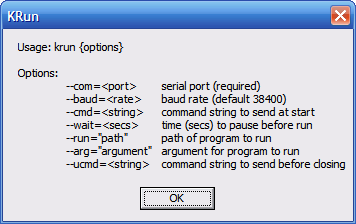
These command line parameters are what tells KRun what you want it to do, so you’ll need to know how to create a shortcut containing command line parameters, or use a batch file. You’ll also need to know what CAT commands to use, which will require a degree of familiarity with the Programmer’s Reference manual for your radio.
The parameters are:
- –com=n where n specifies the serial port used by your radio
- –baud=x where x os the baud rate to use
- –cmd=string specifying the string of CAT commands to send at startup
- –wait=s where s is an optional delay in seconds to give the commands time to execute
- –-run=”path” the path of the program (e.g. WSJTX) that you want to run
- –arg=”args” optional command line parameters for the program specified above
- –ucmd=string optional CAT commands to send on closing
An example invocation is:
C:\Ham\krun\krun.exe –com=3 –cmd=FT1; –run=C:\Ham\WSJT-X2\wsjtx.exe –ucmd=FR0;
where:
- C:\Ham\krun\krun.exe is the location on my computer of the KRun utility
- –com=3 specifies the com port to use
- –cmd=FT1; is the CAT command to set my K3 into split mode (with terminating semicolon)
- –-run=C:\Ham\WSJT-X2\wsjtx.exe is the location on my computer of WSJT-X
- –ucmd=FR0; is the CAT command to cancel split mode (with terminating semicolon)
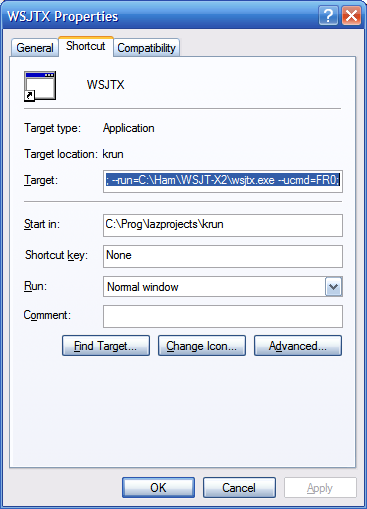 To create a shortcut to do this, first create a shortcut to KRun itself, then edit the Target to add the command line parameters as given above.
You can download KRun as a zip file which contains KRun.exe, the utility itself, and WSJTX, a shortcut configured as described above. If you try to use the provided shortcut instead of creating one from scratch yourself you will need to change the program paths to suit your own system.
So there you are. It works for me so hopefully it will work for you. If it doesn’t then a better solution would be to persuade K1JT to add these CAT commands to WSJT-X!
Julian Moss, G4ILO, is a regular contributor to AmateurRadio.com and writes from Cumbria, England. Contact him at [email protected].
Review: Array of Light (3rd Edition)
My friend Matt, KB9UWU, eggs me on to buy things. Sometimes I listen. Sometimes I don’t. But, eventually he wins me over and I’m usually happy with the purchase (e.g., K3 and Hex beam, although I built the Hex from scratch, which reminds me that I owe the blog a discussion of that). I like to think that I let Matt be the early adopter and then pick and choose based on his experience. He convinced me to buy a copy of N6BT’s book Array of Light. Here’s my review.
If there’s anybody that knows antennas in the amateur community, it’s Tom Schiller, N6BT, the founder of Force12 and now owner of N6BT Next Generation Antennas. He’s also a member of the very successful Team Vertical contest team, who have revolutionized DXpedition and contest expedition antenna systems by replacing trapped tri-band Yagis like the TH-3jr(s), TA-33jr, and A3S, with arrays of verticals located at the water line. Schiller’s work has been nothing short of revolutionary so I had high hopes for the book.
My copy, like every other copy, is signed by the author. It’s a good-quality laser print and has the same spiral binding as the Elecraft manuals. The book is a loosely-edited collection of articles and clippings that read pretty well in series. But, it’s bear to skim or go back to find specific things unless you’ve read the whole thing cover-to-cover a couple of times. But, that’s pretty easy to do because Tom is a good storyteller. My only other complaint is that there are a couple of places where I think Tom has drunk his own Kool-Aid regarding the efficiency of his antennas, especially “linear loading.” This is a topic that I need to revisit with a pencil and paper study at some point because there is a lot of misinformation floating around about traps, linear loading, and “multi-monoband” antennas. It’s not clear to me that anyone has sat down and really examined this in a methodical way. It was disappointing that he quoted numbers like “greater than 99% efficiency” without going into more detail about the efficiency of a full-size antenna versus the linear-loaded one, etc. Of course, this is difficult, but it’s something that always makes me a bit skeptical.
Array of Light is worth the price of admission for a couple of reasons—the first is the stories and the second is the antenna designs. I’m a big proponent of not reinventing the wheel on most of my homebrew projects and this book is sure to provide some proven designs to work with. Especially if you want a good discussion of practical antennas for DXpeditioning and contesting I think it’s a real winner.
Ethan Miller, K8GU, is a regular contributor to AmateurRadio.com and writes from Maryland, USA. Contact him at [email protected].
A Great Day for QRP

Right on the Gulf of Mexico, not 50 feet from the water, This is my favorite venue for QRP.
The crosses are a memorial to people that drowned in a freak storm that blew in from the Gulf Of Mexico, unannounced and unanticipated. This is a beautiful spot for ham radio operation, (bug spray required)!

MFJ push up pole is neatly deployed from the 2 inch towing receiver on the back of my truck. This is the first time I tried it out. There is a 30 meter EFHW, End Fed Half Wave antenna attached to the top with a rope and pulley.
Dave, K4DFG and I operated QRP from this park today. He worked 20 meters. I worked 30 meters. Both of us use the PAR EFHW, antennas. They are very easy to put up and take down.

Kx3 for a radio, and a computer for logging and transmitting CW,
I worked a guy in OK who was also QRP and very glad to be working QRP and is back on the air after a long lay off. We hit it pretty good here today, they just finished mowing the grass as I set up.

Dave used his FT817 and worked a couple of guys in Texas.
No goats here, sorry! No long hike, just a drive up and plop!

Hiking with all this stuff is unthinkable. But for a drive up and plop style of operating. I take extra parts, batteries , just in case!

Fiberglass electric fence post keeps the terminal end of the EFHW off the ground.
The coax is the ‘other half’ of the antenna. I try to make sure its close to a 1/4 wave long on whatever band I happen to be on.
This seemed unnecessary today on 30 meters, the coax was a bit short of that figure but it worked well anyway.
We had a great time, made a few contacts and enjoyed the beautiful venue.
Air boats haunt this very shallow cove so its a good idea to have noise cancelling headphones but even then, they are pretty loud. Only one went by today.
72 de AA1IK
Ernest Gregoire
Ernest Gregoire, AA1IK, is a regular contributor to AmateurRadio.com and writes from Florida, USA. Contact him at [email protected].
NFD from Corney Fell

Months of less than pleasant weather gave way to a sunny but breezy weekend. Ideal for the NFD contest. There was quite a bunch of us involved but unfortunately due to a domestic planning error we had family staying.
I did my bit by helping to set up and an hour or so of logging but no operating. Shame really as, working under Andrews callsign G4VFL/P across 6m, 4m and 2m all in around 180 qso’s were made.
Nice and relaxed contesting from the top of a very isolated fell road. Well done all.
Alex Hill, G7KSE, is a regular contributor to AmateurRadio.com and writes from Cumbria, UK. Contact him at [email protected].
From the mountaintop
I headed up to the top of Mount Prospect to operate in the QRP ARCI Summer Homebrew Sprint. It’s not on the SOTA list, but it affords a fantastic view of Lake George. I headed up there one day last year, but unbeknownst to me at the time, we were experiencing a geomagnetic event, and there was nothing to be heard on the bands.
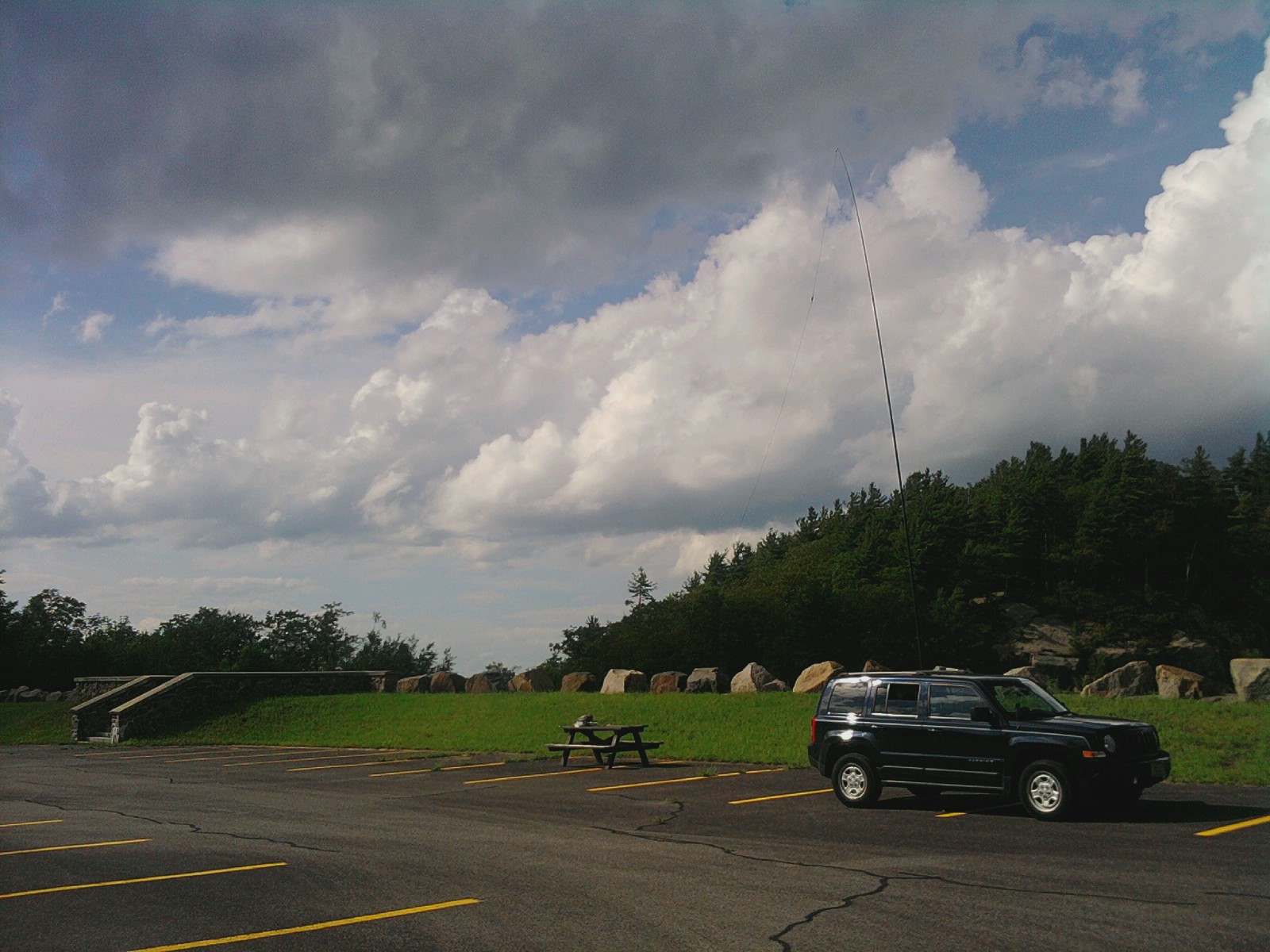
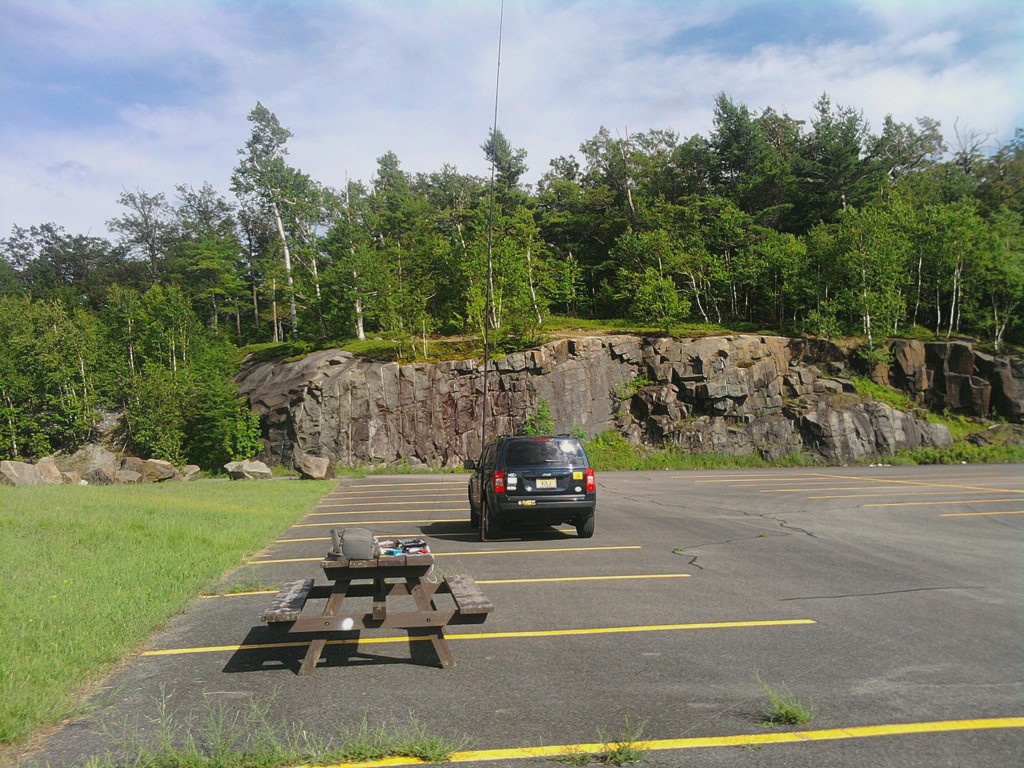
This year was different. I headed out early and set up the PAR ENDFEDZ, using the Jackite pole and my drive on mast support. One thing you notice when you get up there is how quiet it is. There weren’t many people up there, even though it’s an easy drive to the top and its a local tourist attraction. All I was able to hear was the breeze rustling through the trees.
Set up went easy, like a hot knife through butter. It turned out that there was a conveniently placed picnic table there, which provided a perfect operating location. Within minutes I was calling “CQ QRP”.
WB5CTS
KB5JO
VE3EDX
KB5FCF
N7RVD
K4BAI
K4KJP
All these stations were worked on 20 Meters. I tried going to 40 Meters for a while, but the static crashes and QRN were so vicious that I didn’t stay there long. When I went back to 20 Meters to call CQ again, I knew it wouldn’t be for long as I would have to begin packing things away soon for my return trip down the mountain.
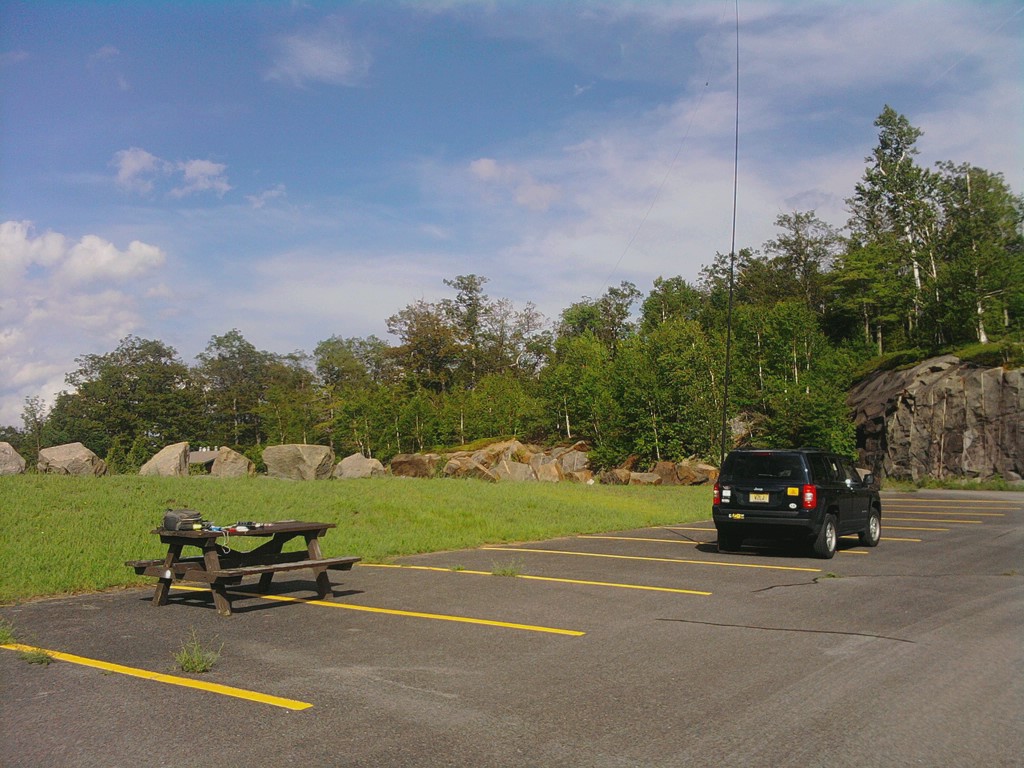
That’s when I had my “winner” QSO of the day. My “CQ QRP” was answered by DK7IT, Fred in Stuttgart, Germany. Fred was a loud 599 and I received a 579 in return. Fred was attracted by the “CQ QRP” and told me that he was not accustomed to hearing such clear QRP signals from the States. He was curious as to what the setup was, so I gave him the rundown. Admittedly, Fred’s great signals were due to him running 100 Watts into a 3 element Yagi, but I guess the mountaintop location sure helped my QRP signal.
After my QSO with Fred, I quickly repackaged everything and made it down the mountain in time before closing. Not a ton of contacts were made, but I had a lot of fun and the DX QSO, which turned out to be a real “honest to goodness” QSO was icing on the cake. The cheeseburgers that I grilled for dinner when I got back to the cabin weren’t half bad, either!
72 de Larry W2LJ
QRP – When you care to send the very least!
Larry Makoski, W2LJ, is a regular contributor to AmateurRadio.com and writes from New Jersey, USA. Contact him at [email protected].
 Ham Radio Deluxe |
 W5SWL Electronics |
 Ham Radio Prep |
 KB3IFH QSL Cards  Hip Ham Shirts  HamRadioAuctions HamRadioAuctions Reliance Antennas Reliance Antennas Enigma Shop Enigma Shop |  morseDX  Ni4L Antennas  R&L Electronics R&L Electronics antennas.us antennas.us QRV QRV |
- Matt W1MST, Managing Editor
