 |
 Profiles in QRP – Volume 1 – Ken Louks WA8REI
 3 August 2013 | by
 One day, I was thinking about how much I like to read about my fellow Amateur Radio operators. I love it when they tell stories about how they became Hams and how they first learned about Amateur Radio, what they’re doing now, and what their other interests are. It simply fascinates me.
I decided to develop a series of blog posts titled “Profiles in QRP”. A series of questions will be posed to those who have shown interest and dedication to the QRP game. In the coming months, some of the profiles published will be of QRPers you are probably very familiar with – some maybe not so. The idea is to ask these questions across an entire cross section of QRPers – portable operators, contesters, rag chewers, tinkerers, inventors, entrepreneurs, (maybe even bloggers!), etc.
I had intended to kick this series off last month, but I was delayed in doing so. My intention is to run one profile a month. For August, I will run two profiles – one at the beginning of the month and one at the end.
The first profile is of Ken Louks WA8REI. If you’re on the air at all, you’ve probably run into Ken numerous times. He is active in a lot of the QRP Sprints and is always to be found, ready and eager for a rag chew. Ken is also very active in the Polar Bears QRP group – a bunch of QRPers dedicated to portable outdoor ops away from the conventional shack. There he is most affectionately known as Blackjack Bear. It’s always a great pleasure to run into Ken, whether it be a short sprint QSO or a longer one where you can gnaw on a piece of “sammin” with him.
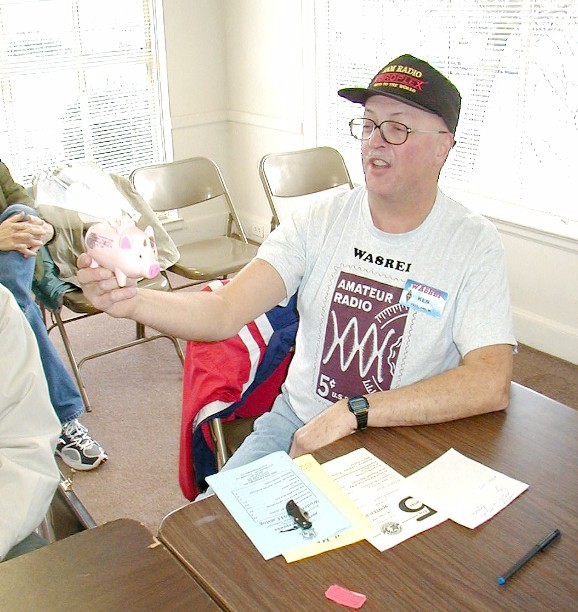
1) How did you first become interested in Amateur Radio?
My first exposure to Amateur Radio was through my Uncle Ed Wissmiller, formerly 8CEH, who resided in Saginaw, Michigan. He helped me learn the code when I was 12 years old. He had let his ticket expire years before I was born, but he was quite the guy! He was a WW I pilot, and later, a stunt pilot and a wing walker. In fact, he invented the remote water meter reader, so he had quite the technical bent. He was a printer by trade, and had several printing presses in his basement.
Also, my dad had given me a Heathkit CR-1 Crystal Receiver when I was 10 years old, in 1957. I still have it, and it works like new! My dad always encouraged me to learn about many things. I sent and received Morse Code via light to and from another neighborhood kid. I was also inspired by several other Hams who all lived within 2 or 3 miles from me – “bicycle range”. I was both a Cub Scout and a Boy Scout.
2) How long have you been licensed?
Since June, 1965. My Novice station was a Knightkit T-150 transmitter and a Heathkit HR-10 receiver, both of which I built as new kits.
3) What drew you to QRP?
I had a Heath HW-100 Transceiver, which I always tuned up at minimum power. One day, I forgot to increase my power after tuning up, and following a long, solid QSO, calculated that my output power was 4 Watts. I’d operate QRP a few times a year in the ’90’s. Always liking a challenge, I became a serious QRP Op in about 2000.

4) Who has been your biggest QRP influence?
Nobody in particular! I had no QRP Elmers. With the advent of the Internet, I’ve found many like-minded Hams throughout the world and many QRP clubs, so I’d have to give credit to the Internet for being my main influence. Again, the challenge of working other stations at 5 Watts or even milliWatts is a thrill that kW QRO Ops will never experience!
5) What is your favorite QRP activity?
Contesting. It keeps my CW skills honed, and it shows me how well my antennas are performing. This can be a major contest or a QRP Sprint; either are enjoyable. I like the competition, but I’m never a sore loser!
6) What’s your favorite piece of QRP gear (past or present)?
My Yaesu FT-817ND. My first QRP rig was its predecessor, the FT-817. It’s a great all band, all mode rig, and it’s very portable.
7) Describe your current QRP station.
FT-817, Hustler 4BTV Vertical, 80 M Dipole, Bencher Paddle (I’m 100% CW), LDG Z100 Autotuner at my camping trailer in the woods near Rhodes, MI – “Permanent Portable” Hi! At home, a FT-2000 at 5 Watts and a Mosley Pro 67B Yagi at 48 feet. I also have a DC40B, built by my friend WD9F that puts out about 700 milliWatts on 40 Meters. It’s a fun rig!
8) What is your fondest QRP memory.
That would be working 3B9C, Rodriguez Island in the Indian Ocean, through a MASSIVE pileup while I was on Wagon Wheel Hill, elevation 1,500 feet back in the Winter of 2006. My 2nd best was working Tanzania from near Dayton Hamvention, using 2.5 Watts.
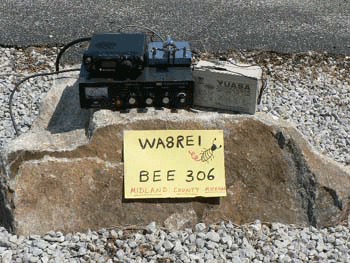
9) What other hobbies/interests do you enjoy when your not on the radio?
I was a professional organist/pianist from the age of 16 until I had a stroke in 2008. I taught private piano lessons for many years. I play the hammered dulcimer. Ham Radio has always played “second fiddle” to my music. I have a grand piano in my living room, 4 electronic keyboard and a professional recording studio.
I have hiked 1,500 miles in 2007, bicycled 60 miles per day. I enjoy traveling, especially to the mountains of New Hampshire or Colorado. I could live outdoors if not for the bugs and weather!
Thank you Ken – for being my first victim …… err, QRP Profile! You are indeed a very brave soul!
Seriously – a very hearty “Thank You” to Ken for sharing his Amateur Radio and QRP background with us. As I stated before, I hope to have a profile for you every month. Ken was supposed to have been the profile for July 2013. There will be another at the end of the month for August.
So ……. if you see an e-mail from me in your Inbox titled, “Profiles in QRP”, please don’t run, screaming into the night. It will be a request for us to get the opportunity to know one of our fellow QRPers just a little bit better!
72 de Larry W2LJ
QRP – When you care to send the very least!
Larry Makoski, W2LJ, is a regular contributor to AmateurRadio.com and writes from New Jersey, USA. Contact him at [email protected].
Working DF1LX (Peter) from the River
Dear Peter – What a wonderful QSO with you from along the riverside! I promised I would send some pictures and here they are. I am also writing you a note with a full account of my radio adventure this afternoon including our QSO. I also worked Columbia and Denmark.

The journey starts when I take the bicycle out of my VW camper on the old road that runs along the river and goes to New Hampton. The road has a gate, so to proceed, one must use a bicycle, a horse, or go on foot.
The road hasn’t been used regularly since the 1940s. It’s beautiful and passes through old farm land. When I first came to this spot nearly 40 years ago, a farmer grazed his cattle in the nearby fields. After cycling for a kilometer or so, I come to a corner with a perfect view of the river.

I continue another 2 km and come to an old bridge abutment. The bridge is no longer there, but there is a small clearing under some tall trees where I like to operate.

I pull the equipment from my bag and heave a line up about 12 meters over an oak branch. Then I pull up a 10 meter wire. It is perfectly vertical, and I sit down directly under it.

Today I am using the KX3 at five watts. The coax runs to a 9:1 unun and then to the antenna. At first I listen on 20 meters and hear HK1R calling CQ from Columbia. We quickly exchange 599s, and I switch to 15 meters. There you are, and I call. You know the rest, but for the sake of other readers, I will say you are 589 and you give me a 569. I tell you that I am QRP and portable near the river. You send, “solid copy from UR QRP DR Jim.” While we are chatting, you find my web page and comment on the pictures. I promise to send you some photos from today. We continue for more than 20 minutes. I am amazed that you can copy my tiny signal so well! Finally the QSB arrives and you drop down to 549… Surely you can not copy much of what I am sending at the end… You send, “So now I have got some QSB x Perhaps conditions are changing.” With that we say goodbye. What a wonderful contact half way around the world.
Before packing up, I go to 17 meters and make a quick contact with OV1CDX on Sjaelland Island in Denmark. Frank is 599 and he gives me a 559. I am overjoyed and walk down to the old bridge site to take a picture.

I drink in the view, being careful to avoid the poison ivy! It’s everywhere here. And I walk back to the operating position and pack everything away for the ride back.

Peter, I hope you can now imagine how much fun I have on these radio outings. What could be better than a ride through glorious countryside… add to that a QSO with DF1LX and a perfect afternoon is guaranteed. Thank you, my friend. 73 Jim W1PID
Jim Cluett, W1PID, is a regular contributor to AmateurRadio.com and writes from New Hampshire, USA. Contact him at [email protected].
Amateur Radio Newsline Report 1877 August 2 2013
- Hams in Hawaii go on alert for Pacific Storm Flossie
- India recognizes three hams as rescue radio heroes
- More than 400 attend ARRL Hurricane readiness webinar
- Vandals topple a radio tower that’s home to digipeater
- Monitoring Times to cease publication at the end of 2013
SOTA Activation, Locke Mountain, Davis Mountains, TX
Tomorrow I will try Emory Peak in Big Bend National Park, W5T/CI-009. This is a 9 mile round trip. I will be on the trail early, but if it gets too hot, I will call it a day. Check out www.sotawatch.org for spots. I will try to summit between 1400-1500z on 2 Aug.
Mike Crownover, AD5A, is a regular contributor to AmateurRadio.com and writes from Texas, USA. Contact him at [email protected].
10,000 Steps for Health
As mentioned in my previous blog posting, I’ve taken a serious approach to my health. Much of what I accomplished in losing over 30 pounds was just done by following the Atkins diet and casual exercise. Much of this exercise has been in the form of walking as my wife and I are trying to get in better shape for our trip to Europe. In previous years, we didn’t prepare ourselves in advance for all the walking we end up doing. We suffer for the first week as a result. I believe this year will be different.
My goal of reaching 200 pounds prior to 15 August was in an effort to verify that diet and exercise will help improve my cholesterol levels. I will have a checkup next week and my ultimate goal of those results is just to verify that the needles are moving in the right directions. I know I have more work to do…but I am looking for proof that what I’ve accomplished in the past four months is the right thing.
Part of vacation is enjoying life and I don’t plan to follow the Atkins plan while in Europe. If you are familiar with Atkins or the Low Carb diet, you know that carbs are avoided like the plague. The national dish of Belgium is Belgian Frietjes or Belgian Fries. These are the best fried potatoes (can’t refer to them as French) that I have ever tasted and I’ve enjoyed more than my share of fries. In addition to the Belgian fries, I’ll also enjoy a few Belgian Waffles and many other delicacies which I just can’t get here in the US. I figure many of the carbs I consume while on vacation will be offset with the tremendous amount of walking we do.

Anyway…..10,000 Steps for Health is how I plan to tackle the next phase of my goal. I’ve heard people talk about losing weight just simply making sure they walk 10,000 steps daily. But just how many steps does an average person….or more importantly, how many steps do I take on an average day? A friend of mine has had incredible success with this this program and uses a little device called a Fitbit. A Fitbit is a small electronic gadget (fancy pedometer) which is worn to track the number of steps you take, the number of floors you’ve climbed, distance in miles or kilometers and calories burned. You basically wear this little device and sync the data to a free Fitbit account where you can view your results.

What I found by just wearing the device each day was without even trying I was averaging about ~6000 steps each day. So by adding an additional daily walk to my schedule (and taking the stairs more at work) has proven successful at pushing me over the 10K mark each day.
For now, my focus remains on the final 4.5 pounds which I plan to lose by 15 August, then enjoying a fantastic vacation with my wife. Once I return home and return to work, I will begin working on the next phase of my plan to reach 180 pounds by Christmas. At this point, I really don’t plan to go any lower than 180 pounds. I’m 6 foot tall and at 180 pounds, this places my BMI in the normal weight range. But of course, I’ll consult with my doctor and most importantly perform another blood test to check my overall cholesterol numbers.
Until next time…
Jerry
P.S. I realize this blog post has nothing to do with amateur radio. However, my getting in better shape, getting healthy and staying healthy will most certainly allow me to continue to enjoy the hobby for many years to come. Plus I just want to share this info with others who might be interested in shedding a few extra pounds. 73 de KD0BIK
Jerry Taylor, KD0BIK, is a regular contributor to AmateurRadio.com and writes from Colorado, USA. He is the host of the Practical Amateur Radio Podcast. Contact him at [email protected].
Lunchtime QRP continues to be successful
My lunchtime QRP sessions continue to be a success with QSOs all over the world. SOTA stations, special event stations, DX stations and rag chews all have been making it into the log.
Larry Makoski, W2LJ, is a regular contributor to AmateurRadio.com and writes from New Jersey, USA. Contact him at [email protected].
K4UPG FOBB 2013 Antenna on da Ground!
Grrrrrrrr! and then more Grrrrrrrr’s! FOBB 2013 was a gud one! Grrrrrr!
Anticipated rain and thunderstorms and was not disappointed. Accordingly, I took up my backpack and walked about 1/2 mile to set up under a small pavilion in our housing development’s lakeside park. So far, so good. Originally I planned to have an EFHW for 40m and another one for 20m. Upon unpacking, realized my 40m wire was in my other pack at home. SHUCKS. I had already put a shot over a 40′ high branch and pulled up a paracord to hook to the wire which was not available. Oh well… it happens even to the best of us, eh?
Grrrrr! So I tried to set up the 20m EFHW and after another great shot with my 1 1/2 oz sinker and pulling up a line realized the tree wasn’t going to give me a good shot as it was too close and not very high. Grrrrrrr=ed a bit more!

K4UPG FOBB 2013 BB#23
Rethinking mode kicked in and was glad I got out early so all the wasted time did not mess me up. Pulled out my handy 20 ft Jackite and a 17 ft crappie pole and decided to give up on a typical K4UPG “hang ‘em high” antenna and do a very Lazy L. I tried to orient it for a bit of slope towards 330 degrees which shoots from FL to Iowa and provides decent coverage of most of the US. Turned out that low antenna worked great but I think the band was pretty doggone decent for a change too.
So about 15 min before FOBB start time fired off a CQ and made a contact and shot the breeze for a bit to warm up. Nice QRP to QRP contact but not counted for contest. Just for grins. I did notice a few “early out of the blocks ops” were calling CQ BB about 10 min before the clock struck go! Grrrrrrrrr! Sync those watches gentlemen!
Contest Started:
First station heard was Cam out in California N6GA but no joy when I responded to his CQ as there was a mini-pileup on him. Grrrrr… Heard a few more 6′s during the day but no peep from Rem Bear or any others I recognized. I did end up with eight PB’s for the day though and a great TU and Grrrrr to my fellow PB’s: AF40 Chuck- PB 153 TN my last contact of the day (more later); Snowbird FL Bear Don K3RLL PB 187 in PA with his new KX3; Jeff K9JP PB 175 in MI was the loudest signal of the day and blew my ears out till I got the RF and AF turned down Grrrrr! didn’t recognize you as a PB… sri bout dat; N1EU Barry in NY PB 336 got a Grrrrr!; N3AAZ John in MD PB 276 sri 2 ya… missed a Grrrrr!; W1PNS Pete in MA PB 348 got a Grrrrrr!; W5ESE Scotty beam me up Bear PB 287 missed a Grrrr too; WA8REI a perennial PB contact for me gave me a PB 21 style Grrrrrrr! I was closing a contact and Blackjack Bear called me on the guy’s freq so kept it REAL short and sweet as I felt like if we tried to QSY there was too much traffic and we’d not make the connex. Sri Ken Bear was a messy QSO cuz of that. Missed hearing Larry W2LJ this time and listened fur some of you udder PB’s but no connex. Grrrrrr!
All in all worked 25 QSO’s in 17 states and all of them were BB’s! Lightning came up as I was finishing my QSO with AF4O and it was TOO CLOSE. Almost blew me out of my seat but I held onto the key and finished up. Sitting there holding the wire and I started singing, “Antenna on the ground, antenna on the ground, when da lightning is around get your antenna on da ground” to the tune of the famous “Pants on the Ground” song by “General” Larry Platt.
Thus ended a nice outing after 2 hrs and 45 minutes but I truly enjoyed this one. Great number of participants and bet I could have almost doubled the numbers if the lightning did not end the day. Was hearing a lot of new calls just prior to shutting down. At least I got to give the serious contesters some points this year. Maybe next year will be my turn fur sum extra Q’s ? Grrrrrrr!
72 from Orlando, Kelly K4UPG PB 173
Kelly McClelland, K4UPG, is a regular contributor to AmateurRadio.com and writes from Florida, USA. Contact him at [email protected].
 Ham Radio Deluxe |
 W5SWL Electronics |
 Ham Radio Prep |
 KB3IFH QSL Cards  Hip Ham Shirts  HamRadioAuctions HamRadioAuctions Reliance Antennas Reliance Antennas Enigma Shop Enigma Shop |  morseDX  Ni4L Antennas  R&L Electronics R&L Electronics antennas.us antennas.us QRV QRV |
- Matt W1MST, Managing Editor
