 |
 Playing Around With Reverse Beacon Network
 22 August 2013 | by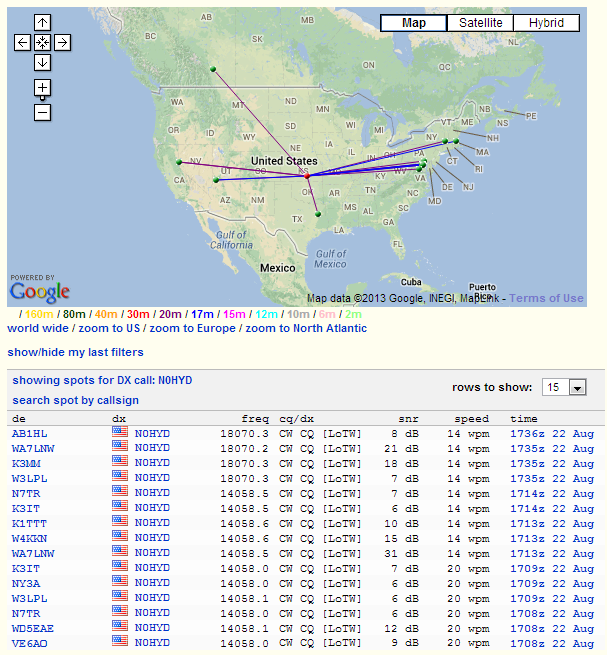
After parking at my usual lunch time portable operating position, and not hearing much on the bands, I decided to do something I had been wanting to do for awhile now.
I have been wanting to play around with the Reverse Beacon Network using my portable QRP antenna. When not hearing much on the bands, I wanted to see if there was just not many operators, or if the band was actually dead. The other thing is that many times when I call CQ I call at less than 15 wpm because that is where I am most comfortable. I have never seen many reports on RBN in the past when calling CQ so I wanted to see if speed made a difference.
So I started off with 20 WPM and called CQ for about 3 minutes on 20 meters. You can see the spots on the photo, but I was heard mainly to the East coast and West part of the country – and one Canadian station.
Then I went down to 14 WPM and called CQ again – as you can see on the photo. At 14 WPM, my signal was still decoded and I got spotted by 5 stations. Where at 20 WPM I was spotted by 6 stations. So not really much difference. I did change frequency so that it would show the new spots.
I didn’t call as long at 14 WPM because I heard someone answering!
KO4OP – Rick was answering my CQ and had a nice sounding signal. He was in King William, VA. He was 599 and he gave me a 559. We went on to have a nice 15 minute exchange – really nice QSO Rick! Thanks for giving me a call!
As you can see in the picture I then went to 17 meters and put out a CQ at 14 WPM and was spotted by 4 stations (3 on the east coast and one out west). I did hear someone call ..__.. (?) after one of my CQ calls but I never could reach him, and they never gave a call.
After this I did hear NE1SJ very, very weakly calling from a SOTA summit on 20 meters. I gave him a call and he heard me, but when he came back he got weaker and I just could not pick him out of the noise. Sorry we couldn’t make it today – I would have liked to pick up some more points!
It seems my SOTA chasing has stalled a bit. Lately 20 meters seems to be skipping right over me here in Kansas!
So the RBN site was fun to play around with. It just tells me that even when you don’t hear anything, it doesn’t mean that you aren’t getting out! Put out some CQ’s and have some fun!
Burke Jones, NØHYD, is a regular contributor to AmateurRadio.com and writes from Kansas, USA. Contact him at [email protected].
Amateur Radio Newsline Report 1880 August 23 2013
- Trans-Pacific emcomm demonstration will involve US MARS
- FCC and Industry Canada reach spectrum sharing agreement
- Vanity call sign fee goes to $16.10 immediately
- ARRL says no to TCB expansion
- City takes an unlicensed broadcaster off the air
- YHOTY recipient KC9UUS honored at the Huntsville Hamfest
High Quality HyEndFed

The HyEndFed antenna is momentarily my only HF antenna. Just 11,85 meters long (38.878 ft), very stealth, and a great performer. It was much better than my dipole. And it absolutely outperformed all my verticals I've had. The antenna is made for 40-20 and 10 meter. A high quality Dutch product. Of course when someone is handy you can made it yourself. But I know my restrictions and capabilities for technical skills. I tune this antenna with a MFJ-925 for all other HF bands. On 40, 20 and 10 meter I don't need a tuner. I know, a perfect SWR says nothing about the effectiveness of the antenna. Nevertheless, here are my SWR readings on the other HF bands with the HyEndFed.
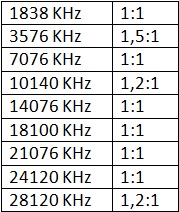
Maybe I replace the 6 meter antenna, after the Es season, for a ground plane antenna for 30 meters.
Useful links: http://www.hyendfedantenna.nl/joomla/ and http://www.hyendcompany.nl/
Paul Stam, PC4T, is a regular contributor to AmateurRadio.com and writes from the Netherlands. Contact him at [email protected].
QRP and Frustration
One of the biggest caveats that’s always mentioned to potential QRPers is what I like to call the “frustration factor”. All the QRP “how to” books bring this up. I’ve read them, you’ve read them …… I’m sure you’re familiar with all the bug-a-boos:
“Hams new to HF should never start out using QRP.”
“QRP is difficult, don’t expect much success.”
And my favorite – “Never call CQ using QRP.”
In my personal and most humble opinion, these statements, if they are taken as absolute truisms or rules of thumb, are pretty much hogwash.
But rather than refute these, or dwell on the negatives, I would like to accentuate the positives. If you’re new to the QRP game or are perhaps thinking of dipping your toe into low power waters, you SHOULD do several things to maximize your chances for success.
DO put up the best antenna that you can. A tower and beam are the best, if you have deep pockets and plenty of property and an understanding wife. If you’re like the rest of us mere mortals, that will probably mean dipoles, verticals or whatever. If you can, put them outside and put them up as high as circumstances permit. If you install a ground mounted vertical (not a bad choice) lay down as many radials as you can. If you’re stuck in HOA Hell, attic dipoles have yielded success. Magnetic loops, either home brewed or commercially built, such as the Alex Loop have saved the bacon of many covenant restricted Hams.
But whatever the case may be, just remember a quote that my friend Chris KQ2RP recently reminded us all about in his blog. To quote K2TK, “A poor antenna has infinite gain over no antenna”. In other words, while a better and higher antenna will maximize your QRP experience, ANY antenna is better than none. However, if you’re reduced to loading up your mattress boxspring, then you had better lay in a supply of Advil. Do whatever you can to put up the best aerial you can under your circumstances. This is not the place to skimp.
DO use the full “QRP Gallon”, which is the full 5 Watts for CW or 10 Watts for SSB, if you’re just starting out. While Rockmites and other flea powered radios do a great job, save QRPp for after you’ve gained some experience. QSOs made with less than a Watt ARE a heckuva lot of fun, but if you’re a QRP Newbie, save them for later.
DO make use of the various tools available to you. Reverse Beacon Network is one of these. Not only can you use RBN like a Cluster, to see who is on and who is calling CQ, but you can use it to gauge your own performance. Not getting any answers to your CQs? Check out your own call on RBN to see where and how you’re being heard. You can also use RBN to compare one antenna against another. I did this to check out my vertical vs. my wire on 80 Meters one Autumn evening last year. I picked a lonely, deserted frequency and called CQ with one antenna for about five minutes, and then switched. By going to RBN, I was able to see how (roughly) how one did against the other.
And while we’re talking about calling CQ, go right ahead and call CQ if you want to. Odds are you will be heard by someone, somewhere, depending on propagation. Many times, when a band has seemed dead, I have called CQ and have been answered, and have had great QSOs. I see no reason on God’s green Earth why calling CQ should be limited to those running power.
DO jump into the DX pileups! This will give you experience, which will be your greatest teacher. Getting on the air, making QSOs, and experimenting with antennas, participating in the QRP Fox hunts will teach you more than any Website, book, or Elmer. Getting your hands dirty and learning “when to hold ’em and when to fold ’em” will make you a veteran QRP op in no time. But remember, then it will be YOUR time to share what you have learned with those who come after you.
72 de Larry W2LJ
QRP – When you care to send the very least!
Larry Makoski, W2LJ, is a regular contributor to AmateurRadio.com and writes from New Jersey, USA. Contact him at [email protected].
A Navy Ship in the Southern Coal Fields of West Virginia
The advent of “radio” changed the nautical world. Today sailors still consider it a godsend much like “fresh water” and “smooth seas” as they traverse the worlds shipping lanes. Radio still offers security, comfort, and safety in the marine world today.
We don’t get many “seafaring” ships here in the “southern coal fields” of West Virginia; so it’s quite a surprise to hear that such a ship will be in our “home port” next week.
Although the capitol city of Charleston is in the southern coal fields, the Kanawha River is navigable due to a series of locks and dams. (there are three on this river) I worked as a deck hand on a river boat many years ago.
I hauled coal from the headwaters of this river to a large “coal fired power plant” on the Ohio River.
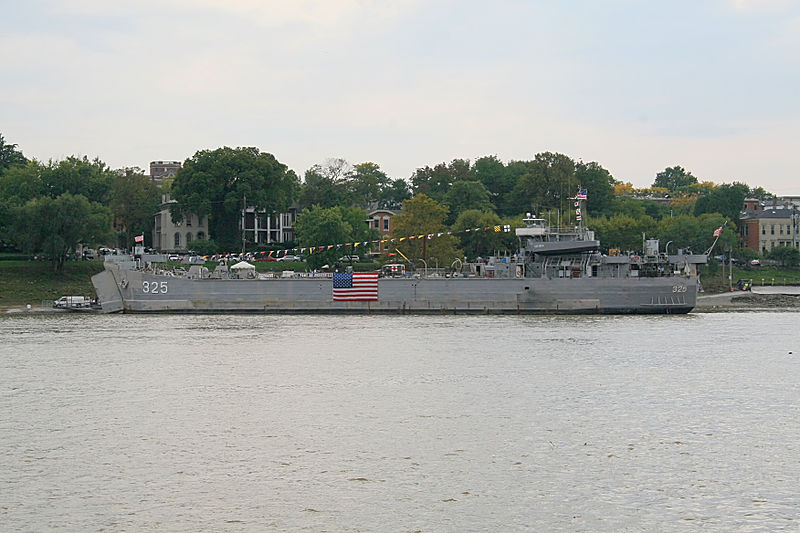
You can read about it HERE
I regret that I will not be in town the week LST 325 is docking in my hometown; but I hope the “radio guys” in my valley take the time to “roam” around this historic ship. These old “flat bottomed” boats were the “worst riding ships” on the seas. When I did the same a few years ago, and mentioned that I was a “ham” to one of the crew members, I was allow access to the “radio room” and made a CW contact with a “Marine Museum” in California.
I used 20 meters to make my 20 meter CW contact from the LST at that time.
Listen for the call sign WW2LST on the CW portions of the bands this year. Morse code played a significant role on these old ships because it’s one of the simplest and most effective modes of communication in the world.
I’ll be listening for it from Calgary this year.
John Smithson, Jr., N8ZYA, is a regular contributor to AmateurRadio.com and writes from West Virginia, USA. Contact him at [email protected].
80m JT65A
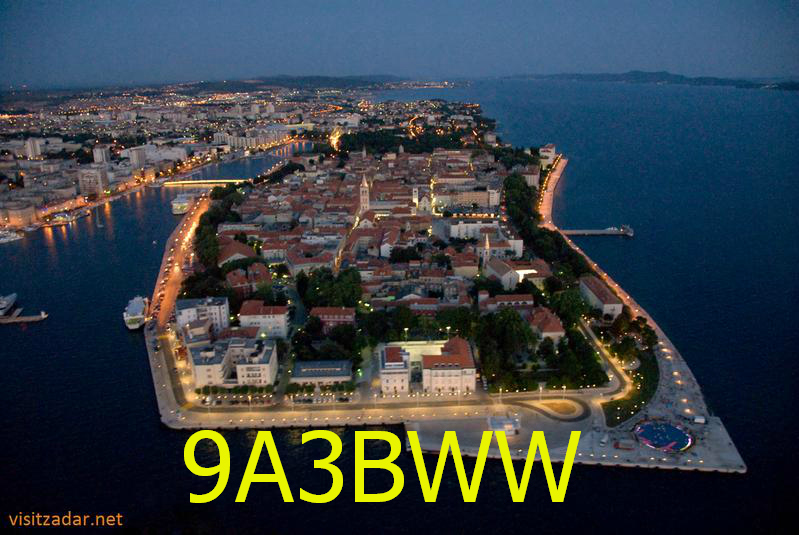
Though conditions are poor / fair on the lower bands, I tried JT65A on 80 meter tonight with my 3 band HyEndFed antenna which is made for 40-20-10m. I worked 9A3BWW -6dB # -14 dB. 1221 km. So I am very pleased with this qso. I also worked GW3TYI and DF2MR on 80 meter.
Paul Stam, PC4T, is a regular contributor to AmateurRadio.com and writes from the Netherlands. Contact him at [email protected].
IZ4RTE & UX1AA – Amazing Lunchtime Portable QRP
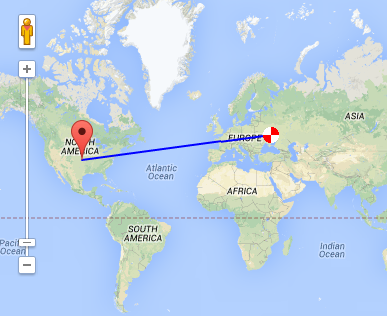 |
| Map from N0HYD to UX1AA |
Wow! It was a fun lunch today working portable from the park. I heard a little activity on 15 meters, but then tuned down to 17 meters and started having fun!
I had TWO great DX contacts on 17 meters today…
IZ4RTE – He was first up. He was calling CQ and after several repeats of my call he finally got it. He gave me a 519 and I gave him a 599. Eddie was near Bologna, ITALY! I don’t know call prefixes well enough to recognize where people are from – so I was super excited when he said this. From his QRZ profile apparently he was running a Elecraft K3 – so this was a nice 2xElecraft QSO.
UX1AA – I heard Serge finish a QSO and start calling CQ. It took several attempts for him to get my call, but he finally did. He gave me a 559 and he was 579 here in Kansas. When I looked him up on QRZ I realized he was in the western part of Ukraine! This is roughly 5,600 miles from my location!
It was about time to head back to work, but I spun to 20 meters and heard nothing, so I put out a CQ on 14.060. N7BBH – Steve in is Arizona. We have worked each other before in early August. Today he was on his TenTec Eagle at 40 watts – sounded great!
Well, another fun lunch time working QRP portable with my vertical EF QRP antenna. Its always fun, but today was exceptional with two nice DX QSO’s and working Steve again!
Burke Jones, NØHYD, is a regular contributor to AmateurRadio.com and writes from Kansas, USA. Contact him at [email protected].
 Ham Radio Deluxe |
 W5SWL Electronics |
 Ham Radio Prep |
 KB3IFH QSL Cards  Hip Ham Shirts  HamRadioAuctions HamRadioAuctions Reliance Antennas Reliance Antennas Enigma Shop Enigma Shop |  morseDX  Ni4L Antennas  R&L Electronics R&L Electronics antennas.us antennas.us QRV QRV |
- Matt W1MST, Managing Editor
