 |
 JT9
JT9
 5 September 2013 | by
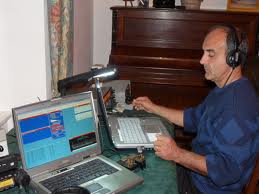
Nice contact this morning into Russia with JT9 on 14078 KHz with RWØBT 4397km. On 30 meter I had good WSPR spots in the USA/Canada.

Paul Stam, PC4T, is a regular contributor to AmateurRadio.com and writes from the Netherlands. Contact him at [email protected].
Whoa! SSB DX from the Pemigewasset
This afternoon I rode my bicycle along the Pemigewasset River. Today I brought a microphone along! I worked Italy, Svalbard Island and Estonia using five watts and SSB. This was a first for me.

Judy and I rode down to the old bridge to Hill. It’s right near the spot where Knox Brook flows into the Pemi. We stopped in a small grassy spot, and I set up the KX3 under an oak tree.

I tossed a 33 foot wire over the branch and sat directly under it, so the wire was vertical. I started out on 17M CW. Right away I worked S50R in Slovenia. Leo gave me a 599 and I gave him the same. When I told him I was QRP, he sent, “FB FOR UR 5W NICE.” Next I worked the Canary Islands. EC8AFM gave me a 559. He was a solid 599. Then I switched to SSB.

Right away I heard ES3AX in Estonia calling CQ. August gave me a 58. He was 59. I remembered his call and mentioned that we had worked before on CW. He also remembered. What a thrill. Tuning up a bit I heard Flavio
IZ1JLG calling CQ from Italy. He gave me a 55 and we chatted for a moment. Then I worked JW9JKA in Svalbard Island, Arctic Norway. Svein was on a DXpedition to Bear Island EU-027 and had a rough time getting my call but we completed the exchange and he gave me a 52. I didn’t realize this was a rare catch until I received an email from Dave W0CH who suggested I check closer…. Not just Norway, but Svalbard.
Next was another Italian station. IK6SNR, Lucio gave me a 59. When I told him I was QRP, he said that copy was easy and audio was excellent. I was really excited and equally surprised that I could make contacts so easily using 5W on voice.
I went back to CW to calm down a bit… Pavel OK4RQ gave me a 599 and when I told him I was QRP, he sent, “FB UR QRP S-9.” What more could I ask for? I packed up and headed back downstream toward the car. On the way, I rode alongside a beaver! The swimmer was so long, I thought it was an otter. But when it caught a glimpse of me, there was a loud splash of his tail as he dove beneath the water. As the sun started falling behind the trees, I stopped and took another snapshot of the river.

Jim Cluett, W1PID, is a regular contributor to AmateurRadio.com and writes from New Hampshire, USA. Contact him at [email protected].
15 Meters seems to be decent lately
First, before a brief discussion of 15 Meters, I’d like to share a video on QRP – actually it’s HamRadioNow Episode 93 – “QRP (Life’s Long Enough …….). This was pointed out by Norm WA4ZXV on the nogaqrp e-mail reflector.
The episode is about an hour long, though, so before starting it, you might want to pop some popcorn and open up a cold one and get comfortable for a bit. (It’s instances like this where tablets and other hand held devices really soar!)
Now on to 15 Meters. The past few days during lunch, I have been noticing some very loud signals on 15 Meters, even though various propagation tables have been calling for only “fair” conditions on the band. There were a few loud Europeans and South Americans on the band, but I was being beat out in the pileups by stronger signals (Them’s the breaks). Rather than give up on the band totally, I decided to go on up to venerable ol’ 21.060 MHz and put out the CQ call for a lil’ bit.
I was rewarded with a call from Bert F6HKA who is very well known on the CW portions of the bands. Bert and I have QSO’ed before, but always in a contest situation. It was nice to be able to spend a few minutes with him today, actually chatting for a bit.
Larry Makoski, W2LJ, is a regular contributor to AmateurRadio.com and writes from New Jersey, USA. Contact him at [email protected].
IC-7000 vs IC-7100 Special

The IC-7000 vs IC-7100 Special is now available for download.
A no holds barred, cage match between the Icom IC-7000 vs the IC-7100. See how these two great mobile HF/VHF/UHF radios stack up beside each other in an unscripted competition. Who will win, Team Tommy or Team George?
31:26 radio competition
View in web browser: YouTube
George Thomas, W5JDX, is co-host of AmateurLogic.TV, an original amateur radio video program hosted by George Thomas (W5JDX), Tommy Martin (N5ZNO), Peter Berrett (VK3PB), and Emile Diodene (KE5QKR). Contact him at [email protected].
Magnetic Loop Construction – Part 1
So I got a little time over the weekend to make some progress on my magnetic loop antenna. I constructed this antenna from 1″ copper pipe in a square shape with 90 degree elbow. The loop is 30″ square.
At this time it will be rockbound on 20 meters, centered around 14.060 – so the bandwidth will be very limited. I want to do this so that I can do some testing before I go all out and convert it into a multi-band loop, which will hopefully work on 20-10 meters (with maybe 30 if I am lucky).
.JPG)
Making the Coax Stub Capacitor
So what I did was take a piece for RG-213 coax and cut it about 30″ long. Then on one end I removed about 2 1/2″ of the shield and pulled the braid away from the core. I taped it all up really well with multiple wraps of electrical tape, leaving about 1/2″ of braid and 1/2″ of conductor (sticking out of core).
After sanding the copper to a nice shine, I took some stainless steel hose clamps and clamped the braid to one side of the loop and the center conductor to the other side.
This piece of coax becomes the capacitor which will be used to tune the loop to the desired frequency. Right now it is longer than needed so it will resonate well below the 20 meter band.
.JPG)
The Feed Loop
I then took some RG-8 and made the feed loop. For my loop size the feed loop is about 1/5th the circumference of the main loop – so about 24″. I added a bit for the coax connector. I decided on a shielded Faraday loop after reading that they are quieter on the mag loop email list.
To construct this loop I formed the circle and soldered the center conductor to the braid at the bottom of the circle. Then at the top of the circle I removed about a 1/2″ of the braid only. I taped up all connections and exposed braid, etc.
.JPG)
Initial Tuning
I quickly taped the Faraday loop to the main loop with some painters tape because I wanted to see how it looked just sitting on the bench. Before I do the final tuning I will hang the loop on the wall of my garage – its final home. I was just excited to see where it was resonant!
So I hooked up the antenna analyzer and started a slow sweep from 20 meters down looking for the SWR dip. THERE IT WAS SWR 1.2 @ 11.131 MHZ – clear as day!
Next Steps
The next thing I am going to do is mount the loop to a piece of 1x wood and then mount that on the wall at its final location. Loops are sensitive to their surroundings, so you always want to tune them at the location they will be when completed.
Then with the analyzer connected I will start cutting 1″ chunks off the coax until I get close to 14 MHZ – the final tuning will be done by sliding the braid up and down the core to get the frequency exactly where I want it.
Once it is operational I will spend some time testing with the Reverse Beacon Network and making contacts. If it works well, ultimately I will construct a butterfly capacitor for tuning and build an Arduino stepper motor controller so that it can be remotely tuned from the shack.
I can’t wait to see how it works and if the noise floor is substantially lower than using my Portable QRP Vertical.
If you would like to construct something similar (although he shows a Gamma Match for the feeding) you should check out W2BRI‘s pages – great instructions with pictures to make everything easy.
Burke Jones, NØHYD, is a regular contributor to AmateurRadio.com and writes from Kansas, USA. Contact him at [email protected].
Japan

In the afternoon I was spotted in Japan on 17m with WSPR. Just like Ron PA2RF a few days ago. Also K0VM from Iowa.

Paul Stam, PC4T, is a regular contributor to AmateurRadio.com and writes from the Netherlands. Contact him at [email protected].
Slow it down
I worked a station at lunch time today, and it was a frustrating experience. He was sending way too fast …… not for me, but for him.
He was 599 Plus and should have been easy copy, and he would have been if he had been able to send his own call correctly more than once in a row. But it took a while to figure his call out, as he sent it differently each time, tripping over himself the whole way.
You know, when you turn up the code speed to that point, you’re not doing anyone any favors – yourself or the stations you’re trying to work. What’s the point of sending so fast that repeats become necessary or you turn off potential contacts? No one really wants to listen to gobbledygook.
It makes more sense to slow it down. You might not break any land speed records, and your ego may be a bit deflated, but you will also not send people away going, “Huh?!?”.
As they say in the FISTS club, “Accuracy transcends speed.”
72 de Larry W2LJ
QRP – When you care to send the very least!
Larry Makoski, W2LJ, is a regular contributor to AmateurRadio.com and writes from New Jersey, USA. Contact him at [email protected].
 Ham Radio Deluxe |
 W5SWL Electronics |
 Ham Radio Prep |
 KB3IFH QSL Cards  Hip Ham Shirts  HamRadioAuctions HamRadioAuctions Reliance Antennas Reliance Antennas Enigma Shop Enigma Shop |  morseDX  Ni4L Antennas  R&L Electronics R&L Electronics antennas.us antennas.us QRV QRV |
- Matt W1MST, Managing Editor
