 |
 The Rock Mite and It Did
 29 September 2013 | by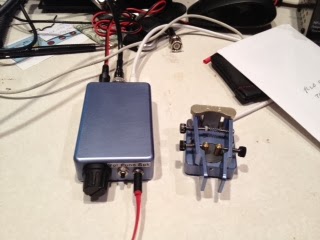
Mike Crownover, AD5A, is a regular contributor to AmateurRadio.com and writes from Texas, USA. Contact him at [email protected].
Big Magnetic Loop for QRP in the Park

I’ve been experimenting with magnetic loop antennas of various sizes and configurations for the past year or so. They are fun to build and even more fun to use.
QRP and Magnetic Loop antennas go hand in hand for many reasons. They work well, are very quick to set up, and are bidirectional! Its nice to be able to ‘aim’ an antenna at a prospective target, like say ‘Africa’!
Copper face plate with PL 259 and Gamma Match sticking out of the side

Soldering with a plumbing torch is necessary in some places, like attaching the main loop tubing to the PL 259.
It may not look very pretty here, but believe it or not, my torch soldering skill is actually improving. The PL 259 is attached with screws and is soldered with a regular soldering iron to reduce inter component resistance. I’ve pretty much settled on the Gamma Match for a number of reasons. It’s easy to match and its easy to build. It works well too.
This T’ fitting helps to make the loop more stable, therefore easier to transport for portable ops.

What would hams do without PVC pipe?
Half inch PVC tubing bisects the mast and passes through the center of it. This three point connection stabilizes the loop and makes it much more robust. My first few magnetic loops didn’t have this feature and were a bit ‘wobbly, and bent more easily as they bounced around in the back of my truck.
This is the ‘business end’ of the Gamma Match

Using a plumbing torch, I attached this copper strip to the Gamma match from the main loop tubing.
Here is another nifty improvement

You can see the support PVC pipe passing through the center of the mast here, The black piece is a plastic pipe clamp. It is held in place with tie wraps. I try to keep the use of anything made of metal to a minimum in the center of the loop. I’m not worried about radiation patterns as much as trying to keep the overall weight of the antenna low. The smaller PVC pipe on the left is a tuning stick. It is tied to the capacitor and is very light and makes reaching way up to tune the antenna unnecessary. Keep in mind that merely approaching this antenna closely affects the SWR. Touching it certainly changes the SWR as well.
How Well Does It Work?

I got great signal reports today, and that is saying something for a high Q antenna and only 5 watts of RF
This is my favorite pavilion at Hagen’s Cove Florida.

Hagen’s Cove is about 17 miles from my home, along the shore route. Its a county park that is right on the Gulf of Mexico. This particular pavilion is only 50 feet from the water’s edge. I bring a sandwich and bottle water lunch, but it took me an hour to eat it today. I had very curious visitors asking a million questions about radio, and my set up. I also keep my QSL cards handy to pass around. Visitors really like seeing them.
Hagen’s Cove

There is a kayak and canoe launching ramp here. Air boats have their own launch site close by. And darn it, I forgot my noise canceling headphones today, again! Air boats pass by in only inches of water and just 50 feet away, so I can’t hear anything on the radio when that happens. I have this place all to myself during the week, but its busier on weekend as you can imagine with such a nice venue.
For more information about Magnetic Loop Antennas go to http://groups.yahoo.com/group/MagneticLoopAntenna/
or http://groups.yahoo.com/group/MagLoop/
Hagen’s Cove is in Taylor County Florida http://taylorflorida.com/
73 de AA1IK
Ernest Gregoire
Ernest Gregoire, AA1IK, is a regular contributor to AmateurRadio.com and writes from Florida, USA. Contact him at [email protected].
Mobile Install
I have taken my HF mobile install through a number of different iterations (the constant being the rig: an Icom IC-706MKIIG). Today I hope that I have finally reached a lasting, workable setup. Here is a quick re-cap of my trials and tribulations:
First attempt (2007):
What this install lacked in experience, it made up in effort. The successes were routing the powerline and the feedline. The antenna system was a different story. My combination of Hustler and Hamstick antennas (along with the unfortunate choice of putting an Icom AT-180 autotuner in the mix) met with mixed success. I did make contacts and enjoyed the mobiling. The rig itself was placed under the passenger seat. Placed side by side with my TM-D710A left very little room and little clearance between the seat and the floor. I came to realize that my 2005 Toyota Tundra lacked any real great locations to stash a rig. The drivers seat (no way), behind the back seat (nope), under the back seat (not going to happen).
Tarheel Model 75A and the stake pocket mount (2008):
I have not regreted going with the Tarheel Model 75A. I finally figure out that using an autotuner was a non-starter and a screwdriver offered a great solution. The stake pocket mount was a mixed success. The way the pocket was always had the antenna sticking up at a funny angle. It also did not seem very secure. I still made lots of contacts and had lots of fun.
Switched to MT-1(S) mount (2009):
Switching to the MT-1(S) mount did a lot to improve my operations. By having the antenna mounted right to the side of the bed, my ground (… and other half of the antenna) was greatly improved.

Using the iPortable (2009-2012):
I don’t usaully have a passenger in the front seat – just two kids in the back. But having a heavy weight passenger in the front seat was a no-go for IC-706 in the all too cramped location under the seat. The iPortable setup allowed me to consolidate the IC-706MKII and the TurboTuner in one spot. No more messy nest of wires. But the iPortable offered somewhat of an obstacle to the kids in the back seat.
Current (…and final?) install (2013):
I have had the TM-D710A installed for a while. The AVMAP makes a good pairing and you can find my location via APRS here.

Now the iPortable is in the large tool box mounted to the bed of the pickup.

The big task was to reroute all the cables: an extension to the powerline, pulling out the feedline, and moving the control cable for the Tarheel antenna. The IC-706 includes the AD5X fan modification.

I had to drill a hole on either side of tool box to route the cables in and out. So far, so good – everything works and I am getting a full 100 watts out on every band.

I did forget to run a line for a CW paddle… that is on the To Do List.
There are also a few additional improvements I would like to make.
– 12v booster to 13.8v
– Extra 12v battery
– amplifier? 
Scott Hedberg, NØZB, is a regular contributor to AmateurRadio.com and writes from Kansas, USA. Contact him at [email protected].
Mobile Install
I have taken my HF mobile install through a number of different iterations (the constant being the rig: an Icom IC-706MKIIG). Today I hope that I have finally reached a lasting, workable setup. Here is a quick re-cap of my trials and tribulations:
First attempt (2007):
What this install lacked in experience, it made up in effort. The successes were routing the powerline and the feedline. The antenna system was a different story. My combination of Hustler and Hamstick antennas (along with the unfortunate choice of putting an Icom AT-180 autotuner in the mix) met with mixed success. I did make contacts and enjoyed the mobiling. The rig itself was placed under the passenger seat. Placed side by side with my TM-D710A left very little room and little clearance between the seat and the floor. I came to realize that my 2005 Toyota Tundra lacked any real great locations to stash a rig. The drivers seat (no way), behind the back seat (nope), under the back seat (not going to happen).
Tarheel Model 75A and the stake pocket mount (2008):
I have not regreted going with the Tarheel Model 75A. I finally figure out that using an autotuner was a non-starter and a screwdriver offered a great solution. The stake pocket mount was a mixed success. The way the pocket was always had the antenna sticking up at a funny angle. It also did not seem very secure. I still made lots of contacts and had lots of fun.
Switched to MT-1(S) mount (2009):
Switching to the MT-1(S) mount did a lot to improve my operations. By having the antenna mounted right to the side of the bed, my ground (… and other half of the antenna) was greatly improved.

February 2010
Using the iPortable (2009-2012):
I don’t usaully have a passenger in the front seat – just two kids in the back. But having a heavy weight passenger in the front seat was a no-go for IC-706 in the all too cramped location under the seat. The iPortable setup allowed me to consolidate the IC-706MKII and the TurboTuner in one spot. No more messy nest of wires. But the iPortable offered somewhat of an obstacle to the kids in the back seat.
Current (…and final?) install (2013):
I have had the TM-D710A installed for a while. The AVMAP makes a good pairing and you can find my location via APRS here.

Now the iPortable is in the large tool box mounted to the bed of the pickup.

The big task was to reroute all the cables: an extension to the powerline, pulling out the feedline, and moving the control cable for the Tarheel antenna. The IC-706 includes the AD5X fan modification.

I had to drill a hole on either side of tool box to route the cables in and out. So far, so good – everything works and I am getting a full 100 watts out on every band.

I did forget to run a line for a CW paddle… that is on the To Do List.
There are also a few additional improvements I would like to make.
– 12v booster to 13.8v
– Extra 12v battery
– amplifier? 
Scott Hedberg, NØZB, is a regular contributor to AmateurRadio.com and writes from Kansas, USA. Contact him at [email protected].
A Radio Day at the Airstrip
I had a great time watching a “radio controlled” airplane demo yesterday and I also thought (correctly) that I might meet a few “hams”. The Flying Hillbillies RC Club put on this “show” as a benefit for the “Wounded Warriors” which is a support group for injured and recovering military personnel in our nation. There are “thousands” of these brave people in America who struggle with injures that have changed their lives forever.
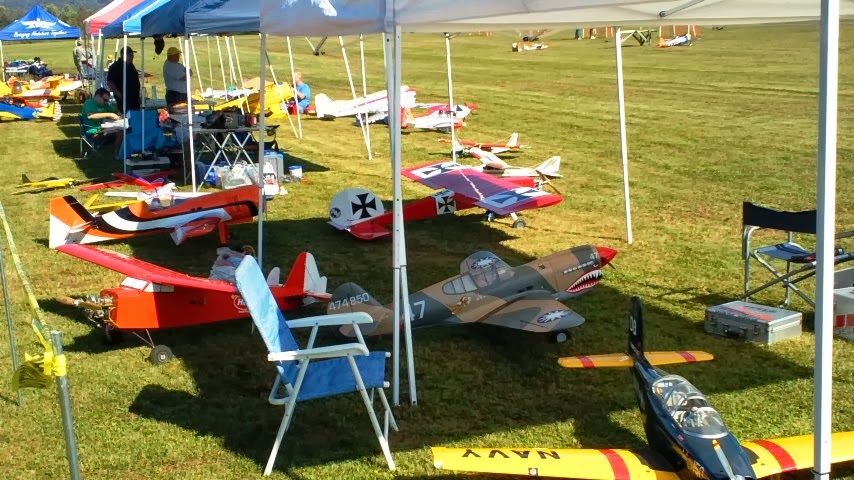
The first video is what I call the equivalent of a “burn out” which high powered “dragsters” use to heat up the tires and get a good “grip” on the asphalt racetrack. In this case with the airplane, the radio operator was using this maneuver to “get the feel of the controls”. He also did some remarkable things in the air, which I wonder are possible with a real aircraft?
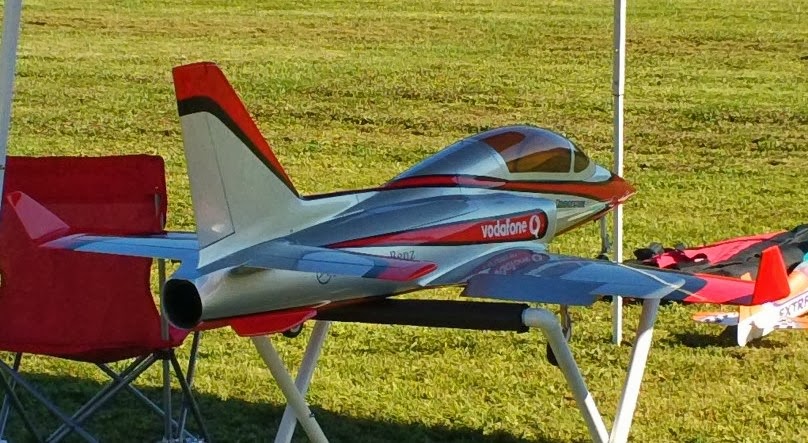
My hopes were twofold at this event; In addition to being around this kind of technology, I find it common to see “hams” at these kind of things. It took only moments to see the “tags” on a pick-up which displayed KE8V and after roaming around a bit, and looking at some of the aircraft like this 200 mph “jet”, I also met WV8RC and W8BV. Rick (WV8RC) is a mover and shaker for the annual “Charleston Hamfest”. I set up my QRP station there last year and worked stations in Denmark, Germany, and France.
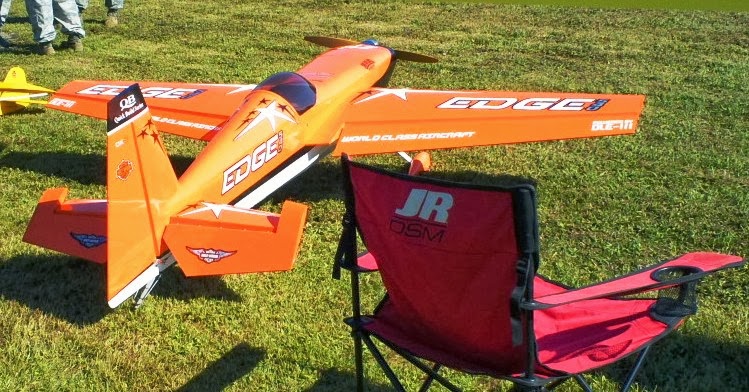
I felt the outing was a real “success” when I noticed my old friend (and my mentor) Bill Walker (NK8Y) in the crowd. Bill was the motivating force for QRP radio when I first entered the hobby! I also made him aware of the “new” West Virginia Chapter of the North American QRP CW Club. I think I’ve got him hooked on the new club.
The NAQCC WV Chapter is in it’s infancy. It’s open to all West Virginia CW QRP operators, and those wanting to learn this valuable skill and work the world with only a few watts of power.
The helm is steered by “yours truly” (N8ZYA)
I’ll have more to say about this group soon, but for now, I’ll continue wandering around and recruiting members for the new chapter of the larger NAQCC Club. The airshow outing was an attempt to mingle with some local hams and spread the good news of the infant club. I had a great time doing so…..
John Smithson, Jr., N8ZYA, is a regular contributor to AmateurRadio.com and writes from West Virginia, USA. Contact him at [email protected].
Apologies
for not posting all week. Whew! What a week! It was so busy this week, that I only managed to get one lunch time QRP session in. The other days, I ended up either working through lunch, or got saddled with “must attend” conference calls during lunch hour.
Last Monday, I had to serve out a jury duty summons. Here in Middlesex County, you are summonsed for “either one trial or one day”. You report to the county courthouse with your juror badge, which is mailed to you ahead of time. The badge has your name and a juror number. People are randomly picked throughout the day in groups of 20 or 30 or more. If your number gets called, you go into a courtroom as part of a “panel” where you may or may not be selected to serve on that jury. If your number isn’t selected for any panels and you’re not picked from a panel to be on a jury that day – you go home. My number wasn’t selected for any panels, so I came home and now I don’t have to concern myself for reporting for jury duty for another three years.
Since the week was so busy, I rewarded myself this morning by attending the OMARC Fall Hamfest, down in Wall Township, NJ. I attended their Spring Hamfest, which was held on Dayton weekend. I liked it enough to go back. Again, it’s a small event, but it’s very nice, nonetheless. Attendance was decent and the people there were really nice, and the weather was absolutely gorgeous, so it made for a pleasant morning. (Great job, folks from OMARC! I’ll be back next year, for sure.) My only purchase was a 25 foot length of RG-8X coax with a male PL259 on each end. This will be used to connect my PAR ENDFEDZ when it is sufficiently high up in a tree.
But, I was given a great idea by two guys who were selling military surplus fiberglass antenna masts. In particular, I really like this:
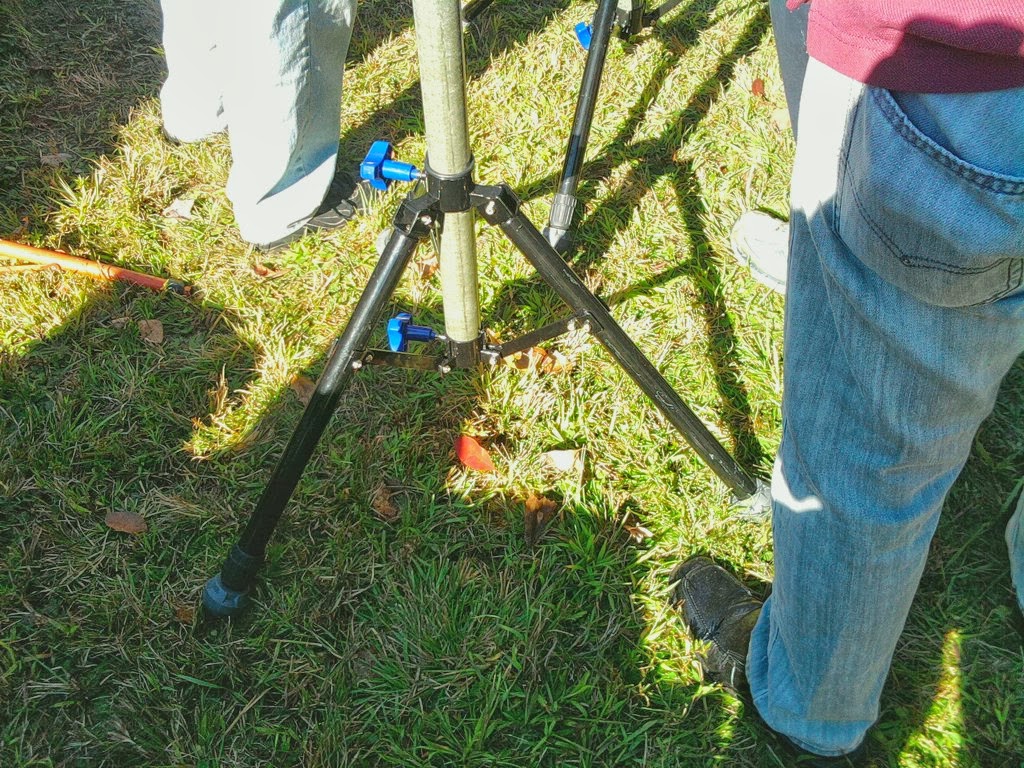
They anchored the bottom section of mast in these tripods. I asked them if they were selling them, as one of these puppies would be just perfect for holding my Jackite pole. They informed me that they don’t sell them, and they acquired theirs at Lowe’s. They are the tripods used to support quartz work lights. Perfect! I have to look into getting one of these. The two gentlemen had 26 feet worth of mast being held by this particular tripod. It was slightly breezy and yet it was anchored like a rock. Looks like a promising concept.
The other thing I noticed at the Hamfest was just a personal observation. Something that to me, is one of the marked differences between CW and Phone operation. A little background – you all know that many times I have stated that I am not a big VHF/UHF talker. I have my handheld mounted in my Jeep because I do enjoy listening to the local repeaters on the way to work and on the way back. If you’re like me and you do mostly listening, you get accustomed to “the regulars” on the different repeaters and you get to know voices and the personalities behind the voices – and after a while, you form a picture in your mind of what you think the face must look like that goes with the voice you are hearing.
I was walking around this morning and amongst the various conversations going on, I heard some familiar voices – some of the guys I listen to each morning and each afternoon. I looked up and, Wow! In each case, the face that I had mentally pictured looked absolutely NOTHING like the actual person!
Then I realized, that this is not something that happens while operating in the CW Mode …… at least for me. Conversing with a guy in code does not cause me to conjure up the face behind the fist. I love looking at QRP Quarterly and the photos from FDIM and the various QRP “Cons” because I can finally see the faces behind the fists. But for some reason, I am never taken aback by seeing a photo of some QRP op, or other CW op and saying to myself, “He just doesn’t look the way I pictured him”. The only thing that I can think of that may be the reason behind this (for me at least) is because voices are distinctive in tonal quality, while CW fists are distinctive in rhythm and pattern.
Crazy, huh? These are some of the thoughts that run through my head while mowing the lawn. Maybe I should see someone about this! 😉
Oh, before I forget …… tomorrow is the inaugural Peanut Power QRP Sprint. Hope to catch you all on the air tomorrow afternoon!
72 de Larry W2LJ
QRP – When you care to send the very least!
Larry Makoski, W2LJ, is a regular contributor to AmateurRadio.com and writes from New Jersey, USA. Contact him at [email protected].
We Discover a New Trail (and work some DX)
Hanz W1JSB and I hiked along the river in Bristol this afternoon. We worked Germany, Lithuania and the Balaeric Islands.

On the Old Back Road there are lots of unused mill buildings along the river. Hanz discovered a trail there last year and we went to explore it today. We walked along a narrow footpath across some rocks and cement dam structures that hung out over the river. Soon we came to a trail that lead south right along the river. It was glorious.

After walking a mile or so we started looking for a place to set up our gear. We found a flat outcropping that just happened to be under a large, over-hanging maple tree. Voila! Hanz threw his water bottle over the branch and hauled up a half wave wire for 20 meters. He used the Par End-Fedz and had a perfect SWR. He operated with his souped up SWL rig.

After tuning around a bit, he made a quick contact with DF5DM, Wilfred in Germany. Happy smiles!
Then I set up my KX3 and clipped onto his antenna. I listened on 15 and 17 meters, but didn’t hear much, so I switched to 20. That was very active and I made two quick contacts. The first one was with Pranas, LY2J in Lithuania. He was a 599 and gave me a 559. Then I worked Keith EA6/G3SZU in the Balaeric Islands. Keith was 589 and he gave me a 459. With that we packed up our gear and headed back toward Bristol.
As we got there, the sun was just setting and I snapped a quick shot of the falls above the river.

Jim Cluett, W1PID, is a regular contributor to AmateurRadio.com and writes from New Hampshire, USA. Contact him at [email protected].
 Ham Radio Deluxe |
 W5SWL Electronics |
 Ham Radio Prep |
 KB3IFH QSL Cards  Hip Ham Shirts  HamRadioAuctions HamRadioAuctions Reliance Antennas Reliance Antennas Enigma Shop Enigma Shop |  morseDX  Ni4L Antennas  R&L Electronics R&L Electronics antennas.us antennas.us QRV QRV |
- Matt W1MST, Managing Editor
