 |
 DX on 40 Meters with an Indoor Isotron Antenna
 1 October 2013 | by
 Due to a busy personal schedule, I’ve sparsely been on the air for a few days; but I still continue to work a few DX stations. Early this morning, I found this VERY satisfying QSO with a station near Munich Germany.

I’ve been hearing a few nightly DX stations, on the lower end of the General class portion of the 40 meter band, but never thought I could work one. I was very surprised when I called DJ6ZM on 7026 MHz with 5 watts from my indoor mounted Isotron antenna – and he answered with a “question mark“. (IMI)
After re-directing his beam, and me repeating my call sign a few times, he could hear me clearly, and responded with a 449 report! He lives about 15 KM from the headquarters of BMW motor company.

I’ve worked Germany 41 times now. Fifteen of them have been this year, but this is my first German contact on 40 meters. As most of my readers know, I live in a restricted antenna area near the state capitol in Charleston and use stealth antennas.
My 40 meter antenna has often been called “the bird house” because…let’s face it, I’ve seen bird houses about this size. Hihi
My 40 meter Isotron antenna is the one with the “small coil” on the left side of the painters pole.
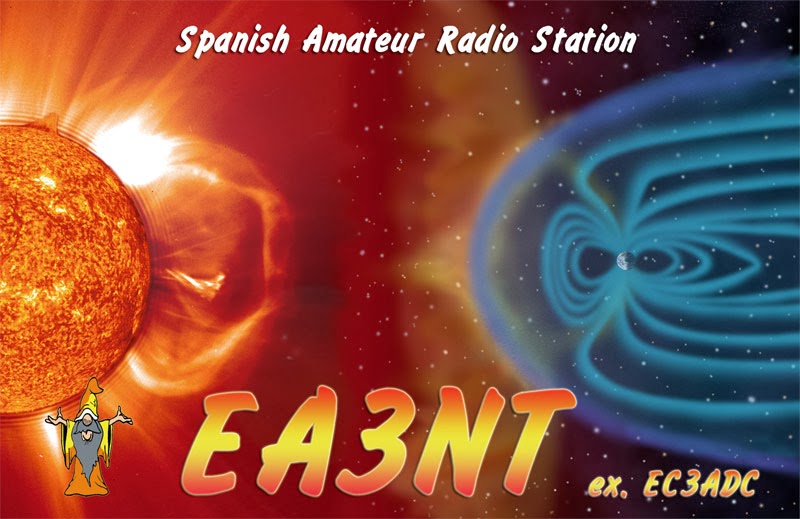
This morning, on 30 meters, I also worked EA3NT for the “third” time and he responded with “nice to hear you again”. This makes my 37th contact into Spain.
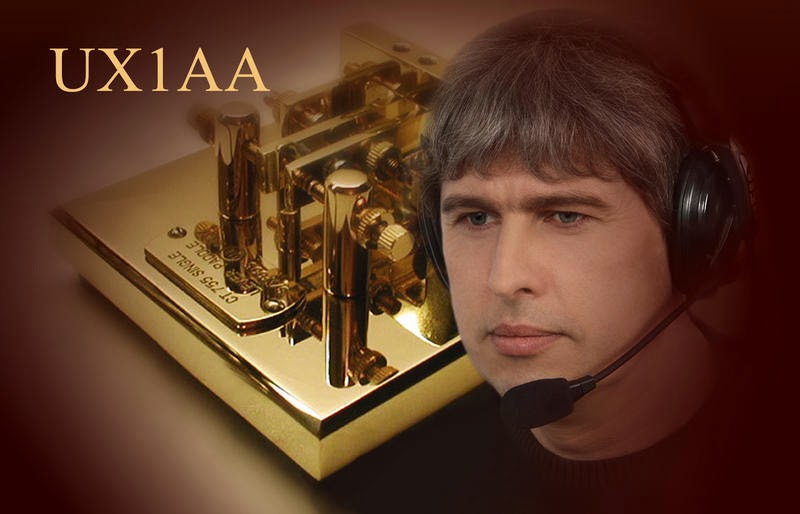
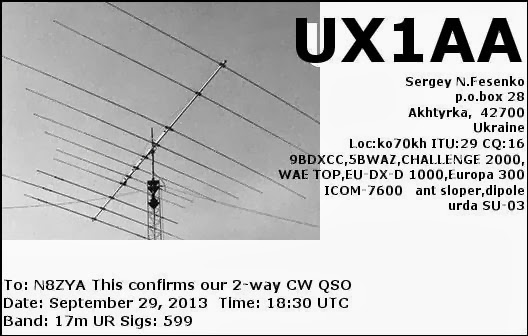
I’m also very proud of a nice contact, on the 29th of September, with UX1AA in the Ukraine ! This was a great signal on the 17 meter band. In addition to a nice card displayed on QRZ.com
John Smithson, Jr., N8ZYA, is a regular contributor to AmateurRadio.com and writes from West Virginia, USA. Contact him at [email protected].
Cool 12m SOTA contact
The past Saturday I had a rare weekend with not much on the schedule so I was chasing SOTA summits among other things. It was a fun day on the radio and I worked several Europeans on 12m. Currently the SOTA program has a 12m challenge in place which encourages activity on this band and when open, provides some fairly long haul DX for these QRP summit operations. I wasn't operating QRP, I was using my FT5000 and my Log Periodic Antenna up about 50 ft, however there are always several summit to summit QSO's among the activators that are QRP both ways across the pond. However this wasn't the most fun of the day.
Around 0130z on Saturday evening a SOTA spot came up for VK3ZPF, Peter, on a Mt. St. Phillack in Victoria, Australia on 12m SSB. I swung the beam around, not expecting to hear a peep. I wouldn't be writing the article if that is how it ended;-) I could hear the CQ faintly, but there was deep QSB. Finally on the peak I called and he came right back. We exchanged reports I had him in the log. A few minutes later, Glenn, VK3YY, who was with Peter was calling and I worked him as well. Glenn sent me an email saying that he was using a 40m EFHW antenna through an Elecraft T1 tuner and an FT817. Pretty cool and on SSB as well.
This radio stuff is fun.
Mike Crownover, AD5A, is a regular contributor to AmateurRadio.com and writes from Texas, USA. Contact him at [email protected].
10 meter openings
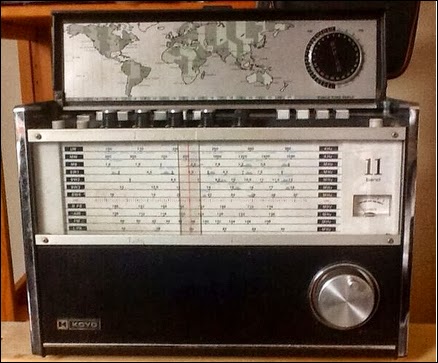
I saw this photo on Twitter (GW1JFV) This was my first SWL radio, a KOYO with real S-meter. Here it starts, my first steps with radio reception. First broadcast stations, later on ham radio. Very nostalgic.
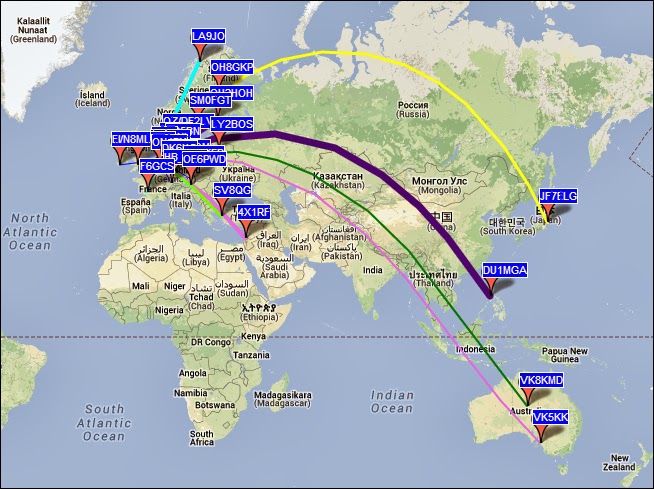
WSPR on 20 m yesterday late afternoon. We should keep an eye on 10 meter. I do hear a lot of DX. Yesterday I heard 5R8FL from Madagascar with PSK31. He was gone after a few minutes. So I could not work him.
Paul Stam, PC4T, is a regular contributor to AmateurRadio.com and writes from the Netherlands. Contact him at [email protected].
A Classic SOTA Hike: Midland Hill (W0/SP-117)
Today, Joyce K0JJW and I decided to hike Midland Hill (W0/SP-117) near Buena Vista, CO (otherwise known as “BV”) and do a SOTA activation on VHF. I call this a “classic SOTA hike” because it is a real hike that requires some exertion, a well-maintained trail to the summit and some great views at the top. By my GPS, it was 2.4 miles one way, with 1600 feet elevation gain.
This hike starts at the trailhead on the east side of BV, where a footbridge crosses the Arkansas River. The SummitPost trail description is very helpful, so be sure to check it out. I checked quite a few topo maps of the area and most of them do not show the trails accurately. I found them more confusing that helpful. I’ve included my GPS track on the map below.
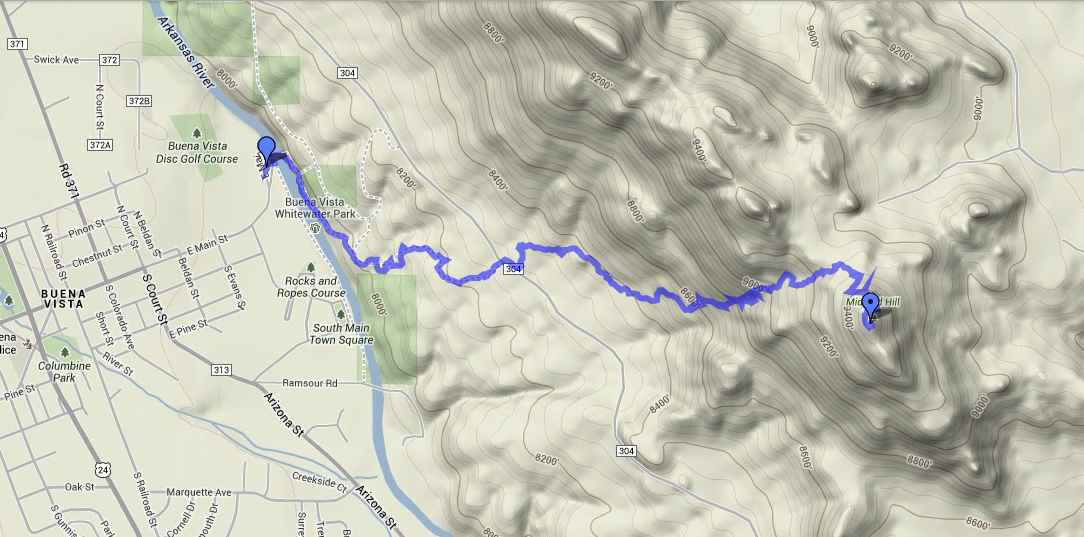
GPS track for Midland Hill
We started at the trailhead, immediately crossing the footbridge to the east side of the river. Then we followed the Midland Bike Trail which parallels the river. Very soon after the bridge, there is a trail leading off to the left (east) uphill that is tempting but we stayed on the main trail that parallels the river. At about 0.5 miles in, we crossed County Road 304 (38.843508 deg N, 106.112297 deg W) onto the clearly marked 6032 trail, which goes up to Midland Hill. Just follow the trail and do not turn onto 6032A trail as it goes off to the left.
If you are pressed for time, you can start the hike where 6032 intersects CR 304, but that only saves 0.5 miles. You’ll miss the bridge and great views of the Arkansas River.
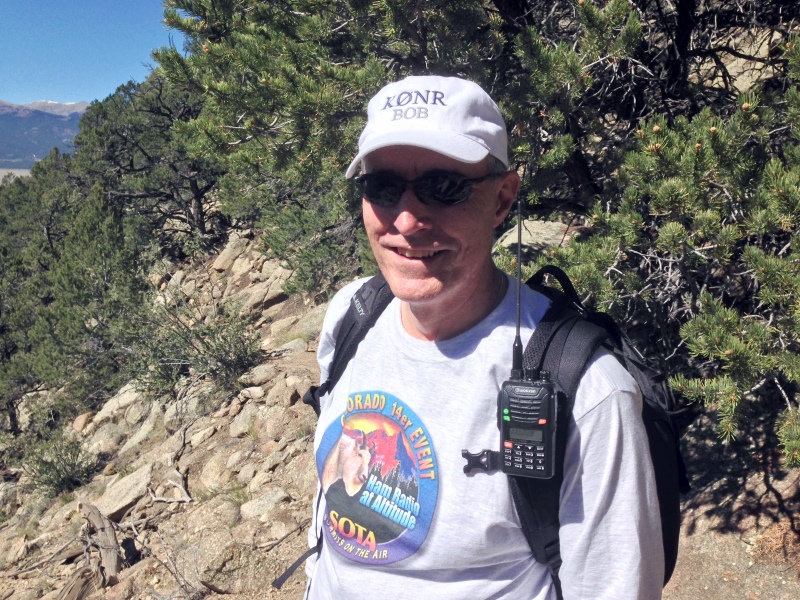
Bob K0NR on the trail
Once we reached the summit, I set up on 146.52 MHz using my VX-8G connected to the 2M Arrow Yagi. Joyce stayed back outside of the activation zone, so I worked her as soon as I made the summit. Then Walt WZ0N came up on frequency and gave me a second contact. I contacted a couple of mobile stations: Ryan KD7OHA on Highway 50 near Texas Creek and Bud NP2CT on Highway 285. Other contacts where with some of the local hams: N0OFQ near Nathrop, Jerry N0VXE and Skip W9GYA near Salida. Not bad for a Monday afternoon in the mountains. Thanks, guys, for the contacts!
Lately, some of the SOTA hikes I’ve done have involved bushwacking up the side of a steep hill to get to the summit. It was great to have a real trail this time. The 1600 vertical feet did get me huffing and puffing but that’s part of the experience. I highly recommend this summit!
73, Bob K0NR
Bob Witte, KØNR, is a regular contributor to AmateurRadio.com and writes from Colorado, USA. Contact him at [email protected].
ZR6AIC’s interesting blog and satellite webSDR
Over the weekend, I came across Anton, ZR6AIC’s blog which is well worth a read, if you’ve not seen it before. Plenty on RTLSDR, Satellites, Raspberry Pi – I enjoyed skimming through it last night.
Anton, based in southern Johannesburg, South Africa also has a couple of interesting WebSDRs that you can play with. One which particularly caught my attention was his VHF/UHF Satellite SDR, on which you can listen around 437MHz. It might be quite interesting to get some Satellite passes for Anton’s location and take a listen!
Tim Kirby, G4VXE, is a regular contributor to AmateurRadio.com and writes from Oxfordshire, England. Contact him at [email protected].
A Mobile Station, QRPper and Two Frenchmen!
Wow! I can’t believe it has has been over a week since I have played radio. On this, the last day of September, I just had to get out. The weather here in Kansas was awesome – 75 deg, sunny and a light wind.
After getting setup, I heard a very faint CQ on 20 meters….
AK4JA (the QRPper) – Bob was calling CQ and was very faint, but readable. He was in Georgia. After reading his QRZ profile, he is a dedicated QRP addict, just like me. I had a bit of trouble copying him, but I believe he said he was running 200 MW! Thanks for the nice contact Bob!
Still on 20 meters….
N7IV/M (the mobile station) – Joe was calling CQ and was nice and strong here. He was calling from Minot, ND (which might be a new state for me) – he was running 200 watts from a TS 480 into a Hustler vertical antenna on rear fender. I believe he said he was on a long bike ride (but my CW skills were having a hard time keeping up 🙂 ). He thought my lunch time activities sounded amazing – and I agree! However, I think bicycle mobile sounds even better!
Now it was time to hit my favorite band for DX – 17 meters…
F8EMH (the first Frenchman) – Flo was calling CQ and after a couple of calls I was finally able to work him. He gave me a 229 – so he has good ears. He was 579 here and sounded great. Looking at the map, he looks to live in the northern part of France, really close to the border.
F8AAN (the second Frenchman) – David was also calling CQ at the bottom of 17 meters. It took a few calls for him to hear me, but we finally connected. He also had great ears giving me a 419 – he was 599 in here. He lives in the western part of France, almost on the coast it appears.
So after a week away, things were still just as fun! Today brought some interesting contacts, and some fun DX to boot.
Burke Jones, NØHYD, is a regular contributor to AmateurRadio.com and writes from Kansas, USA. Contact him at [email protected].
An interesting week at G4VXE (VHF Tropo, RTTY and Bad DVAP Data)
In my last post, the week had started well with some good tropo. That continued on Tuesday, when rather splendidly, I was able to work from home. Although I was busy, I was able to keep an ear on things. Around lunchtime, I just flicked up the volume on 432.200 which had been pretty quiet as I saw the meter flicker. I only caught the tail end and waited….
It was OE2CAL calling CQ at around S7! He worked a GW and I called and was very pleased to be able to make a QSO at around 1120km. Not bad at all. Signals dropped with me just after I worked him, although I suspect he turned his beam. I continued to hear him at good strength throughout the afternoon, sometimes stronger, sometimes weaker. On the vertical, I was hearing the DB0FT repeater on 145MHz from JO40 – not a bad distance.
Later in the week and over the weekend, tropo conditions were still good – although not over such great distances. I was able to work through an ON repeater on 145.6875 on Saturday and on Sunday morning, I had a nice simplex QSO with Ken, G3UDA in Shropshire.
With the CQWW RTTY contest over the weekend, any thought of JT65 or JT9 was off! No matter, I looked to see what RTTY signals were coming through on 28MHz.. Nothing amazing, but logged a few US, Asian and African stations. High power (100W) RTTY feels pretty unsubtle compared to JT65 and JT9 – but very different beasts, I suppose. It was nice to use PZTLog on RTTY for a change.
I also played a little on DSTAR, naturally whilst I was in the garden on Sunday morning, when it’s nice to listen to what’s coming through and have the odd QSO whilst working in the garden and the henhouse. The Raspberry Pi/DVAP combination works well, although I sometimes see an issue when I boot up, with the DVAPNode software reporting Bad DVAP Data and then resynchronising DVAP Stream. This seems to leave the CPU at 100% and so far, I’ve rebooted and it generally comes up ok next time. Not always and on Saturday it took a couple of goes. I’ll have to see if I can avoid rebooting and work out what process I have to kill and then restart. Nice QSO with Wis, YB0AZ from Jakarta, who told me there were two DSTAR users on his repeater in Jakarta. Him and his wife!
Finally, two of my favourite amateur radio bloggers are missing at the moment. Julian, G4ILO is taking a bit of a break on health grounds, as is Roger G3XBM who is also not well. Wishing you both the very best – hope to see you writing again very soon – I miss what you do.
Tim Kirby, G4VXE, is a regular contributor to AmateurRadio.com and writes from Oxfordshire, England. Contact him at [email protected].
 Ham Radio Deluxe |
 W5SWL Electronics |
 Ham Radio Prep |
 KB3IFH QSL Cards  Hip Ham Shirts  HamRadioAuctions HamRadioAuctions Reliance Antennas Reliance Antennas Enigma Shop Enigma Shop |  morseDX  Ni4L Antennas  R&L Electronics R&L Electronics antennas.us antennas.us QRV QRV |
- Matt W1MST, Managing Editor
