 |
 Smartphone SSTV
 15 October 2013 | by
 Yesterday at work, whilst I was waiting for a bit of code to finish running, I was idly looking at some apps on my phone. In particular, I noticed that the icon for my SSTV app had changed.
It’s the SSTV app for iPhone/iPad by Black Cat Systems. I got it a while ago thinking about using it to receive SSTV on the 28MHz rig in the car but hadn’t really got around to doing much with it.
Looking at the app yesterday I noticed that there was now the facility to take a photo with the iPhone and send it via SSTV. That got me thinking. You know how I’m not one for complicated interfaces! Well, I wondered if there would be any mileage in using a handheld and the iPhone together and just using audio coupling.
It struck me it could be fun, if you were out portable on a hilltop, to send an SSTV picture from the phone, through your handheld, just by holding the speaker of your phone in proximity to the microphone of the handheld.
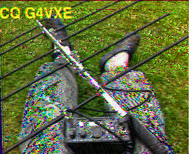
Though I didn’t try it from a hilltop, I did try sending a picture from the iPhone through the Icom E92 (on FM) to the iPad with the Baofeng UV-5R on receive close by. The picture isn’t excellent, but it’s a reasonable approximation of what was sent!
If you’re an Android user, there’s DroidSSTV to do the same as SSTV!
See you on SSTV from a hilltop?
Tim Kirby, G4VXE, is a regular contributor to AmateurRadio.com and writes from Oxfordshire, England. Contact him at [email protected].
CW practice

No time for reading a book? You want to practice CW to update your skills?
Here is the solution and combine both: A whole complete book in morse code. Ernest Hemingway’s The Old Man and The Sea. You can listen to 20, 25, 30, 35 and 40 wpm. Every day one page and you will be a morse code master in a year. Thanks to OK1CQR.
Paul Stam, PC4T, is a regular contributor to AmateurRadio.com and writes from the Netherlands. Contact him at [email protected].
LHS Episode #112: Mother Fudgsicle
 Hello, dear listeners! In this episode of Linux in the Ham Shack, we get a visit from a long-lost friend--who quickly turns out to be kryptonite and derails the show faster than you can say, "Dallas-Fort Worth." Amongst the hilarity and reminiscing, we manage to discuss some Linux and ham radio related news, a new Linux distribution, give some command line tips for the beginner, and generally have a good time. Hope you enjoy. Thanks for being you.
73 de The LHS Guys
Russ Woodman, K5TUX, co-hosts the Linux in the Ham Shack podcast which is available for download in both MP3 and OGG audio format. Contact him at [email protected].
AmateurLogic.TV 59: 8th Anniversary Extravaganza

AmateurLogic.TV Episode 59 is now available for download.
Our 8th Anniversary Extravaganza. You don’t want to miss a minute of this action packed episode!
Peter declares war, Tommy reviews the Icom ID-51A, George shows how and why to use a Megger, we model the new AmateurLogic T-shirts, a Google + Hangout with show friends, info on the 8th Anniversary Giveaway, and more.
1:12:24 of AmateurLogic Celebration
View in web browser: YouTube
George Thomas, W5JDX, is co-host of AmateurLogic.TV, an original amateur radio video program hosted by George Thomas (W5JDX), Tommy Martin (N5ZNO), Peter Berrett (VK3PB), and Emile Diodene (KE5QKR). Contact him at [email protected].
Unintentional Intentional DX
Sometimes with DX, it’s better to be lucky than good. Well, I really shouldn’t say that. I know nothing of being good when it comes to DX, but I sure can relate to lucky.
Band conditions were good today, and I went out to the Jeep at lunchtime to find 15 Meters hopping! I heard a huge pileup around 21.023 MHz and I think it was for JA7SGV/6V in Senegal. He was loud here in NJ, so despite the pileup being furious, and despite having worked Senegal on another band, and because I’m an optimist at heart, I decided to give it a go. I turned on the “Dual Watch” feature on the KX3, hoping that I would be able to figure out where he was listening. After listening for a goodly bit, it became apparent that I was not hearing the same stations that the DX station was going back to. So I hoped for the best and started throwing out my call at 21.025 MHz. It seemed as good a place as any to start.
Then all of a sudden, my call comes back to me. But it wasn’t from the ear bud tuned to 21.023 MHz, but instead from someone transmitting on 21.025 MHz. I quickly turned off “Dual Watch” and deactivated the split function and twirled the main VFO up to 21.025 MHz. I thought just maybe it was someone who heard my call sign in the pileup, recognized it, and wanted to say “Hello”. A half second later, when I got up to 21.025 MHz, the station was still calling me and sending out “W2LJ 579 TU BK” waiting for an acknowledgement. Obviously, this was NOT someone wanting to say “Hello”. So since the station was loud, auto-pilot and habit kicked in and I sent back “DE W2LJ TU 599 NJ BK”.
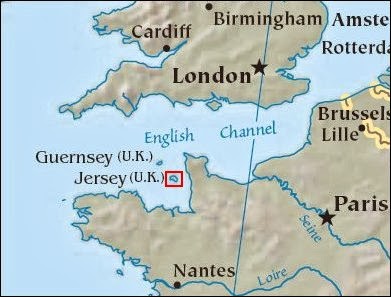
It turns out that it was MJ0ASP, located on the Island of Jersey. A DXCC entity that I have never worked before at all, let alone via QRP! How cool is that! Tried for Senegal, but got a brandy new one, instead (albeit by accident!). Add to the fact that New Jersey was named for the Island of Jersey, so there’s a little historical connection there, too.. My hat is off to Elecraft, because if it weren’t for the “Dual Watch” feature on the KX3, I might have missed Jersey entirely. A very good day on 15 Meters, indeed, as a little while later, I also worked Luca IK3VUT in Italy and Pep EA6FG on the Balearic Islands
I was listening for K3WWP and KC2EGL on 40 Meters, as they were scheduled for another Parkpedition today. I didn’t hear anything on 7.041 MHz, so I broke down, packed up and headed in. Checking e-mail, it appears that it was raining in Kittaning, so John and Mike put lift off on hold for about an hour or so. Can’t blame them. Who wants their equipment to get wet?
72 de Larry W2LJ
QRP – When you care to send the very least!
Larry Makoski, W2LJ, is a regular contributor to AmateurRadio.com and writes from New Jersey, USA. Contact him at [email protected].
RadioKitGuide.com is being updated, and you can help!
Hi all,

The Lydford from Walford
I am in the process of updating radiokitguide.com. If you can think of any new kit sources that I haven’t covered yet, please leave a comment here. I am looking for RECEIVER, TRANSMITTER, and TRANSCEIVER kits. I will cover accessories at a later date. If you know of a spectacular source of accessory kits though, send it along anyway. I am adding a couple of new sources, and making changes to YouKits, Small Wonder Labs (goodbye), TenTec, and several others. Thanks in advance for your help!
Neil Goldstein, W2NDG, is a regular contributor to AmateurRadio.com and writes from New York, USA. Contact him at [email protected].
More 28MHz mobile fun
Conditions seem to have been pretty good on 10m over the last day or two. Yesterday, as I was driving back from the convention the band was buzzing! I concentrated on 29MHz AM and was interested to hear N4ZED coming in from Georgia. I called but although Ken could hear a G there he wasn’t able to pull me out. Hardly surprising given my low power. I was surprised he heard anything at all,
This evening AM was quiet as I was heading home, but the SSB portion was lively. I managed a quick fire contact with K8CW which I was happy with, running 10W or so to the whip.
Tim Kirby, G4VXE, is a regular contributor to AmateurRadio.com and writes from Oxfordshire, England. Contact him at [email protected].
 Ham Radio Deluxe |
 W5SWL Electronics |
 Ham Radio Prep |
 KB3IFH QSL Cards  Hip Ham Shirts  HamRadioAuctions HamRadioAuctions Reliance Antennas Reliance Antennas Enigma Shop Enigma Shop |  morseDX  Ni4L Antennas  R&L Electronics R&L Electronics antennas.us antennas.us QRV QRV |
- Matt W1MST, Managing Editor
