 |
 Moving day is fast approaching
 20 November 2013 | by
 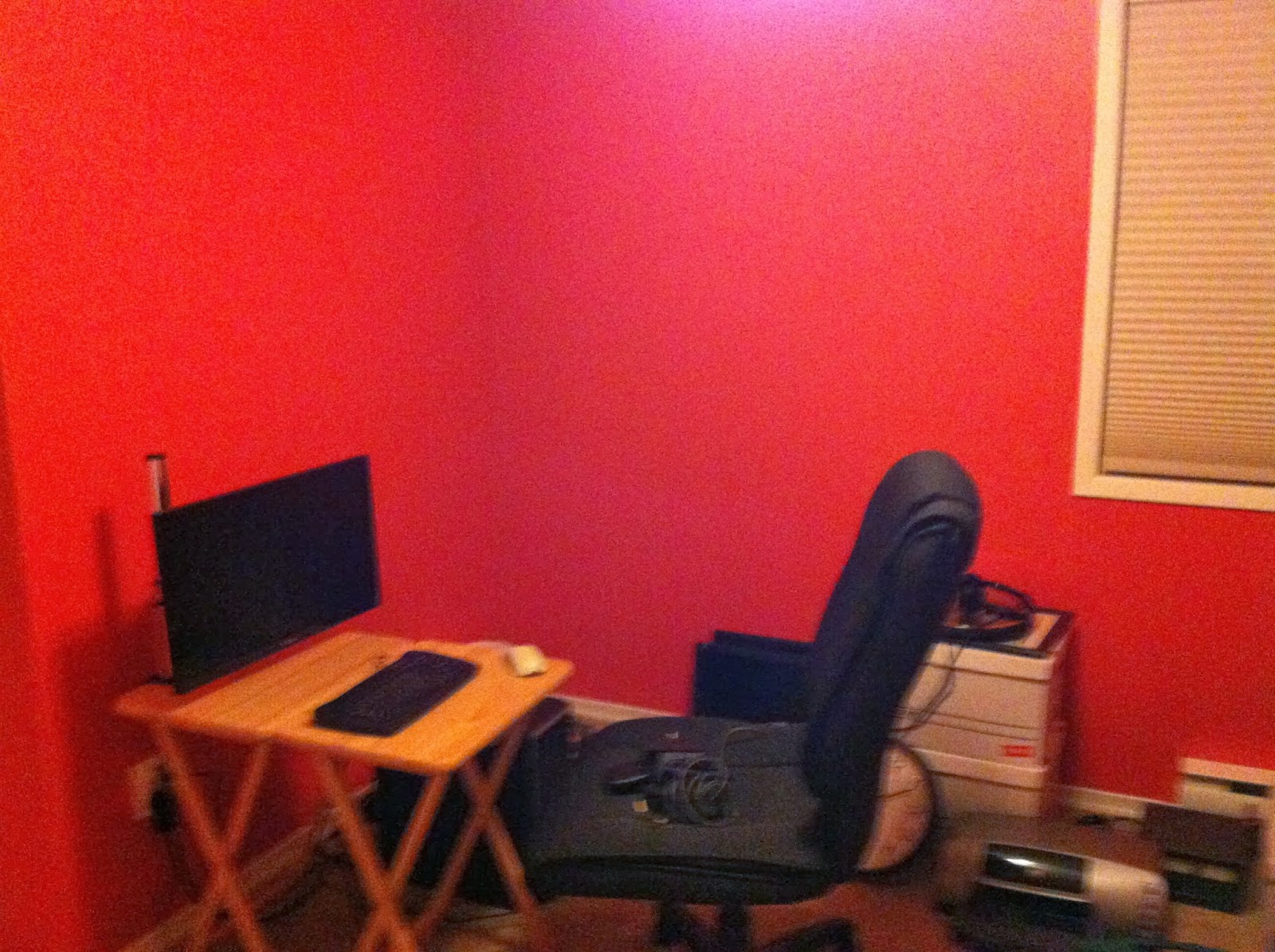 |
| excuse the quality camera has been packed |
I have been very busy packing, selling items and taking deep breaths as the shack is taken apart! I have
not had time to either post or read others blogs these days I can't believe my last post was on the 7th of November! When I have managed to find some down time I have spend it thinking about the new setup and how I was going to fit into a simple roll top desk. I am very much looking forward to the new setup and the challenges it will bring. One of my first "to do's" once the setup is complete is to get on WSPR and see how the new setup is getting out. We are more or less all packed and ready to go it's now just a waiting game. Stay tuned for update from new QTH!!
Mike Weir, VE9KK, is a regular contributor to AmateurRadio.com and writes from New Brunswick, Canada. Contact him at [email protected].
There is a season, turn, turn, turn
A time for W2LJ to ponder and to vent. This is stuff I’ve been thinking over the past couple of days. I can’t speak of these things to “civilians” as they would look at me like I was speaking in tongues (Ham speak?), not comprehending a word that I was saying.
The first occurred the other night as I was walking Harold, our beagle. As usual, I take my dual band HT with me and scan the various repeaters that I have programmed in there. The HT settled on a local VHF repeater that was holding an NTS Traffic Net. Having been a avid traffic handler in my early days as a Ham, I don’t mind listening in on these – procedures haven’t changed so much in all these years. At least I thought not.
The repeater itself was having problems. Some kind of interference or intermod was making communications difficult at best, almost impossible at worst. Two stations were having difficulty passing a couple of messages due to the interference. The receiving station asked the sending station to send him the messages via e-mail, and then he would deliver them. He told the Net Control Station to consider them passed traffic. Passed traffic?!? Would that be proper? Would that be considered the equivalent of going to another repeater or simplex frequency and passing them on the air? I applaud the ingenuity of the two stations, but ultimately passing traffic via a means that was not “radio” has me wondering if those could rightfully be counted as passed traffic. I may be a bit behind the current standards, so – anyone out there know if this would be considered Kosher?
When you get right down to it, I would think (IMHO) that traffic nets are supposed to be the resource available when everything else has turned to deep doo-doo. In that event, there will be no Internet to fall back on. IMHO, the two stations should have exhausted every RF means possible before resorting to e-mail and the Internet. But again, I may be just an old curmudgeon who’s behind the times and isn’t up to current standards. Can anyone shed a little light on this?
Secondly, the next scenario has to do with the QRP Fox Hunts. No calls will be used to protect the innocent and the not-so-innocent. We have been very fortunate to get some new blood showing up in the hunts. New-to-Fox-Hunting Hams have been showing up to participate both as Hounds, as well as Foxes. This is a very good thing, because if there’s no influx of new people, then sooner or later, the “sport” is going to die out. That would be a bad thing, as these are so much fun.
Anyway, a week ago we had a Ham perform his first ever shot at being Fox. I’ve been there, so I know what he faced. Believe me, for an experienced Fox it can be daunting, let alone your maiden voyage. The Hunt begins and close to, if not more than, a hundred Hounds are calling you all at the same time. A wall of barking, and they’re all barking at you. No amount of “Here’s what to expect” from an experienced Fox can really prepare you. It’s truly a “deer in the headlights” moment for most newbies (myself included).
Here’s the rub – it was an 80 Meter hunt, and according to Da Rulez, “The 80M Foxes will operate within +/- 10Khz of 3.560 MHz”. Well, the newbie Fox got distracted, excited, or maybe just a bit overwhelmed and planted himself just a hair above 3.570 MHz – less than 600 Hz away from the boundary. As it was, 42 Hounds found the Fox and snared his pelt. So it’s not like we’re talking that he was so far out of bounds that everyone was left mouth agape, wondering “Huh?”.
When he posted his log, he apologized for his error, and basically stated that this would not be repeated next time. Needless to say, that’s not good enough for some. Let’s just say that some of the responses were not exactly friendly, kind, understanding, encouraging or constructive. Here we get a volunteer to subject himself to a pileup of QRPers for 90 minutes and because you didn’t think to look outside the box, you let the poor guy have it! Nice ….. really nice!
Did he break the rules? Yes. Did he realize his error and apologize? Yes. Is this a cause for making someone feel like a schmuck? Definitely NO!
It’s not like we’re talking of a deliberate act, like interference or jamming, or being a willful idiot. The guy made a one time mistake, apologized for it and intends to do better the next time. I’ll be the first to admit, that in the past, I too may have been hot headed at times and may have been more than willing to jump on the pile with harshness. But due to some of my reader’s comments to me on some of my own blog postings (when I’ve been harsh), I feel that I have learned and have come to realize that this is not the right thing to do. Constructive criticism is the best way to go, and we need to cut the poor guy a break. Otherwise, we’re going to scare off volunteers and you’re going to find yourself hunting a Fox that’s literally not there (never mind just a little off frequency!)
72 de Larry W2LJ
QRP – When you care to send the very least!
Larry Makoski, W2LJ, is a regular contributor to AmateurRadio.com and writes from New Jersey, USA. Contact him at [email protected].
New Internet Modem

Testing download speed and upload speed today. Just happy with my new Internet modem / router. Promised speed 150 Mbps by Ziggo. Almost... no complaints here. :-)
Paul Stam, PC4T, is a regular contributor to AmateurRadio.com and writes from the Netherlands. Contact him at [email protected].
Time for some radio now
I’ve spent far too much time putting this blog back in line thanks to some dodgy code that got into my site. The site as a whole has shrunk a bit and I’m adding content back in as I go along. Its all very time consuming even though I have loads of back ups.
Having said that I’ve found a bit of time to do some planning for the new mast and feeders etc which I’ll order as soon as I get firm quotes for the building work I need to do for the extra room.  There’s still a bit of a battle at home over the position of the thing which looks a bit like this one. They are fairly compact masts in as much as they are telescopic but pretty heavy too at 80+Kg.
Plans are to make up a tilt bracket and to mount it on the side of the new room (with enough space for a decent beam in the future).
With it being telescopic the feeder needs to be carefully considered so it doesn’t fracture from being raised and lowered regularly. This is part planning application and part saving antennas from strong winds and salt spray. Ideally a good quality VHF coax will be used for yep, VHF antenna’s but getting the right one is crucial to avoid expensive mistakes. Time for a chat to the DX shop I think.
Alex Hill, G7KSE, is a regular contributor to AmateurRadio.com and writes from Cumbria, UK. Contact him at [email protected].
Digi-Key vs. Jameco vs. Mouser
I found myself in the unenviable position of having to place a small parts order from one of the larger electronics distributors. Often you find a decent price on the component, only to get hit by an outrageous shipping charge. I usually try to wait and group my items so as not to be hit too hard.
Here’s the little item I needed, a little 1mW Digi XBee for a project I’m working on (similar to this):
 Here is the pricing for one, shipped to the northeastern U.S. via USPS:
- Digi-Key: $19.00 + $2.92 shipping = $21.92 *
- Mouser: $19.00 + $4.99 shipping = $23.99
- Jameco: $24.95 + $2.43 shipping = $27.38
The more expensive option (Jameco) is almost 25% more than the cheapest (Digi-Key). Sometimes it’s worth shopping around a little bit.
Have you found a good (and inexpensive!) source for electronics components?
* I did a little research and found that Digi-Key will give you free shipping if you mail in an order form with a check or money order:
When a check or money order accompanies your order, Digi-Key pays all shipping and insurance (our choice for method of shipping) to all addresses in the U.S. and Canada.
Matt Thomas, W1MST, is the managing editor of AmateurRadio.com. Contact him at [email protected].
The one that got away ……..
Amateur Radio and QRP, in particular, are like fishing. You send your signal out into the ionosphere much like an angler casts his line into the water. Sometimes you get a nibble or a hit, and sometimes you come home with an empty creel. And it seems just about every serious fisherman has a story about “the one that got away”.
Today my story should read more like “the one I never had”. Out at the Jeep during lunch, I had two quick hits on 10 Meters, D44AC on Cape Verde Island and OA4//N7CW in Peru. With those two in the log (very decent DX for 5 Watts to a Buddistick, IMHO!), I was feeling rather confident (read that – cocky), and tuned around the rest of the band. Hearing nothing else that intrigued me, I decided to switch bands to see how conditions were on 12 Meters. That’s when I heard them – 3DA0ET – the Swaziland DXpedtion! They weren’t the loudest, but they weren’t the weakest, either. They were louder than D44AC, who got me on the first call, so I thought I stood a chance (read that – expected to work them). I was seduced by the Dark Side. I ended up wasting the rest of my lunch trying to get them in the log, unsuccessfully (and thereby re-learning a very valuable lesson in humility).
But thinking about it, I guess it really wasn’t “wasted” time. It’s like that saying about the Lottery – “You have to be in it to win it”. I don’t gamble much on lotteries, but I do like to chase DX! Who knows? If I had been on at just a little different time, or if band conditions were just a little different, maybe I would have been heard in Swaziland. And it goes without saying, if you don’t try, you’ll never get them in the log. That’s what makes chasing DX so much fun. First off, you have to think of the sheer distances you’re covering. It still amazes me to this day, that a radio signal of not-much-power can travel that far – over continents, over oceans and make it to the destination – audible and intelligible!. Sometimes it takes a while for my head to wrap around that, even after being in this hobby for as long as I have. It’s so easy to take this all for granted and to not marvel at it anymore. Secondly, there’s the thrill of the hunt. You have no idea as to whether or not you will be successful. But when you do get heard and make it into the DX log – Wow, just wow!
72 de Larry W2LJ
QRP – When you care to send the very least!
Larry Makoski, W2LJ, is a regular contributor to AmateurRadio.com and writes from New Jersey, USA. Contact him at [email protected].
Sunspots!
With smoothed sunspot number of 282 nd a solar flux of 177 we are continuing to enjoy great conditions on the higher HF bands. I can’t remember the last time the sunspot number has been that high – though that joins a long list of other things I can’t remember either. I’m surprised that more bloggers haven’t commented on it – they were happy to spread gloom and despondency when the predictions said that this solar cycle ws going to be a dud.
I’ve spent most of my operating time on my favourite mode – PSK31. Truth is, I’ve always felt more comfortable at the keyboard than in front of the mic. But I really should try to get some time in on phone while conditions are this good. Who knows how long it will last?
WebProp– my solar weather web widget is proving to be a bit of an embarrassment with its prediction that HF band propagation will be poor. The algorithm clear places too much emphasis on the effect of high A and K index values.It would be better for users to use the condx=no option which will show only the raw ininterpreted data.
Julian Moss, G4ILO, is a regular contributor to AmateurRadio.com and writes from Cumbria, England. Contact him at [email protected].
 Ham Radio Deluxe |
 W5SWL Electronics |
 Ham Radio Prep |
 KB3IFH QSL Cards  Hip Ham Shirts  HamRadioAuctions HamRadioAuctions Reliance Antennas Reliance Antennas Enigma Shop Enigma Shop |  morseDX  Ni4L Antennas  R&L Electronics R&L Electronics antennas.us antennas.us QRV QRV |
- Matt W1MST, Managing Editor
