 |
 Merry Christmas!
 25 December 2013 | by
Larry Makoski, W2LJ, is a regular contributor to AmateurRadio.com and writes from New Jersey, USA. Contact him at [email protected].
A Christmas Eve Summit Activation
The Sierra De Las Valles Range, west of Santa Fe, feature many peaks in the mid 7,000's. The range is located in the Caja del Rio (Spanish: "box of the river"). Caja Del Rio is a dissected plateau, of volcanic origin, which covers approximately 84,000 acres of land in northern Santa Fe County, New Mexico. The drainage from this region empties into the Rio Grande River. The center of the area is approximately 15 miles west of Santa Fe. Most of the Caja is owned by the U. S. Forest Service and managed by the Santa Fe National Forest. Access is through New Mexico Highway 599, Santa Fe County Road 62, and Forest Service Road 24.
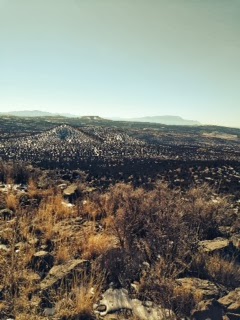
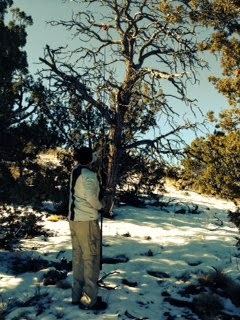
I decided to climb Montoso Peak, which at 7,315 ft. ASL is one of the tallest peaks in the Caja and Cris decided to come along for the hike. The climb is not particularly tough, other than there are no trails. The climb is 100% bushwhack and volcanic boulders and cactus are the primary obstacles. From where we parked our Jeep, we had a 640 foot vertical ascent over a one mile hike. It took us about 40 minutes to get to the top.

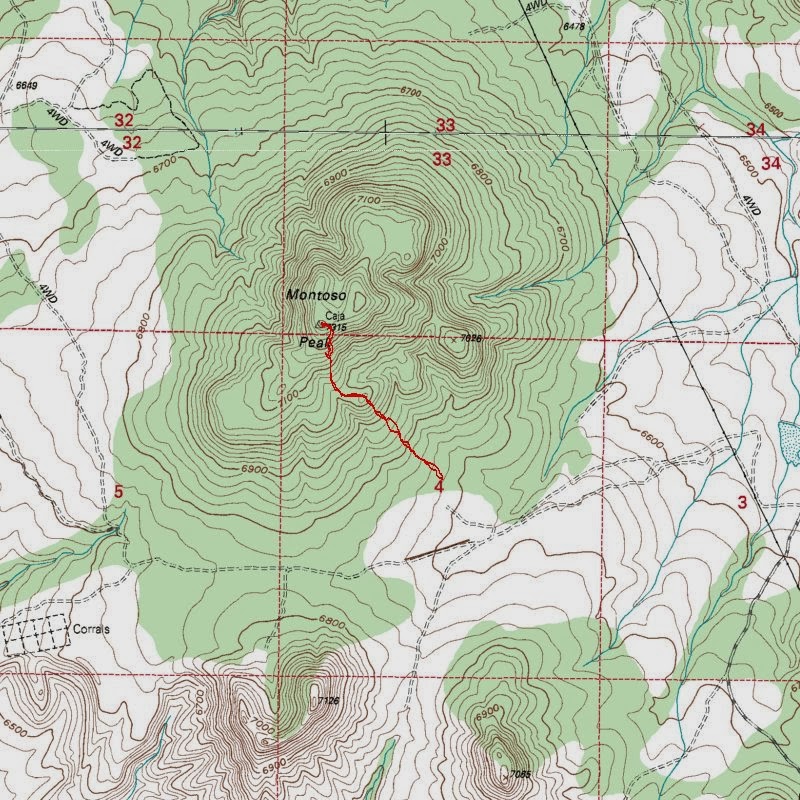 |
| The Route up Montoso Peak |
Mike Crownover, AD5A, is a regular contributor to AmateurRadio.com and writes from Texas, USA. Contact him at [email protected].
Christmas Eve – 2013
Christmas Eve is so special to me. Growing up in a Polish family, Christmas Eve IS Christmas! So I had a hard time deciding what I should post that would be special for Christmas Eve 2013 – childhood memories of Christmas Eves past? Then, thanks to Steve WX2S, who jarred a very, very special Christmas Eve memory from 45 years ago, I decided to post this. It is so appropriate!
Larry Makoski, W2LJ, is a regular contributor to AmateurRadio.com and writes from New Jersey, USA. Contact him at [email protected].
Website woes
The tranquility of my morning was disturbed by receiving an email “Disk Usage Warning” from the web hosting service for the g4ilo.com website.
This was worrying as I had not made any significant changes to the site for several months. I was concerned that hackers might have found a way to upload files to the server so that it was serving porn or some other equally objectional stuff.
After a look around using the disk management tools in cPanel the public_html directory seemed to be excessively large.
I FTP’ed in to the server with FileZilla and found that the error_log file was astronomically large. I took a look at it and the file was full of warnings about a deprecated PHP function:
PHP Deprecated: Function split() is deprecated in /home/g4ilo/public_html/lib/classes/class.contentoperations.inc.php on line 881
A sI hadn’t changed anything my suspicion was that the web host had changed some global PHP setting. When I submitted a support ticket they didn’t admit to anything but with a bit of help I was able to turn error logging off. This seems to have solved the problem so I am crossing my fingers that ‘s the end of it.
It was fine maintaining and supporting a website when my mind was sharp and my eyesight good. But I don’t find messing with this kind of thing very easy nowadays and I could do without the hassle and stress of things like this.
Julian Moss, G4ILO, is a regular contributor to AmateurRadio.com and writes from Cumbria, England. Contact him at [email protected].
Twitter & Morse
I love twitter. Some years ago I thought it was a load of rubbish, and had no purpose. But actually there is a fantastic community on the social media network, and more importantly a group of like minded Radio Hams are also on their sharing ideas, knowledge and experiences.
Take Dec 23rd for example. A simple thread was started about how we are progressing learning Morse and how we are attempting to up our speed. The conversation naturally came around to what’s best – paddle or straight key, and which particular keys do you own. For some crazy reason I mentioned I would complete a YouTube video of my keys, and share with the other participants of the conversation. Well I’m delighted to see that others have gotten on the band wagon and are sharing their keys and their experiences with them. Have a look at the following. I’ve ordered them in chronological order :
Dan Trudgian, MØTGN, is a regular contributor to AmateurRadio.com and writes from Wiltshire, England. He's a radio nut, IT guru, general good guy and an all round good egg. Contact him him here.
A Surprise Card in the Mail

I was elated to work ZD8X on “Ascension Island” last month. I considered myself both fortunate, and lucky, to work this new DX entity for me. At the time, there were hundreds of operators trying to work him. This isolated Island in the Atlantic Ocean, between South America and Africa, was a long, long way from West Virginia, and there were thousands wanting him in their log books. .
I remember Jorma (OH2KI) skillfully pulling my 3 watt QRP signal out of the enormous bee hive. It was a difficult contact. My salutations and congratulations are to him for such a wondrous accomplishment!
Anyone who can do such a thing at 5,362 miles, is a true magician!

I rarely request a confirmation QSL card from a long distance DX station, and this card was no exception. My verification’s are normally done through the E-QSL site since postage is much too expensive now. For those wanting a paper card, I always require a SASE, and am happily willing to return my card to them. I’ll put his return card in the mail immediately.
The thing that really impresses me about this card is the time Jorma (OH2KI) took to send me an additional special acknowledgement:

He apparently read my comments from my earlier blog entry, and made the special effort to send me this note. Professional operators such as this, and the entire ZD8X team, are what makes this hobby so rewarding and fulfilling for all of us.
This is a nice Christmas present for me.
Thank You!
John Smithson, Jr., N8ZYA, is a regular contributor to AmateurRadio.com and writes from West Virginia, USA. Contact him at [email protected].
Radio shield woes

This rather grainy photo is probably going to be the last one of the Radio Shield. Mainly because of its un-christmas like behavior. the little monster has been misbehaving for a a while. It decides when and if it wants to decode any packets, which is pretty mean if you ask me and to cap it off a new fault has occurred, the LCD screen is very intermittent. The way it works is a bit like this.
1. Plug it in and watch it power up and display the splash screen – all good so far
2. Turn on the rig and tune into 144.800MHz
3. Send it a packet from my VX-8G and watch the LED flash green to say its happy listening and then display the callsign, SSID and associated data
4. turn it off and enjoy some dinner
5. Turn it back on. Get the usual start up message
6. Do nothing else regardless of what I throw at it.
The really annoying thing is that the serial monitor displays other messages that should go onto the LCD bu they stubbornly don’t bother to show themselves. There is definitely a fault somewhere on here so I’ve had to email Argent Data for a bit of a clue. Other little issues are that you can set the contrast or brightness by code (which you should be able to do).
It seems as though you get intermittent packet decoding and intermittent LCD displays, even if you wire up a few others to test. Hmmmm, perhaps I’ll tackle the other parts to the code enhancements later.
Humbug
Alex Hill, G7KSE, is a regular contributor to AmateurRadio.com and writes from Cumbria, UK. Contact him at [email protected].
 Ham Radio Deluxe |
 W5SWL Electronics |
 Ham Radio Prep |
 KB3IFH QSL Cards  Hip Ham Shirts  HamRadioAuctions HamRadioAuctions Reliance Antennas Reliance Antennas Enigma Shop Enigma Shop |  morseDX  Ni4L Antennas  R&L Electronics R&L Electronics antennas.us antennas.us QRV QRV |
- Matt W1MST, Managing Editor
