 |
 Cold Indoor Radio Days Again
 7 January 2014 | by
It was another very cold morning when I arose today with the temperature around -17 (C) . It actually dropped down to -20 (C) last night. I had no desire to get outdoors for anything; so my morning routine was much like yesterday.
My radio contacts this morning were much like yesterday too. The contacts were difficult today but I still managed to work another five DX stations.
Although I’ve worked 12 stations in Denmark now, OZ1AAR, on 12 meters, was my first “OZ1″ Station in that country.

Also like yesterday, I moved along the bands as they drifted, and soon worked KP4ED, in Puerto Rico, on 15 meters. He was searching for SKCC members and we exchanged club numbers. His is # 6589 and mine is #4525.

I found 17 meters open this morning and worked the rest of my stations on this band.
Steve (G3VMW) was in England. He is my 8th G3 station now among 21 contacts into that country. I worked a German station (DL1DGS) who was the 4th “DL1″ station of 47 contacts now in that country. Last but not least, I worked the Italian station IK3VUT for the 4th time now. He was the 39th contact I’ve worked in Italy.

Tomorrow morning our WV Chapter of the NAQCC Club will have breakfast in Charleston at 8:30 am so I will “miss the window” for most DX stations. I’ll look forward to working some local radio people.
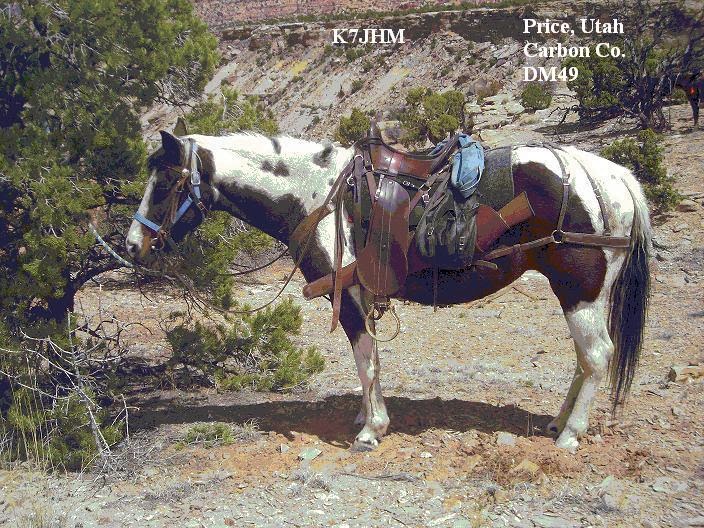
I made a comment in yesterdays post about being “Back in the Saddle Again” which made me think of a neat QRP station I worked several days ago.
This QRP station in the state of Utah (K7JHM) fit’s that description perfectly!
John Smithson, Jr., N8ZYA, is a regular contributor to AmateurRadio.com and writes from West Virginia, USA. Contact him at [email protected].
AnyTone AT-3318 – Reviews, opinions and experiences?

I like to play with new radios and own a small collection of Wouxun and Baofeng models. After my recent issues with my Wouxun HTs, I’ve been looking at trying the new AnyTone AT-3318. Has anyone here had a chance to use one? If you get a chance to use one, come back and leave a comment to share your thoughts about it.
The specs look promising and the price is competitive ($99.00).
- 5 Watts VHF
- 4 Watts UHF
- RX & TX 136-174 MHz & 420-520 MHz
- RX FM Broadcast 79-108 MHz
- Wide Band & Narrow Band
- 2.5 kHz tuning step for splinter frequencies
- 5/Tone encode and decode
- 199 Channels with Alpha Tags
- Squelch level adjustable for each channel
- Squelch tail elimination
- CTCSS that really works – when scanning channels, radio will stop ONLY when CTCSS tone is present
- VFO Scanning – frequency limits can be set for both VHF & UHF
- Channel Scanning – scanned channels can be ADDED or REMOVED via the keypad
- Frequency Reverse button – exchanges TX & RX frequencies
- Talk Around button – sets TX frequency to repeater’s output frequency
- Programmable by computer
- EASY to manually program
- Keypad totally lockable to meet FCC Part 90 requirements
Matt Thomas, W1MST, is the managing editor of AmateurRadio.com. Contact him at [email protected].
High Cost DX-peditions
There have been many reflectors, bloggers, etc... commenting on the current state of affairs in the high-end expedition world. Some of these expeditions have budgets in the $300,000 - $400,000 range. Many commenters discuss that unless amateurs contribute more, these expeditions will no longer happen and the "deserving" will be left with log books devoid of the most rare destinations. And that somehow, its is the responsibility of the non-expeditioning population to insure that these trips are properly funded and if you don't contribute, somehow you aren't paying your fair share.
My feelings, very simply, about this issue fall along the lines of how I manage my personal finances. If I can't afford it, I don't go. No-one is "obligated" to insure that my expedition is funded. That said, I have no issue with someone asking me to help defray their costs, e.g., I am paying for my expedition, if I do a good job and you want to make a contribution, then thank you. But not the approach; I need for you to contribute or I can't go. Two very different approaches.
All of this said, there is nothing new under the sun. I have been an amateur for 25 years and the same issues come up all the time. The fact is, no matter how expensive it gets, someone will go. If we need the entity and we feel inclined, then we should make a contribution, but don't put a guilt trip on me to pay for someone elses trip.
Back to regular programming.
Mike Crownover, AD5A, is a regular contributor to AmateurRadio.com and writes from Texas, USA. Contact him at [email protected].
Higher bands
Paul Stam, PC4T, is a regular contributor to AmateurRadio.com and writes from the Netherlands. Contact him at [email protected].
Watts conversion
The original version of K1JT’s WSPR software had pop-up “tip” windows that showed the power in watts when you hovered the mouse over the dBm setting. Very useful for duffers like me that can’t do a watts to dBm conversion in my head. The new version WSPR-X doesn’t, however.
I found (or more truthfully Google did) an online watts to dBm converter on the web which I have duly bookmarked.
Julian Moss, G4ILO, is a regular contributor to AmateurRadio.com and writes from Cumbria, England. Contact him at [email protected].
Roller Coaster
Like a lot of you in other places, we’ve been on a bit of a temperature roller coaster lately. Last weekend, after Christmas, it was up in the mid 50s (12C) here in New Jersey. This weekend, after New Year, we went as low as -3F (-19C) and our high for the day on Saturday was about 20F (-6C). That was just two days ago.
This morning, when I drove into work, it was 54F (12C). Now, after lunch, it is 38F (3C) and the temperature continues to free fall. By the time I leave to go home, I am sure that the temperature will be somewhere around the mid-20s (-4C). And over the next 24 hours, we’re supposed to get some of the coldest weather we’ve had here in over 20 years. The temperatures are expected to go below 0F (-17C) at night again, but this time with wind chills way lower than that. Tomorrow’s high is supposed to be only somewhere around 11F (-11C). But then, later towards the upcoming weekend, it’s supposed to warm up again to more like springtime temperatures.
Stop the roller coaster, I want to get off! I am NOT a big fan of the cold, but I sure wish that it would already stay one way or the other for a while. It’s winter time, so even though I don’t like it, I can deal with the cold for a bit. This teasing of Spring, and then the plunge back into the deep freeze is just cruel.
On a radio note, I was looking at the solar conditions yesterday and I was licking my lips. High SFI, a goodly number of sun spots and low A and K values. Having some free time for a change, I got on the air, expecting to hear a lot, and for a while I thought ALL my antennas were on the fritz! Nothing much heard yesterday, and nothing much worked. What a let down. At first I thought maybe everyone was working the ARRL RTTY Roundup, but even RTTY signals seemed sparse to me. In a major RTTY contest, we often get interlopers all the way down to the lowest of the low part of the bands. Yesterday, all the RTTY stations that I heard seemed to be staying way above the .060, QRP Watering Hole areas.
Maybe all the RF is freezing from the cold air and is just dropping out of the sky.
72 de Larry W2LJ
QRP – When you care to send the very least!
Larry Makoski, W2LJ, is a regular contributor to AmateurRadio.com and writes from New Jersey, USA. Contact him at [email protected].
Not so busy 70 cm ISM band
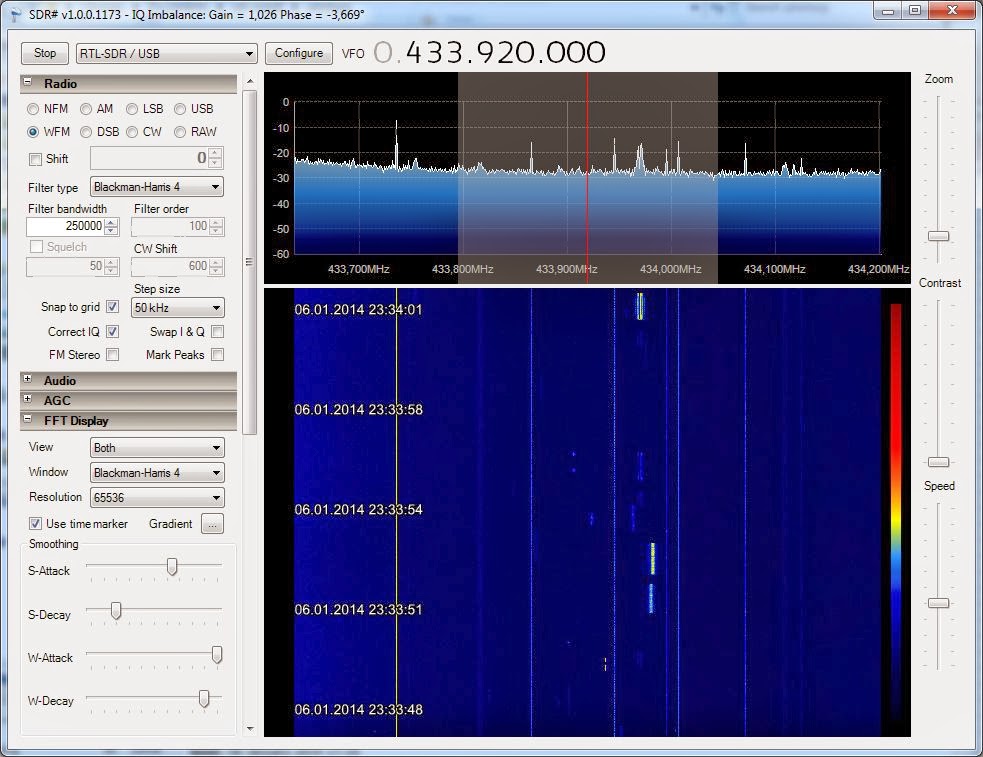
Yesterday’s post entitled “Car keys in the 70 cm band” showed a very busy band around 433.92 MHz with up to 10 simultaneous transmissions. That snapshot was taken on a Sunday afternoon at 16:32 local time. Here is a much less crowded snapshot taken with the USB SDR-RTL dongle under the same conditions as the previous blog post. The difference is that this is from late Monday night at 23:34 local time:
 |
| Press image for a larger view |
Thanks to all viewers who have made the former blog post the most popular on my blog for this week. Thanks also to the RTL-SDR blog which gave it publicity in the blog post “Looking at the 432 to 438 MHz ISM band“.
Related posts:
Sverre Holm, LA3ZA, is a regular contributor to AmateurRadio.com and writes from Norway. Contact him at [email protected].
 Ham Radio Deluxe |
 W5SWL Electronics |
 Ham Radio Prep |
 KB3IFH QSL Cards  Hip Ham Shirts  HamRadioAuctions HamRadioAuctions Reliance Antennas Reliance Antennas Enigma Shop Enigma Shop |  morseDX  Ni4L Antennas  R&L Electronics R&L Electronics antennas.us antennas.us QRV QRV |
- Matt W1MST, Managing Editor
