 |
 Tough Winter
 29 January 2014 | by
 As with most of the USA, this Winter of 2013/2014 sure has been a rough one! The cold snaps have been harsh and long lasting. And this has been causing the snow that we have gotten to stick around longer than usual for this area. Pardon the pun, but this Winter has been about 180 degrees different from last year, when we had only one minor snowfall. And for the most part, last Winter was downright balmy!
The extra cold weather has been kind of keeping me out of my basement shack. Thanks to our efficient gas furnace, all the heat goes to the upper floors, while the basement remains chilly. When the outside temperatures approach the single digits, my shack thermometer registers about 55F (13C), definitely not the most comfortable. Even with wearing a long sleeved T-shirt, a polo, AND a sweatshirt, I get to the point where my hands get cold and sending without errors becomes a chore.
Thanks to all of you who have been sending comments and emails with regard to my quest for a single lever paddle. I am still leading towards the Begali, but looking at some other manufacturers has been fun. It seems I always hesitate before making a purchase like this, as I am not used to spending money on myself. Plus the fact that I’m concerned about the cost of all the natural gas I’m burning this heating season, I have to double and triple think purchases like this.
The QRP Fox Hunt season enters the second half tonight. With the two pelts I nabbed on 40 Meters tonight, I have 16 pelts in 22 hunts for a .727 batting average. In the 80 Meter hunts, I have snared 13 out of 16 possible pelts for a .8125 batting average. Thanks to good propagation and the excellent ears of our Foxes, I am having one of the best seasons I have had in a while.
The last good news that I have for the night is that Jim W4QO posted on the North Georgia QRP Group email reflector that he has successfully worked Amsterdam Island FT5ZM with QRP, not once – but twice! Since Jim is a fellow Eastern Seaborder, that gives me hope. Amsterdam Island is close to 10,000 miles away from New Jersey, so that’s a long haul by any standard. Right there, that puts you close to 2,000 miles per Watt. With my dinky antenna farm, I am sure that if I work them at all, it will be during the second half of their stay on the Island. I read somewhere that if all goes well, the DXpedition will remain in place until about February 20th. So that gives me some time, and I will do my best to get them in the log.
72 de Larry W2LJ
QRP – When you care to send the very least!
Larry Makoski, W2LJ, is a regular contributor to AmateurRadio.com and writes from New Jersey, USA. Contact him at [email protected].
Latest Tinkering (or how Elecraft is taking all my money)
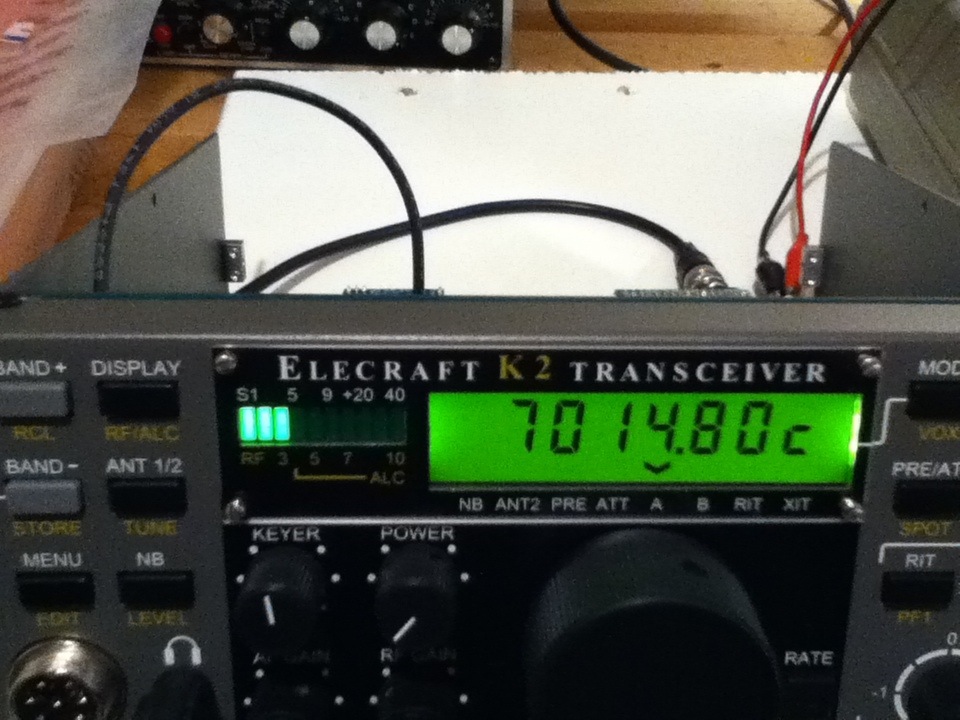
On Christmas Eve, I was sitting at my in-laws’ kitchen table with the Small Wonder Labs SW-40 I built as a high school kid in 1998 listening to beautiful music and I got the itch to come up with a radio smaller (and less expensive) than the K3 to drag around with me when I go places. My mind wandered to the NorCal Sierra, which was a featured project in ARRL Handbook’s of my youth. I was able to come up with a draft version of that Handbook article on the web—pause for a moment and think how revolutionary that is—my in-laws don’t have an ARRL Handbook, let alone the one that contained the Sierra article. I looked at the bill of materials and realized that I had some 70% of the parts in my junkbox. This seemed like a good idea until I went searching for a PCB.
Why PCB? Well, I’ve done the dead-bug thing and it works great but it’s a pain to troubleshoot and unless you have decades of experience doing it, it looks like a Mexico City suburb, sprawling unpredictably in every direction with only the most tenuous connections to the core. Since I was seeking a travel radio, I wanted it to be compact, easy-to-troubleshoot, and relatively rugged. Due in no small part to the wishes of the Sierra’s designers (not coincidentally founders of Elecraft), boards are no longer available. I looked into doing my own board, but if you don’t mix chemicals yourself, you’ve suddenly spent $150 on PCBs, plus the layout effort. I toyed with making the board smaller (a win in several ways) by using surface-mount parts but even that was a non-starter since my junkbox parts are through-hole, requiring me to buy everything.
Astute readers can extrapolate what occurred next. I went to the Elecraft web site to price the Sierra’s successor, the K1. I had all but made up my mind to sell off some junkbox items and raise the capital to buy a K1 kit when something occurred to me: fellow ham blogger Mike, VE3WDM, had recently moved to a smaller QTH and was offering a half-completed K2 kit for sale. His asking price was only a little more than the K1 kit with some of the options I wanted and it was all-band. The ad had been posted for some days by this point, so I fired off a sheepish e-mail to Mike asking if the radio was still available. It was. We sealed the deal and the radio made the somewhat tortuous ride (for us, not the radio—it sat in Chicago for two weeks) from his QTH to mine via the postal system.
I would not have bought a partially-finished kit from just anyone. However, since this was Mike’s second K2 build and he was documenting it carefully in a blog, I figured it was a pretty safe bet. So far, that is definitely true.
While I was eagerly awaiting the radio’s arrival, I redoubled my efforts to get a friend’s TS-930S off of my workbench, a task that involved replacing all 115 electrolytic capacitors on the cookie-sheet-sized “Signal Unit” board (similar to the K2 and K3 “RF unit”). That radio still has low drive (it has ALC again and sounds like a million bucks), something I traced to a hard-to-find semiconductor that’s now on-order. So, I gathered it up and started work on the K2 on Sunday afternoon.
Last night, I got it on 40 meters RX-only and peaked up the RX BPF. Former K2 owner KL9A mentioned to me that it has some blow-by on strong signals but that he thinks it’s a pretty good radio. I can confirm that based on my experience last night. It sounds really really good on CW.
More on the build to come…including a look back at some troubleshooting of the BFO circuit.
Ethan Miller, K8GU, is a regular contributor to AmateurRadio.com and writes from Maryland, USA. Contact him at [email protected].
USA on 40m JT65A

I was early this morning so I tuned to 40m (7076 KHz) JT65A frequency. I worked KJ4DHF Tim from Virginia. He was -16dB here and he gave me -13dB. My power was 25 watts. Only one qso because I had breakfast with my children. Just a short moment for taking advantage of the grey zone.
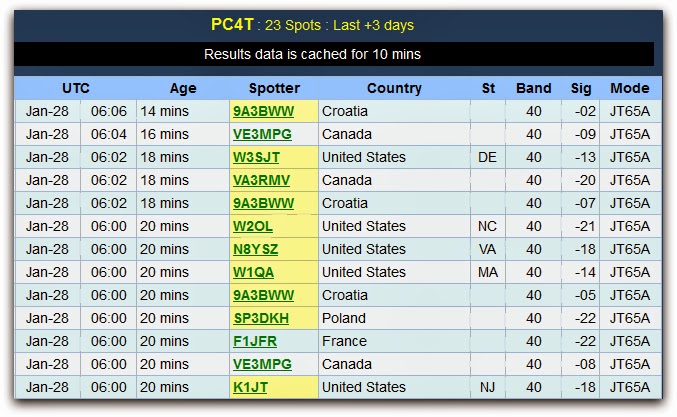
Paul Stam, PC4T, is a regular contributor to AmateurRadio.com and writes from the Netherlands. Contact him at [email protected].
Pondering
I am pondering the possibility of acquiring a single lever paddle, possibly the Bengali Simplex Mono, with the palladium base.
I have always been more comfortable with single lever paddles, and have always used any iambic paddles that I have owned that way. I am not a squeeze keyer.
The Sculpture Mono would be great, but the price tag is too hefty for my wallet. Any of you readers have a recommendation for a good single lever paddle other than Begali? Maybe there’s a good one out there that I am not aware of?
72 de Larry W2LJ
QRP – When you care to send the very least!
Larry Makoski, W2LJ, is a regular contributor to AmateurRadio.com and writes from New Jersey, USA. Contact him at [email protected].
Pileup
Last night after I had enough of writing software code I decided to turn on 160 meters. There was a contest going on, the CQ 160 meter CW contest. I like 160 meter contests for some reason. There’s something just a bit different about them. I have a decent, though modest antenna, an inverted L running about 30 feet vertically and 65 feet horizontally, with a six foot long loading coil on a piece of 1.5 inch PVC pipe. I have only eight or so radials, short by this band’s standards, but the antenna works rather well. My experiences with this antenna lead me to believe that a lot of people could do 160 meters if they just attempted to build an antenna like this, even on space-challenged lots. The antenna I have could fit in a quarter acre property. But I digress.
I turned on 160 and got my contest program going. I did the usual search-and-pounce starting from the bottom of the band and worked my way up. It was like shooting fish in a barrel, and I was starting to get bored with it. What the heck, let’s park somewhere and call CQ. I worked a few stations in the next 10 minutes and then it was like someone opened the floodgates. I had three, four, or five guys calling me each round. Amazingly I was able to pluck stations out of the pileup most of the time with no problem. This was going on for what seemed like an eternity. I started watching my rate meter and it hit 258 QSOs per hour at the peak and later settled down to around 150. This went on for about 45 minutes. I was in shock over the number of stations and how it was just relentless, but somehow I just went into overdrive and commanded the frequency. I’m not rare DX and I don’t have a super big signal on this band, but it was like everyone wanted me. The pileup started to subside and settled down to a few QSOs here and there and I was getting tired from a long day. I wished I had planned to make a serious effort in this contest; it probably would have been fun to start rested up right at dark when the band opened and work the band until the wee hours of the morning, maybe even attempting to crank up the CW speed up a bit.
All in all, I was really pleased with my performance with this unexpected pileup. Recently I have been training with Morse Runner while on business trips, mainly to break up the monotony of long flights. I can tell this practice has made a difference in my ability to manage pileups, pick out stations from the chaos, and rack up the QSOs. This could get interesting.

Anthony, K3NG, is a regular contributor to AmateurRadio.com.
QRP/SOTA Fun Without Climbing A Mountain
So I set up my operating position just as I would on a summit. I was testing one of the SOTA beams EFHW antenna with counterpoise and a homebrew 29 ft. wire. I brought along two tuners including Hi-Tee Tuner from SOTAbeams and a recently acquired Hendricks SLT+ 80m-10m end fed half wave tuner.
The SOTAbeams combo was my first configuration. I put the antenna over a limb about 15ft. up and let it slope down to another limb about 7 feet up and then down to the radio. The antenna wire terminated into a 4mm plug that prevented me from running through the eyelets of my pole. I plugged the wire into the tuner (which will only take a 4mm plug, there is no binding post) as well as the counter poise. The antenna tuned nicely and I had QSO with a station in Arizona. As I finished that QSO I tuned across the SOTA frequencies and heard W0CCA calling CQ SOTA from a summit in Arizona on 20m. Cool, now could I work him with this set-up? I usually don't have to wait long in a pile-up but for this QSO I would have to. I was tempted to run over to the QRO shack and make the contact to ensure I got the points since he was on a 10 pointer, however I resisted the temptation. My faith in QRP was rewarded, Cap finally heard me and gave me a 229. Cool.
So now I set-up the simple 29 ft. wire. Since it didn't have the banana plug on it, the Hi-Tee Tuner was useless, so I set up on the SLT+. I was able to use my pole this time, so the wire was higher off the ground in an inverted L configuration. By that time KX0R was calling CQ SOTA on 20m from a summit in Colorado. Evidently the pile-up had run it's course because I got him on the first call. So my little tuned wires had netted 12 SOTA chaser points. I am regularly amazed by QRP, how much you can do with a few watts and some wire.
A great day of QRP/SOTA fun.
Mike Crownover, AD5A, is a regular contributor to AmateurRadio.com and writes from Texas, USA. Contact him at [email protected].
All systems go…
I have disposed of a lot of junk being quite ruthless to reduce the clutter and have completely changed the layout, increasing the size of the desk and putting it on the other side of the room next to the workbench, which is much more logical.
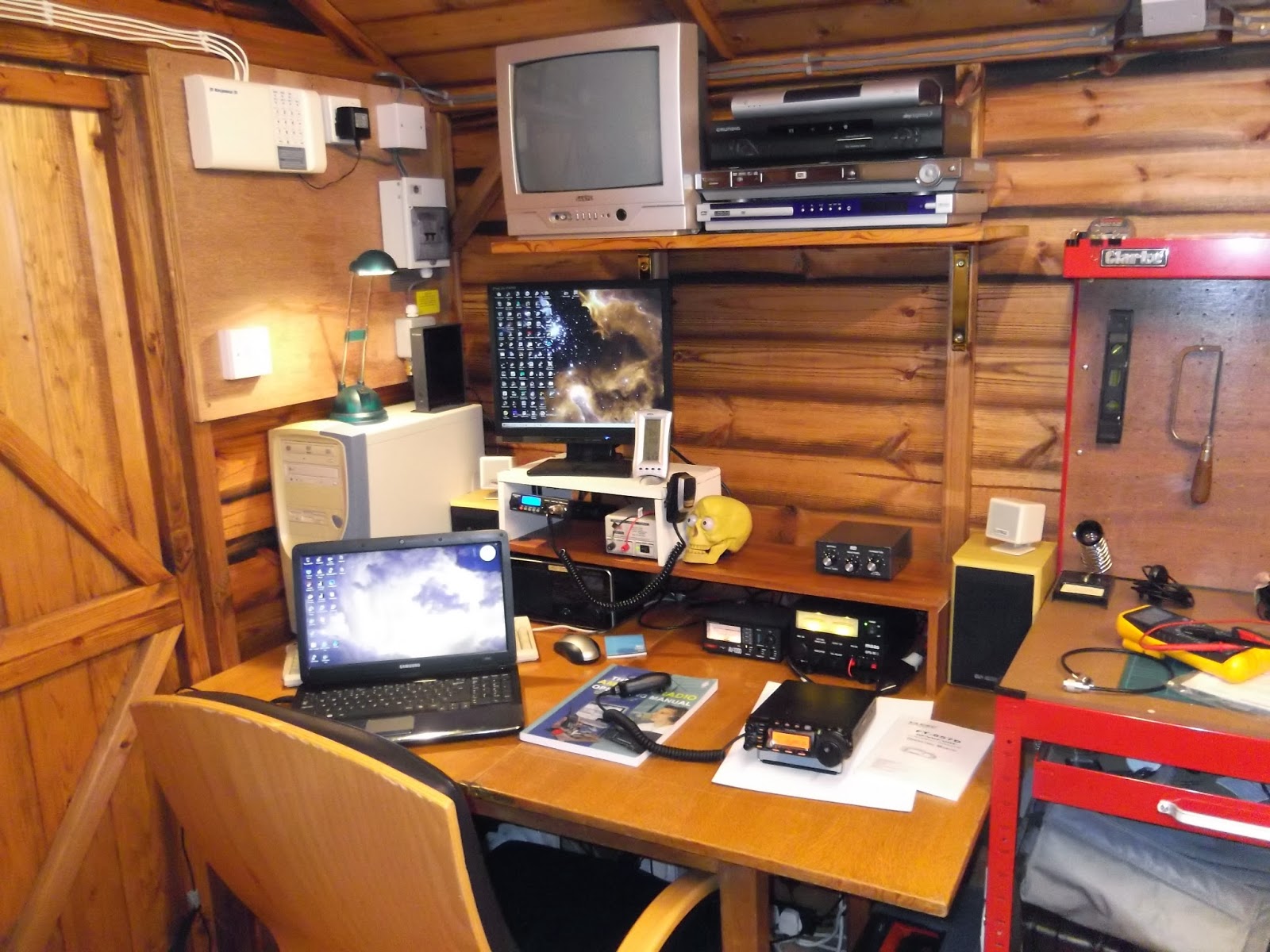 |
| The new look operation centre |
Unfortunately the weather this weekend has been horrendous, yesterday I planned to erect the antenna but gave up following the intense squall which hit in the afternoon with thunder, lightning and hail! Today hasn't been much better with heavy rain for most of the day, the rain did finally eased off so I managed to erect a temporary mast with the 144/430MHz collinear on the top and the HF antenna underneath. I know this isn't ideal as the mast is metal and may affect the HF, but seems okay. The forecast for the next few days is also a bit worrying but the mast is guyed at two heights so should be secure.
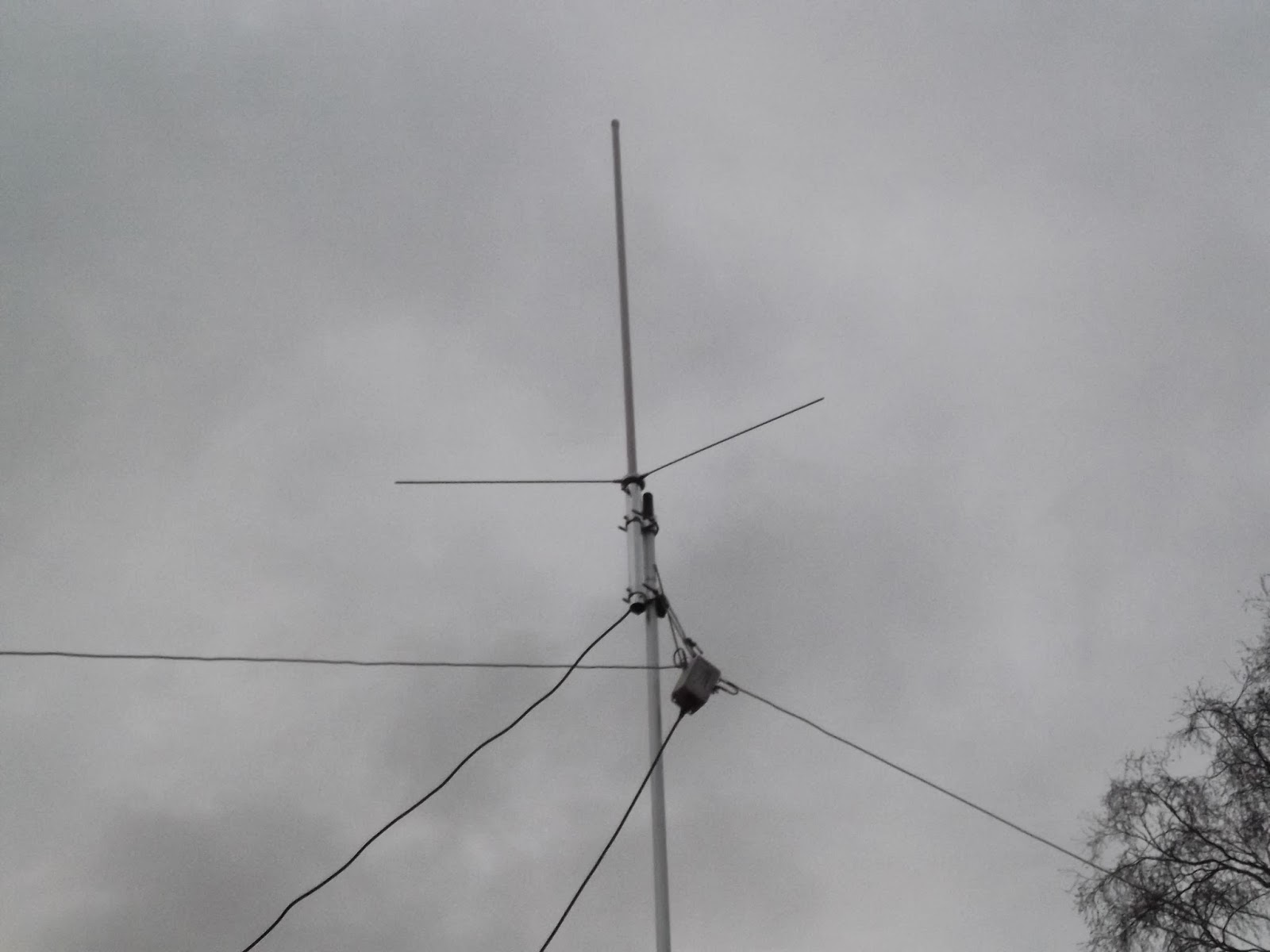 |
| The antennas, with the stormy sky behind |
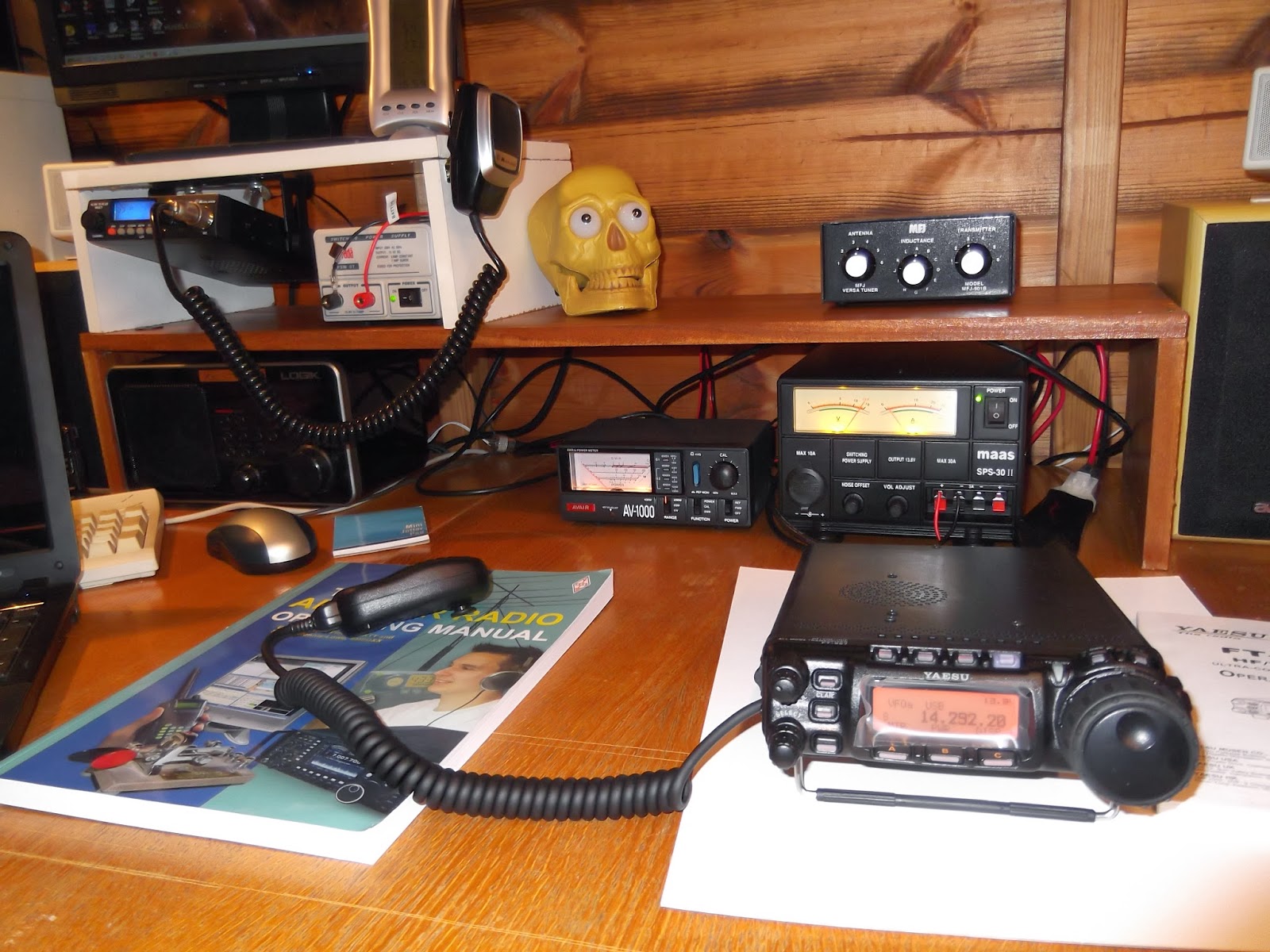
I have a power/swr meter suitable for HF/VHF and UHF I purchased at last years Hamfest and I have it connected in the setup, and was trying to check the SWR but it wasn't registering anything when I pressed the PTT then I realised that with SSB enabled it wouldn't!! Switching to FM and I was able to check that everything was okay... Beginners mistake I know!
Now off to read the manual..
Andrew Garratt, MØNRD, is a regular contributor to AmateurRadio.com and writes from East Midlands, England. Contact him at [email protected].
 Ham Radio Deluxe |
 W5SWL Electronics |
 Ham Radio Prep |
 KB3IFH QSL Cards  Hip Ham Shirts  HamRadioAuctions HamRadioAuctions Reliance Antennas Reliance Antennas Enigma Shop Enigma Shop |  morseDX  Ni4L Antennas  R&L Electronics R&L Electronics antennas.us antennas.us QRV QRV |
- Matt W1MST, Managing Editor
