 |
 And the winner is……
 25 February 2014 | by
 As I wrote in a previous post, being used to rigs from over 20 years ago it was quite a culture shock operating both the KX3 and the IC-7200. Knobs all have dual functions and there are menus abound with almost infinite options. RTFM is not an option, it is a must. In the beginning I found that I would often put my KX3 aside and go back to my tried, trusted and familiar TS130V to have my radio fix.
After I got the IC-7200 that changed, because to me the lay-out and functions came a bit more natural. I did have a “duh” moment when I connected a microphone to the set. I didn’t get the stock HM-36 mike but bought a HM-118TN instead, which is supposed to be wired identically. The mike would key the radio but no sound was being transmitted in SSB. Turned out there is a menu option where you can choose what input to use for SSB: the front connector, the USB connector or the rear aux connector. Maybe obvious to most, but it took me the entire evening to find out, resulting in a brand new microphone being completely disassembled and reassembled.
But after that everything was fine and dandy and now after some two months of operating both I can more or less say which of the two sets has my preference. And the winner is…….none at all! Both are fine rigs in their own right, but neither one will become my favourite rig. Here is why (and remember, these are my opinions based on my experience)….
First the KX3, the pros of this rig:
- an excellent receiver for CW and SSB
- very sharp filters
- excellent internal tuner
- easy CW operation and internal decoder
- energy efficient
- config menu system is very clear and arranged alphabetically
and the cons:
- volume is much too low and distorted when turned up
- lousy AGC
- lousy AM reception
- sub par reception below 1800 kHz
- no separate audio out
- no adaptive tuning speed
- clumsy operation for some functions
- inadequate cooling of the finals
- output power only 12 Watts
My biggest gripe with the KX3 is the audio output. I realize that the rig is designed for use with headphones, but I am not keen on using headphones inside the shack. When receiving weak signals I have to turn up the volume high (up to 50) to hear it comfortably (with NR off, because that reduces audio volume even further). If you then encounter a strong signal the AGC doesn’t kick in enough so you get distortion. I tried playing with the AGC settings, but to no avail. I also tried to further isolate the small speaker from the case, but also no improvement. I could use an external speaker, but that defeats the purpose of the KX3 as being a complete package in a small footprint.
Apart from the audio gripe the KX3 is a dream for CW operators. The spot function is so convenient I already miss it when not using the KX3. Even under noisy conditions the 50 Hz filter still produces clear signals. I compared both rigs during the CQ160 contest in January. On the IC-7200 I heard stations, but could not decode them. With the KX3 they came in clear and decodable. If the Elecraft K3 is as good at receiving as the KX3 it might well become my next rig.
Then the IC-7200. The pros here:
- easy to operate
- excellent audio for such a small speaker
- adaptive tuning speed
- one USB connection for audio and rig control
- filters are excellent for digital modes
- excellent reception on medium wave
- 100 Watts output power
and the cons:
- no band up/down buttons
- no PTT button
- narrow filters settings give a lot of ringing under noisy conditions
- lousy internal keyer
- some often used functions are not easy accessible
- sub par reception below 500 kHz
Operating CW with the IC-7200 is not as pleasurable as the KX3. With little noise the narrow filters work fine and give clear audio. But with the noise level going up, so does the ringing and that makes signals unintelligible. The USB cable connection for both rig control and audio is a great feature, but it has its disadvantages: below 10 MHz the noise from my laptop is noticeable and below 3.5 MHz it obliterates most signals, except the strongest ones. Unplugging helps, but that defeats the purpose of the USB connection, of course.
But you have to live with the cons and enjoy the pros, so I will. Need I make a choice I would keep the IC-7200, because it delivers more bang for the buck and the set just “feels” right to me. The KX3 doesn’t give me that comfy feeling when I operate it, but man, it sure can receive well. I don’t need to make a choice, though. I will keep both rigs because the KX3 will be used in my portable shack-in-a-box and the IC-7200 will remain on my desk for daily operations. It’s almost a bit like with cars: a station wagon for daily commutes and grocery shopping, and a sports car for those short drives in the weekend.
Hans "Fong" van den Boogert, BX2ABT, is a regular contributor to AmateurRadio.com and writes from Taiwan. Contact him at [email protected].
Sun is still very active
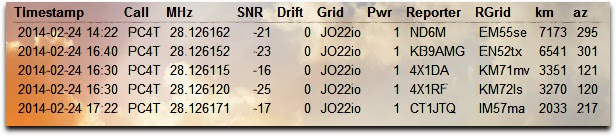
WSPR on 10 meter today with 1 watt output. Not much, but 2 reports across the pond. Tomorrow new HF black outs can be expected.
Paul Stam, PC4T, is a regular contributor to AmateurRadio.com and writes from the Netherlands. Contact him at [email protected].
Welcome new readers
I was very surprised, shocked even, to be asked to syndicate my postings to the site. Hopefully my posts will be of interest to a wider audience.
I have been a licensed amateur operator for six months currently on the bottom of the UK licence structure, the so called Foundation licence, but am hoping to take the Intermediate licence soon.
The main driving force for wanting to progress is I want to build things, to experiment and learn.
In a natural extension/diversion from my day job I have already been experimenting with the Arduino platform, initially with the intention of developing a High Altitude Balloon tracker but more recently with other radio related projects including a satellite tracker and using it in conjunction with DDS modules for WSPR/QRSS purposes. I have just built a dedicated Ultimate 3 QRSS kit from Hans Summers (G0UPL)
The DDS module are particularly interesting and I have some tentative plans for an Antenna Analyser and a Power/SWR meter capable of working down in the mW range which I stumbled across on the website of Loftur E. Jónasson - TF3LJ / VE2LJX. This is of particular interested to low power QRP operating. Did I mention that I have joined the GQRP Club?
Progressing from a couple of Baofeng VHF/UHF handhelds (which I hardly use) to a proper rig last month with the purchase of a Yaesu FT-857D I have been dipping my toe into the frightening world of operating!
It is common for new amateurs to be "Mike Shy" and I admit to suffering terribly. Not being the most outgoing or confident person being confronted by a barrage of rapid fire abbreviations, codes and etiquette it took a while before I had the courage to key up.
I plucked up the courage to have an attempt at some of the RSGB UKAC VHF evening contests and after gaining a bit of confidence I ventured properly onto the HF bands this weekend making a few simple signal report QSOs.
I should like to thank all those who have been patient with me as I fumble along.
Because of the shyness the use of data 'digital' modes is a strong draw since it uses computers and you don't have to talk! I am salvaged some suitable connectors to build a new computer data interface for the FT-857D, I built one several years ago but it got slightly cannibalised when experimenting with an ARPS gateway.
I can afford a commercial interface but why should I pay over the odds for something I can easily build myself? The desire to homebrew isn't just driven by cost, but lets be frank this can be an expensive hobby! Nothing gives more satisfaction when something you built works.. and yes they may be famous last words.
Andrew Garratt, MØNRD, is a regular contributor to AmateurRadio.com and writes from East Midlands, England. Contact him at [email protected].
Doing the MFJ loop happy dance!!
1. Tuning the loop for max noise (as low SWR was not happening) did happen but as soon as the rig was tuned in any way the noise dropped to nil.
2. Once max noise was achieved and I transmitted the max noise was gone again.
3. There was no spots on the Reverse Beacon Network while giving the tuned match a go.
4. When transmitting power levels were all over the place from 1 watt to 5 watts.
I had posted my 20m tuning problem on 2 loop user groups and had some great advice but nothing seemed to even come close to solving the problem. I then emailed MFJ who very promptly emailed me back and advised me to change the shape of a 12 gauge copper loop that was located inside the loop. Easier said than done this involved removing half the plastic cover on the loop and changing the shape of this loop then
 |
| Adjusting the loop |
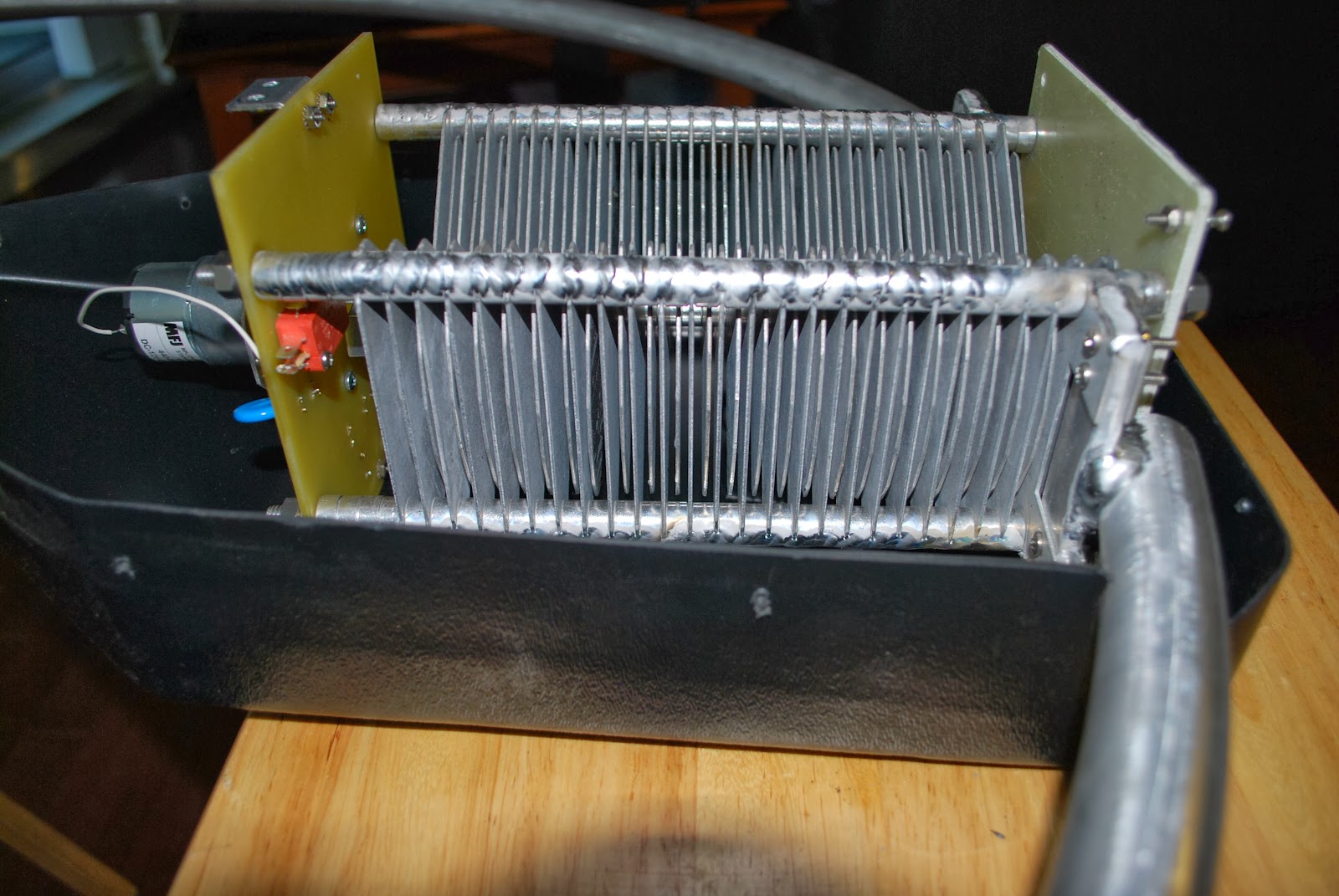 |
| Some plates to close |
Mike Weir, VE9KK, is a regular contributor to AmateurRadio.com and writes from New Brunswick, Canada. Contact him at [email protected].
TX Factor – new online ‘TV’ amateur show
I’m always a bit apprehensive when I hear there’s going to be a new amateur radio podcast. There have been some very good ones and some very bad ones! Just because someone is a keen radio amateur, doesn’t necessarily make them a good broadcaster on the subject!
The ‘TX Factor’ (corny name, but hey…) boded well. The presenters are all professional broadcasters. Bob, G0FGX is someone that I have come across on air a couple of times recently and he’s an engaging and interesting guy with plenty of broadcast experience. Mike G1IAR and Nick 2E0FGQ both have impressive CVs. Mike looks to have a particularly interesting job, mastering recording sessions for some big names.
I had a chance to catch up with the first TX Factor show yesterday. It’s well produced, engaging and inspires you to want to have a go. I really recommend you take a look.
I love Cornwall and it was interesting to see the Poldhu segment. I was glad to see that Bob addressed the question of whether Marconi’s ‘S’ signal really did get heard in Newfoundland! The SOTA activation was very nicely demonstrated by Tom M1EYP and it was good to see Mike G1IAR visit the Norman Lockyer Observatory in Devon. Great stuff.
Well done and I’m looking forward to seeing more shows. They must take quite a bit of production – well done to the team.
Find the TX Factor’s website here
Tim Kirby, G4VXE, is a regular contributor to AmateurRadio.com and writes from Oxfordshire, England. Contact him at [email protected].
Series Seven Episode Four – US Ham Survey (23 February 2014)
Series Seven Episode Four of the ICQ Amateur / Ham Radio Podcast has been released. The latest news, Martin (M1MRB) and Colin (M6BOY) discuss the an emergency box for local weather disasters and Frank Howell (K4FMH) reviews US Ham Survey.
- Outernet - Shortwave radio from space
- New Amateur Radio bands in Europe
- RaDAR Contest
- New Worcester UHF repeater goes on-air
- EURAO Party - Winter 2014 Promoting HF Digital Voice
- Second Amateur Radio Skills Workshop in Chelmsford (February 2014)
- Fully licensed in 57 days
- VK5 SOTA & Parks Symposium
- New Medium Wave Beacon
- Bristol's Cabot Tower sends out Morse code
Many thanks to this episodes donor, Andreas Genemans, KB3WGO and our monthly donors for keeping the podcast advert free. To donate, please visit http://www.icqpodcast.com/donate
Colin Butler, M6BOY, is the host of the ICQ Podcast, a weekly radio show about Amateur Radio. Contact him at [email protected].
Series Seven Episode Four – US Ham Survey (23 February 2014)
Series Seven Episode Four of the ICQ Amateur / Ham Radio Podcast has been released. The latest news, Martin (M1MRB) and Colin (M6BOY) discuss the an emergency box for local weather disasters and Frank Howell (K4FMH) reviews US Ham Survey.
- Outernet - Shortwave radio from space
- New Amateur Radio bands in Europe
- RaDAR Contest
- New Worcester UHF repeater goes on-air
- EURAO Party - Winter 2014 Promoting HF Digital Voice
- Second Amateur Radio Skills Workshop in Chelmsford (February 2014)
- Fully licensed in 57 days
- VK5 SOTA & Parks Symposium
- New Medium Wave Beacon
- Bristol's Cabot Tower sends out Morse code
Many thanks to this episodes donor, Andreas Genemans, KB3WGO and our monthly donors for keeping the podcast advert free. To donate, please visit http://www.icqpodcast.com/donate
Colin Butler, M6BOY, is the host of the ICQ Podcast, a weekly radio show about Amateur Radio. Contact him at [email protected].
 Ham Radio Deluxe |
 W5SWL Electronics |
 Ham Radio Prep |
 KB3IFH QSL Cards  Hip Ham Shirts  HamRadioAuctions HamRadioAuctions Reliance Antennas Reliance Antennas Enigma Shop Enigma Shop |  morseDX  Ni4L Antennas  R&L Electronics R&L Electronics antennas.us antennas.us QRV QRV |
- Matt W1MST, Managing Editor
