 |
 Nancy, WZ8C/SK – It’s a sad sad day
 4 March 2014 | by
Msg from Dennis, K6DF follows:
To All FISTS Members: Early this afternoon I received a phone call from Tim, Nancy’s husband. I am very sad to report that Nancy WZ8C, is now a silent key. Nancy passed away last night and will be missed very much by all FISTS members worldwide.
If you wish to send condolences to her family, please send them to the following address:
Tim Lange and Family
P.O. Box 47
Hadley, MI, 48440.
Please send this notice to any and all FISTS groups and members to disseminate this information as much as possible.
I sadly send 73, God’s Speed Nancy, 88’s . . . Dennis Franklin K6DF FISTS Awards Mgr /Webmaster
End MSG
Nancy was only 58 according to her obituary. Way too young to pass. She will be missed by all FISTS members.
73, Nancy de Larry W2LJ
FISTS #1469- dit dit
Larry Makoski, W2LJ, is a regular contributor to AmateurRadio.com and writes from New Jersey, USA. Contact him at [email protected].
More fun on 29MHz AM
Over the weekend I had my first QSOs on 29MHz AM from the home station, using the FT847. It seemed to work fine, although I had a sense that my long feeder run was a bit of a barrier and I was probably doing better with slightly less power from the mobile!
On the train last night I was chatting on Twitter to Jon, G0IUE. Jon is located in Corsham, some 35 miles or so to the west of me. Jon had been working some nice DX in the late afternoon on 29MHz AM and I suggested that as I would soon be back at the car, we have a go and see if we could make a QSO.
As I was getting of the train, I had a tweet from Jon to say that he was working OX1B on 29.050 AM. I hurried along the platform as quickly as I could and got back to the car, but the frequency was quiet. However, I left the rig on the frequency and started my journey.
As I got out of the built up area, I could start to hear some weak signals and realised it was Jon calling CQ. Although I couldn’t copy him fully at that stage, I could tell he was there. Larry K1IED replied to Jon’s CQ and started a QSO. During one of the breaks in transmission, I dropped my call in and was delighted when Larry heard me.
Heading west all the time, near Abingdon, I was able to hear Jon quite well on ground wave. We were able to have a three way QSO for several minutes. Larry signed with us and Jon and I QSYed to GB3WH on 2m FM.
My destination, the Gym at Carswell, has quite a good take off in Jon’s direction, so on my arrival, I suggested to Jon we try on 29MHz AM. We did and we just able to exchange signals. Jon was easy copy for me, but my slightly lower power from the Anytone was only just making it. We moved onto SSB and it was a very easy QSO. Larry K1IED had been listening and joined in on SSB which was great fun.
A really nice, fun QSO – the stuff that memories of solar cycles are made of!
Jon shot a bit of video of the QSO (on AM) with Larry coming in really well.
Tim Kirby, G4VXE, is a regular contributor to AmateurRadio.com and writes from Oxfordshire, England. Contact him at [email protected].
Not much more to go now
Change is a really handy tool. I’m in the business of delivering projects which always means change. So when it came to managing some change at home I thought I knew what I was doing. When I say change I mean a little bit of landscaping that a fellow ham was going to do and at the same time put in a new cables and a post ready for my new mast and antenna. This mean a bit of planning, cost control and some stakeholder management. Or so I thought.
I had originally decided on extending the house and had some lovely plans drawn up (which included a mast and antenna), put them through planning (domestic / xyl and local council) had them approved only to find that the local builders wanted huge sums for a small job. Hence the scope was reduced to meet the budget.
For the last few weeks I have toiled int he freezing rain to drill new holes in the side of the house, removed old and corroded (poor finishing by me) cables and then set about running new ones before removing some old decking that was the cause of our problem (wooden decking and West Cumbria should be avoided). What is going to go in its place is a mast stub in the ground, ground mounted rotator, heavy duty 12.5m mast and a folding hexbeam.
The schedule is hectic but I imagine in a matter of 4 weeks I will be back on the air on hf and there will be a very tired out g7kse, ready for for some leisurely operating on hf and perhaps in time for some early Es. Until then its the UKAC VHF tuesday nights for me still.
Alex Hill, G7KSE, is a regular contributor to AmateurRadio.com and writes from Cumbria, UK. Contact him at [email protected].
Out and About – Part 2
Saturday was the total opposite of Friday. BM2LDT and I had the plan go out to the seaside to take both our KX3s out for a spin. I picked him up in my old clunker and we drove to a place called Qian Zhou-zi (前洲子 in PL05rf), between Danshui and San Zhi.

We got there a little after two in the afternoon (0600 UTC) and set up the MP1 on a stand and a Diamond RHM8B antenna on the car. Strangely enough it seemed there were no conditions, because there were only a few signals around and nobody came back to my calls. So instead we did some antenna measurements with an RigExpert analyzer. My el-cheapo VHF/UHF whip turned out to be very good on 2 meters, but not so good on 70 cm. The Diamond RHM8B was mounted on the car and could easily be brought into resonance. However, it didn’t didn’t perform as well as the MP1.

BM2LDT next to the car with the MP1 in the foreground.
Then 10 meters started to produce some European signals and the first one who answered was G4ELJ. Nice QSO, but in SSB. The CW portion was still empty and by the end of the afternoon I had logged another 4 SSB 10 meter QSOs: RU3GB, OT4A, DK3T and OZ2PBS. We also checked a SOTA activation on 24.950 MHz in Austria, but signals were too weak to copy. Still, the salt water boost I was hoping for did allow us to work Europe with only 10 Watts in SSB.

Right after my QSO with OT4A. It’s getting chilly now.
We hadn’t seen much of the sun all afternoon and by 0930 UTC it became rather chilly, so we packed up and went home. Being Dutch I always enjoy the smell of the sea, so despite a lack of some warm sunshine and loads of DX it was still a very worthwhile portable operation.
Hans "Fong" van den Boogert, BX2ABT, is a regular contributor to AmateurRadio.com and writes from Taiwan. Contact him at [email protected].
Final repairs on MFJ loop
 |
| Time to repair the control box. |
 |
| Ready to remove switch |
 |
| A great tool to have |
Mike Weir, VE9KK, is a regular contributor to AmateurRadio.com and writes from New Brunswick, Canada. Contact him at [email protected].
Events in Ukraine
I have just got off the air after making several contactsintoRussia and Ukraine on 10m PSK31. Ham radio transcends political boundaries and engenders friendships betweenpeople of all nations. All politicians could learn from it. My thoughts today are particularly with my radio friends living in Ukraine I hope that peace and normality are restored soon
до свидания!
Julian Moss, G4ILO, is a regular contributor to AmateurRadio.com and writes from Cumbria, England. Contact him at [email protected].
Cheap GPS module
Most GPS devices have a limit on the altitude they work at, normally 60,000 feet or less. This is a legacy of the now defunct CoCom (Coordinating Committee for Multilateral Export Controls) restrictions. For my HAB project this restriction needs to be disabled and the GPS must be switched into 'flight mode' In the HAB community the favoured devices are made by U-BLOX
Therefore when I was sourcing a GPS I had search specifically for a inexpensive device using a U-BLOX.
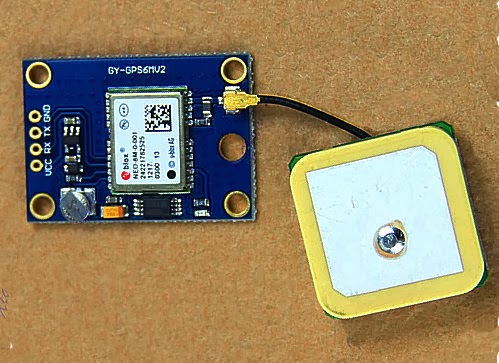 s s |
| The GY-GPS6MV2 as supplied |
It is also available from domestic suppliers but often at a much more inflated price, but you don't have to wait several weeks for them to be delivered.
There are many other GPS modules available but this module seems to be one of the cheapest available. it is often listed as a NEO6MV2 GPS Module Aircraft Flight Controller.
The module consists of a small PCB 25mm x 35 mm size with a separate ceramic antenna connected by a small lead which is 25mm x 25mm in size. The Antenna is quite heavy and isn't suited to Pico HAB payloads but for other uses is more than satisfactory.
On the board is a small button-cell battery to provide backup to the GPS chip and a small EEPROM connected to the GPS chip which I believe can store configuration(s). I haven't used it myself just using the module in it's default set up at the moment. For a schematic click here
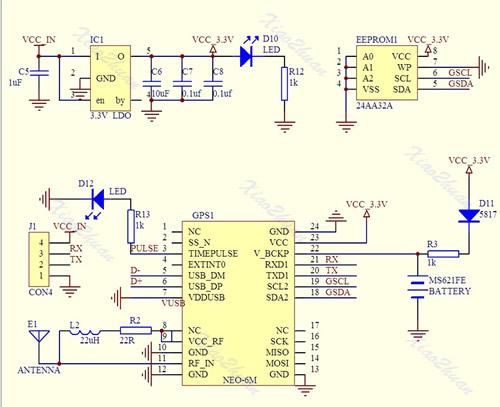
The board has four connectors VCC, GND, TX (Transmit) and RX (Receive) and can be powered by the 5V supply on Arduino boards since it has a small regulator to provide the 3.3V needed.
In most projects all that is required is data out of the GPS. The GPS TX (data out) being connected directly to the microcontrollers RX (data in) The (0V and 3.3V) level shift of the signal is compatible with the TTL input of the microcontroller.
The GPS by default will start up and output standard NMEA sentences at 9600 Baud, until GPS position lock is achieved the NMEA sentences won't have a long/lat location. The module also has an LED which will start flashing once a lock is achieved.
There is no direct connection for the highly accurate 1PPS (pulse per second) signal that can be used for frequency calibration, but the flashing LED is driven by pin 3 of the GPS module which is the 1PPS (pulse per second) signal required.
The 1PSS signal, like the TX is either 0V and 3.3V, in order to use it a small lead will need to be soldered onto the board, either directly onto Pin3 of the GPS chip, or alternatively on to the small current limiting resistor used by the LED, as indicated below.
 |
| Showing the GPS 1pps points |
Andrew Garratt, MØNRD, is a regular contributor to AmateurRadio.com and writes from East Midlands, England. Contact him at [email protected].
 Ham Radio Deluxe |
 W5SWL Electronics |
 Ham Radio Prep |
 KB3IFH QSL Cards  Hip Ham Shirts  HamRadioAuctions HamRadioAuctions Reliance Antennas Reliance Antennas Enigma Shop Enigma Shop |  morseDX  Ni4L Antennas  R&L Electronics R&L Electronics antennas.us antennas.us QRV QRV |
- Matt W1MST, Managing Editor
