 |
 Finished the Shack-in-a-Box
 27 February 2014 | by
 Normally my projects take a long time to finish because I can’t find the right materials (I’ll dedicate a post on that later). But my “Shack-in-a-Box” project was done fairly quickly: only six weeks.
The box is an old German army issue box that my Junker straight key came in. Very sturdy and not too heavy.

I padded it with foam I got from a shop selling notebook batteries; the plexiglass dividers were left-overs from old cosmetic product displays. The little basket was a dollar from the local hardware store and the only thing bought new.

Everything but the antenna is in there: the KX3, LiPo battery (old laptop battery cells from a friend), the touch paddle and various cables. There are ear plugs and an old computer microphone with which I get very good audio reports. With this setup it takes me less than a minute to be operational and packing up is equally fast. This weekend is a long one in Taiwan because of Peace Memorial Day and I’ll be out on the coast doing my first serious stint of portable operation. If you hear me on air don’t hesitate to call me. 73.
Hans "Fong" van den Boogert, BX2ABT, is a regular contributor to AmateurRadio.com and writes from Taiwan. Contact him at [email protected].
Thank you Pietro and Bruna!
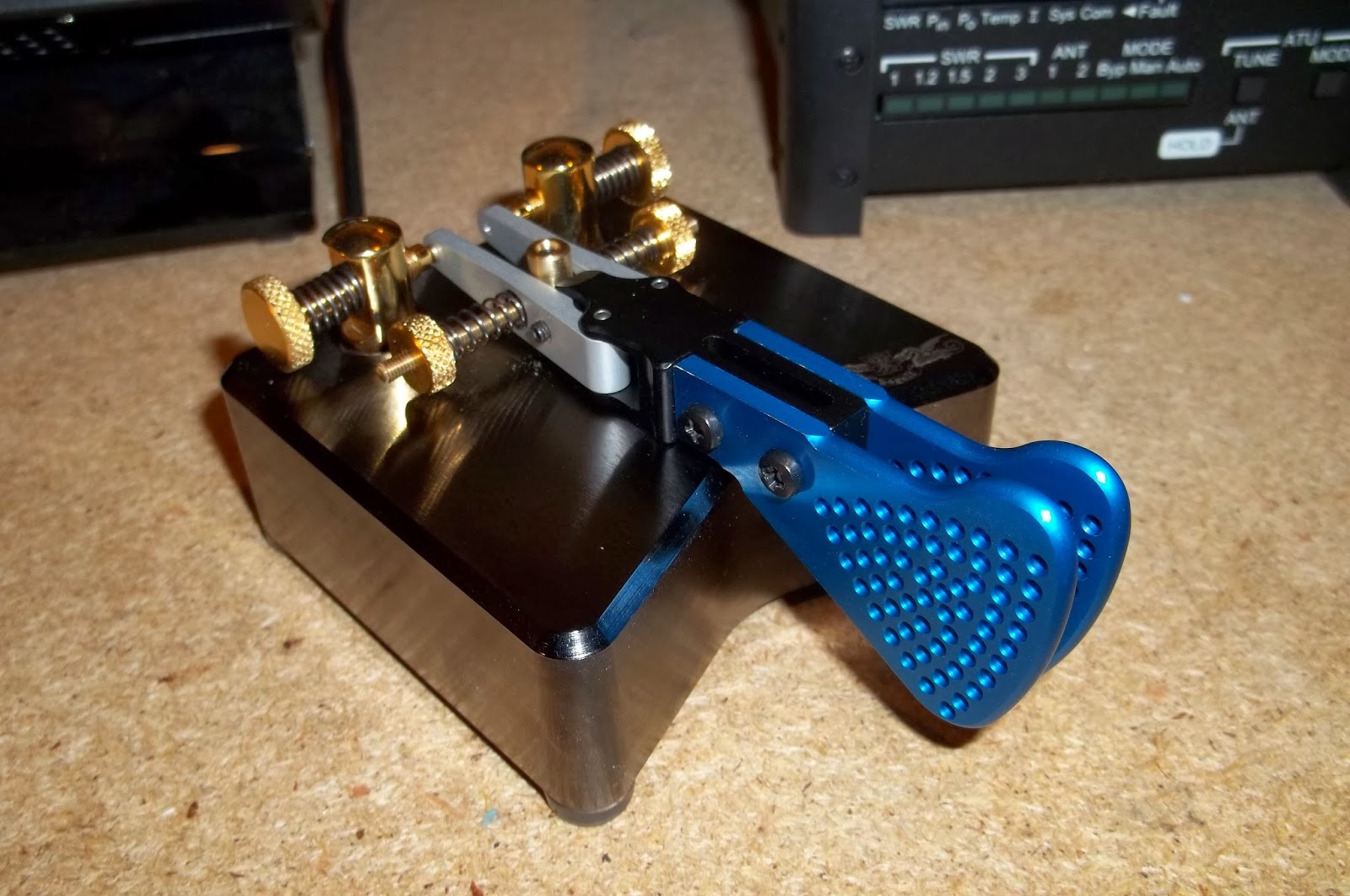
Thanks for the sexy, royal blue aluminum finger pieces! I removed the black plastic ones and put these on. Oh, and by the way, they also sent me a spare pair of black aluminum ones, too!
72 de Larry W2LJ
QRP – When you care to send the very least!
Larry Makoski, W2LJ, is a regular contributor to AmateurRadio.com and writes from New Jersey, USA. Contact him at [email protected].
A book for DXers and dreamers: Pocket Atlas of Remote Islands by Judith Schalansky
Out for a lunchtime walk yesterday, I decided to pop into the local bookshop for a browse, not particularly intending to buy anything.
However, in the ‘travel’ section, I came across a lovely little book called ‘Pocket Atlas of Remote Islands: Fifty Islands I have not visited and never will’ by Judith Schlansky. As I leafed through the book, beautifully presented, I realised that in a manner of speaking, I had ‘visited’ many of the islands mentioned through the medium of radio.
When we have a contact with a distant island though, it is easy for it to be just a tick on a list and very often we have little sense of what life is like there. This is where this book comes in nicely!
For each island, there’s a map – as well as a couple of pages with some background to the island. In fact, the entry for Annabon relates directly to amateur radio and the aborted DXpedition in the early years of the ‘noughties’.St Kilda’s entry was even sadder, describing the issues of infant mortality that had beset the island.
I only browsed a handful of islands last night, but for anyone who is interested in the big wide world out there, and I’m certain that includes many radio amateurs – you’ll love this book!
Tim Kirby, G4VXE, is a regular contributor to AmateurRadio.com and writes from Oxfordshire, England. Contact him at [email protected].
I guess I am not the hardiest individual
This past weekend, we enjoyed some temperatures in the upper 40s and lower 50s (9 to 12C) and we had a lot of snow melt. I’ve even seen some robins hopping about – a sure sign that Spring is on the way. These Polar Vortices that we have been enduring, bringing bone chilling cold and snow down into our midst have sure taken a bite out of my lunch time QRP operating sessions.
I guess I am not the hardiest individual. While I love QRP and CW, and getting on the air as much as I can, I do not cherish the cold weather. I have not been on the air at lunchtime since last December. Way back then, daytime temperatures were tolerable, and I didn’t mind sitting in the car and pounding brass. It was chilly, but not mind numbingly cold.
The past few Winters spoiled me. I look back at my logbook, and I see that there were actually days that were so mild in January and February, that I actually spent some lunch hours out of doors in the local park! This year, that would have been the height of insanity. Hating the cold weather as much as I do, even Amateur Radio is not enjoyable for me if I am not comfortable. Operating under adverse conditions during an emergency is one thing. Doing it when you’re supposed to be just having everyday fun is not my cup of tea.
The good news is that, if the weather prognosticators are correct, we should be heading into more normal temperatures come maybe the second week of March. So even if it isn’t balmy, it will be more than warm enough to head out to the car for some daily lunch hour QRP. The old 60’s song rings true – “Don’t it always seem to go that you don’t what you’ve got ’til it’s gone?” I really miss my daily fix of QRP.
72 de Larry W2LJ
QRP – When you care to send the very least!
Larry Makoski, W2LJ, is a regular contributor to AmateurRadio.com and writes from New Jersey, USA. Contact him at [email protected].
Air mobile over Colorado
http://www.youtube.com/watch?v=5Vdpsg_ZLwE
John W1LNX worked Scott W9AFB aeronautical mobile over Colorado recently. Not a bad signal for just over 100 miles away. I am curious about his distance record.
According to John’s description, Scott was operating aboard a Boeing C-135 (or one of the many variations thereof) at about 33,000 feet.
Although Scott’s transceiver in the airplane is limited to 2M and 6M, I think his enviable operating position gives new meaning to the term “air superiority”!

Matt Thomas, W1MST, is the managing editor of AmateurRadio.com. Contact him at [email protected].
Show off your project in a clear top tin

I first learnt about these tins from the 4 State QRP Group. They advertised them as “Clear Top Enclosure – An Altoids On Steroids. Do you need an enclosure slightly larger than an Altoids tin? Would you like to see your project after building it, instead of hiding it? If so, this enclosure is for you!”
The rectangular hinged tins are no longer sold by the 4 State QRP Group, but I was able to buy them from Specialty Bottle via a friend of mine in the US (their minimum order for export was too high for me).
My projects from left to right and top to bottom are:
- Component tester (transistors, capacitors, resistors, inductors, equivalent series resistance) from Ebay based on this open source design.
- Direct digital synthesis (DDS) generator that generates RF from 0 to 20 MHz
- Ultimate2 QRSS kit transmitter from G0UPL
- 3.5 MHz Pixie transceiver
- AVR Butterfly Morse keyer from KD1JV
- Softrock Lite 6.2 SDR (Software Defined Receiver) in an enclosure which originally housed a 4.5″ USB flash disk.
Sverre Holm, LA3ZA, is a regular contributor to AmateurRadio.com and writes from Norway. Contact him at [email protected].
And the winner is……
As I wrote in a previous post, being used to rigs from over 20 years ago it was quite a culture shock operating both the KX3 and the IC-7200. Knobs all have dual functions and there are menus abound with almost infinite options. RTFM is not an option, it is a must. In the beginning I found that I would often put my KX3 aside and go back to my tried, trusted and familiar TS130V to have my radio fix.
After I got the IC-7200 that changed, because to me the lay-out and functions came a bit more natural. I did have a “duh” moment when I connected a microphone to the set. I didn’t get the stock HM-36 mike but bought a HM-118TN instead, which is supposed to be wired identically. The mike would key the radio but no sound was being transmitted in SSB. Turned out there is a menu option where you can choose what input to use for SSB: the front connector, the USB connector or the rear aux connector. Maybe obvious to most, but it took me the entire evening to find out, resulting in a brand new microphone being completely disassembled and reassembled.
But after that everything was fine and dandy and now after some two months of operating both I can more or less say which of the two sets has my preference. And the winner is…….none at all! Both are fine rigs in their own right, but neither one will become my favourite rig. Here is why (and remember, these are my opinions based on my experience)….
First the KX3, the pros of this rig:
- an excellent receiver for CW and SSB
- very sharp filters
- excellent internal tuner
- easy CW operation and internal decoder
- energy efficient
- config menu system is very clear and arranged alphabetically
and the cons:
- volume is much too low and distorted when turned up
- lousy AGC
- lousy AM reception
- sub par reception below 1800 kHz
- no separate audio out
- no adaptive tuning speed
- clumsy operation for some functions
- inadequate cooling of the finals
- output power only 12 Watts
My biggest gripe with the KX3 is the audio output. I realize that the rig is designed for use with headphones, but I am not keen on using headphones inside the shack. When receiving weak signals I have to turn up the volume high (up to 50) to hear it comfortably (with NR off, because that reduces audio volume even further). If you then encounter a strong signal the AGC doesn’t kick in enough so you get distortion. I tried playing with the AGC settings, but to no avail. I also tried to further isolate the small speaker from the case, but also no improvement. I could use an external speaker, but that defeats the purpose of the KX3 as being a complete package in a small footprint.
Apart from the audio gripe the KX3 is a dream for CW operators. The spot function is so convenient I already miss it when not using the KX3. Even under noisy conditions the 50 Hz filter still produces clear signals. I compared both rigs during the CQ160 contest in January. On the IC-7200 I heard stations, but could not decode them. With the KX3 they came in clear and decodable. If the Elecraft K3 is as good at receiving as the KX3 it might well become my next rig.
Then the IC-7200. The pros here:
- easy to operate
- excellent audio for such a small speaker
- adaptive tuning speed
- one USB connection for audio and rig control
- filters are excellent for digital modes
- excellent reception on medium wave
- 100 Watts output power
and the cons:
- no band up/down buttons
- no PTT button
- narrow filters settings give a lot of ringing under noisy conditions
- lousy internal keyer
- some often used functions are not easy accessible
- sub par reception below 500 kHz
Operating CW with the IC-7200 is not as pleasurable as the KX3. With little noise the narrow filters work fine and give clear audio. But with the noise level going up, so does the ringing and that makes signals unintelligible. The USB cable connection for both rig control and audio is a great feature, but it has its disadvantages: below 10 MHz the noise from my laptop is noticeable and below 3.5 MHz it obliterates most signals, except the strongest ones. Unplugging helps, but that defeats the purpose of the USB connection, of course.
But you have to live with the cons and enjoy the pros, so I will. Need I make a choice I would keep the IC-7200, because it delivers more bang for the buck and the set just “feels” right to me. The KX3 doesn’t give me that comfy feeling when I operate it, but man, it sure can receive well. I don’t need to make a choice, though. I will keep both rigs because the KX3 will be used in my portable shack-in-a-box and the IC-7200 will remain on my desk for daily operations. It’s almost a bit like with cars: a station wagon for daily commutes and grocery shopping, and a sports car for those short drives in the weekend.
Hans "Fong" van den Boogert, BX2ABT, is a regular contributor to AmateurRadio.com and writes from Taiwan. Contact him at [email protected].
 Ham Radio Deluxe |
 W5SWL Electronics |
 Ham Radio Prep |
 KB3IFH QSL Cards  Hip Ham Shirts  HamRadioAuctions HamRadioAuctions Reliance Antennas Reliance Antennas Enigma Shop Enigma Shop |  morseDX  Ni4L Antennas  R&L Electronics R&L Electronics antennas.us antennas.us QRV QRV |
- Matt W1MST, Managing Editor
