 |
 An Old Buzzard’s Guide to Getting Started with HSMM-Mesh
 2 March 2014 | by
 Getting started with HSMM-Mesh™ (High Speed Multimedia-Mesh), also known as Broadband Hamnet™, can be daunting to hams that have the interest, but lack the expertise of network engineers. Indeed, perusing comments and documents on the Web can be confusing to newcomers who want to participate in setting up Amateur Radio broadband mesh networks under FCC Rules in Part 97.
Alex Mendelsohn, AI2Q, is a special contributor to AmateurRadio.com.
Nostalgia post: 49MHz handhelds and AM CBs
I was thinking about the ‘Handy from Tandy’ conversion from 49MHz and it occurred to me that the first set that I ever transmitted on was a 49MHz handheld.
It must have been around 1980 when I was a keen shortwave listener and starting to get interested in getting an amateur licence. My parents had taken us on holiday to Fishguard in Pembrokeshire. Just along the A487 from Fishguard towards Cardigan is the village of Dinas. This particular year, a new shop had appeared in Dinas, a CB shop. I was very keen on looking in the shop window!
Of course, at this stage, CB was illegal in the UK and as I was living at home – there was no possibility of illegal operation – not that I would have done anyway 🙂
I can remember a number of 49MHz handhelds for sale in the shop as well as the 27MHz AM sets.
When I returned home to Cheltenham, I researched the 49MHz handhelds. They were very low power and they appeared to be legal to use. I bought a set of two. The range was probably 100-200 yards in a built up area. A couple of doors from me lived Jon, G6BHS, so it made perfect sense for Jon to have the other handheld and for us to use them to chat. Good fun!
27MHz CB was legalised in 1981, on FM, and I very quickly purchased a CB licence and a Cybernet Beta 1000 set (great receiver!) and had some fun and learned some basics about aerials and propagation.
Of course, it was just the push I needed to get my first amateur licence, G6TTU early in 1983.
Tim Kirby, G4VXE, is a regular contributor to AmateurRadio.com and writes from Oxfordshire, England. Contact him at [email protected].
Snow is coming
And I certainly hope this is the last blast for the Winter of 2013/2014. The Equinox is less than three weeks away, and I am ready – perhaps readier than I’ve been in a while. The snow that is forecast to start this afternoon, and last into Tuesday morning my bring us 4 inches – and then again may bring us 14-18 inches. The meteorologists just cannot seem to agree on this one. So that tells you the situation is extremely volatile, and we’ll just have to wait until after it’s over to see who was right.
But in the meantime, here are some warm weather thoughts from the Buddies in the Caribbean from LAST Winter. Barbados seems like a good place to be right about now!
I was able to get on the air for a bit yesterday afternoon. The CW portion of the bands were kind of on the barren side, as the ARRL DX SSB was going on. I could swear I heard a tumbleweed or two blow through. But I did manage to work W1AW/7 in Washington State on both 12 and 15 Meters – first call with QRP each time. I also worked HK7/AL4Q – an Alaskan call in Colombia – that’s different! I also worked EA6BH in Mallorca. That’s probably another wonderful place to be this time of year.

Clear away those dishes after a delightful dinner – enjoy some wine and set up the KX3, throw an EFHW over the railing, and we’re good to go!
I can dream ….. can’t I?
72 de Larry W2LJ
QRP – When you care to send the very least!
Larry Makoski, W2LJ, is a regular contributor to AmateurRadio.com and writes from New Jersey, USA. Contact him at [email protected].
50mW on 50MHz FM – ‘The Handy from Tandy’
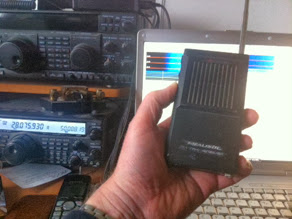
Earlier in the week, I noticed a handheld 50MHz FM transceiver on eBay for £6.99. I read a little and it turned out to be a converted Tandy/Realistic 49MHz handheld. Back in the late 1980s (I think), Practical Wireless ran an article by Peter Julian, G7PRO on how to convert one of these on to 50MHz FM.
There had been a follow up article by Mike Hadley G4JXX and by coincidence, the transceiver on eBay was Mike’s! Unfortunately, Mike didn’t have a copy of his article, although he did kindly send me a scan of the original G7PRO one. I’m sure I can locate a copy of Mike’s article.
The little transceiver arrived today and I wasted no time in putting a 9v battery in it! It works fine and transmits and receives quite happily on 51.510MHz FM. The original article suggests the power output is in the region of 50mW, but I think Mike’s modification is for a little more output.
Actually, my thought was not particularly to use this as a transceiver, although it will be fun to play with the low power and see how far it will go, but in the Es season, to use it as a monitor receiver in the greenhouse/garden and see if I can hear any Es on it.
As for the price, I think it’s provided £6.99 worth of enjoyment already!
Tim Kirby, G4VXE, is a regular contributor to AmateurRadio.com and writes from Oxfordshire, England. Contact him at [email protected].
Amateur Radio Newsline Report 1907 February 28 2014
- An Ohio town challenges the states PRB-1 like law
- The Sun unleashes a powerful X Class Flare
- GAREC 2014 to meet in Huntsville Alabama this August
- 2014 National Hurricane Conference to take place in Orlando Florida
- DARC questions PLT measurement process in Germany
- Researchers try to find out if salmon follow magnetic force lines
Security camera for the repeater site?
Gerrit PA3BYA has created an interesting SSTV Security Camera with the Raspberry Pi.
I could see this set up in the doorway of a repeater building on a remote mountaintop somewhere. It would be priceless to see a vandal’s bewildered face!
Would that jibe with Part 97? 🙂
Matt Thomas, W1MST, is the managing editor of AmateurRadio.com. Contact him at [email protected].
Ham Radio Product Survey
 Jameco recently reached out to me to ask if I’d be willing to ask you about the type of amateur radio products you’d like to see them carry.
Like DigiKey and Mouser, Jameco is one of the larger electronics component distributors in the United States. They’ve taken notice that amateur radio is a growing hobby and that their current inventory selection may not be serving us as well as it could.
So, what type of items do you have trouble sourcing?
Antennas? Batteries? RF connectors? A wide selection of QRP and other types of inexpensive kits? Other components you’ve had to source overseas?
No idea is too crazy — they want to know what’s on your mind and what frustrations you have when trying to get the items you need.
Matt Thomas, W1MST, is the managing editor of AmateurRadio.com. Contact him at [email protected].
 Ham Radio Deluxe |
 W5SWL Electronics |
 Ham Radio Prep |
 KB3IFH QSL Cards  Hip Ham Shirts  HamRadioAuctions HamRadioAuctions Reliance Antennas Reliance Antennas Enigma Shop Enigma Shop |  morseDX  Ni4L Antennas  R&L Electronics R&L Electronics antennas.us antennas.us QRV QRV |
- Matt W1MST, Managing Editor
