 |
 I think we have a pile-up …
 27 March 2014 | by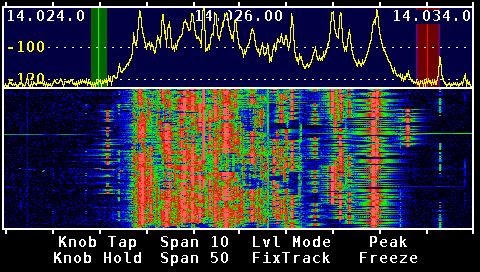
Sverre Holm, LA3ZA, is a regular contributor to AmateurRadio.com and writes from Norway. Contact him at [email protected].
Amateur Radio Newsline Report 1911 March 28 2014
- Ham radio offered transponders on an upcoming geostationary satellite launch
- Final commissioning of the new Ham TV on the ISS is again delayed
- United Kingdom hams may get added spectrum on 2 meters
- FCC grants several experimental licenses in the 70 centimeter band
- Planning is underway for International Marconi Day
- A special April 1st report on remote operation from a remote location
Got ’em!
A very big “Thank You” and a tip o’ the old callsign cap to Will NQ2W who sent me an e-mail letting me know that he had worked TX6G from his home near Albany, NY with 5 Watts on 10 Meters.
I just ran down the basement, and after figuring out the pattern, also snagged them with 5 Watts.
Thanks again, Will!
72 de Larry W2LJ
QRP – When you care to send the very least!
Larry Makoski, W2LJ, is a regular contributor to AmateurRadio.com and writes from New Jersey, USA. Contact him at [email protected].
Bath Taps into Science
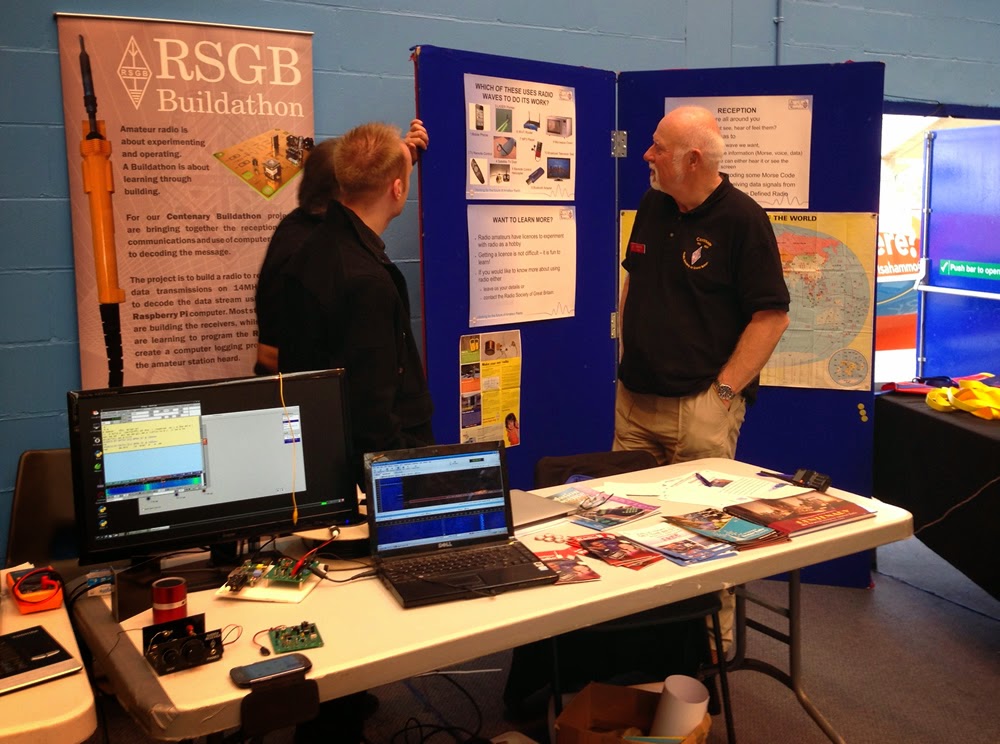
Bath Taps into Science was hosted in Bath University and Green Park Station during 21st and 23rd March. On Friday Steve (G0FUW), Phil (M0PHI), Russ (M0WYB) and myself set up a stand showcasing the science behind radio. Our audience was 1500 School children who were aged between 9 and 14 years. Reception was well received.
We demonstrated the Oscillation, modulation, reception and transmission elements with small experiments. despite having exploding, messy and amazing things – we grabbed the attention of many teachers and students. Our buildathon demonstration again was really welcomed by STEM co-orindators, and general feedback was excellent.
On Sunday Steve, Phil, Lewis (G4YTN) and Mike(G3VTO) again showcased the science behind radio in Green Square in Bath – this time open to the general public. We had many mums and dads ask us about the buildathon, and even some keen people sign up for some in-class education ready to obtain their Amateur radio license.
Dan Trudgian, MØTGN, is a regular contributor to AmateurRadio.com and writes from Wiltshire, England. He's a radio nut, IT guru, general good guy and an all round good egg. Contact him him here.
Been a busy boy
JT-65HF
I have been using my newly built datamode interface in anger.
As well as running WSPR on occasion I have also been active using JT65-HF.
JT65 is a communication mode developed by Joe Taylor, K1JT, (specification here) originally intended for amateur radio communication with extremely weak signals such as Earth-Moon-Earth (EME) contacts on VHF it has gained popularity on the short wave bands using JT65-HF an adaptation of the JT65A protocol.
Being restricted to 10W it is an attractive method of making contacts. The protocol includes error-correcting features that make it usable even when the signals are too weak to be heard or are being subject to interference.
There are several how-to guides available
Get On the Air with HF Digital (from the ARRL)
JT65-HF -- an 'Odd' but Fun Digital Mode (from eham.net)
A number of software packages support JT65, the most popular being JT65-HF originally developed by Joe, W6CQZ. Sadly Joe is no longer developing the software, but the last version released still works, and is available at http://sourceforge.net/projects/jt65-hf/
Thankfully the project was open source and Beat Oehrli, HB9HQX as developed his own version with the catchy title JT65-HF-HB9HQX-Edition, available at http://sourceforge.net/projects/jt65hfhb9hqxedi/ This is the version I have been using with great success, the colour coding and simple button pressing makes a QSO straight forward and the built in logging and exporting make uploading to QRZ, eQSL and HRDlog painless.
Whilst to a traditionalist amateur operator it is perhaps a little slow, remote and impersonal (each exchange occurs during alternate minutes) I really like it! One advantage is I can set up the radio in the shack with CAT control via HRD and then have QSOs while VNC'ing into the computer from the laptop whilst in front of the TV with the wife and the dogs! (Thanks Tim G4VXE for that suggestion!)
I have been active on the 10/20/30 and 40M bands over the past few weeks making contacts with Bulgaria, Canada, Denmark, Germany, Greece, Iceland, Kazakhstan, Poland, Russia, Serbia, Sweden, Thailand, Ukraine, USA and Venezuela.
Contesting 'DX' Headset and Interface
I have become hooked on the RSGB UKAC VHF contests, operating on a Tuesday evening on different frequencies (50MHz, 144MHz, 432MHz depending on which week of the month) Whilst my results are small-fry compared to the big guns I have been more than happy with my modest antenna set up and less than ideal location (previous blog posts)
I soon appreciated that using headphones rather than the speaker made life easier but I was still using the stock supplied hand microphone. Several times I have found it difficult to make myself understood and suspected that not only am I plagued by my 'Black Country' accent and poor enunciation but maybe the microphone wasn't quite cutting it.
Not able to afford or justify the purchase of a Heil headset just yet I took inspiration from Charlie M0PZT and his recommendation for a budget solution using a £10 computer headset from CPC (product AV21444).
On the Yaesu FT-857D the microphone connector is a 8-pin RJ45 socket which is behind the removable front panel with the lead coming out of one of a number of openings. Whilst the panel is easily removable I didn't want to keep removing it when switching between microphones, also re-purposing an obvious CAT5 network lead was problematic as they are often thicker than the openings.
 | |
| The lead removed from MH-31, RJ45 on interface |
 |
| Mic lead connected and headset |
 |
| The budget 'dx' headset |
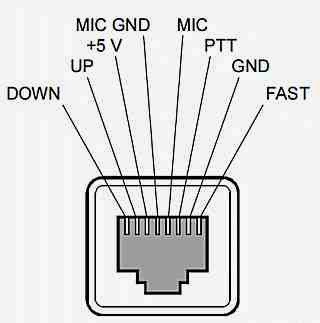 |
| Yaesu FT-857D mic socket as view from front |
The box also has a PTT switch, this could have simply grounded the PTT line but I wanted to have a LED indication on the box and again I could have just wired a LED and resistor to 5V and to the PTT line so it would light when the switch was closed, pulling PTT to ground and completing the circuit. I opted to use a simple transistor open collector switch to add a little isolation.
The interface works well and I used it for the first time last night in the 50MHz UKAC with my homebrew MOXON antenna...
6M/50MHz MOXON
My first contest back in January was the 50MHz UKAC and as I blogged I made a solitary contact due to antenna issues, i.e I didn't really have one!
I missed the February contest so this month I really wanted to have a decent stab at it which meant building an antenna. I decided early on that a Moxon was probably the easiest to construct, so I downloaded the MoxGen program to calculate the element lengths.
Using 1mm diameter 'garden wire' for the driven element and reflector. I had various bits of flexible plastic pipe kicking about and decided to use them to construct an x-shaped spreader, unfortunately the pipe was obviously from different batches and as soon as it was tensioned by the wire it bent into all sorts of strange shapes due to the different elastic properties so I abandoned that design.
I had left the build to the last minute and needed a quick solution, so yesterday morning plan-B was to go an get some cheap timber from the local B&Q on the way to work and build a simple frame to wrap the wire round.
 |
| Moxon on garage floor |
 |
| Coax and common-mode choke, and sturdy support! |
One thing I hadn't appreciated was just how big the final antenna was, it wasn't heavy just big! So last night an hour before the contest started I fitted the choke balun and coax to the terminal block. To be safe I removed the other antenna from the mast and hoisted her up.
 |
| Up in the night sky |
Moment of truth, thankfully the VSWR was around 1.5:1 at 50.2MHz, rising to nearer 2:1 at the top end of the band. Not ideal but close enough. The VSWR measurements would suggest that the Moxon is a little bit long, interestingly some online Moxon calculators suggested dimensions for a slightly smaller Moxon than the downloaded Moxgen program did? Something to tweak/experiment with possibly using some thicker wire to increase the bandwidth.
50MHZ UKAC 25 March 2014
I was sorted! Moxon antenna up, contesting headset and interface plugged in and a quick scan up and down and I could clearly hear several stations testing and setting up. I poured myself a beer and soon the contest started.
 |
| Time between QSOs for a 'selfie' |
I was not disappointed in fact I was quite happy with what my 10W, my new headset and home brewed antenna had achieved. The Moxon showed great promise and directional characteristics but for some reason just couldn't get south as the map indicates.

Out of interest I wondered what the line of slight view from my mast looked like so I strapped a camera on to the moxon this afternoon..
Need more height I think, especially if pointing South and a rotator would be nice!
Well that wraps it up for the moment.. 73
Andrew Garratt, MØNRD, is a regular contributor to AmateurRadio.com and writes from East Midlands, England. Contact him at [email protected].
DXCC QRP
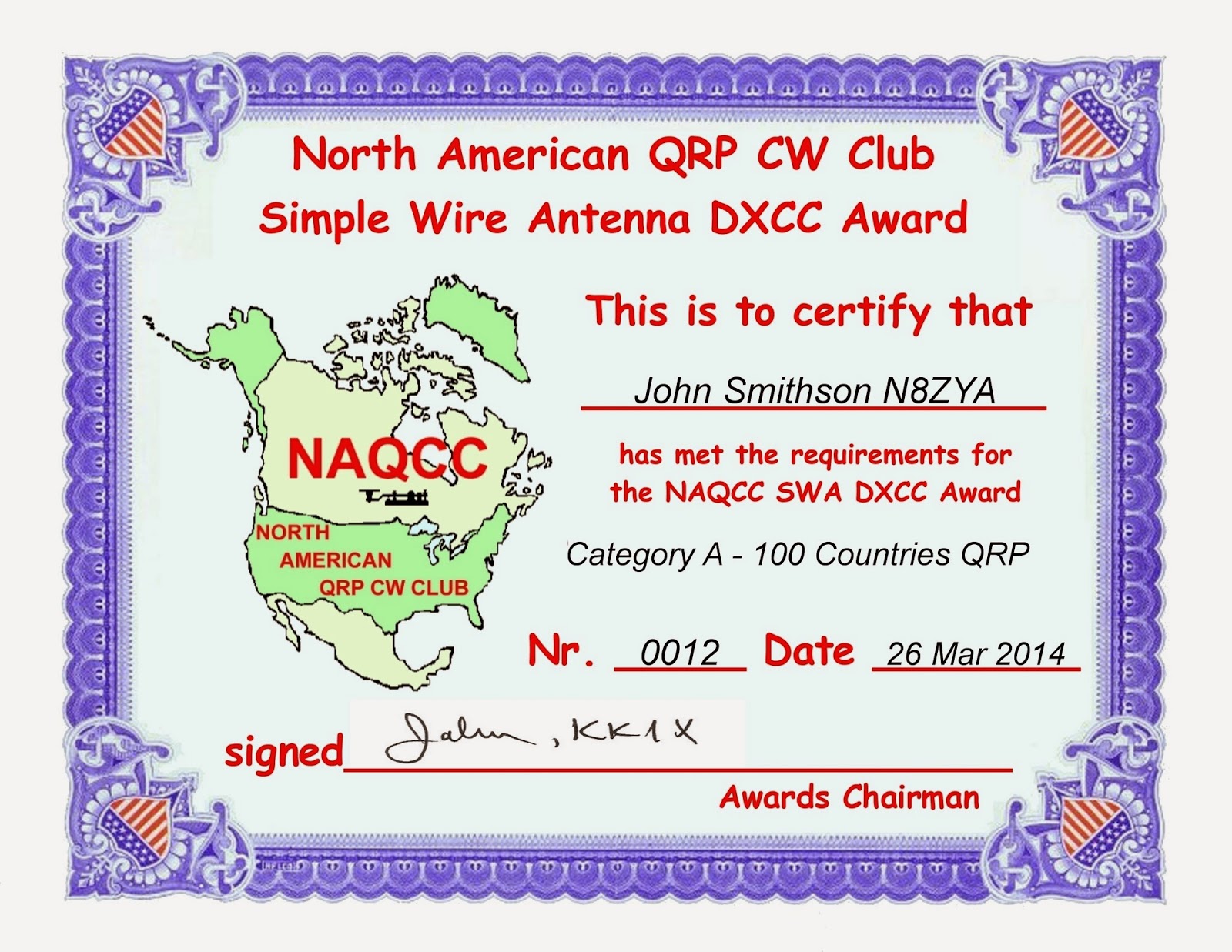
It’s taken a while, but when I finished tallying up my countries, there were 102 countries in the DXCC logbook a few nights ago. I had just sent in my WAS (worked all 50 states) data in February, and received my certificate for that award, just a few weeks ago.
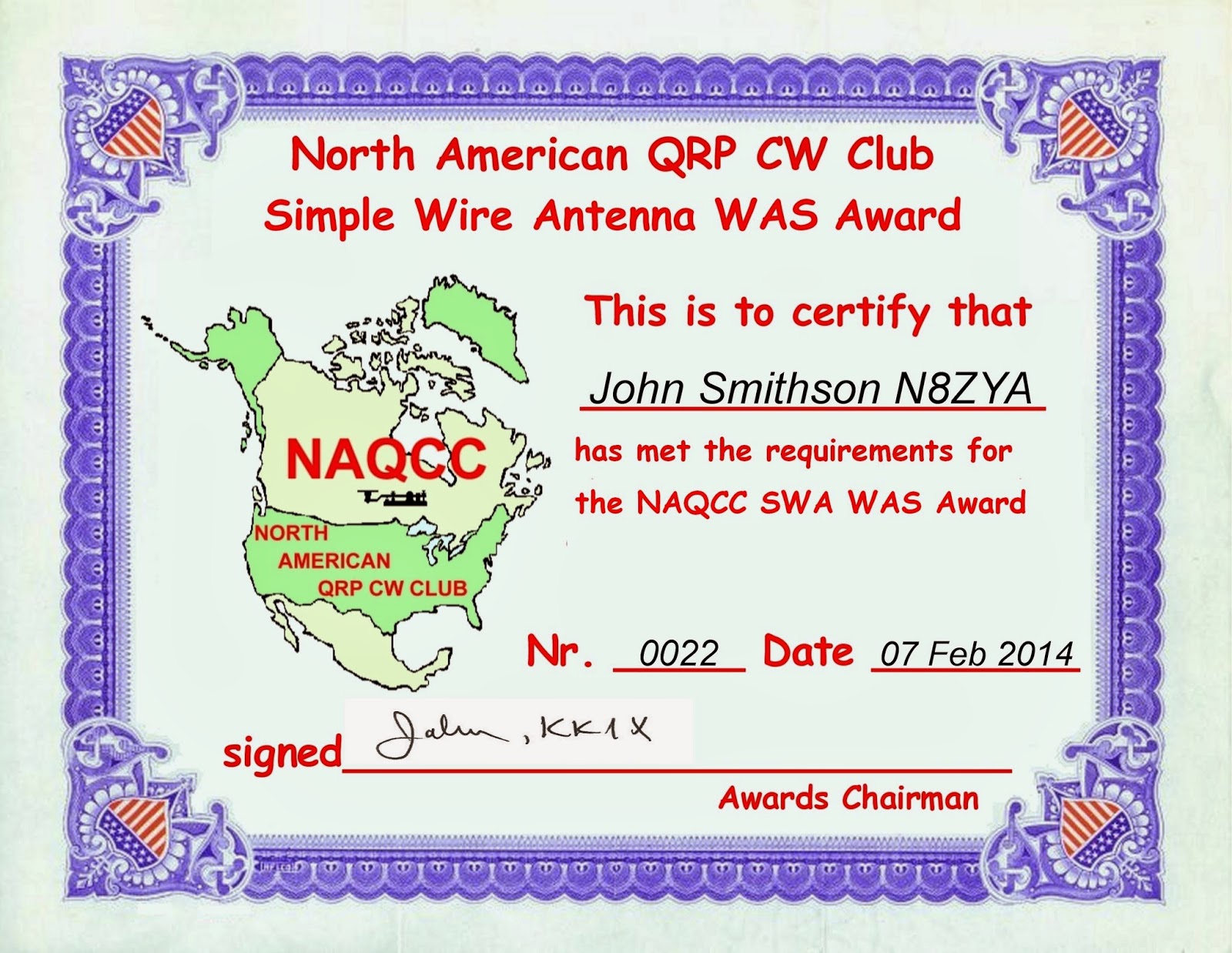
It’s taken me about three years to achieve both these awards, with never more than 5 watts of power, and indoor “stealth” antennas. My immediate neighbors still don’t know I’m a ham radio operator, and since I live in a historic area, where outside antennas are prohibited, I consider that a good thing. lol
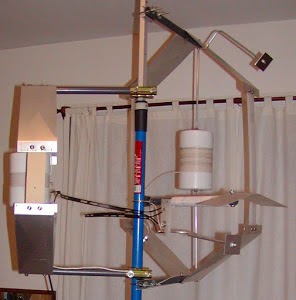
I worked nearly all of my WAS contacts (48) with my Isotron antennas on either 40 meters or 20 meters. Alaska and Hawaii were my two most difficult states; I worked those with a 50 ft length of “Radio Shack” speaker wire which I strung around the perimeter of a spare room in the house. The wire runs from my tuner, across the windows, which have wooden curtain rods, across the hallway, over the top of an “open” wooden door, and is tied off the the “downstairs” wooden stair railing. It’s a tough way to do it, and it’s a true “random wire“, but I’ve enjoyed every minute of the challenge it took to work those 102 countries.
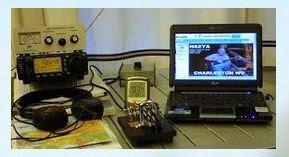
The process accelerated a little before September of 2012 when I started using “dedicated band dipoles” for my DX contacts. My indoor “upstairs” space is very limited but I’m able to stretch out a dipole for 10 meters and 15 meters. Those two dipoles barely hang between the wooden curtain rod, on one side of the house, and the bathroom window sill, on the opposite side of the house. This picture below shows my “end fed” 10 meter antenna. The 15 meter dipole antenna requires an “open door” and an extended length to the bathroom window frame.
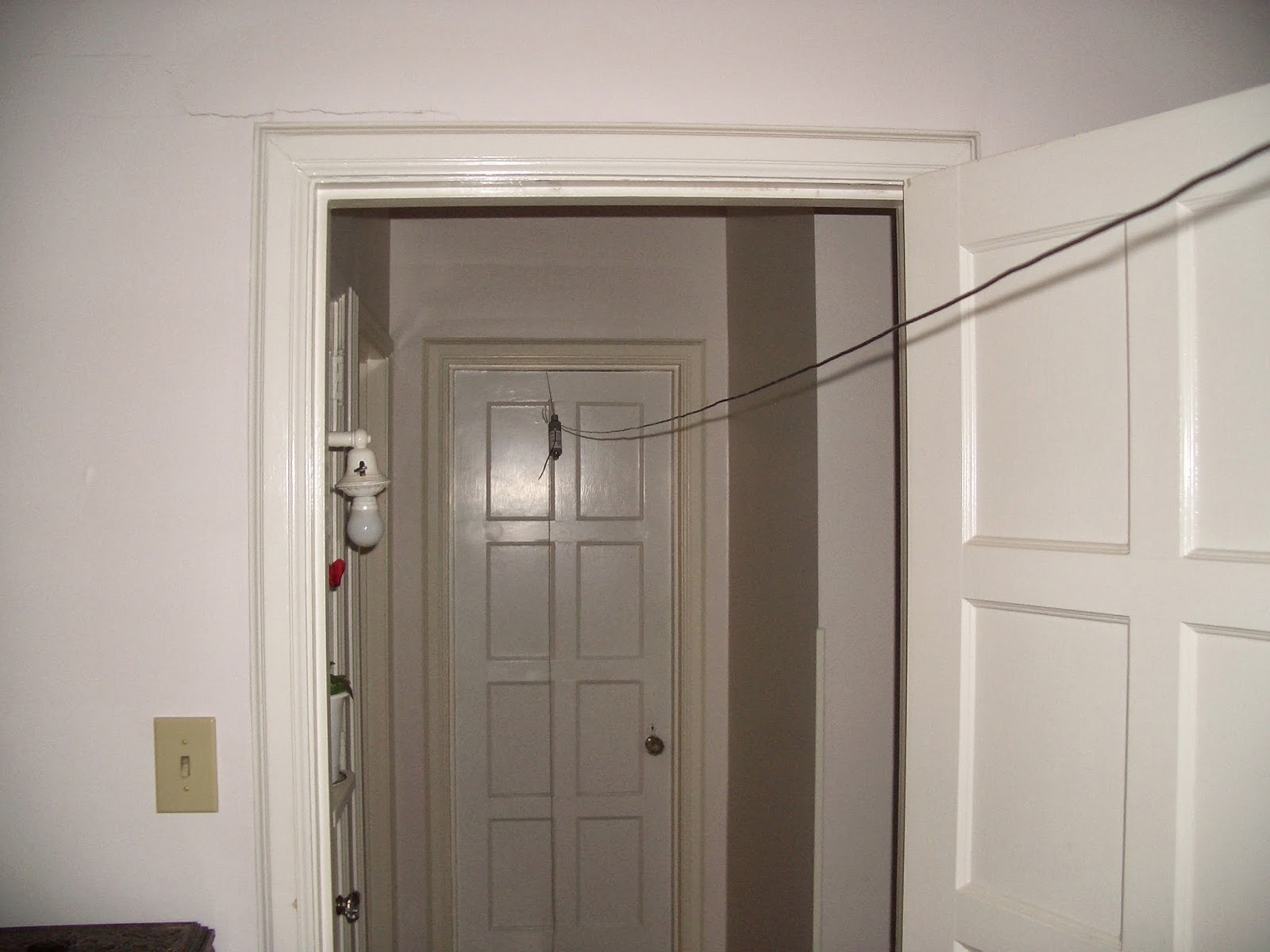
Those two antennas work well on those bands (even indoors) but the 50 foot random wire, which allows me easy access to the 17, 12, and especially the 30 meter band, were the true deciding factors in my DXCC award.
What are my immediate goals now?
There’s DXCC on a “single” band, working the “capitol cities” of every country and state, or perhaps working DXCC with “outside antennas” while operating in the field. I’m not sure what it will be now that I have the QRP DXCC award but I’m sure something will soon grab my attention.

The North American QRP CW Club has always been my favorite organization. I hope my addition of the NAQCC DXCC QRP Award will be an inspiration to those of our members who think working over a 100 different countries with five watts, or less, of power and “simple wire antennas” is impossible.
Those 17, 12, and 30 meter contacts were actually done with about 3 watts of power. Never say the word “never” when I comes to QRP. I’ve been an optimist when it comes to my QRP operations. I’m looking forward to the next challenge, whatever it might be.
John Smithson, Jr., N8ZYA, is a regular contributor to AmateurRadio.com and writes from West Virginia, USA. Contact him at [email protected].
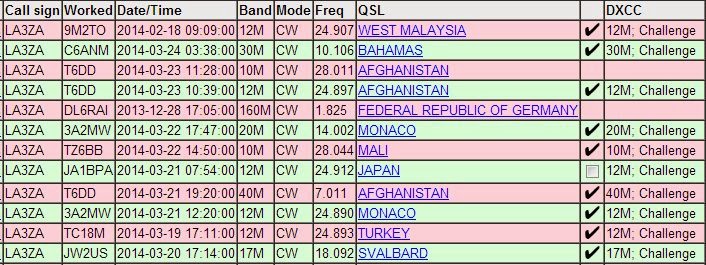
Fantastic Conditions on 10 and 12 m
Sverre Holm, LA3ZA, is a regular contributor to AmateurRadio.com and writes from Norway. Contact him at [email protected].
 Ham Radio Deluxe |
 W5SWL Electronics |
 Ham Radio Prep |
 KB3IFH QSL Cards  Hip Ham Shirts  HamRadioAuctions HamRadioAuctions Reliance Antennas Reliance Antennas Enigma Shop Enigma Shop |  morseDX  Ni4L Antennas  R&L Electronics R&L Electronics antennas.us antennas.us QRV QRV |
- Matt W1MST, Managing Editor
