 |
 Sunday afternoon on the wireless
 14 April 2014 | by
 Dan Trudgian, MØTGN, is a regular contributor to AmateurRadio.com and writes from Wiltshire, England. He's a radio nut, IT guru, general good guy and an all round good egg. Contact him him here.
Incentives and Licensing
Jeff Davis, KE9V, wrote in his weekly letter, Quintessence, about something we’ve all heard on the air, the roundtable discussing and lamenting about those who are not real hams. He posits this is one unintended consequence of incentive licensing, where new amateurs tend to stay on repeaters and not upgrade to acquire HF band privileges, creating this us and them mentality. Newbies will always be on repeaters and the real hams are on HF.
Incentive licensing was introduced in 1964 by the ARRL and FCC. I got my ticket as a teenager in 1984, but I don’t recall hearing the term incentive licensing or angst about it until perhaps ten years ago. It never really occurred to me that there was something before incentive licensing in amateur radio. It was always what I knew amateur radio to be, even when I was a budding radio artisan in the 70s. License classes were an integral part of amateur radio, much like color television is in every living room today.
The original motivation behind incentive licensing was to get amateurs to increase their knowledge and skill. While in theory it makes sense, in practice I don’t think it’s been very effective. Today you can find Extras who are, well, quite simply, numbskulls. While the exams can test for specific isolated technical tidbits, they never were able to test for operating skills, uncover deep understanding of topics, or examine practical skills like soldering a connnector. Some would argue the CW exam tested for operating skill, but in reality it didn’t. It tested operators copying CW for a certain period of time but didn’t really test whether they could copy weak signals, send code, or have a QSO. It certainly didn’t test whether they were proficient operators or good and wholesome people. A review of FCC enforcement actions and on air monitoring in which violators and LIDs most often are code tested Extras provides empirical evidence that exams and incentive licensing aren’t always effective at determining good operators or weeding out those guys.
Over the years I’ve found that license class has little to do with the technical proficiency of amateurs. The biggest factor I’ve found has been professional experience and formal education. The most technically astute amateurs are, ironically, professionals in telecommunications, electronics, and engineering. Often these folks have access to equipment and resources that let them expand their knowledge, and amateur radio is a secondary technical endeavor. The best of these folks seed the rest of the amateur radio community with technical know how.
Personally I’ve found passing amateur radio exams to be trivial. While I’m a telecommunications professional with some schooling in electronics, I’ve thought tests were fairly easy to pass with just simple question memorization and very little, if any, technical study. I’m not saying I didn’t know the material. I could draw a bipolar transistor amplifier circuit from memory and do the calculations on a whiteboard or explain modulation. Passing a test was merely an inconvenient formality. Advancing my knowledge and skills in amateur radio has never been driven by a test or advancing in license class, like the original intent of incentive licensing. It certainly wasn’t driven by getting an extra 20 kHz of space on 20 meters at the time. Increasing knowledge has been triggered by my interests. I really got into CW when I saw others using it and saw how quickly and efficiently QSOs could be had, not because I had to pass a 20 WPM test. I took up rig building when I saw others making simple rigs from 2N2222s and it seemed cool. I’m exploring satellites now because I find relaying a radio signal through a little box orbiting the Earth intriguing.
If incentive licensing isn’t really motivating amateurs to learn more and increase their skills, what purpose does it serve, other than supporting a needless hierarchy, one implemented back when post-war middle-agers and old codgers were bucking free love and turn on, tune in, drop out? I think incentive licensing in the US has outlived its usefulness, and it’s perhaps time to eliminate it — one test and license class to rule them all. What is the worst that could happen, someone new won’t be destined for that local repeater and its accompanying unfair stereotypes, and will instead make a QSO on HF, perhaps get interested in CW, build a rig, and then work through satellites or do moonbounce…and become… the proverbial real ham?

Anthony, K3NG, is a regular contributor to AmateurRadio.com.
Portable Hexbeam
Saturday saw me opening a beer celebrating finishing off the new decking area…which means….Sunday saw me finishing off my portable hexbeam from Folding Antennas. The build took quite a while, about 8 for the hardware and about 3 for the layout and tuning. I’ve not used it much in anger as the rains started coming.
An early doors write up is here…..but so far its looking worth the build time. Here’s a shot of the half finished decking…oh and a half finished antenna.

Alex Hill, G7KSE, is a regular contributor to AmateurRadio.com and writes from Cumbria, UK. Contact him at [email protected].
And here I thought it was me!
To say it is a beautiful day in New Jersey today is in understatement. The sun is shining, and the temperatures are in the upper 60s (20C). The breeze (if there is any) is so gentle that you don’t even notice it. So I decided that after grocery shopping, but before other chores, that I would sneak off to the park and try out the EARCHI antenna. I built the 9:1 UNUN late last Autumn and didn’t get a chance to try it out.

So it ends up that today was not the day to base a critical performance review on, I will have to wait for another weekend with decent weather and better band conditions for another test. In the meantime, I will also browse the Internet to see if I can garner more information on optimal radiator lengths for use with a 9:1 UNUN.
72 de Larry W2LJ
QRP – When you care to send the very least!
Larry Makoski, W2LJ, is a regular contributor to AmateurRadio.com and writes from New Jersey, USA. Contact him at [email protected].
AmateurLogic Live Stream
AmateurLogic.TV will be streaming live tonight at 7:00 PM CDT. Special guest Randy Hall, K7AGE. Plus Tommy and George’s revenge for the Vegemite incident and more.
The live stream has completed now. Thanks to all who joined us. Look for it to be posted in the next day or so.
George Thomas, W5JDX, is co-host of AmateurLogic.TV, an original amateur radio video program hosted by George Thomas (W5JDX), Tommy Martin (N5ZNO), Peter Berrett (VK3PB), and Emile Diodene (KE5QKR). Contact him at [email protected].
More on FO-29 and VO-52 operation with the V2000 vertical
A little later FO-29 was due over and I wondered if I might be able to hear anything. The pass was quite quiet, but I did hear my Twitter friend, Berend, PA3ARK on CW. I was able to find my signal and place it reasonably close to Berend’s and we had a bit of a sketchy, but valid QSO.
Really pleasing to find that some simple CW satellite operation is viable with just a vertical antenna.
Berend sent a nice photo of the entry of the QSO in his logbook!
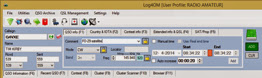
Evening update: I caught a late afternoon pass of VO-52 and was hearing myself well enough to have a tune around and was able to answer UT3UX who was calling CQ on CW and work him. I’ve not found too much CW activity so far. I’m sure I can work some SSB, but with the slightly lower signal levels, CW gives a bit more latitude!
Tim Kirby, G4VXE, is a regular contributor to AmateurRadio.com and writes from Oxfordshire, England. Contact him at [email protected].
Wouxun KG-UV8D: Hands-on review

I had the opportunity this afternoon to be one of the very first people to go hands-on with the new dual-band Wouxun KG-UV8D HT courtesy of Danny at BuyTwoWayRadios.com. What’s the verdict? I’m impressed!
VHF/VHF dual receive — for the win! This is a great feature and, at least for me, one of the most compelling reasons to upgrade to this radio. It mixes the audio from the two frequencies so you won’t miss anything. Great feature for EmComm, especially. I personally don’t have a great need for cross-band repeat, but that’s just icing on the cake.
-

- Speaker/mic jacks are well protected
-

- PTT and various function buttons are easy to tell apart by feel
-

- Standard Wouxun keyboard layout
The text on the color screen is so much easier to read than on previous Wouxuns. There’s about twice the screen real estate and it makes the radio much more usable. Although I didn’t get a chance to play with every feature of the KG-UV8D, I can honestly say that this radio seems to be much easier to program from the keypad. I think that larger screen helps a lot. For the first time, I feel that I could field program one of these without the manual. Trust me, that’s saying something!

The radio seems slightly narrower and thinner than previous versions. This is a definite step up and it improves the ergonomics of the radio. The PTT button is large and segmented in a way that makes it hard to mistake it for a function button as with the KG-UV3D. The programmable buttons under the PTT are also cool. You can program it to activate the FM radio or to start scanning, for example. Very easy to customize.
-

- I like the recessed battery eject button
-

- Slim profile battery
-

- Chassis backplate
The battery is different which is a little disappointing for those of us who have a collection of older Wouxun batteries, but I like the changes they’ve made to the way it slides on and off the chassis.
The rubber ducky antenna they include is OK, but for me a Smiley 270A would replace it in short order. And speaking of antennas, why can’t Wouxun figure out if they want to use SMA-male or SMA-female on these radios? I think we can all agree that they should just standardize on one or the other. This radio has a SMA-female connector while my KG-UV3D is SMA-male.
I’ve fallen in love with this little radio and I’ve only had it a few hours. When they begin shipping in a couple weeks, I will definitely be ordering one. While there aren’t really any must-have new features (except dual-receive), the radio just feels much more refined than other radios I’ve used that are anywhere near this price point.
Whether you’re a brand new ham looking for your first rig or you’ve been at this game for decades, you can’t go wrong with this $139 radio.
Update 4/28/2014:
If you click through to BuyTwoWayRadios.com, you will notice that the final price of this radio is now $159. If you order this radio, don’t forget to use the coupon code 139UV8D to get the original $139 price! Not sure how long this coupon code will remain active. Your mileage may vary.
Matt Thomas, W1MST, is the managing editor of AmateurRadio.com. Contact him at [email protected].
 Ham Radio Deluxe |
 W5SWL Electronics |
 Ham Radio Prep |
 KB3IFH QSL Cards  Hip Ham Shirts  HamRadioAuctions HamRadioAuctions Reliance Antennas Reliance Antennas Enigma Shop Enigma Shop |  morseDX  Ni4L Antennas  R&L Electronics R&L Electronics antennas.us antennas.us QRV QRV |
- Matt W1MST, Managing Editor
