 |
 Another one got away
 21 April 2014 | by
 Band conditions seem to have deteriorated lately. Bob W3BBO and I were discussing this on Saturday. The upper bands, 10, 12, 15 Meters still have signals on them, but they seem to be not as plentiful and nowhere as strong as they were just a month or six weeks ago. Just after the cold weather broke here in NJ and I resumed my QRP sessions, it seemed like each lunchtime from the car netted 3 our 4 or even 5 DX stations per sitting.
Lately, those kind of band conditions seem to have disappeared. Signals are fewer and weaker. But today was a case of the one that got away. I was tuning up and down the bands and heard JY9CF on 12 Meters. He was kind of loud and was calling “CQ USA ONLY”. I tried, and wasn’t being heard. But I did have time, as I heard him early on during lunch hour and he was getting louder. I figured giving just a little bit more time, I just might have nabbed him. However, many non-USA stations began calling, and the operator was getting frustrated as a few times he sent, “PLS LSN USA ONLY”. As his signal strength to me increased, so did his frustration. Finally he announced he was going QRT.
Rats! My gut was telling me that with a just a bit more time …… maybe. I am pretty certain that if I was home and had the shack KX3 fired up to the 75/100 Watt neighborhood, that I would have garnered a new country. It seems that 5 Watts and the Buddistick just didn’t cut it today, even though the JY9 station was the loudest I have ever heard here.
On the bright side, I did have a short QSO with Jim N0UR on 20 Meters. I have worked Jim in many Sprints and many QRP Fox hunts. It was good to hook up with him in an “everyday QSO” situation. Jim was running 4 Watts from his Flex1500 and he was a good, solid 579 here into New Jersey (when QSB wasn’t kicking in).
BTW, Paul NA5N has announced the theme for this year’s QRPTTF – “Tres de Mayo” considering how close this year’s event is to Cinco de Mayo. I have already decided what I am going to do to be “in theme” – but I am NOT sharing until after the event. All the rules can be found here: http://www.zianet.com/qrp/qrpttf/2014/ttf.htm
72 de Larry W2LJ
QRP – When you care to send the very least!
Larry Makoski, W2LJ, is a regular contributor to AmateurRadio.com and writes from New Jersey, USA. Contact him at [email protected].
Troubles with the FT-950
Having some issues with my Yaesu FT-950. On Friday I noticed the 950 had a high SWR reading on 40m. Tried tuning and it wouldn’t correct the issue. I went back to 20m and over the weekend worked almost 200 SSB contacts without issue and was receiving solid signal reports on my audio all weekend long. Last night I tried working W1AW/5 on 40m and again couldn’t get the 950 to tune.
I decided to connect the 950 to a dummy load and check it out. I used my LDG AT-600ProII and the analog meter in bypass mode to record the following measurements with the FT-950 in CW mode and sending a continuous carrier.
10m – flat SWR and 50w fwd power
12m – flat SWR and 35w fwd power
15m – flat SWR and 25w fwd power
17m – flat SWR and 15w fwd power
20m – flat SWR and 10w fwd power
30m – flat SWR and 0w fwd power
40m – flat SWR and 0w fwd power
80m – flat SWR and 0w fwd power
160m – flat SWR and 0w fwd power
About 15 minutes later I repeated the tests, which produced different results as noted below:
10m – 35w
12m – 20w
15m – 15w
17m – 10w
20m – 5w
30m – 0
40 – 0
80 – 0
160 – 0
I’m a bit perplexed as to what is going on. I’m going to try another power supply tonight, but I have a feeling the 950 will need to take a trip to California and spend some time in the Yaesu hospital. I’ve also performed a full factory reset, but still getting the same results. Anyone else have any other bright ideas?
If the 950 does need to take a trip to California, I’m hoping Yaesu can turn it around in time to have it back for my stint operating W1AW/Ø.
Until next time…
73 de KDØBIK
Jerry Taylor, KD0BIK, is a regular contributor to AmateurRadio.com and writes from Colorado, USA. He is the host of the Practical Amateur Radio Podcast. Contact him at [email protected].
Down
Paul Stam, PC4T, is a regular contributor to AmateurRadio.com and writes from the Netherlands. Contact him at [email protected].
Printing your own QSL cards using HAMQSLer
Anyone who knows me well may be slightly taken aback to find me writing about QSL cards! Each to their own, but it’s a part of the hobby that really doesn’t appeal to me at all. However, I’ve always said that I think it’s nice to be able to QSL contacts which are special to you in some way.
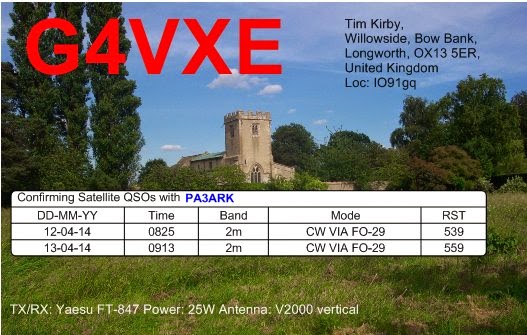
And so it was, I felt, the other day when I worked Berend, PA3ARK on FO-29. Berend often inspires me to try something new and so I thought it might be nice to try and create a QSL to commemorate the QSO.
I looked around and found the HAMQSLer program from VA3HJ. I managed to get past the ‘the final courtesy of a QSO is a QSL’statement at the top of the website! In my opinion, the final courtesy of a QSO is to say 73, but therein lies why I find myself at odds with the ‘every contact must be QSLed’ brigade!
The program is free to download and I found it well-designed and easy to use. I did have to install the Microsoft .Net framework 4.5.1 and install it on my PC before I could install the software.
I was able to import a background image of a photo of our village church to use. I really had wanted to try and use one of the aerial photographs I took of the village when I flew over in G3WGV’s aircraft a couple of years back. However, I found the colours didn’t really lend themselves to overlaying text on top of the photo. Actually, I’m sure a more artistically gifted person would have managed, but I opted for the easy approach – one where I had a nice blue sky, where I could place most of the text.
I found that I was able to setup various static text fields and create a QSOs box, which could be populated from an ADIF file from my logger.
After a bit of resizing and trying various options, I was ready to import my ADIF records. I did tweak the Mode field in the ADIF record, so that I could show that the QSO took place on a satellite. The logger, of course, records that I was (in this case) transmitting on 144MHz, but not that it was a satellite QSO. I wanted this to be clear, so I amended the Mode field in the ADIF field to say CW Via FO-29, which I thought was clearer.
Tim Kirby, G4VXE, is a regular contributor to AmateurRadio.com and writes from Oxfordshire, England. Contact him at [email protected].
Series Seven Episode Eight – Yaesu FT-252E Review (20 April 2014)
Series Seven Episode Eight of the ICQ Amateur / Ham Radio Podcast has been released. The latest news, Martin (M1MRB) and Colin (M6BOY) discuss the recent Kempton Park Amateur / Ham Radio Rally and Martin (M1MRB) reviews the Yaesu FT-252E 2m Handhelad Amateur / Ham Radio.
- MacLoggerDX Version 5.53 released
- Important update - 5 MHz Band
- Ofcom 2300 and 3400 MHz ham radio bands statement
- Marconi Day - 26 April 2014
- U.S. Coast Guard, Liberian tanker, and Panamanian ham operator rescue from sinking sailboat
- 915-921 MHz Licence Exempt allocation
- ISS HamTV moves to 2369 MHz
Colin Butler, M6BOY, is the host of the ICQ Podcast, a weekly radio show about Amateur Radio. Contact him at [email protected].
Spring Peepers on Johnson Road
I heard spring peepers for the first time this year. I hiked in an old field off Johnson Road and worked Russia, Panama and a couple of stations in the Michigan QSO Party.

I hiked about a quarter of a mile on a trail from the road and turned south skirting the edge of the field when I heard the peepers. I know where they are! There’s a vernal pool down a horse path through a large and prickly raspberry patch. I look through the woods and onto the small pond. Every time one of these tiny frogs sings, his body trembles enough to send circular ripples into the pond. They are, of course, calling CQ. It is a clear sign of spring and I am overjoyed.

I wandered through this overgrown field for a while. I was searching for a warm spot out of the wind. It’s only about 45F with a stiff breeze and a bit chilly. I pass the telltale signs of a long winter… tiny holes in the grass where mice and voles have sought cover while enduring the bitter cold.
I set up under a tall pine tree on a little hillside facing the sun.

I heave my wire over a branch and tune the KX3 on 20 meters. Stations are strong, but they don’t hear me well. I work UA2FL who is operating the Mineira DX Contest from Russia. Then I work two stations in the Michigan QSO party… N8KS and K8BZ. I switch to 12 meters. HO100CANAL is calling CQ and he answers right away. This is a special event station in Panama celebrating the opening of the canal 100 years ago.
With this I pack up and head back to the car. I check for ticks (usually out
by now) but thankfully, I don’t find any. Maybe the hard winter has reduced
their numbers.
Jim Cluett, W1PID, is a regular contributor to AmateurRadio.com and writes from New Hampshire, USA. Contact him at [email protected].
Its quiet. WSPR quiet
If you ever needed proof that QRP is good fun and very rewarding, look no further than my latest project. I just (today) finished building the QRP Labs Ultimate 3 kit. This kit is amazing and I’ve ordered mine with the 20m BPF as thats the lowest band my home Antenna will go to.
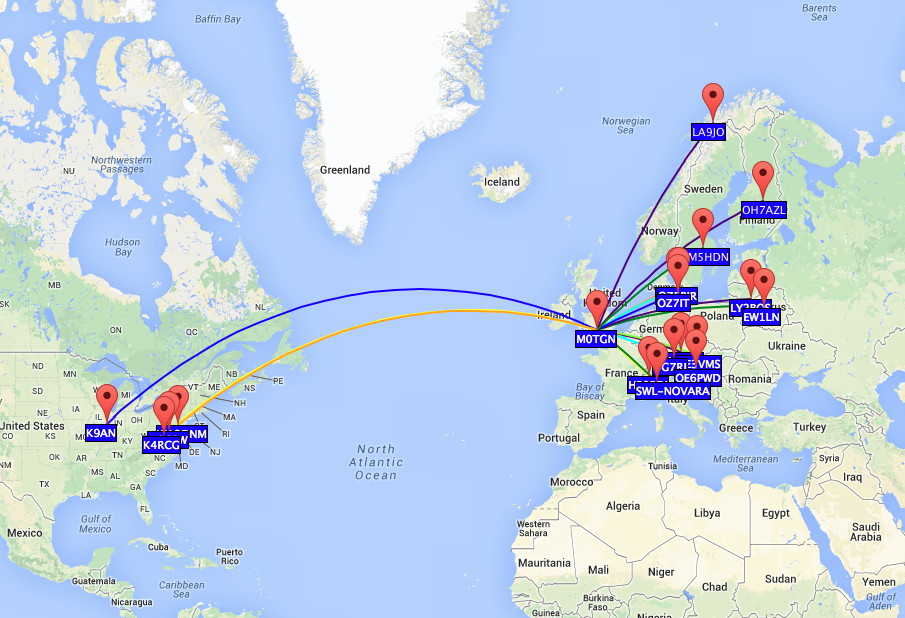
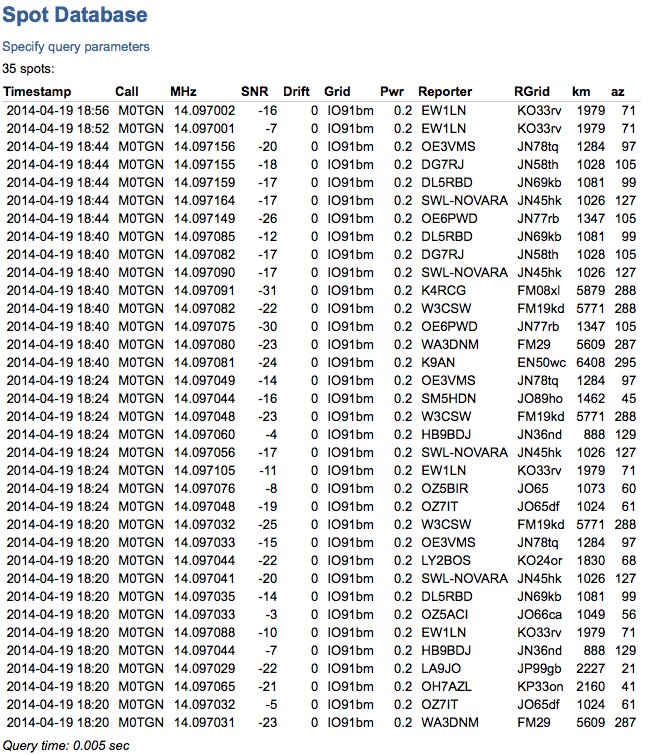
In its current configuration my kit only pumps out 200mW and I left it running while i went out to a party with the family. On my return I was staggered by the reach on the little kit. The longest distance it was heard was a staggering 6408Km ! all that way with just 200mW of RF..
Here is a map I’ve downloaded of the plots :
and a list of the stations that heard it. You will notice some frequency fluctuation. I have to box the kit up and think about some stabilisation on the DDS. but hey for its first outing – I’m very happy !
Dan Trudgian, MØTGN, is a regular contributor to AmateurRadio.com and writes from Wiltshire, England. He's a radio nut, IT guru, general good guy and an all round good egg. Contact him him here.
 Ham Radio Deluxe |
 W5SWL Electronics |
 Ham Radio Prep |
 KB3IFH QSL Cards  Hip Ham Shirts  HamRadioAuctions HamRadioAuctions Reliance Antennas Reliance Antennas Enigma Shop Enigma Shop |  morseDX  Ni4L Antennas  R&L Electronics R&L Electronics antennas.us antennas.us QRV QRV |
- Matt W1MST, Managing Editor
