 |
 GigaParts Ham Radio Day Special
 29 April 2014 | by
GigaParts 2014 Ham Radio Day Special is now available for download.
On March 29, 2014 Tommy and George visited the annual GigaParts’ Ham Radio Day. Come along for the trip and see interviews you won’t find anywhere else. Ray Novak from Icom America, Phil Parton from Kenwood, Dennis Motschenbacker from Yeasu, Emmett Hohensee from Radiowavz, Richard Stubbs from MFJ, George Howard from GigaParts, Charlie Emerson from Huntsville Hamfest, and Tom Medlin from W5KUB.
53:06 of Huntsville fun.
George Thomas, W5JDX, is co-host of AmateurLogic.TV, an original amateur radio video program hosted by George Thomas (W5JDX), Tommy Martin (N5ZNO), Peter Berrett (VK3PB), and Emile Diodene (KE5QKR). Contact him at [email protected].
Exceptional Service
Last Wednesday evening, just before turning in for the night, I placed an order with Amateur Radio Supplies for some antenna rope and wire. I placed an order for 150 feet of 14 gauge jacketed Flexweave and 200 feet of Dacron rope.
The next morning, I had an order confirmation in my inbox and by the end of the day on Thursday, I had received a “your order has shipped” e-mail. To be honest, my initial thought was, “Yeah, right!”.
Much to my surprise, the rope and wire arrived on Saturday via FedEx Home Delivery. Wow! I have to say that Amateur Radio Supplies made a believer of this sceptic. I certainly was not expecting such fast service, but was very happy to receive it.
This weekend is QRP To The Field. The weather for Saturday is looking “iffy” right now – partly sunny/cloudy with a 25 percent chance of showers in the afternoon. I will probably operate from the backyard and will have my son help me cut a few radiators to try out the 9:1 EARCHI UNUN a little bit more.
In order to prepare, I did the first lawn mowing of the season tonight after dinner. The front yard needs some work (re-seeding), but the back yard is in decent shape.
72 de Larry W2LJ
QRP – When you care to send the very least!
Larry Makoski, W2LJ, is a regular contributor to AmateurRadio.com and writes from New Jersey, USA. Contact him at [email protected].
40 meter band
Paul Stam, PC4T, is a regular contributor to AmateurRadio.com and writes from the Netherlands. Contact him at [email protected].
Switching to Windows 7 adventure.

Mike Weir, VE9KK, is a regular contributor to AmateurRadio.com and writes from New Brunswick, Canada. Contact him at [email protected].
SSB Makes the Difference on Prospect Mountain
Spring is finally making an appearance in the Rocky Mountain region which means it is time to get on top of some SOTA peaks and transmit some RF energy. On Saturday, Joyce K0JJW and I had planned to drive through the Big Thompson Canyon to Estes Park and also sneak in a quick SOTA activation. Matt K0MOS suggested a few peaks and we chose Prospect Mountain (W0C/FR-069) just south of Estes Park. See Matt’s trip report for a good overview of the hike.
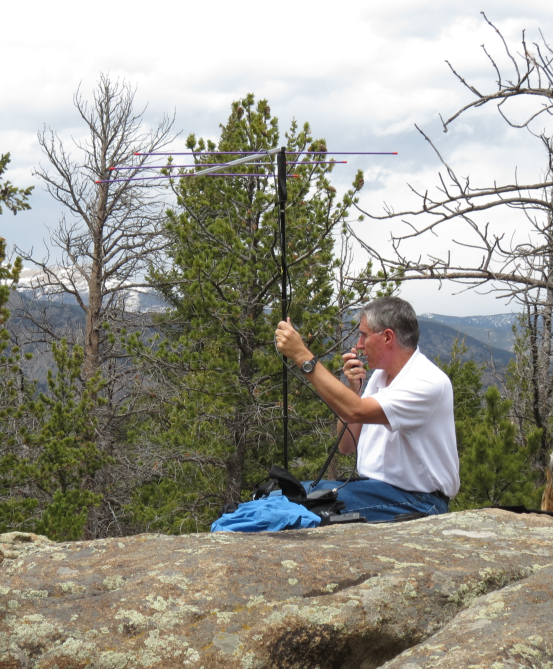
For a low hassle SOTA activation, I usually just take my Yaesu FT-60 handheld radio and operate 2m FM. Most of the VHF activity is on FM anyway and I usually rustle up some SOTA contacts that way. On this trip, I also brought along my Yaesu FT-817 so that I could operate 2m ssb, to provide better weak signal options. For SSB operation, my 3-element Arrow yagi antenna was mounted on my walking stick for easier pointing, with horizontal polarization.
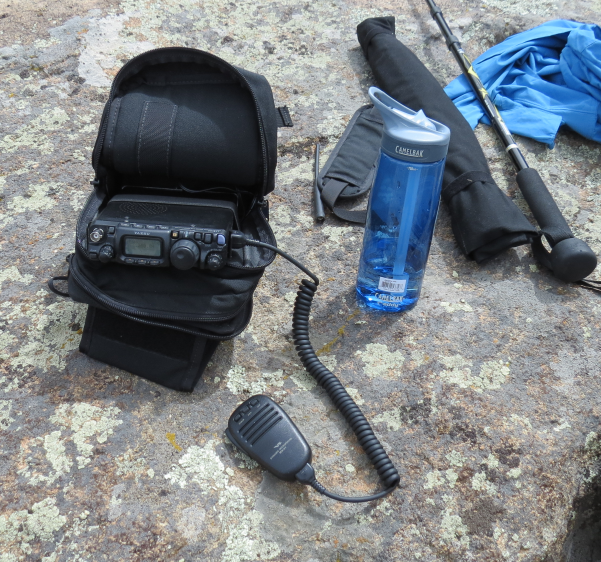 The above photo shows the FT-817 in its Sitting-On-A-Big-Rock operating position, using the AMP-3 carrying case with lead-acid battery inside.
I had arranged a sked with Stu W0STU who was located ~100 miles away with a group of Scouts at Peaceful Valley Scout Ranch. There wasn’t a solid radio path between our two locations, so I wasn’t sure if we’d make it or not. I did not think we could make the contact on FM but the efficiency of SSB should do better. He had a small yagi pointed in my direction driven by an FT-857 transceiver but we tried working on 144.200 MHz SSB without any success. Another station W6LEV near Loveland came up on the calling frequency so I worked him.
After working a few stations on 146.52 MHz using a half-wave whip on the FT-60, I decided to try to work W0STU one more time. I sent him a text message and confirmed that he was available. However, snow was moving into his location (welcome to spring) so he had dismantled his yagi antenna and only had a vertical antenna on his truck. I told him to give me a call on 144.200 SSB and I’d try to find him. I flipped my yagi to vertical polarization and pointed in his direction.
At first, I heard nothing but noise. I was about to give up when I rotated my antenna around to see if the signal peaked up in another direction. Sure enough, when pointed S/SW, I could hear Stu’s signal rise to just above my noise floor. His actual direction from me was SE, so we were probably getting a reflection off one of the mountains to the south. My signal was right at his noise floor, so we just barely completed a contact. Without the weak-signal performance of SSB and the gain of the yagi antenna, I am sure we would have never completed the contact. Another lesson is that it pays to point your antenna in different directions, since you don’t always know what the best propagation path will be.
Another fun day messing around with ham radio.
73, Bob K0NR
Bob Witte, KØNR, is a regular contributor to AmateurRadio.com and writes from Colorado, USA. Contact him at [email protected].
80 m WSPR
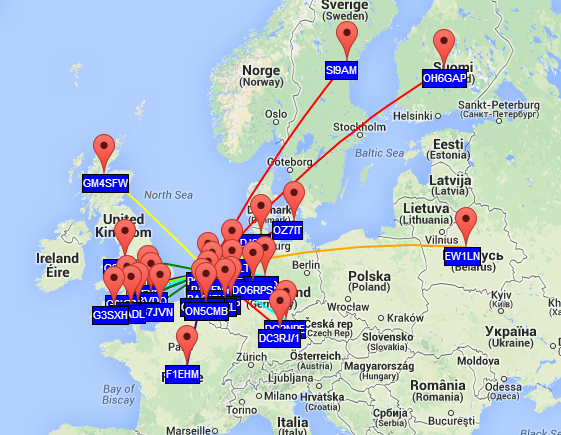
WSPR tonight. Best DX was EW1LN 1514 km. With QRP CW I worked YO7AHR and EA2CW/P sota station on 20 meter.
Paul Stam, PC4T, is a regular contributor to AmateurRadio.com and writes from the Netherlands. Contact him at [email protected].
Catching up! More satellite QSOs, First 50MHz Es of the season and 1000 blog posts
It seems to be a while since I stopped and wrote something here.
The simple satellite operation on VO-52 and FO-29, using the FT847, diplexer and the V2000 vertical continues. On VO-52 in particular, I have been surprised how well it works and have made a fair few QSOs, mostly on CW. Some passes are better than others, depending on the direction of the satellite and the vertical nulls of the antenna. I was interested to get decent signals through VO-52 the other day as it was over Greenland and the footprint of the satellite covered VE1 and W1 – so perhaps I may manage a QSO into North America when the time is right.
FO-29 tends to be a bit harder – just in terms of finding my downlink signal – again it depends where the satellite is, but I’ve managed a few contacts now, which is very pleasing indeed.
Nice to work GS3PYE/P – the Camb-Hams expedition to Lewis (IO68) on SO-50 this evening. I ventured out into the garden with the UV-5R and the Elk.
I’ve missed them both, but there have been at least a couple of Es openings on 50MHz. Earlier in the week, Ron ZB2B emailled to say that he had worked some stations in G, GW and EI in an Es opening and it looks like the band was nicely open yesterday morning (we were out, cleaning the local village church!).
Finally, apparently, this is my 1000th post to this blog. I enjoy writing it – and sometimes, enjoy looking back a few years to see what I was playing with then. It’s interesting to see how things change. Thank you to YOU, though, for reading it!
Tim Kirby, G4VXE, is a regular contributor to AmateurRadio.com and writes from Oxfordshire, England. Contact him at [email protected].
 Ham Radio Deluxe |
 W5SWL Electronics |
 Ham Radio Prep |
 KB3IFH QSL Cards  Hip Ham Shirts  HamRadioAuctions HamRadioAuctions Reliance Antennas Reliance Antennas Enigma Shop Enigma Shop |  morseDX  Ni4L Antennas  R&L Electronics R&L Electronics antennas.us antennas.us QRV QRV |
- Matt W1MST, Managing Editor
